


Ask ten skiers for the best ski resort in Austria and you will usually get the same roll call of big names. But having actually skied these mountains myself, I have learned that statistics like total kilometres of pistes or number of lifts only tell part of the story. A technically impressive mega-area can deliver a stressful, expensive week, while a smaller or less-hyped resort can quietly become the place you cannot wait to return to. What follows is not a theoretical ranking but a resort-by-resort account of where I have genuinely clicked into my bindings, what each place turned out to be best for, and the trade-offs you should know before you book.
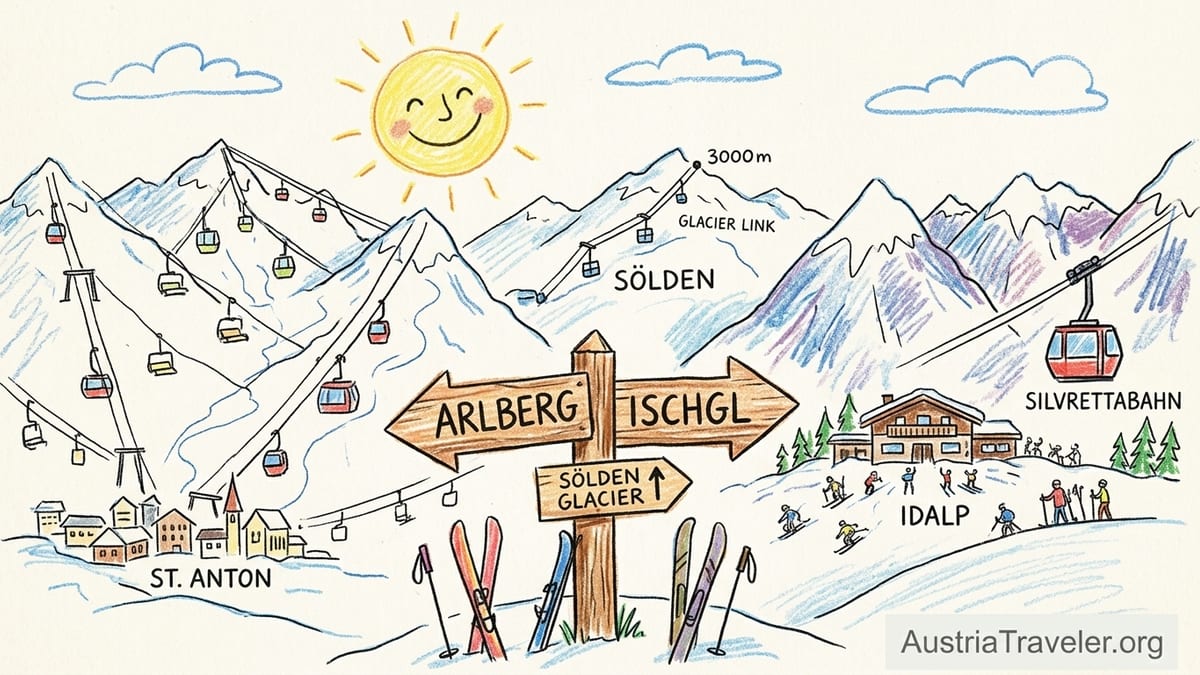
Ski Arlberg: Where Scale Meets Reality
I have skied Ski Arlberg on three separate trips, for a total of about 14 days, splitting my time between St Anton, Lech and Warth-Schröcken. Official figures talk about roughly 300 kilometres of pistes and more than 80 lifts all linked into a single domain, and you feel that scale the first time you stand above St Anton and see chairlifts vanishing in three directions. In practice, though, your experience depends heavily on which sector you actually ski and how disciplined you are about getting back before the afternoon queues to the return lifts.
Most of my days based in St Anton focused on the Galzig, Kapall and Valluga side, using the Galzigbahn, Kapall chair and Schindlergrat to lap a mix of steep reds and genuine blacks. For freeride days I let guides lead me toward off-piste around Valluga and down toward Stuben. On another trip, staying in Lech, I treated the Lech–Zürs bowl and the link toward Warth-Schröcken almost as a separate holiday: gentler, more scenic, with long cruising reds and blues and much less pressure to prove anything. Warth itself, reached via the Auenfeldjet link, felt like a compact powder playground compared with the big, busy front face of St Anton.
Did Ski Arlberg feel large or repetitive in reality? From St Anton, the system felt vast to the point of overwhelming on the first couple of days. You can ski all week on the St Anton–St Christoph–Stuben triangle alone and still find new lines, especially if you dip into the marked ski routes between pistes rather than sticking to perfect corduroy. Crossing to Lech and Zürs opens up another personality again. Only when I pushed all the way to Warth and back in a single day did the area briefly feel like a transport exercise, watching the clock and counting lifts rather than turns.
Queues depend heavily on date. On a mid-January trip, the new-generation gondolas out of St Anton kept lines moving, and we rarely waited more than five minutes except at Galzigbahn right at 9 am. On a sunny half-term Saturday, that same Galzigbahn had a snaking queue down the steps, and the Flexenbahn link toward Zürs developed ten-minute backups mid-morning as everyone chased the same circuit. The lower home-runs into St Anton deteriorated fast on warm afternoons, especially the busy blue back to town: chopped-up piles of sugar, scraped patches and the occasional nervous intermediate sideslipping through the chaos. By contrast, returning to Lech or Oberlech at the end of the day usually meant wide, still-grippy slopes and a more relaxed final descent.
Did the ski area match the piste map? Mostly yes, but the huge fold-out map flattens the terrain. On paper it looks easy to “do it all” in a day; in real life, traverses and link lifts eat more time than you expect. The Lech bowl, which looks like a modest sub-area on the map, feels almost like its own resort with multiple routes back into town. The one frustration is that you sometimes find yourself funneled into narrower choke points or busy cat-tracks that are hard to read off the map in advance, especially on the way back from Warth. For strong, mileage-hungry intermediates and confident off-piste skiers, though, Ski Arlberg still sits at the top of my Austrian list. For nervous intermediates or families, I would base in Lech or Warth and treat St Anton itself as an optional day out rather than home base.
Ischgl: High, Snow-Sure and Surprisingly Efficient
I have spent around nine days skiing Ischgl and the linked Swiss sector of Samnaun, including one Christmas-New Year week and one late-March trip. Both times I was struck by how much skiing you get from a relatively tight lift system. Once you rise out of the village on the main gondolas, the core Idalp plateau acts as a central roundabout, with reds and blues fanning out toward Pardatschgrat, Greitspitz and across the border. It felt large enough that I never repeated runs out of boredom, yet compact enough that I never worried about being stranded on the wrong side of the area late in the day.
On my busiest visit over New Year, I deliberately tested the resort’s queue-handling reputation. Lifts like the Silvretta and Fimbabahn gondolas did develop short lines between 9 and 9:30 am, but the capacity was such that I usually stepped into a cabin within five minutes. Once on the mountain, most chairs were ski-on-ski-off except just after lunch, when the key connecting lifts out of Idalp briefly backed up. Compared with other major Austrian names I have skied, Ischgl handled peak periods impressively well, which meant more actual skiing and less shuffling in lift corrals.
The slopes themselves cater best to confident intermediates who enjoy fast cruising on well-groomed reds. Runs dropping from Pardatschgrat toward Idalp, and the long red and blue combinations down toward Samnaun, were my favourites for that rhythmic, big-radius carving that feels like flying. There is freeride potential, particularly under some of the higher chairs, but the resort’s popularity and frequently sunny weather mean that classic lines get tracked quickly. For genuine powder days I have had more memorable descents in Ski Arlberg and Sölden; Ischgl’s strength is as a high, snow-sure playground for on-piste mileage, with altitude on its side well into April.
Evenings in Ischgl are where the trade-offs show. The resort’s reputation for heavy après-ski is real, especially around the base stations and central bars. On my first trip I made the mistake of staying right above the liveliest stretch of the village and slept poorly until I invested in industrial earplugs. Food and drink prices in the central bars and slope-side self-service restaurants were on the high side compared with quieter Tyrolean resorts, and accommodation in peak weeks can feel more like a small Swiss town than traditional Austria. In exchange, you get a modern, exceptionally efficient lift system, extensive intermediate terrain and snow reliability that makes it a smart bet for Christmas, Easter and late-season trips.
The piste map matches reality quite well, largely because the ski area fans out from a central plateau. Where it can mislead is at village level: some home-runs marked as options on the map ski much harder and narrower than their colour suggests late in the day. When the lower slopes turn to porridge, downloading by gondola is often the smarter choice for less experienced skiers. Overall, Ischgl is where I send groups of strong intermediates and mileage-hungry friends who want reliable snow, efficient infrastructure and at least one big night out, while warning anyone seeking quiet village charm to look elsewhere.
Sölden: High-Altitude Miles and Glacier Insurance
Sölden is where I go when snow uncertainty hangs over the early season or when I want to ski long, high-altitude runs without obsessing over weather forecasts. I have skied there for roughly ten days in total across three visits in November, January and late April. Each time I spent most of my days looping between Giggijoch and Gaislachkogl, with at least one big circuit out onto the Rettenbach and Tiefenbach glaciers once the full “Golden Gate to the Glacier” connection was open. The resort publicises an October glacier opening and a full-area start in mid-November, and from my experience that feels realistic. On my early-season trip I skied clean, grippy snow on the glaciers while lower-lying Austrian areas were still looking nervously at brown meadows.
In day-to-day skiing terms, Sölden splits neatly into three sectors. The Giggijoch side offers wide, mostly gentle blues and easy reds that are ideal for early intermediates and relaxed families, along with the main terrain park. Gaislachkogl feels steeper and more serious, with long, sustained reds and the odd black that let you really open your turns. The glaciers add altitude, views and a slightly different rhythm, with broad motorway pistes that hold winter snow quality long after valley runs elsewhere have turned to slush. The modern gondolas out of the village, which Sölden promotes as some of the highest-capacity feeder lifts in the world, keep queues moving even on popular weekends; in my time there, I rarely waited more than a couple of cabins.
Despite the statistics and marketing, did Sölden feel repetitive? On a five-day stay, I never ran out of interesting variations, especially when mixing up the order of lifts and adding in laps on the big glacier runs. That said, if you spend a full week skiing just the non-glacier area, the pattern of Giggijoch warm-up, Gaislachkogl challenge and home-run back to town can start to feel familiar. Sölden is not as endlessly sprawling as Ski Arlberg or Ski amadé’s overall network, but for most skiers its 140-ish kilometres of pistes, spread over high and varied terrain, are plenty.
The lower home-runs into Sölden were the biggest negative on my spring trip. By mid-afternoon, the final pitches into the village turned into heavy, bumpy snow with clear brown patches appearing on sun-exposed sides. Many locals simply downloaded on the gondolas after lunch and saved their legs for higher laps. In mid-winter, those same runs were fine, just busy. Off the slopes, Sölden sits somewhere between traditional village and small ski town, with a noticeable après scene along the main road but quieter side streets if you step away from the neon. Prices in the valley were slightly kinder to my wallet than Ischgl for meals and drinks, and it felt easier to find a low-key guesthouse rather than a full-service hotel.
Sölden’s piste map reflects the lift network accurately, but what surprised me in person was the vertical separation between the sectors. Lines that look like simple traverses on paper can feel like full journeys when you factor in lift rides and altitude changes, particularly when heading back from the glacier sector to make a late-afternoon spa booking. For skiers who rank snow reliability and high-altitude terrain above chocolate-box charm, Sölden is the Austrian resort I most often recommend, especially for early-season or Easter trips where lower resorts might struggle.
Kitzbühel: Atmosphere Over Statistics
Kitzbühel is one of the most famous names in skiing, largely thanks to the Hahnenkamm downhill and the Streif racecourse that loom above the town each January. I have skied there on two trips, totalling about eight days, and what stands out in my memory is not the raw size of the ski area but the village atmosphere and the variety packed into its rolling, tree-lined hills. Unlike Sölden or Ischgl, this is not about glaciers or extreme altitude. It is about classic Tyrolean scenery, historic streets and the feeling of skiing through a landscape that has lived with winter sports for generations.
On snow, I spent most of my time between the Hahnenkamm side and the Kitzbüheler Horn, using the Hahnenkammbahn to lap the main front face and the high chairs out toward Pengelstein and Pass Thurn for longer cruising days. The piste map for the KitzSki area looks slightly fragmented at first glance, with fingers reaching toward neighbouring villages, but in practice the network feels more connected than it appears, especially once you learn a few key crossing points under roads and through forests. For a strong intermediate, it never felt small or limiting within a week; I still discovered fresh-to-me combinations of red and blue runs toward the end of my second trip.
Queues and slope conditions here depend even more on timing than in high-altitude resorts. In mid-January, with cold temperatures and recent snowfall, the lower runs into Kitzbühel held up beautifully all day, even under heavy traffic from race fans doing their own tentative laps near parts of the Streif. On a warmer March visit, the same home-runs deteriorated significantly by 2 pm, turning into mashed-potato snow and shiny patches where the sun hit steep sections. On those days, the better strategy was to stay high, lapping the upper chairs and downloading in the gondola to avoid a leg-torching, crowded finale.
The trade-offs in Kitzbühel come mostly from its success. Accommodation in the old town, especially around Hahnenkamm race week, is among the most expensive I have encountered in Austria outside of peak Ischgl. Mountain restaurant prices were broadly similar to other big-name resorts but noticeable if you come from smaller valleys like the Zillertal. In return, you get a rare combination of serious ski heritage, non-skiing diversions and a setting that invites evening strolls rather than a straight line from bar to bed. Friends who travel with non-skiers or who like to mix skiing with boutique shopping and long lunches usually enjoy Kitzbühel more than they would a purpose-built, high-altitude station.
Looking at the piste map beforehand, I worried the area might feel disjointed. In reality, Kitzbühel skis more fluidly than the diagrams suggest, but you do have to pay attention to signage if you are far out toward Pass Thurn and want to make it back before lift closures. On my first trip I misjudged that once, spending the last hour of the day pushing along a flattish return route instead of enjoying steeper descents. For skiers prioritising village atmosphere and mixed-ability groups, Kitzbühel is the Austrian resort I am most likely to revisit, even if others beat it on altitude and raw piste mileage.
Comparing Experiences: Size, Stress and Value
Across these Austrian resorts, one pattern became clear. The places that advertise the biggest statistics are not automatically the ones that gave me the best holidays. Ski Arlberg, with its hundreds of kilometres of pistes, delivered my most memorable powder day and the greatest sense of wild, open terrain, but it also produced the only days where I felt genuinely stressed about getting back to base before long traverses and bottleneck lifts. Ischgl and Sölden, with their modern lifts and altitude, provided the most reliable snow and uninterrupted skiing but could feel expensive or loud if you chose the wrong accommodation street.
On the value side, none of these headline Austrian resorts is truly cheap. However, there are ways to tilt the equation in your favour. In Sölden I found that staying a bus stop or two away from the main gondola reduced room rates noticeably while still giving easy access via the free ski buses. In Ski Arlberg, basing in Warth or Stuben instead of St Anton or Lech brought prices closer to what you pay in less-famous valleys, at the cost of a slightly longer journey to some sectors. In Kitzbühel, avoiding Hahnenkamm race week cut both accommodation prices and crowd levels dramatically, transforming lift queues from a daily factor to something I barely noticed.
From a stress perspective, the resorts where the piste map and the on-the-ground experience lined up best were Ischgl and Sölden. Both fan out logically from a central hub and make it quite hard to end up stranded in the wrong valley as long as you pay basic attention to closing times. Ski Arlberg, by contrast, demands more planning. Long links to Warth or the far side of Lech are wonderful when the snow and weather cooperate, but several times I felt mentally tethered to the clock from early afternoon onward. Kitzbühel sits somewhere in between. Its terrain is less extreme, but the lateral reach of the network means you still need to think ahead if you have ventured far toward Pass Thurn on a short winter day.
Snow reliability is where Sölden stands out. On my November and April visits I skied proper winter snow on the glaciers while pictures from lower Austrian resorts showed green fields. Ischgl runs it close thanks to its high base lifts and predominantly north-facing slopes above the village, and I have happily booked both resorts for late-March and early-April weeks without a second thought. Kitzbühel and parts of Ski Arlberg offer magical tree skiing in fresh snow, but in warm spells you feel the lower altitude quickly, especially on south-facing home-runs that age badly by lunchtime.
The Takeaway: Matching Resorts to Traveler Types
After skiing these Austrian resorts enough days to move past the honeymoon phase, here is how I would match them to different traveler types rather than trying to crown a single “best” destination. For confident intermediates and advanced skiers who want the most expansive terrain and are willing to manage logistics, Ski Arlberg still sits at the top. St Anton offers steep pistes and legendary freeride, Lech adds a more polished, family-friendly experience, and Warth-Schröcken gives a quieter, snow-rich base with full access to the network if you plan your routes carefully.
For strong red-run skiers who care about modern lifts, snow reliability and long, fast pistes more than chocolate-box villages, Ischgl and Sölden are my real-world recommendations. Ischgl wins for lift efficiency and linked cross-border novelty, with nightlife as a bonus or a drawback depending on your tastes. Sölden wins for glacier access and early or late-season security, with a more balanced village vibe and a clear division between easy Giggijoch terrain and steeper Gaislachkogl slopes that works well for mixed groups.
If your group includes non-skiers, or if you personally value historic streets, restaurant choice and evening atmosphere as much as skiing, Kitzbühel is where I would book first. It may not match Sölden or Ischgl on altitude, but it consistently provided my most enjoyable all-round holidays, where a bad weather day felt like a chance to enjoy the town rather than a write-off. In terms of value, all of these resorts demand a healthy budget, yet by staying slightly away from the most famous bases or travelling outside peak race and holiday weeks, I have repeatedly nudged Austria’s headline resorts into the realm of good, if not bargain, value.
Above all, my own returns tell the story. I keep going back to Ski Arlberg for the terrain, to Sölden for the snow reliability, and to Kitzbühel for the feeling of being in a real, characterful town that just happens to be attached to a major ski area. Rather than chasing the single biggest number of piste kilometres, I suggest deciding what you actually want from your week: leg-burning laps, high-altitude insurance, historic atmosphere, or nightlife. Once you know that, one of these Austrian resorts is very likely to feel like the place you, too, would happily return to after skiing it for real.
FAQ
Q1. Is Ski Arlberg too big for first-time visitors?
It can feel overwhelming at first, especially from a base in St Anton, but focusing on one sector per day and avoiding long cross-area missions on your first two days makes it manageable.
Q2. Which Austrian resort mentioned is best for late-season snow?
From my experience, Sölden offers the best late-season security thanks to its glacier sectors, with Ischgl a close second due to its altitude and north-facing slopes.
Q3. Is Ischgl suitable for beginners or mostly for strong intermediates?
Ischgl has beginner-friendly terrain around Idalp, but the resort as a whole suits confident blue and red-run skiers better. True beginners may be more comfortable in quieter, smaller areas.
Q4. How busy do lift queues get in these major Austrian resorts?
On peak holiday weeks, base lifts in Ski Arlberg, Ischgl and Kitzbühel can see queues of several minutes at opening, but modern gondolas and high-capacity chairs usually keep things moving once you spread across the area.
Q5. Which resort offers the best village atmosphere off the slopes?
For traditional streets, varied dining and a sense of history, Kitzbühel stands out. Lech in Ski Arlberg also offers a refined, upmarket village feel, though at higher prices.
Q6. Are the piste maps accurate for planning routes back to base?
In Ischgl and Sölden the maps reflect reality well, but in Ski Arlberg and Kitzbühel lateral distance and the complexity of links are easy to underestimate, so you should allow extra time for returns.
Q7. How do late-afternoon slope conditions compare between these resorts?
Lower home-runs in Sölden, Kitzbühel and parts of Ski Arlberg can become slushy and crowded on warm days, while high, north-facing runs in Ischgl and on Sölden’s glaciers usually stay firmer longer.
Q8. Which resort is best for freeriders based on actual skiing?
Ski Arlberg, especially around St Anton and Stuben, has given me the most memorable lift-accessed off-piste, with Sölden’s high terrain a good backup when snow is better at altitude.
Q9. How do prices compare between these big-name Austrian resorts?
All are premium, but central Ischgl and Kitzbühel around major events tend to cost more for accommodation, while outlying bases in Ski Arlberg and side-street guesthouses in Sölden can soften the blow.
Q10. If I prioritise a relaxed holiday over maximum piste mileage, where should I go?
Based on my own trips, I would choose Kitzbühel or Lech in Ski Arlberg, where comfortable villages, scenic runs and a slower pace made for the most enjoyable overall weeks.