


I learned the hard way that you can pay for thousands of kilometres of pistes in Austria and still spend most of your ski week lapping the same three chairlifts. Planning my most recent trips, I set out to understand whether Austria’s big interconnected and multi-region passes genuinely add value, or whether a well-chosen local pass at a smaller resort is the smarter buy for a normal one-week skier.
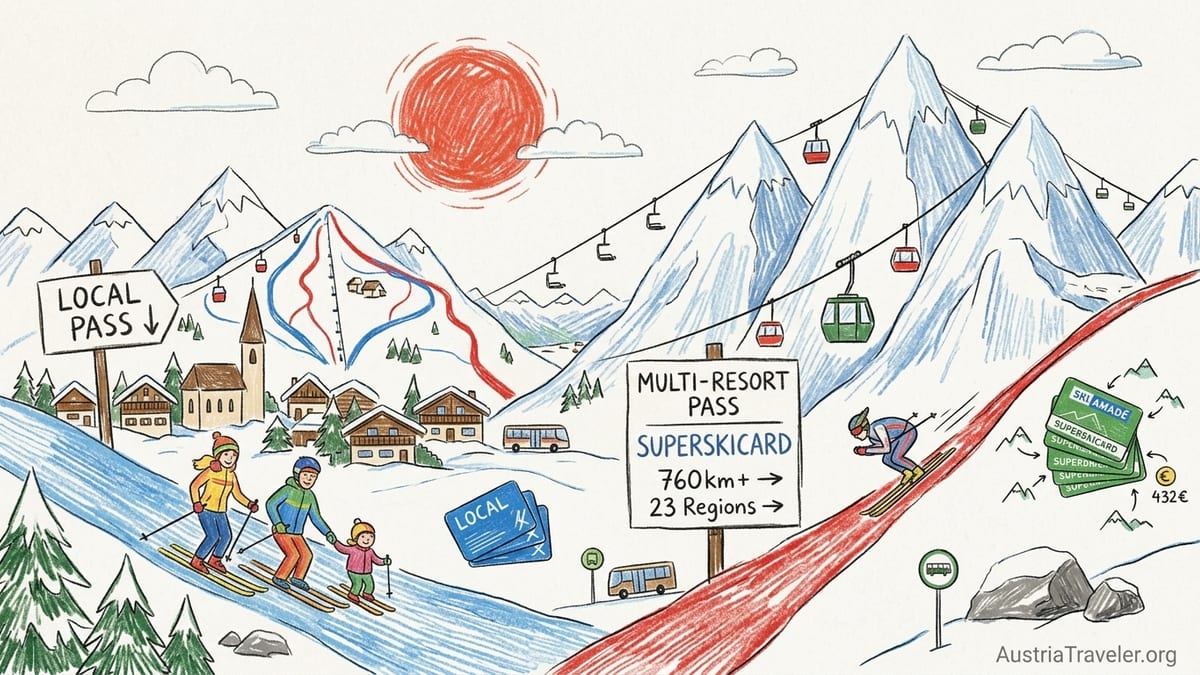
The Passes I Actually Bought On Recent Austria Trips
Over the past couple of winters I have bought both small-resort passes and big-area products in Austria, and the contrast has been instructive. On one January trip, I based myself in a village within Ski amadé and bought a standard six-day adult Ski amadé pass at the ticket office for the central season rate of 432.50 euros. That pass theoretically covered up to 760 kilometres of pistes across 25 resorts, from the Gastein valley to Hochkönig. In reality, I skied almost exclusively in the local valley network, clocking perhaps 120 to 150 kilometres of unique runs over the week, despite skiing hard nearly every day.
On another, shorter family trip later in the season, I went the opposite direction and bought a three-day local pass at a smaller Ski amadé area, purchased directly at the lift station for roughly half the cost of the big six-day product. We never left that single mountain, and nobody felt deprived of terrain. The daily rhythm was relaxed, and we repeated our favourite red and blue runs without ever feeling that we were “wasting” a bigger region ticket.
Across these trips I paid the usual Austrian keycard deposits, typically between 2 and 4 euros per card, refunded at the end of the stay when you return the undamaged card at a ticket window or one of the automated machines. In practice this is a minor cost, but it adds up for families who need multiple cards and can be a small, unexpected extra if you are used to paper tickets.
The important lesson was not about the deposit or the per-day rate. It was about how much of the “map” we actually used. In the Ski amadé case, my six-day pass theoretically opened 25 resorts, but my legs and the weather meant I realistically experienced no more than two linked sectors in depth. The rest of the coverage was paid for and untouched.
Understanding Ski amadé’s Dynamic Pricing And What You Really Get
For winter 2026/27, Ski amadé has moved fully to dynamic online early-booking prices for multi-day passes. A six-day adult Ski amadé pass is currently advertised in the range of about 367.50 to 432.50 euros if bought online in advance, depending on demand and period, while the fixed ticket-office price is 432.50 euros. The headline benefit is obvious: buy early online and you can save around 60 euros compared with walking up to the counter during busy weeks.
What that six-day Ski amadé pass actually covers is huge. On paper you have access to up to 760 kilometres of pistes across 25 resorts, stitched together in several big clusters such as Salzburger Sportwelt, Schladming-Dachstein and Hochkönig. In marketing terms, it is a dream. One pass, multiple valleys, and the freedom to chase snow or sunshine almost at will.
However, using that full coverage in a single one-week holiday is surprisingly difficult. Even skiing bell to bell, you are limited by lift opening times, your own fitness, and the real-world layout of the mountains. Transfers between valleys can eat up an hour or more. Poor visibility days often keep you on tree-lined slopes close to home, and if the wind closes a critical connecting gondola, that ambitious day trip to another sector simply does not happen.
On my six-day Ski amadé pass, I had planned to ski at least three different valleys. Instead, one day was lost to heavy snow and high winds that shut upper lifts for safety, another became an impromptu rest day when my legs gave out, and two days were spent doing laps around the main village area with friends who preferred familiar runs. I probably used about half the theoretical value of the pass.
When A Giant Pass Is Overkill For A Normal One-Week Skier
If you are booking a typical Saturday to Saturday package with five or six days of skiing, a giant region pass is often more than you can realistically use. Most people underestimate how much non-ski time will eat into their days. There are rental fittings, ski school drop-offs, long lunches, and the simple fact that many skiers stop by mid-afternoon, especially early in the week when their legs are not yet conditioned.
On that Ski amadé trip, my six-day pass looked perfect on paper. Yet out of the six days, one was a complete rest day after a minor knee tweak, and another was shortened to just a couple of relaxed hours on the local blue pistes so that a beginner friend could build confidence. These are exactly the kind of scenarios that quietly destroy the theoretical cost-per-kilometre value of a mega-pass. I had paid to ski across five valleys, but we spent an entire afternoon practicing snowplough turns within sight of our hotel.
Weather is another silent thief. In Austria it is normal for storms, fog, or Föhn winds to shut higher lifts or whole connecting ridges for part of a day. On my trip, a planned excursion over to a neighbouring Ski amadé sector had to be abandoned when the top gondola closed due to strong winds. Instead, we took shelter on a handful of tree-lined runs lower down, repeating the same three or four pistes on our “big” multi-region ticket.
Looking back, a cheaper local-area pass would have delivered almost the same skiing for less money and far less psychological pressure to “get value” from the huge map. The bigger ticket gave flexibility, but most of that flexibility remained theoretical under normal holiday constraints.
Where The SuperSkiCard And Other Mega-Passes Start To Make Sense
At the next level up is the SuperSkiCard, which covers 23 ski regions and more than 2,750 kilometres of pistes across a broad swathe of Austria. For 2026/27, published price lists show that a six-day adult SuperSkiCard bought early in the season is just over 400 euros, rising to around the mid-400 euro range at the ticket office depending on the issuing resort and period. In other words, the price gap between a six-day SuperSkiCard and a six-day Ski amadé pass is not enormous, even though the theoretical area more than triples.
On paper, the SuperSkiCard is extraordinary value. One ticket can cover everything from large names like Saalbach Hinterglemm Leogang Fieberbrunn and Kitzbühel to smaller local hills that would otherwise require separate local passes. If you are a strong skier doing a road trip by car, staying in different valleys and actively planning to ski a new area every day, this kind of product can pay for itself very quickly.
In my own case, I once structured a ten-day car-based trip around a multi-region pass that is similar in spirit to the SuperSkiCard. We skied a different area almost every day, using the car to chase sunshine and snow conditions. Under that style of travel, a mega-pass is brilliant. There was no time wasted queuing at ticket offices, no need to mentally convert daily ticket prices, and the freedom to bail out of a foggy valley and drive to a sunnier one felt liberating.
But that kind of trip is not what most one-week holiday skiers are doing. If you are flying in, taking a transfer to one resort, and staying put in a chalet or hotel for seven nights, a SuperSkiCard-style product can easily become expensive overkill. You will likely stay on the local mountain network for most of your days, with perhaps one or two excursions if the weather and family needs align perfectly.
The Hidden Frictions: Keycards, Deposits And Getting Around
Beyond the headline pass price, there are smaller details that matter when comparing huge areas with local hills. Nearly all Austrian resorts now use contactless keycards. Deposits are usually between 2 and 4 euros per card, as seen in the fare conditions for resorts like Obertauern, Kitzbühel or Hinterstoder. If you are a couple or family buying several passes, the deposit can equal the cost of another quick mountain lunch, even though you get it back if you remember to return the cards at the end.
In big networks like Ski amadé, your keycard will typically work across multiple linked valleys, but you should factor in the time and effort involved in physically moving between them. Mountain transfers often require a combination of chairlifts, gondolas and ski-bus rides, each adding potential waiting time and crowding during peak weeks like New Year or February half-term.
When I tried to “use” the full reach of my Ski amadé pass, I quickly discovered that a theoretical 760 kilometres of pistes is far more than anyone can ski in a week once you include transfers, queues and coffee stops. A day that looks like it will take you from one end of the map to the other can shrink rapidly when a connecting valley run ices up or a bus is missed by five minutes.
By contrast, on my smaller-resort trip, everything lived within a compact bowl. There were no buses to catch and no high-stakes decisions about making the last lift home from a distant valley. The psychological difference was striking: I felt less pressure to dash around and “cover ground,” and more freedom to repeat enjoyable runs, take photos and linger at mountain huts without a watch in my hand.
Family Needs, Ski School And The Reality Of “Wasted” Coverage
Families and mixed-ability groups are particularly likely to leave big chunks of large-area passes unused. Children in ski school usually spend most of their time in a small corner of the mountain, often on the same beginners’ area and adjacent blue runs for several days. Parents may find themselves doing the same home runs repeatedly so they can be near pick-up points and meeting spots.
On one trip with friends and their children, we had a generous regional pass that allowed for roaming across several neighbouring valleys. In theory we could have skied new terrain every day. In practice, two of our six days were anchored almost entirely to the nursery area and the main gondola mid-station so that we could coordinate with ski school schedules and tired youngsters. The long, scenic circuit to a neighbouring valley stayed as a line on the map instead of a real outing.
Rest days and half-days also eat into the value of mega-passes. Even for fit adult skiers, six consecutive full days can be a lot, especially at altitude. On my own Ski amadé week, I had one unplanned early-finish afternoon when a boot hot-spot flared up, and another when we cut the day short to enjoy the spa at our hotel. In both cases, a cheaper, shorter-duration local pass would have yielded a lower effective cost per hour actually spent on snow.
The other reality is that beginners and cautious intermediates often do not need, or even want, the full variety that a giant pass offers. A smaller, friendlier hill with 20 to 40 kilometres of pistes can feel large enough at their stage, and it is often easier to navigate without getting lost or overwhelmed. Yet they can end up paying for a vast region ticket simply because it is the default add-on in a package deal.
How I Now Decide Between Huge Passes And Smaller Resorts
After these experiences, my own decision-making has become more structured. When I consider a pass like Ski amadé’s six-day adult ticket, I start by asking how many realistic full ski days I will actually have. If I am travelling with friends who enjoy long lunches and spa time, I now assume four and a half to five solid ski days, not six. That alone changes whether the extra coverage is worthwhile.
I then look closely at the local area included in a standard resort-level pass. Many Austrian villages sit within local networks of 80 to 150 kilometres of pistes, which can easily occupy a solid week for most skiers. If that local domain already has a good mix of blue, red and black runs, plus a few itinerary or freeride options, I am less inclined to pay extra for a ticket that opens far-flung valleys I will probably never reach.
By contrast, if I am planning a trip with strong, motivated skiers who specifically want to explore multiple valleys and are happy to ski bell to bell, day after day, a larger region product starts to make more sense. If we have a car and are comfortable driving mountain roads, the argument for a SuperSkiCard-style pass becomes even stronger, because we can actually use the freedom it offers.
Finally, I seriously consider the online dynamic pricing. For Ski amadé in 2026/27, the difference between an early-booked six-day pass at around 370 euros and the ticket-office rate of 432.50 euros is significant. If my plans are firm and the online system allows date changes or refunds under clear conditions, I now try to lock in the lower rate well before departure, accepting that complete spontaneity has a cost.
The Takeaway
The lesson from my recent Austrian ski trips is simple: the bigger the ski pass, the more honest you need to be about how you actually ski. A six-day Ski amadé ticket promises 760 kilometres and 25 resorts, but a combination of weather, rest days, family logistics and simple human laziness meant I only ever sampled a fraction of that potential. The headline coverage sounded impressive, yet most of my turns happened on a single mountain and its immediate neighbours.
Enormous products such as the SuperSkiCard, with its thousands of kilometres of pistes across dozens of regions, are excellent tools for specific types of travel. If you are stringing together a road trip by car, chasing snow conditions and deliberately changing resort every day or two, a mega-pass can save both money and hassle. In that context, the small price gap compared with a standard regional pass starts to feel like a bargain.
However, for the classic one-week skier flying in from abroad and staying in one village, a well-chosen local or regional pass usually delivers better real-world value. You reduce the pressure to “use everything,” you minimise time lost in transfers, and you keep more of your budget available for quality accommodation, good food and perhaps a guided off-piste day or a lesson that will improve your skiing more than another unused valley on the map.
The key is to match the pass size to your actual habits, not your fantasy itinerary. Look at how many full days you will ski, who is in your group, and how likely you are to roam beyond your home mountain. Then compare the cost of a local-area pass, a regional product like Ski amadé, and a multi-region ticket such as the SuperSkiCard, ideally taking advantage of dynamic online discounts where they exist. When I do that honestly, I usually find that smaller, simpler passes win for relaxed holiday weeks, and the mega-passes come into their own only on carefully planned, mileage-hungry trips.
FAQ
Q1: Is a six-day Ski amadé pass worth it for a first-time visitor to Austria?
For a first-time visitor staying in one village, a six-day Ski amadé pass can be great if you are an enthusiastic skier who wants to explore beyond the local area. If you are more relaxed, or travelling with beginners who will stay on easier slopes, a cheaper local-area pass often delivers similar enjoyment for less money.
Q2: How much can I save by booking a Ski amadé pass online in advance?
For winter 2026/27, early-booked online prices for a six-day adult Ski amadé pass are currently advertised from about 367.50 euros, compared with a fixed ticket-office rate of 432.50 euros. The exact saving depends on date and demand, but booking early can reduce your total bill by the cost of a couple of good mountain lunches.
Q3: When does a SuperSkiCard-style mega-pass make financial sense?
A multi-region pass like the SuperSkiCard makes most sense if you are doing a road trip or a long stay and plan to ski several different regions. If you are based in one resort for a single week and will rarely leave that area, the added coverage can become expensive unused capacity.
Q4: How do Austrian keycard deposits work, and should I budget for them?
Most Austrian resorts issue ski passes on reusable keycards and charge a refundable deposit, typically between 2 and 4 euros per card. You pay this on top of the pass price and receive it back when you return the undamaged card at a ticket office or machine at the end of your trip.
Q5: What happens if bad weather closes lifts during my holiday?
If heavy snow, fog or strong winds close lifts, you usually have to accept that you will ski a smaller part of the area that day. Resorts rarely offer refunds for short-term weather closures, so big region passes can feel underused if several days are affected. This is one reason to be cautious about paying for maximum theoretical coverage.
Q6: Are smaller Austrian resorts enough for a full week of skiing?
Many smaller Austrian resorts have between 20 and 80 kilometres of pistes, which can easily occupy a week for beginners and intermediates. If the area has a good spread of blue and red runs and a few longer descents, most holiday skiers will not feel limited, especially when they factor in ski school, breaks and rest days.
Q7: How should families with children choose between big and small passes?
Families with children in ski school often benefit from choosing a pass that focuses on the local area where lessons take place. Youngsters spend most of their time on a small set of slopes, so paying for a huge multi-valley or multi-region pass can be unnecessary unless the adults plan to venture far while the children are supervised.
Q8: Is it risky to rely on dynamic pricing and wait to buy passes later?
Dynamic pricing means that leaving your purchase late can result in higher prices, especially for busy weeks. If your travel dates are fixed and a resort offers meaningful online discounts for early booking, it is usually safer to buy as soon as you are sure of your plans, after checking the terms for changes or refunds.
Q9: Can I upgrade from a local pass to a bigger region ticket during my trip?
Some Austrian resorts allow you to upgrade from a local-area pass to a larger region ticket by paying the price difference, but policies vary. It is important to check the specific resort’s conditions before you commit, and to keep your receipts and keycard in case you decide to upgrade mid-week.
Q10: What is the best overall strategy to get good value from Austrian ski passes?
The best strategy is to be realistic about your skiing style and group needs, compare local, regional and multi-region prices for your exact dates, and take advantage of early-booking discounts when you can. For most one-week holidays, a good local or regional pass offers the right balance of terrain, flexibility and cost.