


I used to think more ski days and more kilometers of piste automatically meant a better holiday in Austria. After several winters experimenting with three, five and seven day trips in places like Ski Arlberg and Ski amadé, I learned the hard way that your legs, the weather and transfer time matter just as much as the trail map. This guide walks through those real trips and distills them into a practical way to choose how many ski days you actually need, and how big an Austrian ski area is really worth paying for.
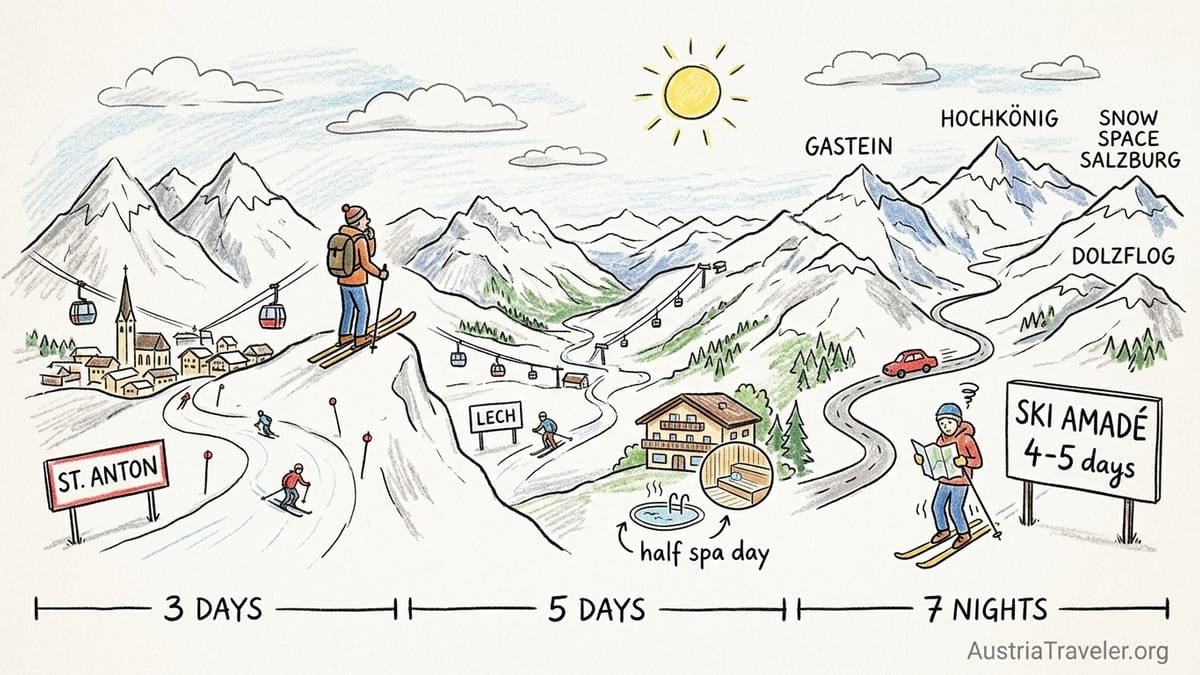
What My Real Austrian Ski Weeks Actually Looked Like
Over the last few seasons I have tested three patterns in Austria: a short three day hit in a single resort, a five day stay inside a large interconnected area, and a full week where I tried to combine different valleys. On paper, the longest trip with the most variety looked like the winner. In practice, the most enjoyable holidays were the ones with fewer accommodation changes and a realistic buffer for tired legs and bad weather.
One February, I booked three consecutive ski days in St. Anton am Arlberg, arriving on a Thursday afternoon and leaving Sunday night. I collected rental skis in the village after checking into a guesthouse, skipped night life on the first evening, and hit the lifts early on Friday. Those three full days gave me time to warm up on the blue pistes above Nasserein, take a private lesson on day two to tidy up my carving, and finish with a big lap over to Lech and back without ever feeling rushed.
Another season, I extended things to five ski days in Lech. This time I arrived on a Saturday, used late afternoon to pick up equipment and my Ski Arlberg pass, then skied Sunday to Thursday. Wednesday was forecast to be stormy, so I treated it as a half ski, half spa day, finishing early and sinking into the hotel’s small wellness area. By Thursday, I had explored a big slice of Ski Arlberg without having to check out midweek.
The trip that taught me the most was a seven night holiday using the Ski amadé pass. Ski amadé is a vast alliance of resorts in Salzburg and Styria, with about 760 to 860 kilometers of slopes covered by one ticket, spread across places like Gastein, Hochkönig and Snow Space Salzburg. I planned to ski six days and move accommodation once: three days in Gastein, then three in Flachau. Bad weather cut one day short, and packing up midweek cost almost a full morning on the slopes. By the end, my group agreed the extra variety was not worth the time spent in the car and the cumulative fatigue.
How Three Ski Days Really Feel on the Ground
A three day ski break in Austria usually starts with a travel day, an evening of collecting rental equipment, and three full lift-served days before heading home. In my St. Anton example, that block felt like the sweet spot for an early season tune-up or a focused long weekend, especially if you stay in a village that sits right inside the lift system instead of commuting from a valley town.
With only three ski days, it did not make sense to roam every corner of Austria’s largest connected ski area. Ski Arlberg is marketed at around 300 kilometers of groomed pistes and more than 80 lifts, linking St. Anton, St. Christoph, Stuben, Lech, Zürs and Warth-Schröcken. That is an incredible playground, but in three days I realistically sampled perhaps a quarter of it, skiing mainly around Galzig, Gampen and Rendl, plus one ambitious loop to Lech. I never reached Warth or the outer edges of the map, and that was fine.
The key with three days is to choose either a mid-sized self-contained mountain or one village within a larger domain and ignore the fear of missing out. For a long weekend, basing yourself in St. Anton and skiing only its home slopes gives you enough variety in terrain and altitude, from the easier blues near St. Christoph to steeper runs like Kandahar. Similarly, in the Ski amadé universe, three days based in a single valley like Gastein work better than trying to tick off multiple subregions with car transfers.
On a three day schedule, there is no room for forced rest days, so your “rest” becomes smart pacing. For example, I used shorter afternoons after lunch on day two to sit in a mountain hut above St. Anton and watch the sun drop behind the Valluga rather than hammering out more vertical. That gentle approach meant I could still ski solidly on day three without burning my legs, and I did not feel that I had wasted any lift pass value.
Where Five Ski Days Start to Justify a Huge Ski Domain
From my own trips, five ski days is the point when a truly large interconnected area begins to make sense, especially if you are keen to explore widely. In Lech with a five day Ski Arlberg pass, I felt I could actually use the size of the region rather than just admire it on the piste map. I still started with local laps between Lech and Oberlech, but by day three I was confidently planning full day safaris to Zürs and Stuben, returning via different routes to avoid repetition.
The economics begin to line up too. Recent winter rates show that an adult day ticket in Gastein or Großarltal, both part of Ski amadé, costs roughly 70 to 80 euros at the ticket office in peak season. By the time you reach four or five days, a multi-day Ski amadé ticket or region-wide pass typically lowers the per-day cost compared with buying individual daily tickets. For example, published Ski amadé price tables for the 2026 to 2027 season list a four day adult ticket in high season at just over 300 euros at the cash desk, while a single peak day in a major valley runs in the high 70s. That sliding scale encourages you to settle into one valley or alliance for several days in a row.
With five consecutive days, I still did not feel compelled to schedule an official rest day. However, I started to deliberately build “soft” days into the middle of the week. In Lech, that meant skiing only the morning after a particularly lively apres evening, then soaking in the hotel spa and wandering the village in the afternoon. If the weather forecast hinted at strong winds or freezing fog at higher lifts, I used that day to stay on lower, sheltered slopes and enjoy longer lunches. Those tactical choices preserved my energy for the bigger exploration days that followed.
Five days are also enough to make a big Austrian domain feel familiar. By the fourth day at Ski Arlberg, lift names like Galzigbahn and Rüfikopfbahn felt less like abstract labels and more like anchors in my mental map. That comfort level matters when you are deciding in the mid-afternoon whether to link two more valleys or play it safe and start trending home. On a three day trip you rarely reach that level of confidence; on a five day trip, you do, which makes the full size of the domain more usable.
When Seven Ski Days Become Physically and Logistically Tiring
A seven day ski pass sounds like the ultimate value, especially in a country with as many ski areas as Austria, from the Arlberg to big names like SkiWelt and the Skicircus. The reality I discovered in Ski amadé is that seven consecutive days of serious skiing, especially if combined with changing accommodation and chasing different subregions, can tip a holiday from energising to exhausting.
On my Ski amadé week, I planned six days of skiing with one flexible buffer. We based ourselves first in Bad Hofgastein, using the multi-day pass to access Schlossalm and Angertal, then planned to move to Flachau to sample the Snow Space Salzburg area. The Ski amadé alliance officially covers several hundred kilometers of slopes across five regions, but they are not fully interconnected by lifts. That means your pass works everywhere, yet you still need to drive or ride buses between valleys.
In practice, packing up halfway through the week, checking out, driving to a new valley and checking in again swallowed most of one day. When a warm front brought rain to mid altitudes the following afternoon, we ended up with something like four and a half effective ski days out of a potential six. Our legs were also noticeably heavier after day four, especially for the less fit members of the group. By day six, two of us opted for a full rest and spa day while the keenest skier pushed on alone.
That experience changed how I think about seven day itineraries. I still take week-long trips, but I rarely plan to ski hard on all seven days anymore. Instead, I expect to ski four or five full days, plus one flexible shorter day that can be sacrificed to weather or fatigue without guilt. Building that into your expectations and budget makes the week feel more relaxed, and it stops you from chasing artificial “value” out of every hour on your ski pass.
One Huge Interconnected Resort vs a Multi-Resort Pass
Ski Arlberg and Ski amadé illustrate two very different Austrian ski products. Ski Arlberg is a single, largely lift-connected region with around 300 kilometers of groomed runs and roughly 85 lifts, where you can click into your skis in St. Anton and reach Lech, Zürs and beyond without taking them off. It is designed for big on-snow traverses and loop days. You usually buy one straightforward Ski Arlberg pass that covers the whole network.
Ski amadé, by contrast, is an umbrella pass that covers multiple separate destinations across Salzburg and Styria. Official figures quote several hundred kilometers of pistes and nearly 280 lifts spread over regions like Salzburger Sportwelt, Schladming-Dachstein and Gastein. Some of these subregions are internally connected, but the alliance as a whole is not a single continuous ski area. To move from Gastein to Hochkönig, for instance, you load your skis into a car or onto a ski bus and change valleys.
For a three to five day holiday, an interconnected domain like Ski Arlberg or the Skicircus Saalbach Hinterglemm Leogang Fieberbrunn keeps everything simple. You settle into one village, learn the lift system, and can still ski new routes every day without touching your car keys. The trade-off is price: recent Austrian coverage notes that a peak season adult day ticket in the Arlberg region now costs over 80 euros, and reports from the 2026 season mention walk-up day passes touching around 85 euros. That premium reflects the scale and prestige of the area, and it makes most sense if you stay long enough to explore beyond your home sector.
A pass like Ski amadé shines when you want flexibility over a slightly longer window, especially if you are comfortable driving or using regional buses. Multi-day Ski amadé tickets for high season are priced to cover a whole region, with four day adult passes advertised in the low 300 euro range at the ticket office and a small discount for online early booking. The value appears once you commit to four or more days and use at least two different local mountains within the alliance, such as combining Gastein with a day trip to Großarltal or Hochkönig without buying extra local passes.
Rest Days, Spa Time and Weather Buffers That Actually Help
Across these trips, the happiest groups were the ones that treated rest and weather as part of the plan, not failures of discipline. In Austria, storms, Föhn wind and sudden temperature swings can shut high lifts or turn a bluebird forecast into flat light and drizzle. During my Lech stay, one day brought such strong gusts that several top lifts closed by mid-morning. Because I had already built a mental buffer into my five day plan, I felt no pressure to ski every minute on marginal snow. I simply stayed on lower slopes for a couple of hours, then retreated to the hotel’s small pool and sauna.
In Gastein, where thermal spas are part of the valley’s identity, the best day of the trip turned out to be an unplanned soak in the Alpentherme complex after freezing rain coated the mid-mountain runs. We spent the morning doing easy laps on the lower pistes, then swapped ski boots for warm pools and steam rooms in the afternoon. Technically, that meant we did not “use” a full day of our expensive Ski amadé passes, but no one in the group felt cheated.
What I learned is that on trips of five or more ski days, you should assume at least one half day will be better spent in a spa, on a winter walk or simply sleeping. If the weather stays perfect and your legs feel fresh, you can always convert that buffer into more skiing. If not, you already gave yourself permission to ease off. On shorter three day trips, I handle the same need through pacing: late starts after a travel-heavy arrival day, long coffee stops on the mountain, and a conscious choice not to ski the very last lift if my legs are tired.
Weather buffers also influence which pass you buy. In a high-price region like Ski Arlberg, where single day lift tickets for adults in recent seasons have hovered around or above 80 euros in peak winter, locking into a seven day pass only makes sense if you realistically expect to ski most of those days. In a more moderately priced alliance like many Ski amadé valleys, a four or five day pass spreads that risk. Either way, acknowledging up front that you will probably “lose” a few lift hours to storms or sore muscles makes for a more relaxed week.
Is Changing Accommodation Midweek Ever Worth It?
The Austrian piste map tempts you to design ambitious road trips: a few days in the Arlberg, then a dash over to Ischgl, or three days in Gastein followed by three in Schladming. After testing a midweek move inside Ski amadé, my verdict is that changing accommodation during a single ski week is rarely worth the cost in time and energy unless you have a very specific reason.
On our Gastein to Flachau transfer, we lost at least half a ski day to packing, driving and settling in, even though the valleys are not especially far apart in absolute distance. Simple tasks like returning rental skis, picking up new ones at the next valley, buying fresh lift passes where needed and learning how to reach the nearest lift from a new hotel all ate into our slope time. For families or groups with varied fitness levels, that disruption felt even sharper, since some people needed longer to reorganize gear.
The main situations where I would still consider a midweek move are when chasing very different experiences that cannot be combined in a single area. For example, a split trip between a glacier resort with high altitude snow reliability early in the season and a low, family-friendly area later in the week might make sense in November or early December. Or you might combine a few car-free days in a classic village like Lech with a city and ski combo using an Innsbruck region pass. Even then, I would avoid more than one change of base in a single seven night holiday.
Within one huge connected region, there is almost never a need to change villages midweek. In Ski Arlberg, staying the whole week in St. Anton still allows you to day trip to Lech, Zürs and Warth on skis without moving your suitcase. The same goes for subregions inside Ski amadé, such as staying in one Gastein village while sampling different local mountains. Keeping your bed constant while your ski routes change proved to be the simplest recipe for a relaxed, satisfying week.
The Takeaway
After several Austrian winters, my personal rule of thumb for ski days and resort size has become surprisingly conservative. For a three day ski break, I now pick a single, well rounded area and ignore every marketing slogan about “hundreds of kilometers” that I will never touch. That might mean three days in St. Anton without crossing the whole Arlberg, or three days in one Ski amadé valley like Gastein instead of burning hours in the car.
For five ski days, I deliberately choose a large connected region and plan to use it, but with at least one soft day in the middle. Places like Ski Arlberg come into their own at this length, because you can build confidence in the lift network, tick off some classic routes and still keep a margin for weather and rest.
For seven nights, I decide in advance that I will ski four or five solid days, plus one or two flexible days that might turn into spa time, winter walks or leisurely lunches. I almost never change accommodation midweek unless I am deliberately pairing two very different styles of skiing or mixing a ski break with an alpine city stay.
In short, my revised rule is this: match your ski days to the size of terrain you can genuinely explore at your fitness level, add a realistic buffer for weather and fatigue, and resist the urge to turn your Austrian holiday into a frantic multi-resort rally. The mountain views, the long lunches and the spa evenings are part of the experience, not distractions from it.
FAQ
Q1. Is three ski days in Austria enough for a first-time visitor?
For a first-time visitor, three full ski days can be enough if you choose one convenient resort, stay close to the lifts and book at least one lesson, but you will only sample a fraction of the terrain.
Q2. How many ski days justify paying for a big area like Ski Arlberg?
In my experience, five ski days are where a very large interconnected area such as Ski Arlberg starts to make sense, because you have time to learn the lift system and explore multiple valleys without rushing.
Q3. Should I plan a rest day on a seven day ski trip?
Yes, on a seven night trip it is wise to assume you will want at least one partial or full rest day, which can double as a weather buffer if storms or high winds close lifts.
Q4. Is it better to stay in one big resort or combine several smaller ones?
If your trip is five days or less, staying in one big connected resort is usually better, while combining several smaller areas only pays off on longer stays when you accept losing some time to transfers.
Q5. Are multi-resort passes like Ski amadé good value for short trips?
Multi-resort passes such as Ski amadé tend to offer best value from around four lift days onward; for shorter trips, a local area pass in the valley where you stay is often simpler and cheaper.
Q6. How much does a day of skiing cost in Austria right now?
Recent published prices show peak season adult day tickets in major Austrian areas ranging from roughly the low 70 euro range in some Ski amadé valleys to above 80 euros in premium regions like Ski Arlberg.
Q7. Is changing accommodation midweek recommended to see more resorts?
In most cases, changing accommodation midweek costs almost a full ski day in packing and transfers, so I only recommend it when you have a specific need to combine very different regions.
Q8. How do weather interruptions usually affect an Austrian ski week?
Bad weather can close high lifts or bring rain to mid altitudes, so building at least half a day of flexible time into any trip longer than three days helps you adapt without frustration.
Q9. Do I need to be very fit to ski five or seven consecutive days?
You do not need to be an athlete, but for five or more consecutive ski days, some pre-trip fitness and planned lighter days are important, especially if you want to enjoy long runs in big areas.
Q10. What is your simple rule for choosing ski day count and resort size?
My rule is three days in one mid-sized area, five days in a big connected region, and seven nights with one base, one big pass and at least one built-in rest or spa day.