


I have made almost every possible base decision in Austria: stayed right beside the lifts in big-name resorts, woken up in quiet valley towns and shuffled onto first ski buses, and paid extra for ski-in/ski-out apartments that sounded perfect on paper but proved awkward in real life. What follows is not a ranking of hotels, but a practical guide built from those days and mornings: where I actually stayed, how far I walked in ski boots, how often I missed the easy bus, and what I would do differently next time.
How My Austrian Base Choices Really Worked Out
On one trip I based myself in Mayrhofen, a valley town at around 630 metres in the Zillertal, with the Penkenbahn gondola rising from the main street and the Ahornbahn at the southern edge of town. The railway station sat at the opposite end of the high street, roughly a ten-minute walk from my guesthouse in normal shoes and closer to fifteen in ski boots with skis over my shoulder. The town layout meant that every morning started with a decision: walk in boots to Penkenbahn, detour on the local ski bus for Ahorn, or throw skis into the car and drive to one of the satellite lifts up the valley.
On another trip I booked directly in Obertauern, a high-altitude resort with most hotels between about 1,650 and 1,800 metres and pistes circling above and below the road. There my accommodation sat less than 150 metres from the nearest lift. In good snow I could slide back almost to the ski room door. The village shuttle bus looped around the resort through the day, but I barely used it because the lifts were so close that carrying skis more than a couple of minutes felt unnecessary.
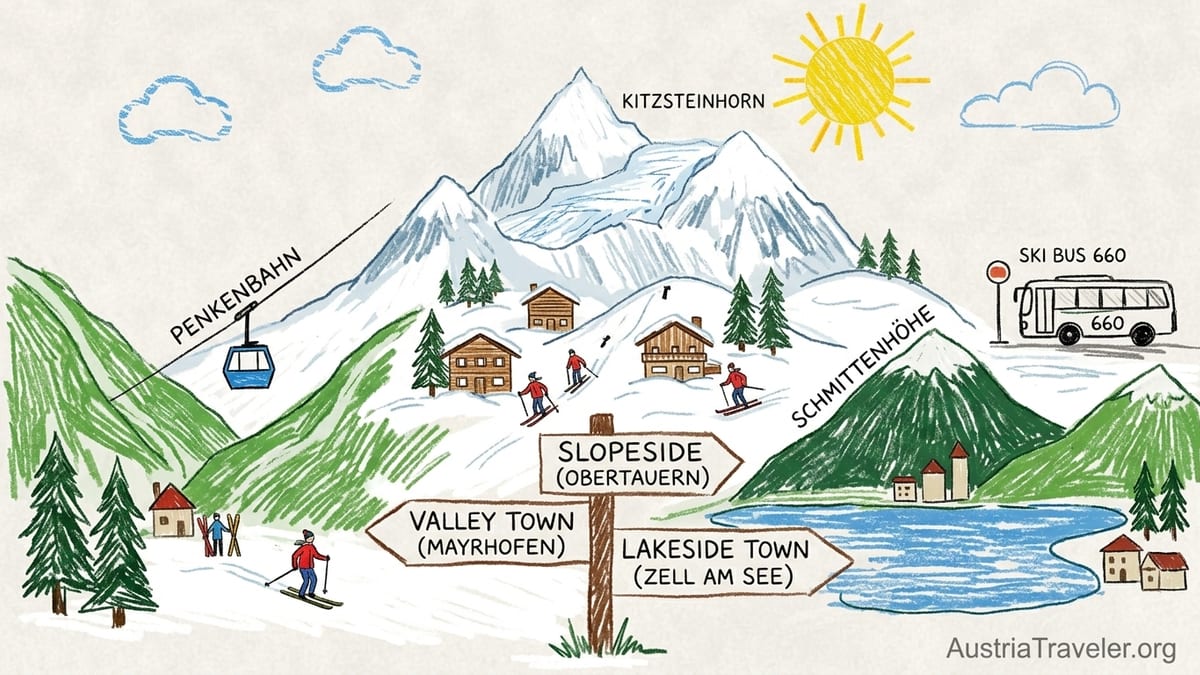
A third style of base was Zell am See, a lakeside town with its own local mountain, Schmittenhöhe, and frequent ski buses shuttling skiers between Zell, Kaprun and the Kitzsteinhorn glacier. Here my apartment was around 800 metres from the CityXpress gondola, which meant a ten-minute flat walk in regular boots. On days when I wanted the glacier or Maiskogel above Kaprun, I relied on line 660, the regional ski bus that, in the main part of the 2025/26 season, was scheduled roughly every 15 minutes at peak times between Zell am See and Kaprun. That frequency sounds generous, but in practice a missed connection at 8.30 in the morning still meant arriving at the lifts behind the first wave.
Across these trips I also tested quieter satellite villages linked to major areas, such as staying in a small Paznaun side village instead of central Ischgl, and using local ski buses up-valley. Those choices saved money and filtered out the louder après-ski, but added extra steps to every ski day. The pattern that emerged was simple but powerful: where you sleep in Austria shapes your boot-walking, your breakfast timing and your patience with buses at least as much as the choice of ski resort itself.
Morning Logistics: Walking, Buses, Lockers and Lift Queues
My clearest memory of Mayrhofen is the sound of ski boots on pavement at 8.20 in the morning. The main street is largely flat, which helps, but a five to ten-minute walk to the Penkenbahn while carrying skis still felt long when I knew there would be a queue at the gondola. On days when I wanted the Ahorn area, at the far end of town, it made sense to wear normal shoes, take the ski bus or car, and change at the base station. There are public lockers at Penkenbahn and Ahornbahn, which turned boot walking into one big carry at the start and end of the day rather than every morning and evening.
In Zell am See, the tight bus timetable dictated my mornings more than I expected. Line 660 from Zell to Kaprun and Kitzsteinhorn is a backbone service, and during the 2025/26 winter timetable its early departures clustered around the half hour. Missing the convenient bus by two minutes meant a wait of up to 15 or 20 minutes, and by the time I reached the glacier base station, the first main wave of skiers had already filled the gondolas. When I timed it well, I carried skis from my apartment to the stop in under five minutes, hopped on with a valid ski pass and stepped into the lift line before it backed up; when I mistimed it, I stood at the shelter watching full buses roll past and promised myself to get out of the door earlier the next day.
In Obertauern the equation flipped entirely. There, the local village shuttle operates throughout ski hours and is free with a ski pass for travel between valley villages and the resort. The bus is useful if you want to start or finish your day on the opposite side of the circuit, but I found that from a well-located hotel I barely needed it. Mornings involved an unhurried breakfast, pulling on boots in the ski room, walking less than two minutes to the lift, and stepping into the line with skis in hand. Lift queues were still a reality on peak holiday weeks, yet the minutes saved not waiting for a bus or walking through town more than made up for any extra time in line at the bottom station.
Using a quiet satellite village in the Paznaun valley introduced a different sort of morning. From base villages like See or Kappl, for example, there are local ski buses that link to the main Ischgl lifts as well as to their own smaller areas. Over a typical 2025/26 timetable, these buses ran at intervals of roughly 20 to 30 minutes in the core of the morning. Staying there meant moving the early alarm forward; if I wanted to be on one of the first gondolas out of Ischgl, I had to be at the bus stop with gear ready. Missing the bus by five minutes did not just delay me; it pushed my entire ski day back, from coffee at the mid-mountain hut to the time I dared to start the final valley run.
Evenings: Après-Ski, Supermarkets and the Price of Silence
Evenings in Mayrhofen were busy and social. The main street offered plenty of bars and a cluster of loud venues near the Penkenbahn base, as well as several supermarkets that stayed open into early evening. Walking back from dinner never took more than ten minutes, but that also meant noise outside until late when events or festivals were running. For me, the convenience of being able to pick up groceries after last lifts and join friends for a drink outweighed the occasional disturbance, but families with young children in early-sleeping rooms might feel differently.
Obertauern felt more self-contained. Many hotels there operate on a half-board basis, with big breakfast buffets and evening meals included. That structure encourages staying in and socialising at your own bar or lounge rather than crossing the village to find restaurants. There were still lively après-ski bars at certain lift bases, and the town’s compact size made every venue walkable, yet the atmosphere was more focused on skiing than late-night clubbing. Because I paid a premium for a slopeside hotel, I did notice that non-included extras, from drinks to spa treatments, also came at resort-level prices compared with valley towns.
In Zell am See the mix of a working lakeside town and a ski resort produced a broader spread of options. I could buy food in large supermarkets a block or two off the lake, eat casual kebabs near the station, or dress up for a waterfront dinner. Après-ski near the Schmittenhöhe base itself was fairly typical, but once I stepped onto the bus or walked down into town the mood turned more local. Taxis were available but not always immediate on busy evenings, and walking uphill in icy streets after a long meal became the trade-off for staying in a residential neighbourhood instead of right beside the gondola.
In the Paznaun side village, evenings were noticeably quieter. A couple of traditional inns, one or two hotel bars, and perhaps a local supermarket that closed soon after dusk shaped the rhythm of the night. That suited our mixed group, which included a non-skiing partner who wanted peaceful afternoons and early nights. It did, however, limit spontaneous late après-ski in Ischgl itself, since the return bus schedule tapered in the evening and taxis up-valley added to the daily cost. The financial saving on accommodation was real, but so was the need to plan each evening ahead.
Comparing Base Types I Actually Used
Major après-ski resorts like central Ischgl or St. Anton offer the classic Austrian experience: lifts stepping straight out of the main street, multiple valley stations within walking distance, and a town that stays awake long after last lifts. Although my longest stay in Ischgl was just outside the busiest core, I still had less than a five-minute walk to the main gondola. The payoff was obvious. Mornings were efficient, even if queues were long during high season, and evenings gave us more options than we could reasonably use. The cost came in two forms: higher prices for almost everything, and the persistent background noise and energy that never quite switched off.
Quieter satellite villages such as See or Kappl in the Paznaun, or smaller communities outside Kitzbühel and Zell am See highlighted another model. These places often have their own small ski hills and direct or connecting buses into the headline resort. Austria Tourism has recently been promoting exactly this pattern as a budget-friendly way to access big ski areas without paying big-resort prices. In practice, staying in such villages gave me shorter queues on the local slopes and more relaxed evenings, at the cost of accepting that every day started and ended with a bus transfer out of and back into the main ski domain.
High-altitude bases like Obertauern or Obergurgl, where most accommodation sits above 1,600 metres and pistes run through or around the village, addressed a different concern: snow reliability. Obertauern’s ski area, for example, runs from roughly 1,665 to 2,500 metres, which meant that even in lean snow periods I could ski back close to the hotel. Comparing that to a valley base such as Mayrhofen, where the town lies below 700 metres and lower slopes can be soft or closed in warm spells, made it clear why high resorts command a premium.
Rail-accessible towns like Kitzbühel, Zell am See, Schladming and St. Anton added yet another layer. In Kitzbühel and St. Anton the railway station lies close to one of the main lift hubs, and official information confirms that a valid local ski pass can include free use of certain trains and ski buses between linked valley towns during the day. That made it realistic to arrive without a car, check into a hotel on foot and rely entirely on public transport within the valley. In Mayrhofen, the Zillertal railway offers a similar backbone, with half-hourly trains from Jenbach up to the town and bus links to nearby ski areas.
Who Should Stay Where: Matching Base to Skier Type
For beginners, the best base in Austria is usually one that simplifies mornings rather than maximises nightlife. Staying within easy walking distance of a gentle nursery slope or a gondola that rises to wide blue runs can make the difference between a confident first week and a stressful one. In practice, that has meant choosing accommodation within a five to seven-minute walk of the main beginner lift, even if it cost a little more or offered a smaller room. In Mayrhofen, that pushed friends toward the Ahorn side with its broad, forgiving pistes. In Zell am See, it meant looking near the lower Schmittenhöhe stations or at the Maiskogel base in Kaprun, rather than far out along the lake.
Families with young children benefited most when I cut down the number of transitions. Lugging small skis and wrangling gloves on a cold bus at 8.45 in the morning quickly made cheap, distant apartments feel expensive in effort. When travelling with children, we tried to stay either directly by a lift in a family-focused resort or in a compact base where our accommodation, ski hire shop, and ski-school meeting point all sat within a few hundred metres. Smaller satellite villages, including some in the Gastein and Paznaun valleys, worked especially well because traffic was light, pavements were short and lift queues were manageable.
Expert skiers, particularly those chasing steep lines and powder, usually care more about terrain than about the gentle slope outside the door. Friends who came to ski the Arlberg circuit cared less about being in a particular neighbourhood of St. Anton and more about early-bird access to high lifts and off-piste routes. For them, staying in a valley town that connects by train or quick bus to a serious ski area made sense. On one rail-focused itinerary, a group used Innsbruck and surrounding valleys as a moving base, riding early regional trains out to places like St. Anton and returning in the evening. The boot walking was longer and the transfers more complex, but the variety of terrain outweighed those drawbacks for experienced riders.
Non-skiing partners changed the equation again. When I travelled with someone who did not ski, towns like Zell am See, Kitzbühel or Mayrhofen, with real high streets, lakeside promenades or spa facilities, were much more appealing than purpose-built high-altitude stations. A partner could stroll to cafes, shop or ride scenic lifts as a pedestrian using special tickets while I skied. That flexibility was worth more than being able to ski to the door, and made valley bases with good public transport and varied non-ski attractions more attractive.
Mixed-Ability Groups and the Hidden Cost of Transfers
Mixed-ability groups are where base choice becomes most delicate. On one Austria Tourism case study, Kitzbühel and St. Anton were highlighted as strong all-rounders, able to keep advanced skiers interested while still providing long blue and red runs and good ski-school infrastructure. My own experience matched that: staying in or near St. Anton, with direct rail access and several gondolas from town level, allowed keen skiers to lap challenging routes while intermediates stuck to gentler slopes and non-skiers enjoyed the village atmosphere.
The hidden cost in mixed groups is not money but time together. When we based ourselves in a satellite village and relied on ski buses to reach a big resort, the group tended to fragment. Faster skiers would head for the first bus, slower or more cautious friends would catch the next one, and meeting for lunch became complicated. Missing the most convenient bus out meant not just arriving late but feeling disconnected from the group’s day. In contrast, when we stayed in compact, lift-side bases like Obertauern, it was easy to pop back to the room, regroup after runs or swap partners mid-morning because everything was within a short walk.
Rail-linked towns offered a partial solution. Using the frequent trains in valleys like the Zillertal or to Kitzbühel and St. Johann made it possible for different sub-groups to start from different stations and still meet up mid-mountain. However, that setup required more planning, including checking timetables and allowing enough time for walks between accommodation, station and lifts. The reward came in flexibility: non-skiers could join for lunch at a mountain restaurant accessible by gondola, while skiers extended their day by catching a later train back.
From these experiences, my rule of thumb for mixed-ability and mixed-activity groups became clear. If the trip’s success depends on spending time together on and off the mountain, choose a base where walking, not buses, is your main mode of transport, even if the terrain is slightly less extreme than in headline expert resorts. If the group prioritises individual goals, such as skiing a famous steep run or logging maximum vertical, then a valley or rail base with broad access to multiple areas can make more sense.
The Takeaway: When Ski-In/Ski-Out Is Worth Paying For
After dozens of Austrian ski days across valley towns, high-altitude stations, rail-linked hubs and quiet satellites, my rule about paying for ski-in/ski-out is simple. It is worth it when it removes a daily bottleneck that would otherwise dominate your mornings and evenings. That usually means trips with young children, beginners who tire quickly, or groups who want to spend the maximum amount of time actually skiing together rather than syncing bus timetables.
In places like Obertauern or Obergurgl, where the entire village functions as one large slopeside base, paying more for a hotel a few steps closer to the lift can feel less critical, because almost everywhere is ski-convenient. In contrast, in valley towns such as Mayrhofen or Zell am See, choosing accommodation within a truly easy walk of the main gondola, or beside a very frequent ski bus stop, can transform your experience, even if you cannot literally ski to the door. For family trips, I now actively prefer a compact, lift-adjacent village with simple logistics over a more glamorous but spread-out town where the children would face a long bus ride twice a day.
Where ski-in/ski-out is not worth the premium is when it adds comfort without solving a meaningful problem. For expert groups happy to walk in boots, catch early buses and ride trains to find the best snow, spending extra to be right on the piste often delivers less value than investing in better guiding, safety equipment or an extra day on the mountain. Similarly, for couples where one partner does not ski, being able to slide to the hotel door matters less than having shops, cafes and scenic walks just outside.
In short, choose your Austrian base by picturing the first 90 minutes of your day and the last 60 minutes of your evening. If those windows are full of awkward transfers, long boot walks and crowded bus stops, then ski-in/ski-out, or at least a very lift-close base, is worth serious money. If, on the other hand, your priorities are varied terrain, town life, non-ski activities or simply stretching your budget, a smartly chosen valley town or satellite village, well aligned with ski bus or rail timetables, will serve you better than the most glamorous slopeside address.
FAQ
Q1. Is it better to stay in a high-altitude resort or a valley town in Austria?
High-altitude resorts such as Obertauern or Obergurgl usually offer more reliable snow and shorter walks to the lifts, but they cost more and often have fewer non-ski activities. Valley towns like Mayrhofen, Zell am See or Kitzbühel are livelier, with better shopping and dining, and can be reached easily by rail, but may require ski buses or longer walks to the gondolas, especially in warmer periods.
Q2. How important is ski-in/ski-out for beginners and families?
For beginners and families, being very close to the lifts or nursery slopes can make a huge difference. Short walks in boots, simple routes to ski school and fewer steps between apartment, hire shop and meeting point translate into more energy for learning and fewer stressful moments. In many cases, a near-lift base with flat access is almost as valuable as true ski-in/ski-out.
Q3. Do Austrian ski buses run often enough to rely on them completely?
In major regions such as Zell am See–Kaprun, the Paznaun and Kitzbühel, ski buses run frequently in peak season, sometimes every 15 to 30 minutes at busy times. You can rely on them, but you need to check the current season timetable and plan your mornings carefully. Missing the most convenient early bus can easily delay your arrival at the lifts by 20 to 40 minutes.
Q4. Are rail-accessible resorts like St. Anton or Kitzbühel practical without a car?
Yes. Rail-linked bases such as St. Anton, Kitzbühel, Zell am See, Schladming and Mayrhofen are designed to work well without a car. Stations are close to the centre and often near major lifts, and in some cases a valid ski pass includes free use of specified local trains and ski buses. The key is to choose accommodation within a manageable walk of both station and lifts.
Q5. How far is too far to walk to the lift in ski boots?
Most skiers find that a flat five-minute walk carrying skis is acceptable, while ten minutes starts to feel tiring, especially for children. In hilly villages or on icy pavements, even a short distance can be uncomfortable. If your route involves slopes, stairs or busy roads, consider renting a locker at the lift to store boots and skis and walk in normal shoes instead.
Q6. Do satellite villages really save money compared with staying in big-name resorts?
Often they do. Smaller villages near headline areas, such as See or Kappl near Ischgl or outlying communities near Kitzbühel and Zell am See, usually offer lower accommodation prices and a quieter atmosphere. The trade-off is reliance on ski buses and more limited evening options. For budget-conscious groups who do not need intense nightlife, the savings can be significant.
Q7. What type of base is best for non-skiing partners?
Non-skiers generally prefer towns with real life beyond the pistes. Bases like Zell am See, Kitzbühel or Mayrhofen offer lakeside walks, historic centres, shops, cafes and spa facilities, plus pedestrian-friendly lift access to viewpoints. Purpose-built high stations can feel limited if you are not skiing, even if they are perfect for maximising time on snow.
Q8. How early should I aim to be at the lifts in popular Austrian resorts?
In high-demand resorts such as Ischgl, St. Anton or Kitzbühel, being at the gondola 20 to 30 minutes before official opening during peak weeks can reduce your time in queues significantly. If you depend on ski buses, work backwards from the first departure that delivers you to the base in time, and allow a margin for walking from your accommodation to the stop.
Q9. Is paying for a hotel directly beside the slopes always worth it?
Not always. It is most valuable on trips with beginners, children or groups that ski together all day, where every minute saved on logistics adds to slope time. For experienced skiers comfortable with buses and longer walks, or for couples where town life matters more, a slightly cheaper base a short distance away can offer better overall value.
Q10. How should I choose between several potential bases in the same ski region?
Start by mapping your daily routine. Look at the distance from each base to the lifts, frequency of ski buses, presence of rail links, evening food and shopping options, and needs of non-skiers or children. Then prioritise what matters most to your group: maximum snow reliability, easiest mornings, liveliest nightlife or best value. The right Austrian base is the one that makes your specific days simple and satisfying, not just the one with the most famous name.