


I did not set out to design the perfect Instagram loop through Austria. I simply picked up a car, pointed it at the Alps and spent several trips stitching together a route between Vienna, Salzburg, Hallstatt, the Salzkammergut lakes, Tyrol and Carinthia. What follows is not a theoretical itinerary but what actually happened on Austrian motorways, in snow on Alpine passes, and while hunting for parking near lakes and old towns.
Picking Up the Car and First Encounters With Austrian Motorways
My most recent Austria road trip started in Vienna in late spring 2025, arriving by train at Wien Hauptbahnhof and walking upstairs to the rental counters. I booked a compact automatic through a major broker and ended up with a Volkswagen Golf from Europcar, petrol engine, with a built-in navigation system. At the counter I added the extra insurance to reduce the excess because I already knew from earlier winter trips that Alpine hairpins, narrow village streets and tight hotel garages reward a bit of caution.
The rental car already had a digital vignette registered to its license plate, which is now standard practice for large companies. The agent confirmed that ASFINAG, the motorway operator, shows the car as covered for the duration of my rental. That meant I did not need to peel a sticker onto the windscreen or worry about buying a vignette at a petrol station before entering the motorway ring around Vienna.
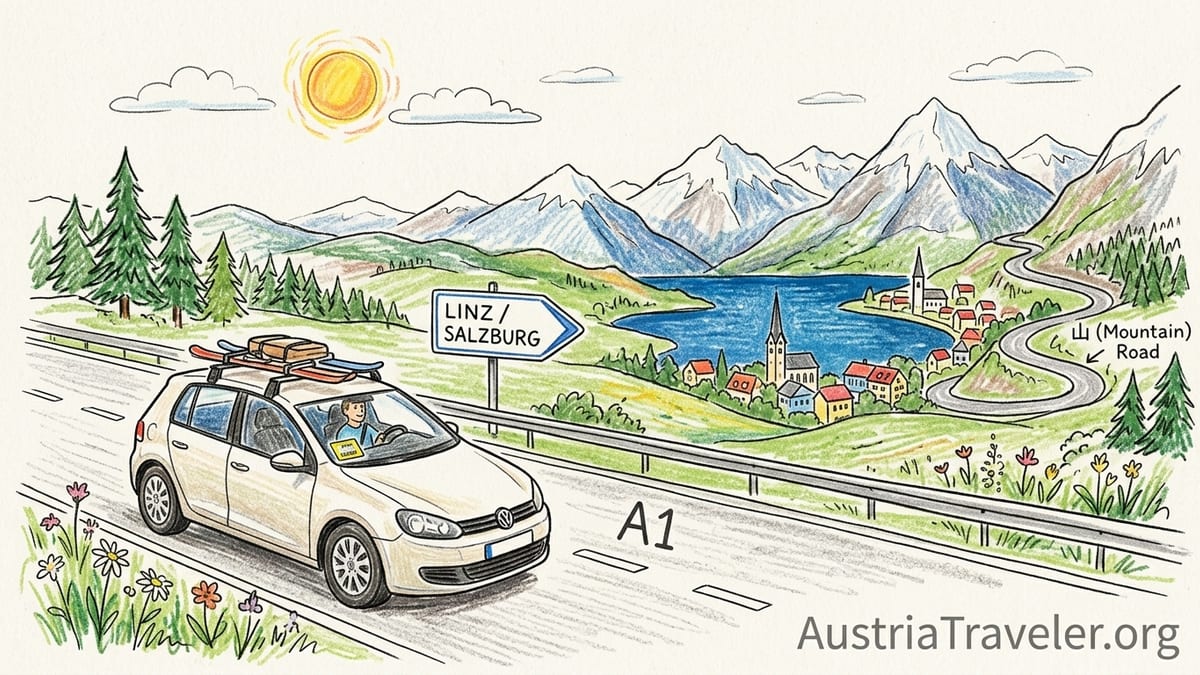
Leaving Vienna on the A1 towards Linz and Salzburg was my reintroduction to Austria’s motorway system. Traffic flowed smoothly, with clear signage and generally disciplined lane use. Compared with German Autobahns, speed limits are more consistent, often around 130 km/h on clear stretches and lower near interchanges or construction. In reality, the right lane generally moves between 110 and 130 km/h, which suited the Golf and my jet-lagged brain.
The first surprise for newcomers is how quickly the driving rhythm changes when you leave the motorway for regional roads. Around Vienna, the A1 feels familiar to anyone who has driven in Western Europe. Two hours later, as the peaks begin to appear on the horizon and the motorway undulates, you get the first hint that gradients, tunnels and weather can make the same 150 kilometers feel very different depending on the season.
Understanding Vignettes: What I Actually Bought and What Has Changed
On an earlier winter trip in January 2024, I entered Austria from Germany near Salzburg in my own car and had to sort the vignette myself. I pulled into a service station just before the border, where the cashier sold both the traditional windshield sticker and access to ASFINAG’s digital system. That time, I chose the classic 10 day sticker vignette, because it was simple and I knew I would be in Austria for a week of skiing. The process took two minutes: pay at the counter, stick it to the windscreen, and you are legal on motorways.
By 2026, Austria has introduced a 1 day vignette alongside the familiar 10 day, 2 month and annual options. For passenger cars up to 3.5 tonnes, ASFINAG lists the 2026 prices as 9.60 euros for a 1 day digital vignette, 12.80 euros for a 10 day vignette, 32 euros for a 2 month vignette and 106.80 euros for the annual product. The key detail is how quickly they become valid when you buy online as a private consumer. The 1 day and 10 day digital vignettes can be valid immediately, which is ideal if you are already at the border or in your hotel room. The 2 month and annual digital vignettes normally only become valid from the 18th day after purchase because of consumer protection rules around distance selling.
On a summer visit in 2025 with my own car, I tested the digital system by buying a 10 day vignette online in advance. I entered my license plate, chose the start date to match my arrival, paid by card, and received email confirmation. By the time I crossed from Germany into Upper Austria, the vignette was active. There was no sticker on the windscreen; enforcement relies on cameras and checks against the central database. The only habit change was reminding myself which car’s license plate I had registered because I regularly drive different vehicles.
If I were driving into Austria in 2026 in my own car, I would decide between the 1 day, 10 day and 2 month vignette based on my plan. A weekend ski dash from Munich to Tyrol and back might justify a 1 day if I only touch motorways briefly, but in practice I would usually still choose the 10 day product for a typical holiday. For a multi-week itinerary that stitches together Vienna, the Salzkammergut and Tyrol, the 2 month vignette at 32 euros becomes attractive, with the caveat that I would buy it at least three weeks before departure so that the 18 day waiting period does not catch me out.
Real Drive Times Between Cities, Lakes and Alpine Valleys
My first long leg on the most recent trip was Vienna to Salzburg via the A1. On a clear weekday in May, with one coffee stop, it took just under three hours of driving time for around 300 kilometers. The motorway is mostly two lanes in each direction, with some gentle gradients and occasional construction zones. Cruise control set around 125 km/h kept me in flow without feeling pressured by faster drivers. Approaching Salzburg, traffic thickened but never became a full traffic jam.
From Salzburg to Hallstatt, I left the A1 at Thalgau and wound through the Salzkammergut region on smaller roads past Fuschlsee and Wolfgangsee, eventually connecting to the B158 and B145. On the map, it looks like a short hop of just over 70 kilometers. In reality, it took about 1 hour 45 minutes with slow sections behind trucks, speed limits through villages and photo stops. The road surface is excellent, but there are frequent curves, lakeside sections with limited overtaking opportunities and occasional tour buses to follow. This is where the difference between motorway averages and lake district reality becomes clear.
Another classic stretch I drove repeatedly is Innsbruck to the Ötztal and on to Sölden in Tyrol. From Innsbruck, the A12 motorway west to the Ötztal exit is a quick 30 to 40 minutes depending on traffic. Leaving the motorway, the Ötztal road climbs gradually along the valley. It took me about 45 minutes from the valley entrance to Sölden, with the last third noticeably steeper and curvier. In winter, behind chains-on vehicles or buses, this can stretch to well over an hour. The distance is not huge, but you feel the vertical gain in the engine’s workload and your concentration.
The most dramatic single drive I have done in Austria remains the Grossglockner High Alpine Road, which I tackled from the Salzburg side on a clear September day. From the valley town of Bruck to the Kaiser-Franz-Josefs-Höhe viewpoint, with stops at lookouts and a slow coffee break, it took about three hours one way, even though the raw distance is under 50 kilometers. The gradients, repeated hairpins and temptation to stop at almost every curve make time estimates based on distance meaningless here.
Autobahn Versus Mountain Roads: Tunnels, Gradients and Section Tolls
Austria’s Autobahn network is deceptively straightforward until you factor in tunnels and specific tolled sections. On one winter trip from Vienna to Innsbruck, snow was falling lightly as I drove the A1 and then the A8 and A12 via Germany. The motorway gradients felt manageable in the Golf with winter tyres, but I noticed how quickly conditions could change when passing through long tunnels and emerging at different elevations. Exits directly after tunnels demand attention, especially at night or in heavy rain when your eyes are still adjusting.
Section tolls are a separate story from the vignette. On my drives, I personally encountered the Brenner Pass toll on the A13 between Innsbruck and the Italian border and the Arlberg road tunnel on the S16 between Tyrol and Vorarlberg. These stretches require an extra payment in addition to the vignette. In each case, I had to slow down at a toll station, choose a lane that accepted debit or credit cards, and either take a ticket and pay or pass through a pre-paid digital section lane if I had arranged it in advance. The price for a single passage varies by section, but the key lesson is that these tolls are independent charges on top of your vignette.
The tunnels themselves can be long and slightly claustrophobic. I drove the Arlberg tunnel in both directions during a September crossing, spending several minutes underground at a steady 80 km/h. Ventilation is good and signage is clear, but fatigue can sneak up on you. I learned to open the window slightly for fresh air before entering and to avoid tailgating the car in front because sudden braking inside a tunnel is far more stressful than on an open motorway.
In contrast, mountain roads like the Grossglockner or the road up to Dachstein’s cable car base station replace monotony with constant inputs. Gradients frequently reach double digits, and even in late summer there were patches of moisture in shaded hairpins. On these roads, first or second gear and engine braking are your friends. On one descent towards Heiligenblut, I smelled my brakes getting hot after too many enthusiastic corners and had to pull into a viewpoint parking lot for ten minutes to let everything cool. It was a practical reminder that mountain driving is as much about managing your car’s temperature and brakes as it is about enjoying the view.
Parking in Cities and by the Lakes: Mistakes I Would Not Repeat
My worst parking moment in Austria came not in Vienna but in Salzburg on a busy Saturday in July. I arrived mid-morning from Hallstatt, planning a leisurely lunch and a walk through the old town before continuing west. Instead, I spent half an hour circling one-way streets until I gave up and followed signs into an underground garage near the river. The entrance ramp was tight, with a blind curve that had me inching forward and relying heavily on the parking sensors. Inside, the spaces were short by North American standards. I parked neatly between the lines, only to find that I could not open the driver’s door fully without brushing the neighboring car.
Hallstatt was a different kind of lesson. Arriving around 9 a.m. on a shoulder-season weekday, I followed the official signage to the large pay-and-display lot outside the village center. Paying felt straightforward: a machine with English instructions, coins or card accepted, and a ticket displayed on the dashboard. The catch came when I underestimated how long I would stay. I paid for four hours and ended up exploring the town and viewpoint for nearly five. When I returned, a yellow slip was tucked under the wiper. It was a polite but firm reminder that Austrian parking enforcement is efficient, even in scenic lakeside villages.
By contrast, lakes like Attersee and Wolfgangsee offered some of the most relaxed parking of the trip, provided I arrived early. Municipal lakeside lots often charge by the hour, with clear signage about maximum durations. Where I got it wrong once was in Mondsee, where I assumed that a small gravel area by the shore was free public parking. It turned out to belong to a nearby guesthouse, which I learned when the owner approached and gently informed me that I needed to move. There was no fine, but the conversation would have been avoided by following the blue Parking signs instead of improvising.
Next time, I will treat city centers like Salzburg and Innsbruck differently. Rather than driving straight to the heart, I plan to identify a park-and-ride or a large edge-of-town garage in advance, leave the car there for the day, and use public transport or walk into the old town. This is especially sensible if your accommodation is in a pedestrian zone or within a short tram ride of the main station.
Narrow Alpine Roads and Winter Conditions: When the Car Felt Too Big
On my first winter drive into a smaller Tyrolean valley above Ötztal, I discovered what “narrow” really means in the Austrian Alps. The road to a guesthouse above Längenfeld started broad and well marked, then gradually shrank to what felt like a single lane with occasional passing places. Snowbanks reduced the usable width even further. When I met a local driver coming the other way, both of us had to reverse slightly to reach a wider segment of road. I was grateful to have a compact car with winter tyres and to be comfortable reversing uphill without panicking.
Snow itself was rarely the problem on main roads and motorways because Austria is efficient at plowing and salting. The stress comes at transitions. Driving off a cleared main road into a hotel’s sloped driveway or underground garage can be surprisingly tricky when a thin layer of packed snow or ice covers the ramp. At one guesthouse near Sölden, I had to reverse out and take a second run-up at a slightly higher speed to get enough traction to crest the incline into the covered parking area.
I made one clear mistake on a January evening: trusting the navigation app’s “shortest route” suggestion from the Zillertal towards a small side valley. It led me onto a steep farm road marked for local access that quickly narrowed to a lane barely wider than the car, with high snowbanks on both sides. After a tense kilometer, I reached a driveway that allowed me to turn around in three careful maneuvers. It cost me fifteen minutes and a noticeable spike in heart rate. Since then, I cross-check winter routes against the main valley roads on a paper map or satellite view and avoid anything that looks like a local shortcut.
Chains were never mandated on the days I drove, but I carried a set in the trunk on winter trips, as required in parts of the Alps when conditions deteriorate. The practical lesson was to practice fitting them once in a dry, flat parking lot rather than discovering the instructions at night by the side of the road. Even if you never use them, that familiarity reduces stress when you see roadside signs indicating chain requirements ahead.
Why I Still Rented a Car When Trains Are Excellent
Austria’s rail network is excellent. On other trips I have happily taken ÖBB Railjet trains between Vienna, Salzburg and Innsbruck, enjoying fast, comfortable travel without worrying about parking or vignettes. Yet I still chose to rent a car for this road trip because certain experiences are markedly easier or only really feasible by car.
One example is connecting smaller lakes and trailheads in a single day. From a base near St. Gilgen, I drove one morning to a quiet bathing spot on Attersee, then on to a hillside trail above Mondsee, and finished with a late-afternoon coffee in St. Wolfgang. Public transport theoretically reaches all these towns, but the bus connections and timetables would have turned that into a two-day puzzle. With a car, it became a relaxed circuit with as many photo stops as I liked.
Another is staying in remote guesthouses and mountain inns. South of Innsbruck, I spent two nights in a farmhouse-style pension partway up a valley hillside. The nearest rail station was in the main valley; from there, it would have been a bus plus a long uphill walk with luggage. Instead, I drove directly to the door, parked on a gravel pad behind the house and carried my bags ten meters. The ability to arrive late in the evening or to leave at dawn for a sunrise hike felt liberating compared with watching departure boards.
There were moments, especially while circling for parking in Salzburg or queuing at the Brenner toll, when I questioned the choice. But each time I pulled into a small lakeside parking area at 7 a.m., with mist still lifting off the water and only a handful of local cars around, the trade-off felt worth it. For me, the sweet spot in Austria is using trains for the long intercity hops when I am not pressed for time and renting a car specifically for focused periods in the lakes and Alps.
The Road Trip I Would Actually Repeat Next Time
After stitching together several journeys, I now know how I would structure a future Austria road trip in a realistic way. I would again enter by train into Vienna, spend a couple of car-free days there on foot and public transport, and only then pick up a rental car from a city location to avoid airport surcharges and unnecessary days of parking. I would choose a compact automatic with winter-capable tyres if traveling between November and March, and confirm at the counter that the car has a valid digital vignette for the full rental period.
From Vienna, I would drive the A1 to the Salzkammergut and base myself near St. Gilgen or Bad Ischl for three or four nights. That would allow unhurried day trips to Hallstatt, Attersee and Wolfgangsee without constantly packing up luggage. Drive times of one to two hours each way on lakeside roads are manageable and leave plenty of time for walks and swims. I would avoid the mistake of underestimating parking time in Hallstatt by simply paying for a full-day ticket on arrival.
Next, I would continue to Salzburg, but instead of driving into the center, I would book a hotel or guesthouse with on-site parking on the edge of the city and use buses to reach the historic core. After two nights there, I would take the A10 and A2 corridors towards Carinthia or, if returning to Tyrol, the familiar A12, factoring in the additional section tolls where relevant and choosing my departure times to avoid peak Saturday holiday traffic.
I would only include one serious mountain road like the Grossglockner in a single itinerary and watch the weather closely, building in flexibility so that I can shift that drive by a day if fog, storms or late snow roll in. On departure, I would return the car in Innsbruck or Salzburg and continue by train, rather than forcing a long drive back to Vienna just to drop the vehicle.
FAQ
Q1: Do I need a vignette to drive on all roads in Austria, or only motorways?
For passenger cars, the vignette requirement applies to motorways and expressways managed by ASFINAG. Many regional and local roads, including some scenic routes, do not require a vignette. However, section tolls may apply on specific motorway stretches even if you already have a vignette.
Q2: Which vignette should I choose for a one week holiday in Austria?
For a typical seven to ten day holiday that includes motorway driving, the 10 day vignette at 12.80 euros for cars in 2026 usually offers the best balance of price and flexibility. The 1 day product at 9.60 euros can make sense for very short transit trips but is less economical if you plan to drive on motorways on multiple days.
Q3: How strict is parking enforcement in Austrian cities and tourist areas?
In my experience, parking rules are clearly signed and consistently enforced. In places like Salzburg and Hallstatt, overstaying a paid period or parking in restricted zones can quickly result in a ticket. It is worth taking an extra minute to read the signs and pay for more time than you think you need.
Q4: Are Austrian mountain roads dangerous for inexperienced drivers?
Major valley roads and popular passes are well engineered and well maintained, but they require more concentration than motorways. Gradients can be steep and hairpins frequent. If you are new to this type of driving, start with well known routes in good weather, use lower gears on descents and avoid narrow local shortcuts suggested by navigation apps.
Q5: Do I need winter tyres or snow chains for a winter road trip in Austria?
Winter tyres are effectively essential between November and March if you plan to leave lowland cities, and many rental cars in Alpine regions are equipped accordingly. Chains are not required on every route but may be mandated on certain passes during heavy snow. Carrying a set and knowing how to fit them is prudent if you will be in high mountain areas.
Q6: Is it worth paying the extra section tolls for tunnels and passes?
For routes that cross major Alpine barriers, section tolls like the Brenner or Arlberg often save significant time compared with lower alternatives. If your itinerary only includes one or two such crossings, the extra cost can be justified by reduced fatigue and simpler navigation.
Q7: How long does it really take to drive from Vienna to Salzburg?
On the A1 motorway in normal conditions, the drive of roughly 300 kilometers usually takes around three hours of pure driving time. Adding a fuel or coffee stop and possible minor delays, planning for three and a half to four hours is realistic.
Q8: Can I rely on navigation apps for routing in the Austrian Alps?
Navigation apps are useful for general orientation but can sometimes suggest narrow farm roads or steep local shortcuts, especially in winter. I use them in combination with a sense check on the map and avoid routes that clearly diverge from main valley roads or signposted passes.
Q9: Is it better to rent a car in Vienna or pick one up closer to the mountains?
If you plan to spend several days in Vienna itself, it often makes sense to stay car free there and pick up your rental just before you leave the city. This avoids parking costs and allows you to focus your rental days on the parts of the trip where a car adds the most value, such as the Salzkammergut lakes or Alpine valleys.
Q10: Would you recommend trains instead of driving between the main Austrian cities?
For direct travel between cities like Vienna, Salzburg and Innsbruck, I would often choose the train, which is fast and comfortable. I rent a car specifically for periods when I want to explore lakes, villages and mountain roads that are time consuming or awkward to reach by public transport alone.