


After several extended trips circling Austria by train and rental car, I ended up with a very different list of favorite places than the official brochures suggest. Austria’s tourism material neatly separates Alpine regions, lake districts, cities, wine country and spa towns, but when you are actually on the ground with a suitcase and limited vacation days, some areas justify the detour far more than others. What follows is not a list of “top sights,” but a look at where I would realistically spend my time if I were planning another country-wide trip, based only on places I have actually stayed in and not just rushed through on a day tour.
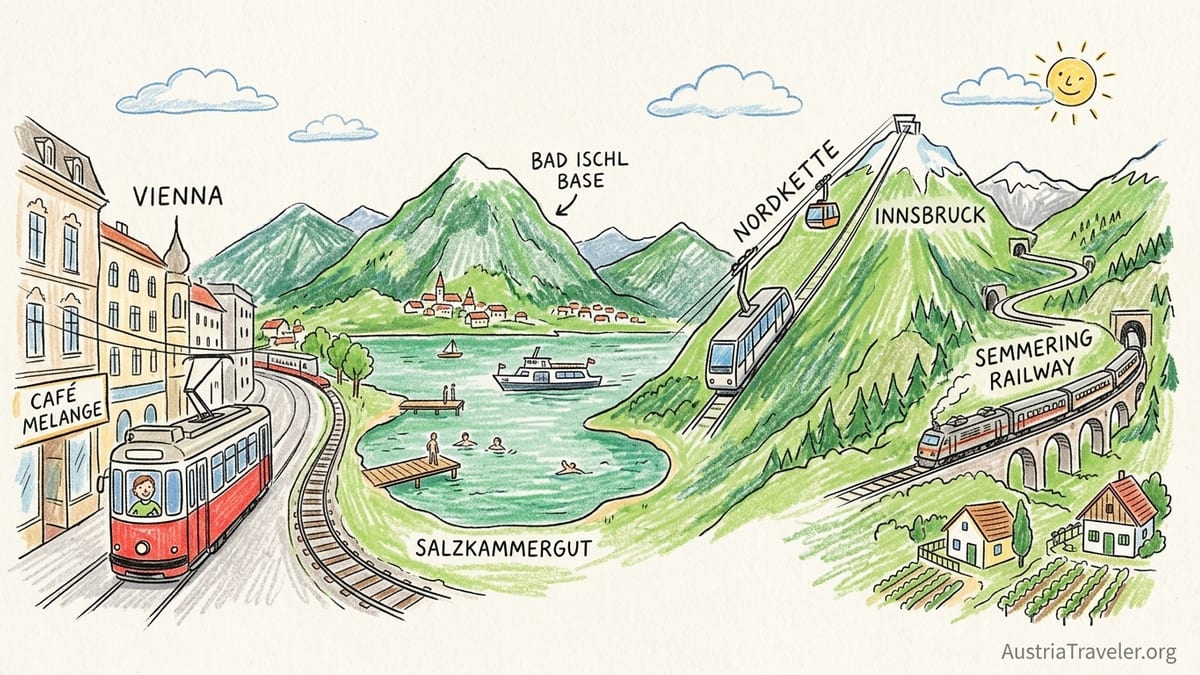
Vienna: Essential Cultural Anchor, Best Without a Car
I have stayed in Vienna three separate times, for a total of about ten nights, and I would still put it at the heart of any Austria itinerary. Not because it has palaces and museums, but because Vienna sets the tone for how the rest of the country feels. Staying in a midrange hotel near the Naschmarkt, I could walk from a weekday opera rehearsal spilling out of the State Opera to a late coffee in a wood-paneled café in under ten minutes, which grounded the entire trip in everyday Austrian life rather than sightseeing alone.
For Vienna, I learned that three full days feels like the sweet spot for most travelers. Less than that and you will spend too much time figuring out trams and ticket machines; more than that and you may start padding the schedule with museum visits you do not really care about. I always arrived and left by train, usually into Wien Hauptbahnhof, and I would not recommend having a car here. Parking garages were expensive, and street parking near the Gürtel was time-limited enough that it felt like a part-time job to move the car. The public transport pass, on the other hand, let me reach outlying neighborhoods like Grinzing and the Danube Island with almost no planning.
What Vienna contributed to my overall Austria experience was a sense of rhythm. Mornings started slowly with a Melange and pastry, even for office workers; evenings could be as formal as a concert at the Musikverein or as casual as drinks in the 7th district. When I later reached quieter wine villages and Alpine valleys, it was Vienna that gave those places context: this was the capital’s weekend playground, the source of the city’s wine list, the origin of dishes I had first seen in a Beisl near the Ringstrasse.
My main criticism is that central Vienna felt noticeably more expensive each time I returned. Coffee and cake at famous cafés came with a mark-up that made me think twice about lingering, and Old Town restaurants leaned heavily into a polished, international menu. The solution that worked for me was to sleep centrally for one or two nights, then move to a simpler guesthouse one or two U-Bahn stops out, where the pricing and pace matched the rest of the country more closely.
Salzburg: Beautiful Stage Set, Best With One Long Night
I have spent a total of three nights in Salzburg, plus a few daytime layovers between trains. It is one of the most photogenic city centers in Europe, with the fortress hovering above a tight baroque core. Yet when I look back on my time in Austria, Salzburg feels less like a place to settle into and more like a spectacular backdrop. It works brilliantly as a cultural stop and jumping-off point for the lakes and nearby mountains, but I would not allocate more than one or two nights there on a short trip.
Arriving by train from Vienna, the walk from Salzburg Hauptbahnhof into the historic center takes about 15 to 20 minutes, and several times I did it in the rain while dragging a suitcase past supermarkets and apartment blocks. That walk told me something important: beneath its Mozart branding, Salzburg is a working small city with traffic and grocery runs, not only church towers and concert halls. Once in the pedestrian zone, you immediately feel the switch to tourism mode, with souvenir shops and Sound of Music tours selling the same images.
For me, the most rewarding moments were early and late. I liked getting up before breakfast to cross the river while the fortress was still in shadow and the delivery trucks were the only vehicles in the alleys. At night, after the last tour buses had left, I ducked into a small beer hall just off the main streets and found families and groups of friends who clearly lived nearby. Those hours made Salzburg feel lived-in again. During the middle of the day, especially in August, crowds packed the Getreidegasse so tightly that I often retreated to the riverbank or up to the Mönchsberg lift just to breathe.
In practical terms, Salzburg is simple without a car. I never rented one in the city. Buses run frequently to nearby lake districts and to the Untersberg cable car, and the train network connects smoothly to both Germany and the Salzkammergut. The downside is that accommodation in the Old Town is priced for festival-goers and tour groups. Each time, I found better value by staying across the river or near the station and walking in. On a future trip with limited time, I would still include Salzburg, but probably only as one overnight with two long days, then move on to quieter bases in the mountains or by the lakes.
Salzkammergut Lakes: Staying in Bad Ischl Instead of Chasing Hallstatt
Across several trips, I dedicated around a week in total to the Salzkammergut lake region, splitting it between Bad Ischl, Gmunden, and a night in the smaller lake town of Traunkirchen. Of all the areas in Austria, this is where my expectations and reality diverged most. Pictures of Hallstatt had led me to expect tranquil lakeside villages everywhere, but the reality was more complicated: some spots felt overrun for much of the day, while others just a few kilometers away remained remarkably calm.
Bad Ischl turned out to be the best base for me. I stayed there twice, for three nights and later for two. As a former imperial spa town that served as a summer retreat for the Habsburg court, it has grand architecture and a famous pastry shop, but it is primarily a town where people live and work. Trains and buses fan out to nearby lakes like Wolfgangsee and Hallstätter See, and the new role of Bad Ischl as part of a European Capital of Culture program in 2024 and 2025 added fresh energy in the form of exhibitions and events spread through the region. The mix of local life and access to surrounding nature made my days feel balanced rather than staged.
I did visit Hallstatt more than once, but I eventually stopped recommending it as a must-see, especially for short itineraries. Even arriving on an early-morning bus from Bad Ischl, I watched the narrow streets fill quickly with tour groups from multiple continents. Ferry loads arrived from the train station, and the “classic” photo point overlooking the village had a constant queue. Local authorities have been discussing visitor management and some limits on tour buses to cope with overtourism, which says a lot about the scale of the problem. By early afternoon in peak season, I often felt more like I was shuffling through a theme park than visiting a lakeside community.
Gmunden and Traunkirchen, on the other hand, gave me what I had been looking for: a sense of ordinary life around extraordinary water. In Gmunden I stayed near the shore of Traunsee, where locals took evening swims off simple wooden platforms, and shops closed at normal hours. Traunkirchen was even quieter, with a small peninsula church and hiking trails heading straight uphill from the village. Both are accessible by train, and I never needed a car once I arrived. On a future trip, I would gladly spend four or five nights in this lake region, focused on Bad Ischl and Traunsee, and skip Hallstatt entirely unless I had ample time and a strong reason to see it in person.
Innsbruck and the Nordkette: Urban Alps Without the Resort Gloss
Innsbruck ended up surprising me. I had initially planned it as nothing more than a transfer point between Italy and the Austrian Tirol, but after staying a total of four nights over two visits, it became one of my favorite Alpine city bases. Innsbruck contributed something unique to my Austria experience: the feeling of being properly in the mountains while still living an urban day-to-day life with trams, supermarkets, and university crowds.
The most memorable day started when I stepped out of my budget hotel near the main station and within half an hour stood high above the city on the Nordkette ridge. The combination of funicular and cable cars takes you from a modern riverside station to alpine terrain above 2,000 meters in roughly the time it takes to commute across Vienna. That contrast between morning espresso in a busy pedestrian street and lunch next to patches of summer snow stayed with me as the essence of Innsbruck. Unlike some pure ski resorts, the city does not shut down out of season; it simply shifts from snow sports to hiking and biking.
I found three nights ideal here. Two days felt rushed if I wanted both city time and proper mountain walking. Innsbruck is very manageable on foot and by tram, so I never rented a car. The station has direct trains to Munich, Vienna, and even Zurich, which made it easy to slot into a larger rail-based itinerary. Compared with more famous Alpine resort towns, Innsbruck also felt more affordable for food and accommodation, though prices near Christmas markets and in high ski season climbed quickly.
The city is not without its downsides. The Old Town can feel like a stage set in the middle of the day, complete with riverfront selfie spots and streets of souvenir shops around the Golden Roof. Twice I ducked into quieter side streets or crossed the bridge just to escape the tour groups. After dark, though, most of that washed away, and the city reverted to its role as a regional hub for students, office workers, and families. Street-level bars and small restaurants remained open but not crowded, and walking the riverside path looking back at the Nordkette lit by the last light of the day made me glad I had stayed overnight instead of treating Innsbruck as a quick photo stop.
Wachau Valley and Vienna Woods: Wine Country That Feels Close Yet Worlds Away
If Vienna was my cultural anchor and the Alps my dramatic backdrop, the Wachau Valley and nearby Vienna Woods provided the soft-focus days in between. Over multiple trips, I have stayed four nights in Krems and Dürnstein combined, and added several day visits from Vienna into the hills and vineyards of the Wienerwald. This was the part of Austria where I felt most tempted to linger, even though the landscapes are gentler than the peaks and lakes that dominate tourism posters.
Reaching the Wachau without a car is straightforward. I would typically take a morning train from Vienna to Melk or Krems, journeys that took about an hour, then rely on local buses or rental bikes. Passenger ferries and excursion boats linked towns like Spitz and Dürnstein, turning the river itself into part of the experience. On one May trip, I checked into a family-run guesthouse in Krems for three nights and used it as my base, cycling along the Danube to small villages like Weißenkirchen and stopping at Heuriger wine taverns where the owners poured their own vintages alongside slices of cold roast pork and salads.
What Wachau contributed to my sense of Austria was this tight connection between landscape, history, and what arrived on my plate. Terraced vineyards climbed steeply above the river, and even casual hikes led past stone walls and small chapels that had anchored this agricultural landscape for centuries. Late afternoons were my favorite time. Day-trippers from Vienna started to peel away on the last boats and trains, and village streets grew quiet except for the sound of cutlery and clinking glasses in courtyards. Sitting under a vine-covered pergola with a glass of Grüner Veltliner felt just as Austrian as any museum visit, just in a different register.
My one complaint about the Wachau is that certain honeypot spots felt over-concentrated. Dürnstein’s main street could be clogged on summer Saturdays to the point where I could barely steer my bike along the cobbles. Tour groups arrived en masse from river cruise ships, and prices for snacks and souvenirs reflected that captive audience. Lodging inside the most famous villages also came at a premium. By contrast, staying in Krems or on the quieter southern bank kept costs more reasonable and crowds thinner. If I were planning a one-week Austria trip, I would still allocate at least two nights in or near the Wachau, but I would sleep in a slightly larger town and treat the postcard villages as late-afternoon or early-evening visits rather than central bases.
Semmering Railway and Rural Retreats in the Vienna Alps
Between Vienna and the high peaks of Tirol lies a less-heralded landscape that ended up being one of my favorite discoveries: the hills and passes around Semmering. I first took the train over the historic Semmering Railway almost by accident, simply following the most direct rail route toward Graz. Later, I deliberately returned and spent two nights in a modest guesthouse near Semmering Pass, using light hiking trails and old villas as my excuse to stay. That small investment of time gave me a sense of Austria’s early mountain tourism that I never found in the glossier ski destinations.
The Semmering Railway itself, completed in the mid-19th century and now on the UNESCO World Heritage list, climbs through a series of tunnels, stone viaducts and tight curves between Gloggnitz and Mürzzuschlag. Looking out the window, I could see why engineers of the era considered it a technical marvel, and why early travelers treated the ride itself as a sightseeing attraction. Walking some of the paths near the line later that day, I passed grand but slightly faded villas and former sanatoriums that had once marketed the crisp mountain air to wealthy Viennese families.
As a rural retreat, Semmering worked best because it was easy to reach yet felt a world away. From Vienna, I caught a direct regional train that took roughly one and a half hours, and once there I never needed a car. Trails started near the station, and small hotels stood within walking distance. Prices for food and lodging were noticeably lower than in the big-name Alpine resorts further west. On the other hand, off-season the area could feel sleepy. On my autumn visit, some hotels and restaurants were closed midweek, and I had to plan ahead to make sure I had a dinner reservation or at least confirmed opening hours.
Compared with the dramatic scenery of Tirol, the Semmering region is gentler and more forested, so travelers seeking jagged peaks might find it underwhelming. For me, though, its role was different. This was where I could slow down, walk on quiet paths, and watch local hikers chat at small mountain huts without the sense of mass tourism. On a future trip, I would happily trade one extra night in a crowded resort town for two or three quiet nights here, especially if I was traveling mainly by train.
How I Would Reshape a One-Week Austria Itinerary
Looking back at how I actually spent my time in Austria, the biggest lesson is that I tried to see too many famous names in too few days, especially on my first trips. I booked nights in Vienna, Salzburg, Hallstatt and an Alpine resort town, imagining that each added an essential dimension. In reality, the most rewarding experiences came from staying a little longer in fewer places, especially those that combined different sides of Austria in a single base.
If I had just seven nights for a first-time visit now, knowing what I know from weeks on the ground, I would design the trip very differently. I would start with three nights in Vienna, enough to settle into the city’s rhythm, visit one or two major museums that genuinely interest me, and enjoy at least one evening performance without rushing. Then I would move to the Wachau Valley for two nights, staying in Krems or another well-connected town, to experience wine country, Danube landscapes and small-village evenings after the buses leave.
For the Alpine portion, I would choose either Innsbruck or the Salzkammergut, not both. With two remaining nights, Innsbruck would give me urban comfort and instant access to the Nordkette for classic mountain views, all without picking up a car. Alternatively, two nights based in Bad Ischl or near Traunsee would deliver lake swimming, gentle hikes and glimpses of everyday life in a regional town. In both cases, I would skip Hallstatt on such a short itinerary. The crowds and transport connections simply do not justify the detour if you only have a week.
Places I would be comfortable cutting for time-pressed travelers include Salzburg as an overnight base, unless there is a deep personal interest in its music heritage; famous but tightly packed lake villages that struggle with overcrowding; and high-profile ski resorts outside of winter, which can feel half-closed in shoulder seasons. Instead, I would encourage visitors to let Vienna handle most of the classic “sightseeing,” then lean into slower, more local experiences in one wine region and one mountain or lake base. Austria rewards that kind of depth much more than a frantic checklist of names.
FAQ
Q1: Is it better to travel around Austria by train or rental car?
For the itinerary I describe, trains and buses worked well between major regions and into the Wachau and Salzkammergut, and I completed most of my trips without driving. I only found a car noticeably helpful when linking smaller lake villages in one day or making a very tight schedule, but parking costs and city restrictions often canceled out that convenience.
Q2: How many days should I spend in Vienna on a first trip?
Based on several stays adding up to about ten nights, I think three full days is a good minimum for a first visit. That gives you time to learn the public transport system, visit one or two museums that really interest you, try a traditional café, and take an evening at the opera or a concert without cramming everything into a single rushed day.
Q3: Is Hallstatt worth a special trip if I have limited time?
From my own visits, I would say no if you only have a week in Austria. The village and lake setting are undeniably beautiful, but heavy crowds and ongoing debates about visitor limits mean it often feels more like a theme park than a peaceful retreat. Nearby towns and lakes offer similar scenery with far fewer people and are easier to fit into a relaxed itinerary.
Q4: Where should I base myself to explore the Salzkammergut lake region?
I had the best experience using Bad Ischl and the Traunsee area as bases. Both are reachable by train, offer everyday services like supermarkets and bakeries, and make it easy to reach multiple lakes and hiking trails without a car. Staying there also kept me in touch with local life rather than only the most touristy streets.
Q5: Is Salzburg still worth visiting if it feels crowded?
Yes, but I would treat it as a short cultural stop rather than a long base. I found that one or two nights, with an early-morning walk and at least one evening after day-trippers leave, gave me the beauty of the baroque center and fortress views without spending too many days in streets that can feel packed during peak hours.
Q6: How many nights should I plan in the Wachau Valley?
On my trips, two or three nights in Krems or a similar town felt ideal. That allowed a full day of cycling or walking between villages, a relaxed wine tavern evening, and some flexibility for changes in weather. Day trips from Vienna are possible, but staying overnight let me enjoy the valley after excursion boats and buses had departed.
Q7: Is Innsbruck a good alternative to a traditional ski resort in summer?
For me, Innsbruck was better. Staying there for a few nights gave me access to serious mountain scenery via the Nordkette cable cars while still enjoying the life of a mid-sized city. Hotels, restaurants and public transport remained active outside the ski season, so the city never felt half-closed the way some dedicated resorts can in summer.
Q8: Does it make sense to visit the Semmering region on a short trip?
If you are traveling primarily by train and enjoy quieter hiking and historic routes, a night or two around Semmering can be very rewarding. The world-heritage mountain railway and gentle forested hills offer a slower, less commercial side of Austria that contrasts nicely with big cities and blockbuster Alpine scenery.
Q9: How expensive did Austria feel compared with other European countries?
City centers in Vienna and Salzburg felt relatively pricey, especially famous cafés and hotels in the most photographed areas. Once I stayed a few tram stops outside the center or in regional towns like Bad Ischl, prices for food and lodging dropped to a more moderate level, and I rarely felt that I was being charged a “tourist premium.”
Q10: If I only have one week, which regions would you prioritize?
With seven nights, I would focus on three main bases: Vienna for culture and history, the Wachau Valley for wine and river landscapes, and either Innsbruck or the Salzkammergut for mountains or lakes. That combination gave me a balanced picture of Austria without feeling rushed, and I would skip Hallstatt and far-flung resort towns in favor of slower time in those core areas.