


Austria’s tourism board likes to sort the country neatly into lake and mountain “products”: Salzkammergut for postcard lakes wrapped in green peaks, Tirol for hard‑edged high Alpine drama, Carinthia for warm bathing lakes, and Vorarlberg for Lake Constance backed by western Alpine ridges. After several trips focused almost entirely on nature, I learned that those labels are only part of the story. The real difference is how each region feels on the ground when you are parking the car, carrying a SUP board to the shore, stepping into a cable car, or trying to find dinner after a long hike. This article is my personal verdict on the regions where I actually spent time, and where I would return, to help you choose the right kind of Austrian nature trip rather than the right marketing slogan.
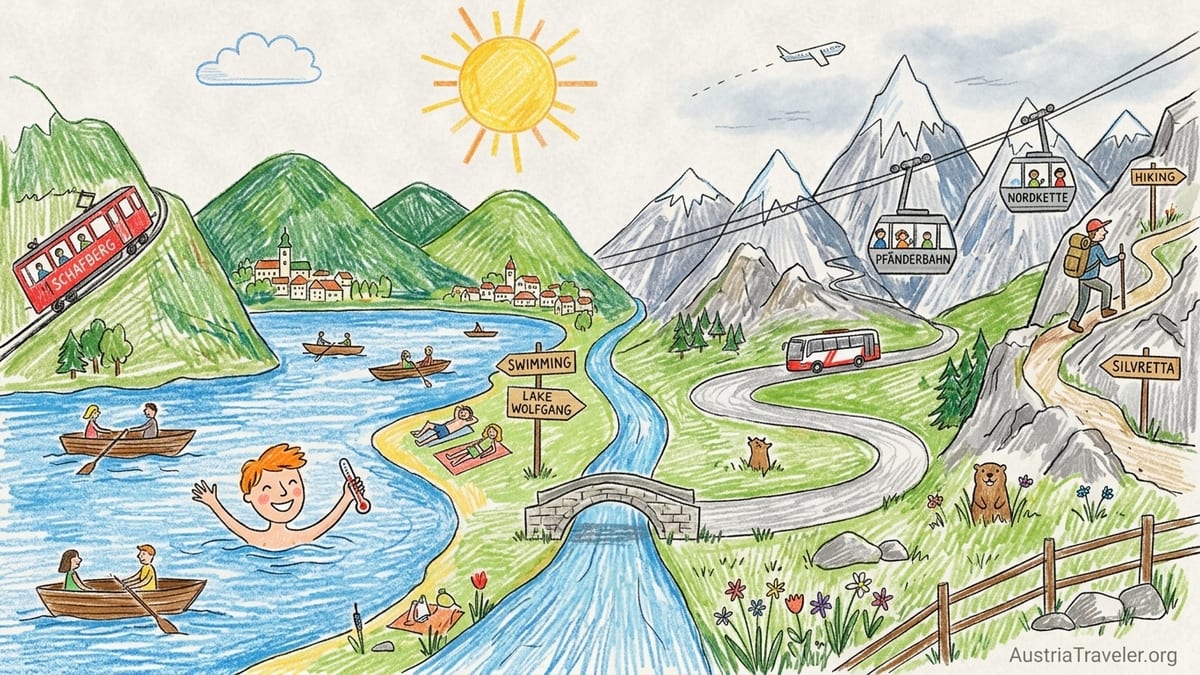
How I Compared Austria’s Lake and Mountain Regions
Before getting into specific regions, it is worth outlining how I actually compared them. On paper, every Austrian brochure promises clear lakes, lush meadows and “panoramic” views. On the ground, the differences become obvious through more practical details: can you swim without turning blue after five minutes, does the local cable car drop you into real hiking terrain or just a viewing platform, and do you need to reverse uphill into a tiny lay‑by every time you want to stop for a photo.
Across several summer trips, I focused on eight things: swimming, mountain views, hiking quality, cable cars, driving experience, accommodation and restaurant access, crowds, and how easy each place was to reach without a car. I mixed paid experiences, such as the Schafberg cog railway above Lake Wolfgang and the Pfänderbahn above Bregenz, with free lakefront access and low‑key valley hikes. Tickets for major lifts usually sat in the range of roughly 30 to 50 euros per adult return, depending on season and combination tickets, which makes it important to know which mountains are actually worth paying for.
I also paid close attention to the weather and water. In mid‑summer I carried a cheap floating thermometer and regularly saw Carinthian lakes nudge the mid‑20s Celsius at the shore, while higher Alpine tarns in Tirol stayed cold enough that I was happy with a quick plunge instead of a long swim. When I talk about parking, public transport links and crowds, it is based on late June to early September visits, when day‑trip pressure from nearby cities and holidaymakers is at its peak.
What follows is not a complete guide to every valley. Instead, it is a country‑level comparison of the four big characters in Austria’s nature story: Salzkammergut, Tirol, Carinthia and Vorarlberg. Within each, I highlight concrete spots I actually visited, but keep the focus on how the regions feel overall so that you can decide which one matches your idea of the perfect lake and mountain escape.
Salzkammergut: Lakes First, Mountains Close Behind
If I had to choose one region in Austria that naturally balances lake time with mountain views for several days, I would return to the Salzkammergut. Basing myself around Lake Wolfgang and Bad Ischl gave me easy access to water, hikes and multiple cable cars without ever feeling locked into a single resort. The lakes here sit at moderate elevations and warm up enough in summer for comfortable daily swims, especially in sheltered bays where the surface water can feel surprisingly mild by afternoon, while peaks like the Schafberg and Dachstein rise steeply behind.
For swimming, Lake Wolfgang was the most convincing all‑round base. Public bathing lawns around St. Gilgen and Strobl meant I did not need to pay for lido access just to get into the water, and the water quality was exemplary, with clear visibility down to my feet even several meters from shore. The lake never felt bath‑warm like Carinthia’s Wörthersee, but in July the temperature was pleasant enough for long swims, and short afternoon storms tended to clear the air rather than ruin the day. Compared with a quick photo stop at Hallstatt, Wolfgangsee justified staying three or four nights because I could mix morning swims with afternoon hikes and evening boat rides without repeating the same experience.
Mountain access in Salzkammergut felt made for travelers who want proper views with relatively little logistics. The cog railway up the Schafberg starts behind St. Wolfgang and climbs directly to an exposed summit ridge, where the lake panorama is one of the best I had in Austria. A standard return ticket for the cog railway in high season typically costs the better part of 50 euros per adult, which is not cheap, but it delivered half a day of slow hiking and ridge wandering at the top instead of just a fenced‑off viewing deck. Elsewhere, cable cars such as those at Dachstein and the Zwölferhorn above St. Gilgen open up clearly marked hiking circuits, while local buses connect lakes and valleys often enough that I did not need the car every day.
Driving and logistics in the Salzkammergut are a mixed bag. Main roads between Salzburg, Bad Ischl and the larger lakes are easy to follow, and there is a satisfying rhythm of “drive 20 minutes, stop at another lake.” The flip side is that parking at small, famous spots such as Hallstatt and Gosausee can feel tight and regimented by mid‑morning, with official lots on the edge of the villages filling early in July and August. When I left the car at Bad Ischl or Strobl and used regional buses or lake ferries, the whole region felt calmer. Restaurant choice in places like St. Wolfgang and St. Gilgen is wide, from simple lakeside grill plates to mid‑range hotels doing ambitious regional menus, but reservations were increasingly useful in peak season evenings.
Tirol: High Alpine Drama and Big‑Ticket Roads
Tirol is the region I would pick if the priority is hiking and high Alpine landscapes rather than long swims. Lakes exist here too, from valley reservoirs to small natural tarns, but in most valleys the mountains themselves are the main draw, often rising to more than 3,000 meters in jagged walls. Even the viewpoints you can reach by cable car sit high enough that summer evenings can feel cool, and sudden weather changes are part of the experience rather than an exception.
Innsbruck is a good example of how Tirol combines city convenience with serious mountains. The Nordkette cable cars lift you from the edge of the old town up to exposed ridges where the views run across the Inn valley and into the Karwendel mountains. As with many Austrian lift systems, you can usually buy combination tickets that include multiple sections and mountain attractions. Prices are significant, but what you get in Tirol is easy access to genuine alpine terrain: rocky paths, short scrambles, and routes where sturdy footwear is a better idea than flip‑flops. Around the wider Innsbruck region, lifts to areas such as Kühtai and the Patscherkofel also put you quickly into high meadows with networks of marked trails.
Two road experiences shaped my view of Tirol. The first was the drive over the Silvretta High Alpine Road, which technically links Vorarlberg and Tirol but feels spiritually like a Tirol showcase. The route climbs to over 2,000 meters, passing reservoirs and trailheads that fan into both provinces. Between tolls and fuel it is not a budget outing, but as a driver it gave me one of the most satisfying sequences of hairpins and broad mountain views in Austria. The second was a day on or around the Grossglockner High Alpine Road, where you climb towards Austria’s highest peak at 3,798 meters. Here, wide parking areas, interpretive centers and well‑marked paths make the experience feel controlled, but the views from platforms and trails remain unforgettable on a clear day.
From a practical point of view, Tirol felt more car‑centric than the Salzkammergut. Major valleys such as the Inntal or Zillertal are well served by trains and buses, but reaching specific trailheads often required at least one change to a local bus or a drive up a branch valley. Parking at popular starting points is usually in designated lots that may charge a day fee; I learned to carry coins and arrive reasonably early to avoid circling. On the upside, accommodation choice in most Tirol valleys is broad, from self‑catering apartments to mid‑range hotels that bundle half‑board with access to spa facilities. Restaurants in larger resorts such as Seefeld or Mayrhofen stay open later and offer more variety than many lake villages, which made post‑hike dinners easy even without advance reservations outside of peak holiday weeks.
Carinthia: Warm Lakes With Mountains in Reach
Carinthia is the corner of Austria I would return to when the goal is to swim a lot, paddle, and still have scenic mountains on the horizon. The region’s lakes are notably warmer than those further north, thanks to their lower elevation and southern location. On a summer trip that included Wörthersee and Millstätter See, I repeatedly measured shallow‑water temperatures in the mid‑20s Celsius, and official regional materials highlight that Wörthersee can reach up to the high 20s in peak summer. That meant I could stay in for as long as my muscles allowed rather than timing my dip with a shiver.
Wörthersee is the most famous Carinthian lake and felt like a cross between an alpine lake and a resort strip. Around the main towns of Velden and Pörtschach, you get manicured lakefronts, stylish hotels and plenty of paid lidos with diving platforms and bar service. Free bathing spots still exist, but they are less obvious and sometimes fill early. For me, Wörthersee worked best as a sociable few days, mixing swims with boat trips and evening walks between bars and gelato stands rather than a quiet nature retreat. If you want a more low‑key base, Lake Millstatt, backed by the Millstätter Alpe, has a softer, more traditional atmosphere but similarly warm water. The lake’s depth and the shelter of surrounding hills help it reach around the mid‑20s near shore in summer, which made it particularly pleasant for evening swims after mountain walks.
Hiking in Carinthia rarely has the harsh drama of Tirol, but from the lakes you can quickly reach rewarding mid‑altitude routes. From Millstätter See, for instance, the ridge trails on the Millstätter Alpe deliver classic views down to the lake and across to the Hohe Tauern, and many guesthouses offer shuttle or taxi links to trailheads that are awkward to reach by bus. Around Wörthersee, paths through the surrounding hills give good lake views without technical difficulty. There are fewer big‑name cable cars than in Tirol or Salzkammergut, but that also means less queueing and fewer crowds compressed at single summit stations.
On the logistics side, Carinthia is very friendly to relaxed, car‑based holidays. The A2 and A10 motorways, along with mainline rail routes, make it straightforward to reach lakes from Vienna, Salzburg or Germany, and then branch off to local roads that usually run along the shore. Parking near bathing areas is often paid but less competitive than at Hallstatt or along some parts of the Salzkammergut in peak season. Towns like Klagenfurt and Villach act as hubs with supermarkets, equipment stores and a wide range of restaurants from traditional inns to international options. If you rely entirely on public transport, you can still do a lot using trains and regional buses between lakes, but some smaller hiking start points will feel much easier with a car or e‑bike.
Vorarlberg: Lake Constance Meets Western Alps
Vorarlberg feels quite different from the rest of Austria’s lake districts, in part because its signature lake is not fully Austrian. Lake Constance is shared with Germany and Switzerland, and the lakeshore city of Bregenz is more about wide horizons and cross‑border ferries than enclosed alpine basins. What makes Vorarlberg special, and why I would return, is the contrast between that broad lake and the sharply rising Alps immediately behind it, accessed easily through local cable cars and high roads.
In Bregenz, I split my time between the lakeshore and the Pfänder, the local mountain that rises above the city. The Pfänderbahn cable car takes around six minutes to climb from near the rail station to about 1,000 meters, where walking paths fan out across meadows and forest. From the top, I counted a horizon that included Lake Constance stretching away like a lowland sea, and a sweep of peaks across Austria, Germany and Switzerland. The cable car runs frequently during the day, and combination tickets with local public transport and attractions are sometimes available, making it straightforward to fold into a day trip by train. For hiking, the Pfänder is more of a gentle half‑day with family‑friendly paths and views rather than a strenuous mountain objective, but the accessibility is outstanding.
As in Tirol, Vorarlberg also offers some high Alpine driving. Approaching the Silvretta High Alpine Road from the Montafon valley, I passed small villages and valley stations for cable cars that link into serious hiking terrain. The climb itself delivers a chain of hairpins and ever‑expanding views that culminate in the Bielerhöhe area, where you can park, walk short lakeside loops or head out on longer routes among peaks that top 3,000 meters. The road is tolled and closed in winter, so it is very much a summer and early autumn experience, but for drivers and photographers it ranks with the Grossglockner and Timmelsjoch as one of Austria’s great viewing roads.
Swimming is not the headline experience in Vorarlberg in the same way as Carinthia, but summer days on the shore of Lake Constance can still be rewarding. Water temperatures are generally cooler than in the southern lakes, and the feeling is more maritime than alpine, with broad, sometimes shallow shores and lidos that combine lawns, pools and lake access. Crowds can be significant on hot weekends, especially around Bregenz and the more built‑up sections of shore, but the atmosphere is holiday‑like rather than frantic. In mountain valleys like Montafon and Bregenzerwald, accommodation and dining lean towards traditional guesthouses and hotels, often with hearty regional food and good access to trailheads by car or local bus.
Comparing Swimming, Hiking, Views and Crowds Across Regions
When I look back at these trips, clear patterns emerge that can help you choose the right region for your priorities. For swimming and general water comfort, Carinthia has the edge, with its warm lakes like Wörthersee and Millstätter See encouraging long, lazy sessions. Salzkammergut’s lakes are very swimmable in summer, but the experience is as much about the postcard scenery as the water temperature. Vorarlberg’s Lake Constance offers space and a sense of openness but cooler water, while in Tirol I treated most lakes as bracing plunges or scenic pauses on hikes rather than primary swimming destinations.
For mountain views and hiking, Tirol and the high‑road sections of Vorarlberg win on drama. The vertical relief above valleys such as the Inn or Montafon is huge, and cable cars and high roads deposit you straight into big‑sky country. That said, the combination of views and accessibility around Salzkammergut’s Schafberg, Dachstein and Zwölferhorn make it an excellent choice if you like substantial but non‑technical hiking with lake panoramas at almost every turn. Carinthia’s hiking tends to feel softer and more rolling near the lakes, with higher, rougher peaks further south along the borders, so it works well for travelers who want satisfying walks without too much exposure.
Crowds and logistics varied notably. Hallstatt and some Salzkammergut hotspots were the busiest places I visited in Austria outside of city centers, with tour buses and tight parking making midday visits feel compressed. By basing in slightly less hyped towns, I found the region much more relaxed. Tirol’s major cable car stations and the Grossglockner road pull their own crowds, but the density spreads out more quickly on the trail network. Carinthia felt busy around the most fashionable stretches of Wörthersee, particularly on hot weekends, yet even there it was easy to find a quieter beach or lakeside guesthouse by moving a few kilometers from the main promenades. Vorarlberg’s Bregenz and Pfänder area can be lively, especially when festivals are on, but many of the mountain valleys retain a calmer, village rhythm.
Public transport access also affects how each region feels. Salzkammergut is the most workable choice if you want a car‑free lake and mountain trip, since buses and trains from Salzburg tie together several lakes, and boats act almost like extra bus lines on the water. Vorarlberg scores well thanks to Bregenz’s position on main rail corridors and the short hop from station to cable car. Carinthia and much of Tirol are perfectly possible without a car if you plan carefully, but reaching certain trailheads or quiet lake coves will feel slower and involve more changes. As a result, I found myself driving more in those two regions, whereas in Salzkammergut I happily left the car parked for whole days.
The Takeaway
If your ideal Austrian nature trip means waking up by a lake, swimming every day and still seeing mountains on the horizon, Carinthia is where I would send you first, especially if you appreciate warm water and do not mind a slightly resort‑like feeling in the livelier towns. If, instead, you picture yourself mixing swims with frequent hikes and easy summit visits by cable car or cog railway, then Salzkammergut is hard to beat as a several‑day base, provided you are willing to dodge the busiest midday windows at the most photographed villages.
Travelers who care more about ridgelines and big skies than about water temperature will probably feel happiest in Tirol or the higher parts of Vorarlberg. There, you trade bath‑warm lakes for the thrill of standing on a high pass or ridge, watching weather boil across glacier‑fed peaks. Innsbruck makes a particularly good compromise if you want a city base with very fast access to genuine alpine environments. Vorarlberg adds its own twist by combining that western Alpine feel with the wide, low‑lying expanse of Lake Constance, which works well if some people in your group prefer gentle lakeside days while others chase summits and hairpin roads.
The most important decision is not which single lake or valley is “best,” but what mix of swimming, hiking, driving and sightseeing you actually enjoy. Austria’s regions are different enough that choosing one over another will shape your days in very practical ways, from how cold your morning swim feels to how long you spend in the car. Once you are clear on that, you can dive into individual lake and mountain‑region guides, knowing which part of the country you are likely to love enough to return to.
FAQ
Q1. Which Austrian region is best if I want to swim every day in warm water?
Carinthia is the strongest choice for warm‑water swimming, especially lakes like Wörthersee and Millstätter See, where summer surface temperatures often reach the mid‑20s Celsius or higher near the shore.
Q2. I am mainly interested in serious hiking and big mountain views. Where should I go?
Head for Tirol or the higher parts of Vorarlberg. Valleys around Innsbruck and routes near high roads such as the Silvretta and Grossglockner put you quickly into dramatic Alpine terrain.
Q3. Is the Salzkammergut worth several days or just a quick visit to Hallstatt?
In my experience it is worth several days, especially around Lake Wolfgang and Bad Ischl, where you can combine swimming, boat trips, and accessible summit excursions without repeating the same outing.
Q4. Can I explore these regions without renting a car?
Yes, but with trade‑offs. Salzkammergut and Bregenz in Vorarlberg are the easiest without a car because buses, trains and boats link major lakes and cable cars. In Tirol and Carinthia, specific trailheads and quiet coves are much easier to reach with your own vehicle.
Q5. How crowded do Austrian lakes and mountain roads get in summer?
From late June through August, famous spots like Hallstatt, the Grossglockner High Alpine Road and popular Wörthersee promenades can be very busy at midday. Arriving early, using public transport where available, and staying slightly away from the main hotspots helps a lot.
Q6. Are cable car and high‑road tickets worth the cost?
They can be, but only if they match your interests. Routes like the Schafberg cog railway, the Nordkette lifts from Innsbruck and the Silvretta High Alpine Road gave me half‑day experiences with substantial views and hiking, which justified their relatively high prices.
Q7. Where is the best place for a mix of culture and nature in one base?
Innsbruck and Salzburg both work very well. Innsbruck combines a historic center with cable cars that rise directly into the Nordkette, while Salzburg gives fast rail and bus access into the Salzkammergut lakes for day trips.
Q8. Which region is most suitable for families with children?
Salzkammergut and Carinthia felt particularly family‑friendly, with easy swimming access, gentle hikes, frequent boats and relatively short drives between attractions. Many hotels and guesthouses in these regions also cater directly to families.
Q9. What should I expect from driving and parking in these regions?
Main highways and valley roads are excellent, but access to famous viewpoints and small lake villages usually funnels into paid car parks that fill by late morning in summer. Allow extra time, carry some cash for parking machines, and consider parking once then exploring on foot, by bus or by boat.
Q10. How does the weather differ between the regions in summer?
Carinthia tends to be warmer and sunnier, supporting its reputation for warm lakes. Salzkammergut and Vorarlberg can see more changeable conditions, with quick showers rolling through. Tirol’s high elevations mean cooler evenings and a greater chance of sudden mountain storms, so carrying layers and checking local forecasts is important.