


In January 2026 I drove my own car from Salzburg through the Austrian Alps and back on a one-week winter road trip, deliberately timing it for fresh snowfall. I wanted to understand what driving in real Austrian winter conditions actually feels like, from empty night-time motorways to steep resort access roads glazed with ice. What follows is not theory or generic advice, but what I learned on roads I genuinely drove in snow, ice and mountain conditions.
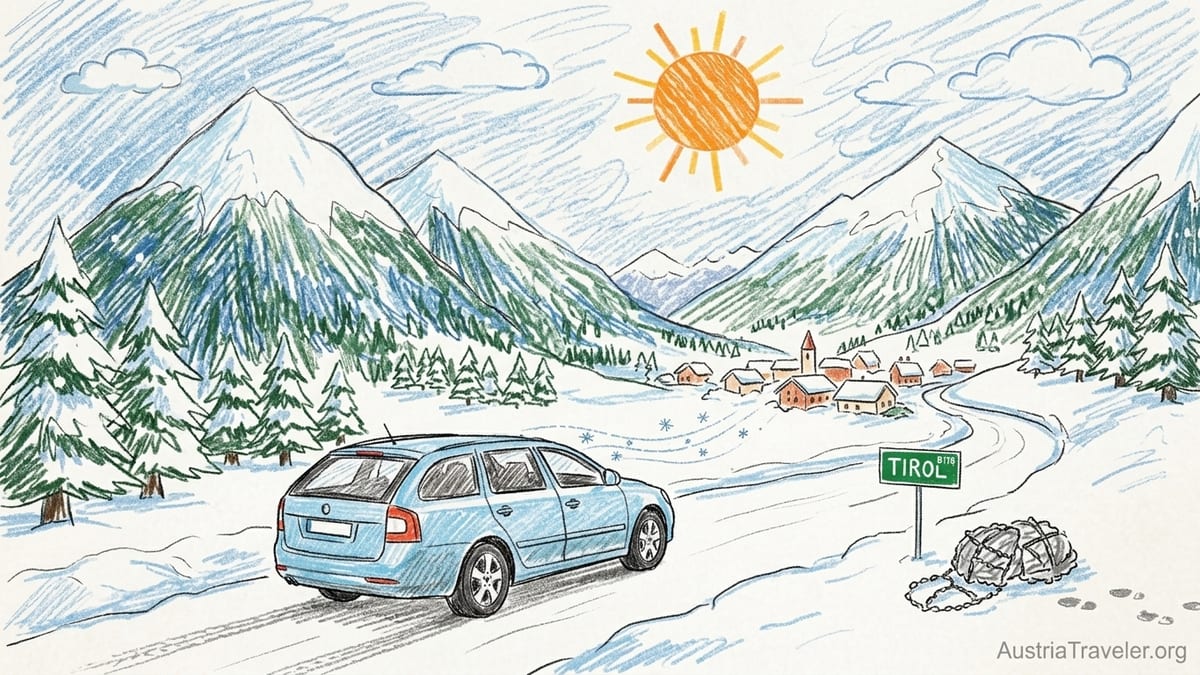
The Car, Tyres, Chains and Vignette: Getting Winter-Ready
I used my own compact wagon, a front‑wheel‑drive Skoda Octavia diesel with automatic transmission. Before setting off I had it fitted in Salzburg with quality European‑brand winter tyres (marked with the mountain snowflake symbol) on all four wheels and checked the tread depth, which was above 5 millimetres. Austrian law requires appropriate winter equipment in wintry conditions between 1 November and 15 April, which in practice means proper winter tyres or, in some cases, snow chains on drive wheels. Government guidance and motoring clubs such as ÖAMTC and the Austrian transport ministry confirm this situative requirement, tied to actual road conditions like snow, slush or ice rather than just the calendar.
I also carried a set of 9‑millimetre snow chains sized to the winter tyres. Chains are not generally mandatory for normal cars on motorways, but they can be required on specific mountain roads when signed, and they remain the only realistic backup if a steep side road or hotel access ramp turns into polished ice. I did not end up fitting them, but there were two mornings in the Kitzbühel Alps where I seriously considered it while watching other drivers slide sideways out of hotel car parks on worn tyres.
Because part of my route used Austria’s motorway system, I bought a 10‑day digital vignette for a passenger car, valid across motorways and expressways. Official 2026 tariff information lists the 10‑day vignette at 12.80 euros and the annual vignette at 106.80 euros for vehicles up to 3.5 tonnes. I purchased the digital version online the day before departure, which meant there was no sticker on the windscreen to scrape around on frosty mornings.
The trip started on the outskirts of Salzburg, near the A1 motorway. I chose a hotel with a small open‑air car park for the first night to test convenience versus cost. That first 6 a.m. windscreen scraping session at minus 7 degrees, with frozen washer jets and a stiff rubber wiper blade, convinced me to book underground or covered hotel parking whenever the price difference was reasonable.
Motorways vs Mountain Roads: A Tale of Two Winters
The contrast between winter conditions on Austria’s main motorways and on mountain roads surprised me. On the A1 from Salzburg east toward Linz and the A10 toward Villach, road-clearing was fast and consistent. After an overnight snow shower, I joined the A10 around 7.30 a.m. and already found both lanes ploughed with just a thin wet film between wheel tracks. Snowploughs were visible on opposite carriageways and on ramps, and salt had turned the snow into slush before it could compact into ice.
Traffic on these motorways was steady but disciplined. In falling snow most drivers dropped to around 90 to 100 km/h even where the posted limit was higher. On a clear, dry section of the A1 late one night I comfortably held 120 km/h, but the moment snow started to stick to side barriers or visibility reduced behind trucks, the flow dropped as if by unspoken agreement. The surface rarely stayed white for long. Austria treats these routes as lifelines, and they are kept open and black even in heavy snowfall, unless an accident closes a section.
That picture changed as soon as I left the motorway and followed smaller federal and provincial roads into the Alps. On the B178 heading toward St. Johann in Tirol, snowfall intensified one afternoon and the character of the road shifted drastically within 20 minutes. Ploughed grey tarmac turned into compacted white snow with deep tyre ruts. Where tree cover shaded the asphalt, slush froze into a dull, glassy sheen, particularly in tight curves and on north-facing slopes.
On these mountain roads, winter revealed every imperfection in my driving. Even with fresh winter tyres, acceleration out of uphill hairpins had to be feather‑light. Braking zones had to begin far earlier than the dry-road signs suggested. On a section dropping into a valley near Waidring, a short queue formed behind a delivery van that simply could not maintain more than 30 km/h up a steeper ramp. There was no safe opportunity to overtake in the snowfall, which immediately stretched a nominal 40‑minute hop between villages into more than an hour.
Driving in Darkness, Snowfall and Poor Visibility
Central European winter days are short, and many key driving hours happen in darkness or half‑light. My earliest mountain start was at 6.15 a.m. leaving a valley hotel for a 9 a.m. gondola opening, and sunrise was barely a glow behind the peaks. Street lighting disappeared as soon as I left the village. The combination of dark trees, white snowbanks and occasional snow showers created an almost monochrome scene where depth perception became tricky.
When light snow fell in the dark, motorway driving remained manageable: reflective lane markings, cat’s eyes and frequent headlights helped. In contrast, snow on minor roads in the dark produced a tunnel effect. On an unlit district road near Filzmoos, falling flakes streamed toward the windscreen, creating the sensation of driving into a white tunnel. My headlamps reflected strongly off the snow, making distant detail almost invisible. Dropping speed from 70 to 40 km/h reduced the stress significantly, but that single 20‑kilometre stretch still took almost 40 minutes.
Fog added a further layer of complexity on two mornings around the Zillertal. Valley fog sat below clear blue skies on the peaks, but at road level visibility fell to around 50 to 70 metres. Snowbanks narrowed the usable carriageway, and any sudden braking by a driver ahead would have been hard to anticipate. In these conditions, I felt safest letting trucks lead. Their rear lights punched through fog better than car lights, and they forced a sensible, steady pace of 40 to 60 km/h.
The most uncomfortable visibility moment came in a long, gently curving tunnel on the A10. Entering from swirling snow into the sodium‑lit interior was almost blinding for a second, and exiting back into heavy snowfall the eyes needed another moment to adjust. Both transitions felt more violent when I was tired after several hours of concentration. I learned to slow slightly before each tunnel portal in snow, giving myself extra time to adapt between light conditions and to anticipate any packed snow or slush ridges forming where ploughed tunnel pavement met untreated open sections.
Steep Hotel Access, Parking Problems and Frozen Cars
Most stories about winter driving focus on passes and highways, yet some of my trickiest moments happened at hotel entrances and car parks. In Kitzbühel I chose a mid‑range pension with open-air parking on a sloping back lot. Overnight snow turned the packed gravel into a smooth, icy crust. Several cars on all‑season tyres struggled to reverse out in the morning, wheels spinning and traction control lights flashing. One driver in a rear‑wheel‑drive BMW needed three attempts and eventually a push from other guests to crest the short incline to the street.
My own car, on good winter tyres, managed the slope on the first try, but only after I disabled aggressive throttle inputs and let the car crawl forward on idle, allowing the tyres to bite gradually. It was not dangerous, but it felt marginal, and it reminded me that the last 20 metres to the road can be harder than the previous 200 kilometres on treated asphalt. After that morning, I treated steep outdoor parking as a genuine risk factor rather than an inconvenience.
Frozen windscreens were a daily routine whenever the car slept outdoors. Even with the screen covered by a fabric frost guard one night in St. Johann, side windows and mirrors froze solid. At minus 8 degrees, washer fluid turned slushy and the jets partly clogged, despite winter mix fluid in the reservoir. Clearing thick frost with a plastic scraper, running the engine for 10 minutes and opening doors carefully so their seals would not stick added at least 15 minutes to every early start.
By contrast, the two nights I paid extra for underground parking in Zell am See felt like a different trip. For around 10 to 12 euros per night over the standard room rate, the hotel offered a heated garage under the building. The car stayed completely ice‑free, tyres remained flexible, and luggage loading happened in comfort. The time saved on scraping, plus the reduced stress of knowing I could climb the exit ramp without drama, made that surcharge feel entirely justified. If I were planning another winter road trip in Austria, I would budget for underground or at least covered parking in most alpine towns and only accept outdoor parking where the lot is flat and quickly cleared.
Road Clearing, Snow Chains and How Much Slower Travel Gets
Austria invests heavily in winter road maintenance. On every motorway and on the main federal roads I used, ploughs and gritters were active within hours of significant snowfall. That said, the effectiveness of clearing varied by road class and timing. Sunday mornings, particularly before 8 a.m., felt like an exception. On one Sunday, driving from a small village in the Pongau region back to the A10, I met only one plough on a 35‑kilometre stretch, and side roads remained white and rutted until mid‑morning.
I kept snow chains in the trunk throughout the trip, but I never actually put them on. None of the roads I used displayed the blue circular sign that mandates chains, and I never felt that traction on winter tyres alone was insufficient on the roads that remained officially open. However, I did see one access road to a remote guesthouse where the owner met guests at the bottom with a 4x4 and politely suggested they leave their two‑wheel‑drive rental cars in a small lay‑by. That was a useful reminder that having chains is not enough; sometimes the sensible choice is simply not to attempt a marginal road at all.
What surprised me most was how much slower real‑world travel became compared with optimistic online mapping estimates. On clear motorways, I stayed close to expected times. But whenever snowfall coincided with mountain stretches, journey times stretched dramatically. A planned 90‑minute drive from Kitzbühel to Zell am See took just over 2.5 hours in steady snowfall, even without any actual road closures. Speeds on open sections fell, traffic bunched behind cautious or poorly equipped vehicles on hills, and every refuelling or coffee stop took longer because drivers were brushing snow off clothing and boots in crowded service stations.
To feel comfortable rather than constantly rushed, I started planning with the assumption that winter mountain legs would take at least 30 to 50 percent longer than summer estimates. For example, a 60‑kilometre stretch that might be a relaxed one hour in July could easily take 90 minutes or more in January, especially if darkness, fog or snow coincided. This buffer transformed the tone of the trip. When I allowed margins, slick patches and unexpected mini‑traffic jams on steep ramps became manageable challenges rather than crises.
Comfort Level, Stress Points and Roads I Would Avoid Next Time
After a week and roughly 1,100 winter kilometres, I felt broadly comfortable driving in Austria’s snow and mountain conditions, but only within self‑imposed limits. On motorways and main valleys with good winter tyres and unhurried scheduling, the driving felt controlled and predictable. The car’s stability systems and ABS were unobtrusive safety nets rather than constantly intervening.
My stress level climbed on three types of roads. First were narrow, steep local roads with packed snow and hidden ice, usually leading to small guesthouses above the main villages. Second were unlit roads on north‑facing slopes around dusk, where thawing and refreezing created black ice in shaded bends. Third were any situations where local drivers in powerful SUVs pushed close behind in poor visibility, seemingly comfortable at speeds I considered unwise. On one such stretch near Hochkönig, I pulled into a lay‑by simply to let a string of impatient traffic go, then continued at my own pace.
If I were planning the same trip again, I would make several conservative route choices. I would avoid minor mountain passes that serve primarily as shortcuts between valleys when a well-maintained tunnel or longer motorway route exists, especially in the late afternoon when roads start to refreeze. I would also decline accommodation that can only be reached via very steep or untreated access roads, no matter how charming the listing looks, unless they specifically guarantee cleared, gritted access or offer transfer from a valley car park.
There were roads I came to appreciate and would gladly repeat in winter. The A10 motorway, despite its tunnels and occasional wind‑blown snow, felt like a stable backbone route as long as I respected speed variations and kept an eye on changing temperatures. The main valley roads in the Salzach and Inn valleys, where traffic and clearing are frequent, offered spectacular winter views without excessive risk. Within villages, I learned to leave the car once parked and walk or use local buses for short hops rather than repeatedly negotiating icy side streets.
Legal Requirements: Winter Tyres, Chains and the 2026 Vignette
Before setting off, I reviewed Austria’s official guidance on winter driving and road equipment, which is updated regularly by government portals and the federal ministry responsible for transport. As of late 2026, Austria applies a situational winter equipment requirement for passenger cars and light vehicles up to 3.5 tonnes from 1 November to 15 April of the following year. In simple terms, if you drive during this window on roads that are snowy, slushy or icy, your car must either be fitted with winter tyres on all wheels or, in limited cases, be using snow chains on at least two driven wheels when the surface is continuously covered in snow or ice.
For a tyre to qualify as a winter tyre in Austria, it must carry the M+S marking or the alpine snowflake symbol, and minimum tread depths are specified. Public guidance from the Austrian government and motoring organizations in 2026 refers to a minimum of approximately 4 millimetres for winter tyres on cars to be legally recognised for the winter requirement, while the absolute legal minimum for tyres in general is lower. In practice, tyre specialists in Salzburg recommended replacing winter tyres when they approach 4 millimetres of tread, as braking performance on snow drops noticeably below that.
Snow chains for cars are not obligatory to carry at all times on all routes, but chains do become mandatory when indicated by specific road signs on certain passes or local roads. In those zones, you must have suitable chains on at least two driven wheels, and using the road without them risks fines and, more importantly, losing control in extreme conditions. For heavier vehicles and buses, separate rules apply, including explicit obligations to carry chains between 1 November and 15 April.
Austria’s motorway and expressway network continues to require a vignette for passenger cars up to 3.5 tonnes. For 2026, publicly available tariff information for light vehicles lists a 10‑day vignette at 12.80 euros and an annual vignette at 106.80 euros. Both adhesive and digital formats exist, and their prices are aligned. Digital vignettes can be bought very close to travel time, but travellers coming from abroad should pay attention to any consumer protection cooling‑off rules that can delay validity when buying online as private individuals. Buying at a petrol station just before the border or in Austria itself keeps things simple if you are already en route.
When Winter Driving Works and When Rail Is Smarter
Driving through Austria in winter can be deeply rewarding. On clear days after snowfall, the combination of blue skies, white peaks and well‑cleared roads creates an almost cinematic scene. With a properly equipped car, flexible timing and realistic expectations, the freedom to stop at small lakes, farm shops or lesser‑known ski areas is hard to match by public transport.
My road trip felt particularly worthwhile on sections where I combined motorway access with short, manageable valley drives. For example, using the A1 and A10 to cover distance, then branching off for 15 or 20 kilometres into a ski village, kept exposure to difficult conditions limited and allowed spontaneous side trips to quiet viewpoints. Having a car also made it easy to carry winter sports gear, extra clothing and groceries, which was convenient when staying in apartments outside town centres.
There were, however, situations where the train or a combination of rail and local buses would clearly have been the smarter choice. One was the transfer between Salzburg and Innsbruck, which I drove via a long winter motorway stretch. The equivalent rail journey on the main line would have taken a similar or shorter time in bad weather, with far less concentration required, and both cities have compact historic centres where a car is a burden rather than a benefit. Another was a day trip from a village near Zell am See to a neighbouring valley resort. I spent almost as long digging the car out of fresh snow and creeping along narrow roads as I did enjoying the slopes, while frequent ski buses glided past on priority-cleared routes.
Looking back, a hybrid approach seems ideal. For a trip focused on one or two major resorts, especially if you fly into Vienna, Salzburg or Innsbruck, rail to the main hub with local transfers may be more relaxing and only marginally slower. A car becomes more compelling if you plan to link several smaller valleys, stay in out‑of‑the‑way guesthouses, or travel with a group carrying bulky gear. Even then, matching your ambitions to daylight hours and forecast is crucial. If a major snowstorm is predicted, rearranging the plan to stay put for a day or shifting between valleys by train can turn a potential white‑knuckle drive into a pleasant snow day.
The Takeaway
A winter road trip in Austria is neither a reckless adventure nor a trivial undertaking. My week on real snowy and icy roads taught me that the experience depends less on bravado and more on preparation, timing and humility. Good winter tyres, an appropriate vehicle and a valid vignette are just the starting points. The real adjustments happen behind the wheel: driving slower than you think necessary, adding generous time buffers, choosing flatter hotel car parks, and being willing to say no to a steep side road that feels wrong.
If you are comfortable driving in winter at home, enjoy route‑planning, and are willing to pay a little extra for underground parking and flexible bookings, Austria’s winter roads can reward you with quiet valleys, frost‑covered churches and mountain views that most visitors only glimpse from train windows. If, on the other hand, ice, darkness and the thought of fitting chains make your shoulders tense, the country’s rail network and resort transfer buses offer a warm, efficient alternative that still delivers you into the heart of the Alps.
In the end, the smartest winter choice is the one that keeps you relaxed enough to enjoy the snow falling outside your window, whether that window belongs to a moving car, a gently swaying train or a hillside hotel looking down on cleared roads you are happy not to be driving tonight.
FAQ
Q1. Do I legally need winter tyres for a winter road trip in Austria?
From 1 November to 15 April, Austrian rules require appropriate winter equipment in wintry conditions, which in practice means winter tyres on all wheels or, in limited situations, snow chains on the driven wheels if the road is continuously covered in snow or ice. In real winter weather, travelling without proper winter tyres is both unsafe and likely to lead to fines.
Q2. Are snow chains mandatory for normal passenger cars?
Snow chains are not generally mandatory to carry for all car journeys, but they become compulsory where blue circular road signs indicate chains must be used, typically on specific mountain roads or passes. Even when not legally required, carrying correctly sized chains is sensible insurance if you plan to drive up steep local roads or stay in remote guesthouses.
Q3. How much slower should I expect to drive in winter conditions?
On major motorways you may only slow slightly in light snow, but on mountain and valley roads real travel times can easily be 30 to 50 percent longer than summer estimates. Fresh snowfall, cautious traffic, fog and darkness all combine to stretch journey times, so planning generous buffers is essential.
Q4. Is underground hotel parking worth the extra cost in winter?
Based on my experience, paying around 10 to 15 euros more per night for underground or covered hotel parking was worthwhile. It avoided frozen windscreens, stiff door seals and slippery exit ramps, and it saved at least 15 minutes of scraping and warming up the car on cold mornings.
Q5. What is the cost of the Austrian motorway vignette for 2026?
For passenger cars up to 3.5 tonnes, publicly available 2026 tariffs list a 10‑day vignette at 12.80 euros and an annual vignette at 106.80 euros. Shorter and intermediate validity options also exist, and both adhesive and digital vignettes share the same prices.
Q6. Are Austrian motorways safer to drive in winter than mountain roads?
Motorways and expressways are prioritised for clearing and salting, so they normally remain black and drivable even during snowfall, apart from accident-related closures. Smaller mountain and valley roads can stay snowy or icy for longer, particularly early in the morning, after heavy snow or where shade prevents thawing.
Q7. Should I choose an automatic or manual transmission for winter driving in Austria?
Both can work if used correctly, but a modern automatic with a manual mode or winter programme can make smooth, low‑torque starts on slippery surfaces easier. The key is gentle inputs and the ability to hold lower gears on descents, rather than the transmission type itself.
Q8. Is it realistic to rely solely on trains and buses for a ski holiday in Austria?
Yes. Major ski resorts such as those in the Tyrol and Salzburgerland are well connected by rail and dedicated ski buses, and many visitors arrive without cars. Rail is particularly attractive between large cities like Vienna, Salzburg and Innsbruck, where winter driving mainly adds stress and parking problems rather than extra freedom.
Q9. How do I deal with frozen windscreens and mirrors in outdoor parking?
If you park outside, expect to spend 10 to 20 minutes scraping frost, warming the cabin and freeing mirrors on cold mornings. Using a windscreen cover, carrying a good ice scraper and ensuring winter‑grade washer fluid helps, but only underground or covered parking truly eliminates the issue.
Q10. Which roads would you personally avoid on your next Austrian winter trip?
Next time I would avoid steep, untreated hotel access roads, minor mountain passes used mainly as shortcuts when a tunnel or main valley route exists, and unlit north‑facing local roads at dusk during thaw‑freeze cycles. Sticking to main valleys, cleared access roads and motorways made the driving both safer and more enjoyable.