

I went to Austria in winter as a complete non-skier, slightly worried I would spend a week drinking overpriced hot chocolate while everyone else carved turns. Instead, I ended up with some of my favorite cold-weather travel days ever, without ever clipping into skis. What follows is not a theoretical list pulled from brochures, but exactly what I did, how it felt as a non-skier, and the practical details you need if you want winter atmosphere without buying a ski pass.
Why Austria Works In Winter Even If You Never Ski
Before this trip, almost everything I read about Austria in winter focused on ski passes and après bars. On the ground, the picture felt very different. Austria Tourism itself now puts a lot of emphasis on “winter holidays away from the slopes” and promotes hundreds of prepared winter hiking paths, snowshoe tours, toboggan runs and wellness spas across the country. In practice, that translated into clearly waymarked trails, regular buses to non-ski activities, and a sense that I was not an oddity for showing up with hiking boots instead of ski boots.
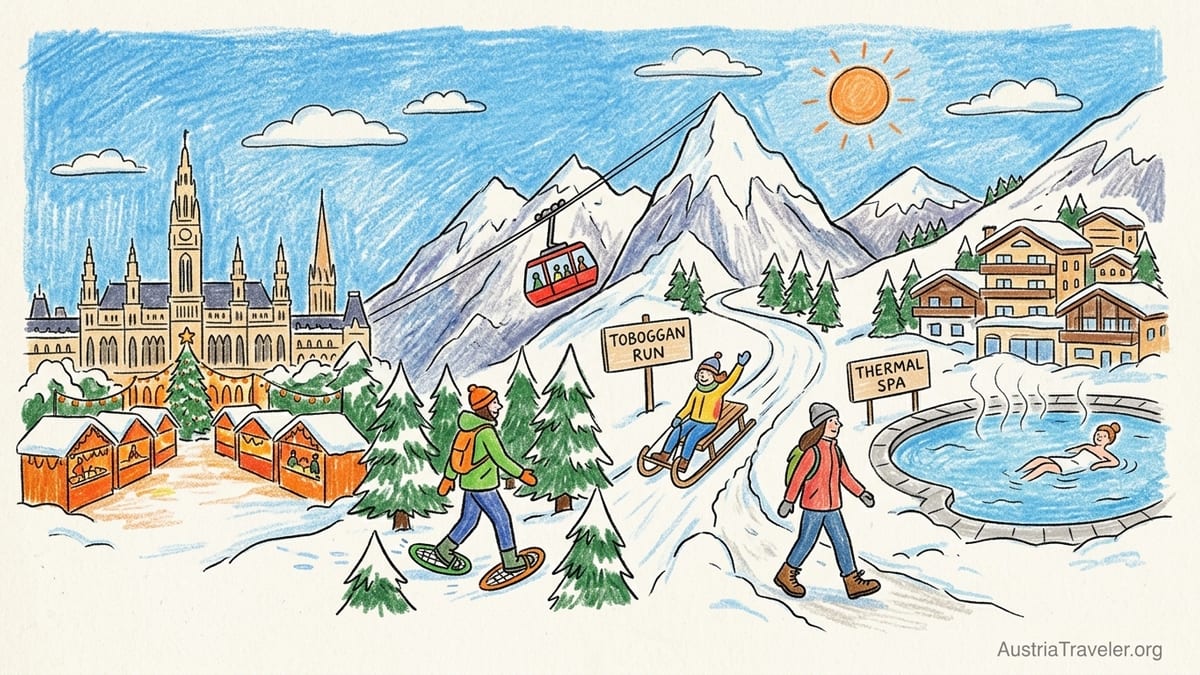
Across Vienna, Innsbruck and Gastein Valley, I was able to fill entire days with winter hiking, snowshoeing, tobogganing, thermal spas, scenic train rides, Christmas markets, ice skating, mountain cable cars and long meals without ever feeling like I was killing time. There were certainly moments when the culture tilted ski-first, especially in pure resort villages, but I never felt excluded as long as I was willing to be outdoors and reasonably active.
The key difference compared with a summer hiking trip was structure. In winter, I relied much more on prepared winter trails, official toboggan runs and cable cars that brought me into the snow without needing mountaineering skills. That suited me perfectly. I wanted snow and mountains, not avalanche calculations. I chose destinations where tourism offices publish winter hiking and toboggan maps and where a thermal spa or lively town center gives you a plan B if the weather comes in.
Below is exactly how my non-ski winter unfolded in three main bases: Vienna for urban winter and Christmas markets, Innsbruck for easy access to alpine scenery, and Gastein Valley for spa-and-mountain days. For each activity, I have included what I wore, how fit you need to be, the rough costs I paid or confirmed, and whether you really need snow for it to feel worthwhile.
Winter Hiking On Prepared Trails: Crunching Snow Without Technical Skills
My first experience of Austria’s winter hiking network was above Innsbruck. The city tourist office publishes maps of signposted winter hiking trails in the surrounding villages, and I followed one from the village of Igls through quiet forests and fields. It had snowed a few days before, so the path was packed down but not icy. This is exactly what Austria Tourism means when it talks about “prepared winter hiking paths”: routes checked and signposted for walking in normal winter conditions rather than alpine expeditions.
Snow is not strictly required for winter hiking in Austria, but it changes the mood entirely. On days when the previous week’s snow was still covering the ground, the same trail felt magical. When warm weather stripped the snow away, it became a simple countryside walk. If you are choosing dates primarily for winter hiking ambience, aim for mid-December to late February at low elevations and be prepared for flexibility. Tourism offices in places such as Innsbruck and Gastein publish current trail conditions and sometimes close routes after heavy snow or thaw cycles.
In terms of difficulty, the winter hikes I did were generally rated as easy or moderate. A typical outing might be 2 to 3 hours of walking on rolling terrain, with 200 to 400 meters of gentle ascent. I am reasonably fit but not an athlete, and I never felt pushed to the edge. The main challenge is stability on packed snow. I wore waterproof hiking boots with good tread, warm socks, thermal leggings under hiking pants, a long-sleeve base layer, fleece, waterproof shell, hat and gloves. On very cold days I added a down jacket under the shell. I carried lightweight hiking poles, which made a huge difference on short icy sections.
Costs for winter hiking are low unless you combine it with a cable car ride. Many Austrian regions treat winter walking paths as an included public good, so you simply step onto the trail from the village edge. The only fees I paid were when I used a cable car to reach higher starting points. In Innsbruck, a return ticket on the Nordkette cable car system from the city to the upper station cost roughly the same as a typical mountain excursion in the Alps, and I planned half a day for the ride and a short winter walk near the top. I did not need to pre-book the hikes themselves, but I checked weather forecasts and local avalanche warnings each morning, and I never left marked trails.
Snowshoeing: When The Snow Gets Deep
On my second day in Gastein Valley, fresh snow had fallen overnight, and the winter hiking paths above Bad Hofgastein were suddenly knee deep in powder. That was the day I switched to snowshoeing. Austria Tourism highlights snowshoeing as one of the main non-ski winter activities, and on the ground that looked like rental shops with racks of snowshoes and poles, plus local guides organizing group tours on signed routes away from the pistes.
I booked a guided snowshoe tour through my guesthouse, which simply called the local guide they regularly worked with. Prices vary by region, but in Gastein a half-day group tour including guide and snowshoes worked out in the range of what you might pay for a short city walking tour. If you already know how to use snowshoes, you can rent them at sports shops in many towns. In Bad Hofgastein, the rental process was similar to hiring skis: I left an ID, tried on snowshoes over my boots, and picked up poles. I allowed about 30 minutes for the rental before the tour start.
Snowshoeing here definitely required snow; without at least ankle-deep coverage, it is not worth the hassle. Physically, snowshoeing felt more demanding than winter hiking on a groomed trail, especially when breaking new tracks in fresh snow. Our route climbed through forest and open meadows at a slow but steady pace. I would describe it as moderate exercise for anyone used to regular walking, and quite strenuous if you are not. The guide controlled the pace and took breaks for photos, which helped. Having a guide also meant I did not have to think about avalanche terrain or navigation, which is important in deep snow.
For clothing, I wore the same waterproof hiking boots as on my winter hikes, plus wool socks, thermal leggings, lined softshell trousers, a moisture-wicking base layer, fleece, and a waterproof and windproof jacket. I added a thin buff around my neck and carried spare gloves in case one pair got wet. I quickly learned to dress slightly lighter than I would for a static winter walk, because snowshoeing warms you up. I still packed a down jacket in my backpack for rest breaks and in case the weather changed. Apart from the rental fee and guide cost, the only extra expense was a bus ticket from my village to the trailhead, which I bought on board using cash.
Tobogganing: Fast, Fun And Much Easier Than Skiing
The purest childlike joy I found in Austria in winter came on a toboggan run above a small Salzburg-region village. Austria Tourism actively promotes tobogganing as a non-ski winter highlight, and by the time I reached my second resort stay I understood why. Instead of ski technique, all you need is a willingness to sit on a wooden sled and steer with your feet and weight.
I rode a dedicated natural toboggan run that wound for several kilometers through the forest. Access worked like this: from the village base, a small cable car or dedicated taxi service brought us up to the start. At the top, a hut rented wooden toboggans for a modest fee. I paid a combined price for the lift and sled rental, then walked a short distance to the start of the track. In good snow conditions, the run stays open into the evening, sometimes with floodlights. Snow was absolutely essential here; without a decent base, the track does not operate.
In terms of physical difficulty, tobogganing was more about confidence than fitness. The climb was handled by the lift, and the descent required only occasional braking with my heels and leaning into the corners. Falls are part of the experience; I tipped over twice on sharper bends but slid onto soft snow and laughed it off along with everyone else. Parents with children, groups of teenagers and couples all shared the same track, which reinforced the sense that you do not need to be an athlete or skier to join in.
For clothing, I essentially dressed as if I were going winter hiking, but with extra attention to waterproof layers. I wore insulated waterproof trousers over my thermal leggings, as you are likely to sit or fall on damp snow. I swapped hiking boots for sturdier winter boots with better ankle support, which handled both walking and steering the toboggan. A helmet is often recommended, and some runs offer them for rent. I chose to wear my own lightweight ski helmet, but I saw other adults using regular wool hats. Gloves with good grip made steering more comfortable. I allowed about two to three hours for one full outing including rental, lift and several runs.
Thermal Spas And Saunas: Indoor Heat In A Snowy Valley
When I picture my Austrian winter now, one of the strongest images is steam rising from an outdoor thermal pool while snow-covered peaks tower above. In Gastein Valley, thermal water is a central part of the tourism offering and features heavily in Austria’s winter-wellness marketing. I visited two major spas there and essentially structured entire days around them, which made a perfect counterbalance to outdoor activities.
Felsentherme Bad Gastein, perched above the railway station, was my first stop. It combines indoor and outdoor thermal pools, rock-lined walls and a panorama terrace with mountain views. The official price list for 2024 and 2025 shows several ticket types, including three-hour, four-hour and full-day options, plus combined tickets for the sauna area. I chose a four-hour ticket that gave me enough time to relax without rushing. This is not a budget attraction, but for what is effectively half a day of wellness the price felt fair compared with urban spas elsewhere in Europe.
On another day I went to Alpentherme Gastein in Bad Hofgastein, a larger complex with multiple themed pools and a prominent outdoor thermal lake. Their published price folder for 2025 lists single-entry tickets and evening specials, and again I opted for a multi-hour pass. Both spas offered discounts with regional guest cards, which I received automatically from my accommodation. Inside, food and drinks cost roughly what you would expect at a mid-range Austrian cafe, so I included a simple lunch in my budget.
Snow is not required for thermal spas, but it amplifies the atmosphere enormously. Floating outside in warm water while snowflakes land on your shoulders, or stepping from a hot sauna to a cold terrace overlooking white peaks, is uniquely satisfying. Physically, these days were about rest, not effort. The main thing to know is that Austrian spa culture usually expects you to be nude or wear a towel in sauna areas, while swimsuits are worn in pools. I brought my own swimsuit, flip-flops and a large towel, though both spas rented towels and robes for an extra fee. I wore a warm coat, hat and boots to and from the spa, plus casual clothes I could pull on quickly over damp skin at the end of the day.
City Winter: Christmas Markets, Ice Skating And Scenic Train Moments
I started and ended the trip in Vienna and Innsbruck, using both cities as gentle introductions to Austrian winter life. Snow in the cities is less reliable than in the mountains, but in December and early January the winter atmosphere is carried by lights, markets and seasonal rituals rather than deep drifts. That suited me as a non-skier looking to ease into the cold.
In Vienna, I spent evenings wandering Christmas markets that typically run from mid or late November through December in the weeks before Christmas. Classic examples include the large market in front of the City Hall and smaller neighborhood markets scattered across the city. Instead of entrance fees, the main costs were food and drink: a mug of hot punch or mulled wine, a sausage or a slice of strudel. Many stalls charged a small deposit for the decorative ceramic mugs, refunded when you returned them. I wore normal winter city clothing here: insulated boots comfortable enough for cobblestones, jeans or warm tights, a wool coat, scarf, hat and gloves. Snow was a bonus when it came in brief flurries, but not necessary for the markets to feel festive.
Ice skating, on the other hand, did depend on cold temperatures but not natural snow. In both Vienna and Innsbruck I found outdoor rinks that appeared seasonally in central locations. I rented skates on-site for a straightforward fee plus a small deposit. Sessions were often open skating rather than timed slots, so I could come and go within broad opening hours. Physical difficulty varies with your skating skill; as a cautious skater I treated it as light exercise and held onto the rail more than once. I wore the same city winter outfit as for the Christmas markets but added thicker socks and chose trousers that allowed free movement.
One of the underrated pleasures as a non-skier was simply sitting on trains watching the landscape slide past. I traveled between Vienna, Innsbruck and Gastein Valley by rail rather than rental car. The journey from Innsbruck into the Gastein area, in particular, felt like a scenic train ride in its own right, with the line threading alongside frozen rivers and between snow-covered slopes. The costs depended on how far in advance I booked, but buying tickets directly from the national railway service gave me clear pricing and seat reservations. Snow outside the window transformed the trip from pure transit into part of the holiday.
Mountain Cable Cars For Non-Skiers: Views, Cafes And Short Walks
One of my initial fears was that Austrian cable cars might only serve skiers. In practice, many major lift systems explicitly sell pedestrian tickets, a point reinforced by regional tourism marketing, which talks about riding up simply to enjoy the panorama or start a winter hike. I used cable cars in both Innsbruck and Gastein Valley without ever touching a piste.
In Innsbruck, the Nordkette cable car system rises from the city center up to high alpine terrain in stages. I bought a return ticket specifically for pedestrians at the ticket office. The ride itself was part of the appeal, climbing from pastel townhouses and church spires into a world of rock and snow within half an hour. At the upper station I walked a short prepared winter path, took photos from the viewing platforms and warmed up in the mountain restaurant with soup and coffee. Snow was essential for the high-alpine feel but not for the basic experience of riding the cable car and sitting in the cafe.
In Gastein Valley, I used a different cable car to access what the local tourism board calls a “winter hiking connection” between two mountain areas, allowing walkers to cross from one side of the valley to the other. I bought a pedestrian ticket that cost significantly less than a full ski pass, and lift staff were entirely unfazed by my lack of equipment. At the top, a signposted winter walking route led between stations, hugging the safe side of the ridge and clearly separated from steeper ski runs. I passed skiers occasionally when trails crossed near huts, but I never felt in the way.
Riding cable cars as a non-skier did not feel exclusionary, provided I was comfortable accepting that many fellow passengers were carrying skis or boards. What mattered more was preparation. Temperatures at the upper stations were often 10 degrees colder than in the valley, with stronger wind. I wore my full mountain outfit even on days that looked mild from the village: warm base layers, insulating mid-layer, waterproof shell, insulated trousers, hat, gloves and sometimes a buff or balaclava. I also carried sunglasses for the glare off snow, and small spikes that I could slip over my boots if the viewing platforms were particularly icy.
Did I Feel Excluded In Ski Resorts As A Non-Skier?
Spending several nights in classic alpine villages raised the obvious question: is there really enough for non-skiers to do, or do you end up sitting alone in empty cafes while everyone else disappears to the lifts? My experience varied by place, but overall I found the balance surprisingly positive, particularly in resorts that double as spa towns or have a genuine village center rather than just slopeside accommodation.
In Gastein Valley, which is heavily marketed for both skiing and wellness, I never felt out of place. Thermal spas drew a mixed crowd where swimwear and robes replaced ski gear as the dominant uniform. Winter hiking and snowshoeing groups obviously skewed a bit older and more relaxed than the ski schools, but they were full. In the evenings, village centers filled with people going to restaurants, bars and concerts, not just après-ski huts. I easily filled five days with alternating hikes, spa visits, tobogganing and short train or bus trips to neighboring villages.
In pure ski towns with fewer non-ski anchors, the daytime streets could feel quieter. When the lifts were running, most visitors were higher up the mountain, and some cafes understandably focused on the morning rush and late-afternoon après crowd. That said, I still found marked winter walking paths from the village edge, and regional marketing materials made a point of listing non-ski activities such as toboggan runs, sleigh rides and tube parks. I had to plan more consciously here, using tourism office maps and daily weather updates instead of assuming the town itself would entertain me.
The most exclusionary moments were social rather than practical. In bar conversations, skiing or snowboarding dominated, and people were sometimes surprised to hear I was not participating. Once I explained I had spent the day snowshoeing, hiking or drifting in a thermal pool, curiosity usually replaced confusion. It helped that national and regional tourism campaigns now openly promote “slow winter” and spa-based stays as valid ways to experience the season, not as consolation prizes for people who cannot ski.
The Takeaway: My Ideal Austria Winter Without A Ski Pass
Looking back, the combination that worked best for me as a non-skier was a triangle of one big city, one spa-focused valley and one easily accessible mountain city. If I were planning this again for someone who wants snow, alpine views and atmosphere without buying a ski pass, I would suggest starting with three days in Vienna, moving on to four days in Gastein Valley or a similar spa region, and finishing with two to three days in Innsbruck.
Vienna delivers the rituals that define an Austrian winter even if it barely snows in the streets. Christmas markets in late November and December, classical concerts, coffee houses, and occasional ice rinks let you sink into the season without technical gear. From there, a scenic train ride into a valley like Gastein gives you a base with real mountain winter: prepared winter hiking paths, guided snowshoe tours, toboggan runs and serious thermal spas where the days pass quickly even if a storm closes the lifts.
Ending in Innsbruck keeps you connected to the mountains without committing to a remote resort. From a hotel in the city center, you can ride cable cars straight up to snow, try an urban ice rink, wander historic streets, or simply watch peaks glow pink at sunset from the riverbank. Throughout this itinerary, you engage fully with Austria’s winter but spend your money on pedestrian lift tickets, spa entries, sled rentals and cultural experiences rather than on ski passes and lessons.
If your idea of a winter holiday is a blend of crunching along snowy paths, soaking in hot water under open sky, sliding down forest roads on a toboggan, and wrapping your hands around a hot drink at a Christmas market, Austria makes it remarkably easy to do all of that without ever stepping into bindings. The key is to choose destinations that value winter in all its forms, not only the ones at the end of a chairlift.
FAQ
Q1. Can I enjoy an Austrian winter holiday without skiing at all?
Yes. In my trip I filled days with winter hiking, snowshoeing, tobogganing, thermal spas, Christmas markets, ice skating and cable car rides without ever skiing.
Q2. Do I need special equipment for winter hiking and snowshoeing in Austria?
For winter hiking, waterproof boots with good tread, warm layers and possibly trekking poles were enough on prepared trails. For snowshoeing, I rented snowshoes and poles from local sports shops while using my own boots and clothing.
Q3. How fit do I need to be for non-ski winter activities like I did?
The winter hikes and snowshoe tours I joined were classed as easy to moderate. If you can comfortably walk for a few hours on rolling terrain, you should be fine, especially on guided outings with regular breaks.
Q4. Are Austrian ski resorts welcoming to non-skiers?
In spa-focused valleys and towns with real centers, I felt very welcome as a non-skier. Pure ski resorts can be quieter during the day, but I still found winter walking paths, sledding and wellness options.
Q5. How much does it cost to visit thermal spas like the ones I used?
Major thermal spas such as those in Gastein Valley charge for timed entries, with three or four hour tickets typically priced in the range of a mid-range attraction. Towel and robe rentals and food inside are extra.
Q6. Do I need to book winter activities in advance?
I bought cable car and pedestrian lift tickets on the day and did not need reservations. For guided snowshoe tours and busy spa days, I arranged things at least a day or two ahead through my accommodation or directly at reception.
Q7. What should I pack to copy my non-ski winter itinerary?
I relied on waterproof hiking or winter boots, thermal base layers, insulating mid-layers, a waterproof shell, insulated trousers, hat, gloves, scarf or buff, and swimwear plus flip-flops for spa visits.
Q8. Is there enough to do for a full week without skiing?
Yes. Between city time, two or three spa days, winter hikes, snowshoeing, tobogganing, ice skating and cable car excursions, I easily filled more than a week without feeling bored.
Q9. When is the best time to visit Austria for non-ski winter experiences?
For a mix of reliable snow in the mountains and Christmas markets in cities, mid-December to late February worked well for me. Conditions vary by altitude and year, so flexibility helps.
Q10. Can children and older travelers enjoy these non-ski activities?
Yes. On my trip I saw families with children and older couples on winter walking paths, toboggan runs and in thermal spas. Choosing easy-rated trails and shorter outings makes it accessible for a wide range of ages.