


I have spent parts of three different winters shuttling around Austria, chasing everything from Christmas markets and baroque concert halls to quiet lakeside walks on squeaky snow. Some places dazzled and drew me back. Others, despite the postcards, felt flat once the lights went off and the last glühwein stand closed. This is not a definitive list of every pretty village in the Alps. It is an honest look at where I would personally return in an Austrian winter, what each place actually delivered, and how I would now divide a future trip between city energy, mountain snow and proper relaxation.
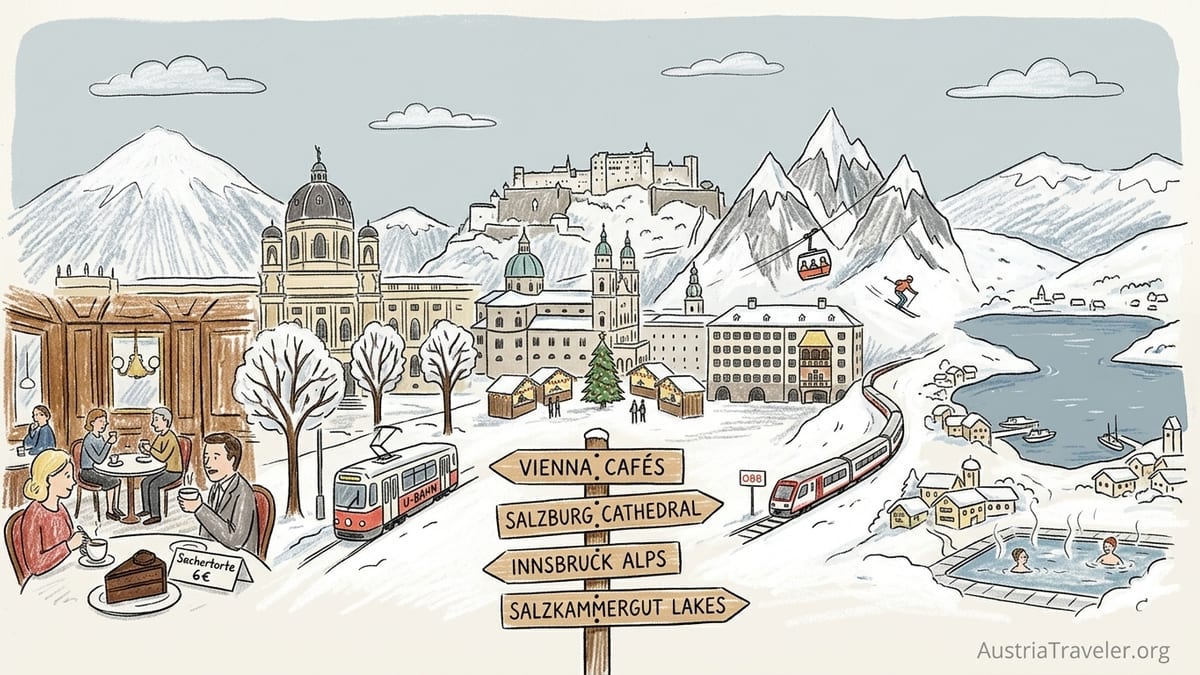
Vienna: Winter Culture That Works Even When the Weather Does Not
Across my trips, I have spent roughly ten winter nights in Vienna, split between two shorter stays in December and a longer stretch in January. That was more than enough to see the headline sights, but I never felt I had “finished” the city. In deep winter Vienna works because it does not rely on the weather. When sleet is blowing down the Ringstrasse, you can still slip into the Kunsthistorisches Museum to stand in front of Velázquez portraits, or warm up in a wood-paneled café over a slice of Sachertorte that costs somewhere between 5 and 8 euros depending on where you sit. Even if the sky stays stubbornly grey, the city gives you layers of music, galleries and coffeehouses to fall back on.
One December, I timed a visit for the pre-Christmas period and based myself near Rathausplatz. The main Christkindlmarkt filled the square with lights and stalls selling everything from hand-carved nativity figures to mugs of punch. In the evening the crowds could verge on uncomfortable around the central tree, particularly on Fridays and Saturdays, and prices for a simple mug of punch edged toward 5 euros plus deposit. The market atmosphere was undeniably festive, but I found myself retreating to quieter corners like the smaller market at Spittelberg, where narrow streets and more local vendors made it feel less like a theme park. On balance, I enjoyed the markets but would not return to Vienna only for those; they were a seasonal layer rather than the main reason to be there.
In January the city felt very different. The Christmas stalls had vanished, hotel prices dipped noticeably compared with early December, and the mood turned more local. I spent slow mornings riding trams simply to see different districts under a dusting of snow, and ducked into the opera house for a standing-room ticket that cost less than a mid-range lunch. Evenings never felt empty, because the core of Vienna’s winter appeal is cultural rather than outdoorsy. When temperatures dropped below freezing and the Danube Canal turned into a corridor of cold air, the fact that most of what I wanted to do was indoors became an asset rather than a compromise.
From a practical point of view, Vienna is the easiest winter base I used in Austria. The airport has frequent rail connections into the city center in under 20 to 30 minutes, and long-distance trains connect it directly to Salzburg, Innsbruck, Graz and beyond. Snow occasionally lingered on side streets but never really disrupted trams or U-Bahn lines while I was there. If you are worried about winter logistics or traveling with someone who prefers galleries and good coffee to ski boots, Vienna is the city that absorbs bad weather best. I would happily start or end any winter itinerary here for at least three nights, even if I had no interest in Christmas markets at all.
Salzburg: From Crowded Advent Weekends to Quiet January Alleys
Across two winters I spent a total of five nights in Salzburg: three nights in mid-December and two in late January on a separate trip. They felt like two entirely different cities. In December I arrived just before Christmas to find the Old Town strung with lights and multiple Advent markets in full swing around the cathedral and Residenzplatz. The setting is as pretty as the postcards suggest, with baroque façades and the fortress lit above the roofs. But on peak evenings the main market stalls were shoulder-to-shoulder crowded, queues for food stretched long, and simply crossing the square took time. It was magical in small doses yet exhausting as a base for more than a couple of nights.
On that first stay I learned how dependent Salzburg can feel on the Christmas season. Many travelers, myself included, time visits for the markets because they usually run from late November through December and sometimes into the first days of January. Once they close, the fairy-tale atmosphere that draws so many visitors drops sharply. Even in mid-December, museum and funicular opening hours were shorter than in summer, which meant days needed more planning. A Sound of Music focused tour, for example, fit best into the limited daylight between about 9 am and 4 pm. I left that first winter visit feeling that Salzburg had been beautiful but a little too packaged, especially when every other stall sold similar ornaments or gingerbread hearts.
Returning in late January changed my opinion. This time I stayed across the river, near the quieter Mirabell area, for two nights on my way between Vienna and the Salzkammergut lakes. The Christmas crowds had gone. Hotel rates were lower, there was more space on the narrow Getreidegasse, and I could wander the steep lanes up toward the monastery without constantly dodging tour groups. A thin layer of snow on the rooftops gave the city a muted, almost introspective feel, and the views from the fortress over the Salzach valley felt more serene without the market noise.
Salzburg in winter rewards travelers who enjoy compact cultural cities and are comfortable with things closing early. By 7 or 8 pm, many smaller shops shut and the Old Town can feel quiet, especially on weeknights. I filled evenings with concerts, simple dinners in Stiegl-serving beer halls, and long sessions in cafés rather than bar-hopping. Snow itself did not complicate much here; the city is used to cold Januaries, and public transport and main walking routes were cleared promptly. Salzburg would not be my only destination on a long winter trip, but for a two or three night cultural break between bigger cities and the mountains, I would gladly return, particularly in calmer January rather than peak Advent weekends.
Innsbruck: A True Winter City Surrounded by Snow
If there is one place in Austria where I felt winter and city life balanced almost perfectly, it was Innsbruck. Over two trips I spent a combined six nights here in January, using the city as a base for both skiing and non-skiing mountain days. Set in a valley with mountains rising sharply on both sides, Innsbruck feels immediately alpine. Snow on the surrounding peaks is nearly guaranteed in mid-winter, and even when the streets in town were mostly clear, cable cars whisked me into proper snowfields in under thirty minutes.
Getting there in winter proved straightforward. On my first visit, I arrived by train from Salzburg, a route of around two hours through gradually steepening scenery. Snow along the tracks did not cause delays, and even during a light snowfall in the valley, the regional trains kept to schedule. The compact city center made arriving in cold weather easier: from the station I walked ten to fifteen minutes to my guesthouse near the Old Town without needing a taxi. For those flying, Innsbruck’s small airport sits just outside the city and receives winter charter and scheduled flights that cater to ski travelers, which I noticed in the number of people wheeling ski bags across platforms.
The variety of winter experiences around Innsbruck is what would bring me back. On skiing days, I joined locals heading up to Nordkette or hopped on buses to nearby resorts like Patscherkofel or the Stubai Glacier area. Lift passes were not cheap but were comparable to other major Alpine destinations, and many accommodations offered guest cards that discounted transport to the slopes. On non-ski days, I rode the Hungerburgbahn funicular up to snow-covered viewpoints just to walk along prepared winter paths, then returned to town for museums and coffee. It felt rare to be able to pivot so easily between a morning in mountain scenery and an afternoon in a fully functional small city.
Evenings in Innsbruck surprised me in a good way. I had expected a resort-town feel where everything revolved around après-ski, yet the city’s role as a regional center meant there were students, commuters and families out as well. After attractions like the imperial palace or the Tirol Panorama museum closed, there were still bars, casual restaurants and riverside walks to fill the time. The Christmas markets that cluster around the Golden Roof are charming before the holidays, but what impressed me more was that in January, without stalls or carousels, the Old Town still felt lived-in rather than abandoned. If I planned another Austrian winter, I would reserve at least four or five nights for Innsbruck, splitting my time between skiing, cable car rides into the snow and simple city pleasures.
Salzkammergut Lakes: Winter Quiet Around Wolfgangsee and Hallstätter See
Most people see photos of the Salzkammergut in summer, with deep green lakes and bright boats. I have now spent parts of two winters there, totaling about six nights split between the Wolfgangsee area and the region around Hallstatt and Gosau. Snow cover varied between visits, but when it arrived it transformed the landscape into one of the most quietly beautiful places I have found in Austria. For me, this region delivered three things you cannot easily combine elsewhere: lakeside winter scenery, gentle winter walking, and the option to be almost completely still for a few days.
On one January trip I based myself for three nights in St. Wolfgang on Lake Wolfgangsee. Getting there took a bit more effort in winter: train from Vienna to Salzburg, then a regional train toward the lakes and finally a bus that wound along the shoreline. Snow along the roadside made the last leg slower, and connections required some attention to timetables, but everything ran. Once there, the feeling was of a small town taking a breath after December. The famous Advent markets that light up the lakefront in the weeks before Christmas had closed, leaving behind a quieter village of year-round residents, a few hotels, a bakery, and well-prepared lakeside paths.
Winter hiking was the real highlight. Cleared paths hugged the lake between St. Wolfgang and neighboring villages, and I spent hours walking alongside frozen reeds and listening to the muffled crunch of snow. Simple day hikes like the winter route toward St. Gilgen stayed low enough to be enjoyable without avalanche risk, and signs clearly marked which paths were maintained as winter trails. One afternoon I took a bus up toward the Postalm high plateau, an area marketed as a gentle winter sports and hiking region. The snow was deeper there, with groomed winter walking trails alongside cross-country ski tracks, and small huts serving soup and hot drinks. It felt like a softer alternative to full-on Alpine resorts, especially if skiing was not your focus.
A few days later I moved to the other side of the region for another three nights near Hallstatt and Gosau. Here the scenery leaned more mountainous. A bus ride brought me to Gosau Valley, where winter walking paths ran across open pastures under the Dachstein mountains and signs advertised horse-drawn sleigh rides and snowshoe routes. Hallstatt itself, a world-famous lakeside village, was beautiful under a layer of snow but also revealed one of my bigger winter disappointments. On a day visit, many smaller shops were closed, and with fewer boats running on the lake, options felt restricted. Without the buzz of summer or the activity of a ski resort, the village looked like a postcard but did not give me much to actually do beyond a couple of hours of strolling.
Overall, I would return to the Salzkammergut for winter hiking and stillness, not for nightlife or complex sightseeing. Evenings were quiet in both Wolfgangsee and Gosau, often boiling down to dinner at the guesthouse and an early night. Public transport worked but ran less frequently than in cities, which meant planning day trips around bus schedules. Snow improved almost everything visually yet made travel days slower and occasionally slushy when temperatures hovered around freezing. If I had ten winter days in Austria, I would devote three or four of them to this region, ideally after some time in Salzburg or Vienna, to decompress among lakes and soft snow before heading deeper into the high Alps.
Tirol Mountain Bases: Stubai and Small Valleys Beyond the Ski Brochures
Beyond Innsbruck itself, I used two small Tyrolean valleys as winter bases for a total of five nights: three nights in the Stubai Valley and two in a quieter side valley closer to the Italian border. These stays were my test of what happens when you chase picture-book Alpine snow without being a hardcore skier. The results were mixed but taught me a lot about what I would and would not seek out next time.
In the Stubai Valley, I stayed in a guesthouse between Neustift and the glacier slopes during a cold spell in late January. Reaching it from Innsbruck involved a regional bus that climbed steadily, passing villages where roofs were thick with snow. Once there, reliable snow was both the main attraction and the main complication. Roads and bus routes were cleared regularly, but walking along the main road felt uninviting because plowed snowbanks narrowed the shoulders. To actually enjoy the scenery I needed to use designated winter trails or rely on cable cars out of the valley floor. As a skier, this would have been perfect; lifts served extensive terrain, and most fellow guests left after breakfast for the slopes.
As a mixed-activity traveler, I found my days more constrained. There were marked winter hiking paths that followed the valley and crossed meadows, and I joined a guided snowshoe outing that followed one of these routes. Tramping through knee-deep powder in the forest and watching the afternoon light turn the glacier pink was unforgettable, and it made the logistical effort worthwhile. But outside those structured experiences, the village itself did not offer much. After dark, apart from hotel bars and a couple of pizzerias, there was little to do if you were not staying at a larger resort complex with its own spa and lounge areas. I left feeling that Stubai was a strong choice for skiers and snowshoe fans who are content with quiet nights, and a less compelling base if you crave varied evening options.
The smaller side valley I tried next, closer to the Italian border, looked idyllic on booking sites: wooden chalets, deep snowdrifts, and a small family-run ski area. In reality, my two nights there were my least successful winter stop in Austria. Reaching the village required two bus changes from Innsbruck, and when a heavier snowfall coincided with my travel day, one connection ran late enough that I spent almost an hour at an open-air stop. Once in the valley, the snow that had looked so romantic from afar made simple things awkward. Footpaths between guesthouses and the tiny lift base were packed and icy, there were very few cleared winter walking routes separate from the road, and non-skiers seemed almost an afterthought.
Evenings were exceptionally quiet. With no spa, no real village center beyond a couple of guesthouses, and no cultural sights, nights consisted of dinner and reading. Some travelers will find that perfect. For me, it tipped from relaxing into dull after one full day. That experience made it clear that, for future winter trips, I would prioritize larger mountain hubs like Innsbruck or valleys that explicitly promote winter hiking and non-ski options, rather than choosing a village simply because it looks snowy on a postcard. Reliable snow is wonderful, but in a very small resort without a car, it can also fence you in.
Thermal Spas and Relaxation: Gastein Valley as a Winter Reset
To balance out the cultural cities and cold mountain days, I dedicated four winter nights to Austria’s spa culture in the Gastein Valley, using Bad Hofgastein as my base. This was the part of my itinerary that felt most like an intentional reset, and it is an experience I would definitely repeat. The valley is known for its thermal waters and has several large public spa complexes, some connected directly to hotels, which stay busy through winter even when the weather is at its worst.
Reaching Bad Hofgastein in January required a change of trains onto a regional line that burrows through the Alps. Snow lined the tracks but services were frequent, and the final station lay within walking distance of the town center. Compared with smaller ski-only villages, the atmosphere here felt more varied. Some visitors arrived with skis, but many, like me, were there primarily to soak, rest and take gentle walks around the valley rather than clock up vertical meters. Check-in staff were used to guests asking about spa opening times first and ski passes second.
My typical day revolved around the Alpentherme complex, a large network of indoor and outdoor thermal pools, saunas and relaxation rooms set against a mountain backdrop. A day ticket cost noticeably less than a full-day lift pass in major ski areas, and unlike a museum you could enter once and stay for hours with no pressure to keep moving. Floating in steaming outdoor pools while snow fell quietly around the edges felt like the purest form of winter indulgence I found in Austria. On one particularly wet day when other destinations on my route were battling slush and low cloud, soaking in warm water made the grey skies irrelevant.
Outside the spas, winter hiking paths crisscrossed the valley floor and low slopes, many of them cleared and signposted specifically as winter trails. I walked from Bad Hofgastein to neighboring villages along riverside paths without needing special gear, and information boards made it clear which routes were safe under snow. Evening life here was relaxed but not dead. Cafés, bars and hotel lounges had people in them after dinner, and the spa complex itself stayed open late enough to become an evening activity. Compared with my experience in the smaller Tyrolean side valley, Gastein felt like a much more balanced place to rest in winter, especially if you value wellness as highly as sightseeing or skiing.
The Takeaway: How I Would Divide a Future Austria Winter Trip
After trying Austrian cities, lakes, mountain resorts and spa valleys in different winters, I no longer look for a single best place to go. Instead, I think in terms of how to divide a finite number of days between three kinds of winter experience: culture-focused city time, snowy mountain scenery and active days, and genuine rest in spa or lakeside environments. The exact split will depend on your interests, but my own ideal two-week itinerary has become much clearer.
For city time, I would allocate five nights in total: three in Vienna and two in Salzburg. Vienna earns more days because it remains compelling in any winter weather, with enough museums, concerts and cafés to fill short daylight hours. Salzburg gets fewer, but I would time them carefully, either for a quieter cultural stay in January or, if markets are your priority, for mid-December while bracing for crowds and higher prices. I would not return to Salzburg for a full week in winter; the city is too small and closing times too early for that.
For mountain scenery and winter activity, Innsbruck would again be my anchor for at least four or five nights. It strikes the right balance between access to serious snow and the comforts of a real city. From there, I might add three or four nights in a region explicitly geared to winter hiking and softer activities, such as the Salzkammergut lakes or one of the Tyrolean valleys that promote prepared winter trails alongside ski slopes. I would avoid the tiniest resort villages unless I was part of a group of committed skiers or traveling by car with full flexibility to relocate if conditions felt limiting.
For rest and warmth, I would reserve three or four nights in a thermal spa valley like Gastein, ideally toward the end of the trip. Here the goal would not be to tick off sights, but to float, read, and take easy valley walks, accepting that bad weather days might become my best memories. Snow in these spa towns enhances the experience visually without shutting down transport or amenities, because so much happens indoors. Combined, these three elements city, mountain and relaxation create a winter in Austria that feels rich rather than rushed, and I would happily return to each of the places that helped me discover that balance.
FAQ
Q1. Is December or January better for a winter trip to Austria?
From my experience, December offers festive markets and lights but bigger crowds and higher prices, while January is quieter, often snowier in the mountains, and usually better value.
Q2. How many days should I spend in Vienna in winter?
I found three full days ideal: enough time for key museums, a concert or opera night, and lingering in coffeehouses without feeling rushed.
Q3. Is Salzburg worth visiting after the Christmas markets close?
Yes, but for different reasons. In January the city is calmer, hotel rates drop, and you can enjoy the baroque streets and fortress views without the crush of Advent crowds.
Q4. Do I need to ski to enjoy Innsbruck in winter?
No. While skiing is a big draw, cable cars, winter hiking trails and the compact Old Town mean you can enjoy mountain scenery and city life even without putting on skis.
Q5. How difficult is it to reach the Salzkammergut lakes in winter by public transport?
Reaching places like St. Wolfgang or Hallstatt usually involves a train plus at least one bus, and snow can slow connections, but services generally run reliably if you plan around timetables.
Q6. Are small Alpine villages a good idea for non-skiers in winter?
In my experience, very small ski-focused villages can feel limiting for non-skiers, with few evening options and short walking routes unless you join organized snowshoe or winter hiking tours.
Q7. What should I pack for winter hiking in Austria?
Waterproof boots with good grip, warm layers, hat, gloves, and a lightweight backpack were essential, and in snowier regions I sometimes rented snowshoes or used poles for extra stability.
Q8. Are thermal spas in Austria family-friendly in winter?
Valleys like Gastein have large spa complexes with separate family areas and adult sauna sections, so it is common to see multigenerational groups enjoying the facilities together.
Q9. Does snow often disrupt trains and buses in Austrian winter?
On my trips, trains and main bus routes continued running even in snowy conditions, though connections occasionally took longer, so I allowed extra time on travel days between regions.
Q10. How would you split a two-week winter trip across Austria?
Based on my own travels, I would roughly divide it into five nights of city time, five to six nights in or near the mountains, and three to four nights in a spa or lakeside region for rest.