

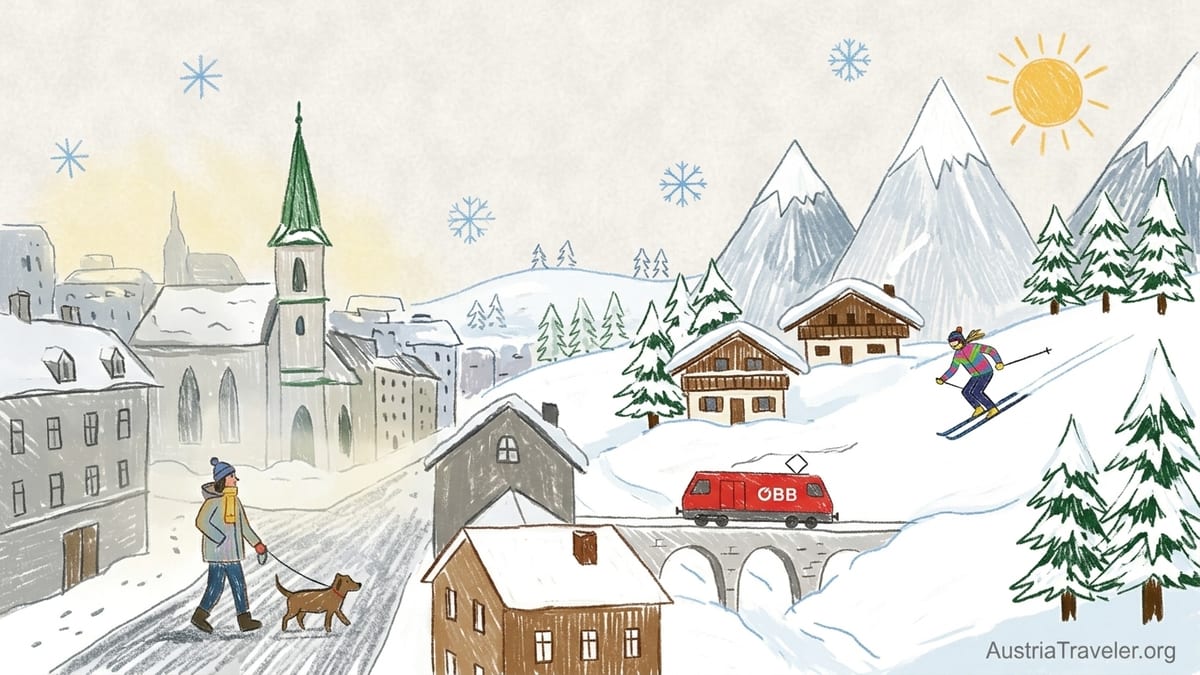
I spent 14 days in Austria one recent January, entering via Vienna, looping west through Salzburg and Innsbruck, and then into the Tirol mountains around Seefeld and the Ötztal valley. I did a little skiing but the trip was mostly about winter hiking, Christmas markets’ last flickers, and seeing how normal Austrian life continues in the cold. Before I landed, I expected storybook snow on every rooftop, icy but manageable streets, and crisp blue-sky days. What I found instead was a much sharper contrast between cities and mountains, a daily battle with wet gloves and heavy layers, and a country whose winter routines are far more organized and practical than the postcard pictures suggest.
How Winter in Austria Actually Feels Day to Day
On my first evening in Vienna, the temperature hovered around 0°C, with a mix of slush and thin ice on the pavements. The snow on the ground was only a few centimetres deep and looked more grey than white at street level. It felt more like a damp November in northern Europe than a romantic alpine winter. Street lighting came on around 4:15 pm, and by 4:45 pm it was properly dark. I noticed immediately how short winter days compress sightseeing into a tight band between about 10 am and 3 pm if you want to see anything in natural light.
Inside, the experience was completely different. My mid-range city hotels kept rooms at roughly 21 to 23°C without me touching the thermostat. Hallways were warm, bathrooms had heated towel rails, and double-glazed windows shut out tram noise along with the cold. That level of indoor comfort lulled me into underestimating the outside chill more than once. I repeatedly walked out overdressed, overheated during a brisk walk, then got clammy and cold when standing in a church or waiting at a tram stop.
By the time I reached Seefeld in Tirol, a small plateau town near Innsbruck, winter became what I had pictured. Snow along the pavements was 20 to 30 centimetres deep on the verges, piled into organised banks by municipal snowploughs. Temperatures dropped to around minus 8°C at night. Walking felt slower and more deliberate. On a short loop from the train station to my guesthouse with a 15-kilogram suitcase and a daypack, I needed 20 minutes for a route that would normally take ten. The weight of winter clothing, combined with packed snow underfoot, simply slows you down.
The most surprising daily difference compared with a warm-season trip was how often I had to schedule “drying time.” Gloves and hats stayed damp from snow showers and condensation. My base layers needed a night on the radiator after every proper hike. In summer I barely think about laundry and drying. In winter I suddenly cared whether a room had a proper radiator versus underfloor heating, simply because radiators are better for drying wet gear overnight.
Cities vs Alps: Two Different Winters
Vienna and Salzburg presented a relatively mild, changeable winter. Some days were dry and just above freezing, others brought sleety snow that turned into puddles by mid-afternoon. Pavements were well gritted, but I still met the occasional hidden patch of ice on shaded side streets. Local commuters moved briskly in normal shoes, but as a visitor paying more attention to architecture than ground-level hazards, I was grateful for boots with proper tread.
Public squares in the cities felt wintry more because of darkness and damp than because of deep snow. The last Christmas market stalls in Vienna, which linger into early January around Rathausplatz and Schönbrunn, stood on mostly cleared surfaces. The atmosphere came from lights, music and steam from punch stands more than from a thick blanket of white. By contrast, when I stepped off the train in Seefeld and later in Ötztal-Bahnhof, winter had a physical mass. Platforms were edged with ridges of compact snow. The surrounding hillsides were fully white, and the air tasted drier and sharper.
Urban Austria in winter is about negotiating puddles and wind tunnels between tall buildings. Mountain Austria is about altitude and visibility. On clear days in the Alps, I had spectacular views, with crisp contours on every ridge. On cloudy days, visibility closed in almost completely. During one snow shower above Längenfeld in the Ötztal, mountain silhouettes vanished in under ten minutes. That meant abandoning a planned viewpoint hike because following a narrow trail along an exposed slope no longer felt safe.
Even sound changes between city and mountain winter. In Vienna, I heard trams grinding gently over damp rails and the occasional hiss of grit under car tyres. In Seefeld, footsteps on packed snow made that hollow, squeaking noise you get only below freezing. Church bells and train announcements felt oddly louder, partly because snow absorbs other background noise. It is a reminder that winter in the Alps is not just colder; it is an entirely different sensory environment from the cities only a few hours away.
Getting Around: Winter Trains, Roads and Stations
I based my entire route on public transport and used trains for every long-distance journey. Austria’s national operator ÖBB runs an all-year timetable, with long-distance Railjet services connecting Vienna, Salzburg, Innsbruck and smaller hubs roughly hourly. The same trains I might use in July perform well in January, but winter introduces two practical differences. First, platforms and track areas can be snowy or slushy, especially at smaller stations where snow-clearing priorities are focused on main paths. Second, delays become slightly more likely on days with heavy snowfall or storms. In my two weeks I saw only minor delays of ten to twenty minutes, which felt remarkably efficient given the conditions.
Large stations such as Wien Hauptbahnhof, Salzburg Hauptbahnhof and Innsbruck Hauptbahnhof become winter refuges. They are brightly lit, well heated and packed with bakeries and coffee stands. This matters when you arrive early to avoid rushing on icy pavements. I routinely added a 15 to 20 minute buffer to any connection where I had to cross an unfamiliar station in bulky winter clothing. In summer, I would happily risk a tight ten-minute change. In winter, dragging luggage and dodging puddles, that same change suddenly felt stressful.
For local movement I used regional trains and buses. In some alpine valleys, buses replace or supplement trains, especially to reach resort villages. Timetables stay active in winter, but frequencies can be lower in the shoulder weeks outside peak holiday periods. I found that planning via ÖBB’s online planner and double-checking the day before each journey helped me avoid surprises from seasonal adjustments or planned engineering works, which occasionally introduce rail replacement buses.
I did not drive, but in the Tirol I watched how locals handled winter roads. Austria requires winter tyres on cars for certain conditions between November and April, and drivers must carry snow chains on designated mountain roads when signposted. This was visible in practice: most vehicles had proper winter setups, and snowploughs passed through resort access roads several times a day when it snowed. Even so, I saw one rental car stuck at the entrance to a guesthouse car park after a fresh fall, simply because the incline and smooth tyres did not match. If I had been driving, I would have aimed to arrive at resort bases before dark and avoided same-day long drives over high passes after heavy snowfall.
Cold-Season Sightseeing: Slower, Shorter, More Intentional
City sightseeing in winter Austria becomes a series of short outdoor bursts linked by warm indoor stops. In Vienna, my museum days started late. Sunrise was after 7:30 am, but the light felt usable for photography only from around 9 am. I would line up my first outdoor objective, perhaps a walk through the Innere Stadt to see the cathedral and nearby streets, then target a museum by late morning. The ten-minute walk between Stephansdom and the Hofburg complex in light snow took closer to twenty with winter boots, a camera that had to be kept under my coat, and repeated stops to warm my fingers.
Layering affects your pace more than you expect. Wearing a merino base, fleece mid-layer and insulated jacket, plus hat, scarf and gloves, I could stay comfortable for around 45 minutes outdoors near freezing temperatures. After that I felt either chilled or overheated, depending on how fast I had been walking. In practice, this meant my “sightseeing segments” were shorter than on a spring trip. Rather than stroll for two hours along the Ringstrasse, I broke the loop into pieces over two days, choosing a cafe or museum every 45 to 60 minutes as a recovery point.
In Salzburg, climbing up to the fortress in winter offered one of those postcard views that looks better in photos than in reality. From the walls, the old town roofs and river looked beautifully dusted with snow, and soft cloud gave the mountains a dramatic backdrop. In the moment, though, a biting wind funnelled along the ramparts, my hands hurt from holding the camera out of my gloves, and patches of compacted snow on the paths demanded constant attention. It was one of several times when I realised that “iconic view” and “pleasant experience” are not always the same thing in winter.
Inside attractions, winter has advantages. Major museums in Vienna and Salzburg were noticeably less crowded than on my previous spring visits, outside the Christmas and New Year peak. I could stand in front of key artworks, move slowly through exhibits and leave my heavy coat in supervised cloakrooms. Cloakroom logistics matter. On days when cloakrooms were closed for security reasons, I had to keep everything with me and quickly remembered how exhausting it is to carry a backpack full of winter layers indoors for several hours.
Snow, Outdoor Activities and What Changes Off the Slopes
I only skied for a single day on this trip, at a mid-altitude area accessible by train and ski bus from Innsbruck. The pistes had a compact 40 to 60 centimetre snow base, according to the resort board, and conditions on groomed runs were excellent. Off-piste terrain, however, looked thin and rocky. Friends who visited glacier resorts at the same time reported deeper snow and more reliable coverage, which illustrates a key winter lesson: in Austria, altitude and orientation matter far more in January than in March. If your trip depends on skiing, it is worth checking specific resort snow reports rather than assuming that all of Tirol will be equally white.
For non-skiers, Austria’s winter infrastructure shines. In Seefeld, I walked on a network of prepared winter hiking trails, which are basically compacted and lightly groomed snow paths separate from cross-country tracks. These turned what could have been ankle-deep trudging into manageable strolls, even after fresh snowfall. In the Ötztal, I used a mix of riverside walking paths and short, marked snowshoe routes near village edges. Trail maps were visible at bus stops and lift stations, and local tourist offices had daily information about which routes were open or affected by avalanche risk.
Thermal spas are where cold-season Austria becomes almost hedonistic. I spent one long afternoon at a large spa complex in Tirol, with outdoor pools steaming in sub-zero air and snow piled on surrounding roofs. Moving between indoor lockers and outdoor basins meant a few seconds of sharp cold followed by blissful warmth. Visually, the contrast between dark mountains, snow and turquoise water looked like an advertisement shot, but the sensory memory is just as strong: the feel of ice crystals on wet hair, the sting when you step out of the water, the relief of heated floors in rest areas.
These outdoor activities required more planning than summer hikes. I checked daily avalanche bulletins posted at lift bases, monitored weather forecasts, and accepted that certain higher routes might close after heavy snowfall. In summer, I would be more inclined to improvise. Winter demands backup plans: a valley walk if the peaks are fogged in, a spa day if high winds close lifts, a museum or church visit if icy rain makes even town walking unappealing.
Food, Evenings and the Winter Atmosphere
Winter changed how and when I ate. In the cities, I gravitated toward hearty dishes like goulash, Käsespätzle and roast pork, not purely for cultural interest but also because warm, heavy food genuinely felt necessary after time outdoors. In Vienna I ducked into a traditional cafe at least once a day, not as a romantic ritual but as weather management. Sitting with a melange and a slice of Sachertorte became a way to reheat fingers and toes for half an hour between sights.
In the mountains, evenings took on a village rhythm. After dark, which came by late afternoon, people seemed to disappear into guesthouses, hotel wellness areas and a small number of taverns. In Seefeld I learned that, even outside the absolute peak weeks, restaurants in resort towns can be busy in winter. On two occasions I walked around in the cold for twenty minutes looking for a table, only to end up back at my hotel’s dining room because independent places were full until later in the evening. On subsequent nights I asked at reception to reserve a spot in the afternoon. That single habit change eliminated the frustration of wandering around icy streets hungry.
The Christmas atmosphere varies sharply by date. In early January Vienna still carried lingering festive mood: some markets were closing down, lights remained strung across main streets, and shop windows displayed winter decorations. By mid-January in Tirol, the explicit Christmas theme had almost vanished, leaving only winter lights and the more timeless scene of snow, church towers and wood smoke. If your mental picture of Austria in winter is intensely tied to Christmas markets, it matters that most major markets shut down around Christmas or New Year, and a January visitor will encounter much quieter evenings.
One thing that looked better in photos than in person was outdoor drinking at punch and mulled wine stands in light snowfall. The images show glowing cups, cosy hats and soft flakes. The reality included wet sleeves from leaning on damp counters, sticky boots from spilled punch freezing on the ground, and plastic cups cooling rapidly in the air. I still enjoyed the ritual, but I found myself retreating to indoor bars sooner than expected. Austrian winter street life is more about brisk walks and short pauses than about lounging outside for hours.
What Was Easier, What Was Annoying and What I Would Change
Some aspects of winter travel in Austria were easier than I had imagined. Train travel remained reliable, and the integrated nature of timetables and ticketing meant I could rely on public transport even in heavy snow, especially in core corridors between Vienna, Salzburg and Innsbruck. City walking felt safer than I feared thanks to prompt gritting and snow removal. Major attractions stayed open with year-round hours, except for occasional maintenance closures clearly signposted in advance. I never encountered the kind of “closed for the season” dead-end that is common in small seaside towns elsewhere in Europe.
Hotel infrastructure also helped. Even modest pensions in the Alps were well insulated and equipped with solid heating, plus ski or boot rooms that doubled as drying areas for hiking boots and gloves. In summer I barely notice such facilities. In winter they make the difference between starting each day comfortable or putting on half-damp gear. In cities, well-heated bathrooms and the ubiquity of cloakrooms in museums removed some of the typical cold-weather irritations.
The annoyances centered on moisture and bulk. Wet trouser hems from slush at street crossings remained stubbornly damp for hours in hotel rooms without radiators. Camera and phone batteries drained faster in the cold, forcing more regular indoor charging stops. My luggage felt significantly heavier because of bulky jackets, snow boots and extra base layers. Even using trams and buses involved a small performance: gloves off to handle tickets or apps, gloves back on, scarf adjusted, hat repositioned. None of these are dramatic hardships, but they add up to what I would call “winter friction,” a layer of effort on top of every simple activity.
If I were restructuring the trip, I would concentrate nights more tightly within each region and plan at least two full “low ambition” days. Instead of two nights in Salzburg and two in Innsbruck, both with onward travel in the morning, I would choose three to four nights in a single city and accept that I would not “cover” as many distinct destinations. Winter slows everything, from walking speed to drying laundry, so attempting summer-style itineraries with a new city every second day feels unnecessarily stressful.
What Really Changes Compared With a Normal Austria Trip
Compared with shoulder-season or summer visits, winter in Austria changes three main dimensions: time, space and energy. Time shrinks because daylight is limited. A castle that you might explore over a leisurely afternoon in May must now be fitted into a narrower window of usable light, or accepted in its nocturnal, floodlit form. This pushes sightseeing into earlier starts, carefully planned sequences, and deliberate trade-offs between outdoor and indoor activities.
Space changes because snow and ice literally alter the ground beneath your feet. Pavements narrow where snowbanks accumulate. Mountain paths become groomed corridors instead of open meadows. Car parks shrink under piled snow. This compresses movement and can make busy resorts feel crowded even when absolute visitor numbers are reasonable. Conversely, some open spaces, particularly in cities, feel emptier than in summer because outdoor seating disappears and people move quickly from one heated interior to another.
Energy management is the hidden discipline of winter travel. The same hill, staircase or cobbled alley that you would bounce up in June becomes a minor workout in heavy boots and layers. You tire faster, carry more, shed and add layers repeatedly, watch footing constantly, and handle damp gear each evening. That does not make Austria less enjoyable; in many ways, it makes experiences feel earned. A quiet bar in Innsbruck after a cold walk, or a simple bowl of soup in a mountain hut, registers more deeply when you have spent the day battling the elements.
The other key difference lies in uncertainty. Summer brings thunderstorms and occasional rain, but winter brings full-day snowfalls, fog that erases entire valleys, and wind that can close mountain lifts without much notice. Building resilience into your schedule, with spare half-days and backup indoor options, is not optional in January. The reward for accepting that uncertainty is seeing a side of Austria that local residents know well: children in colourful ski suits waiting for school buses, commuters in Innsbruck carrying skis onto evening trains, and village church squares lit softly under steady flakes. Those scenes do not appear for most visitors in July.
The Takeaway
My two weeks in Austria’s winter left me impressed less by postcard beauty and more by how well the country functions in serious cold. I arrived expecting decorative snow and Christmas-market charm. I left thinking about snowplough schedules, drying racks, well-timed train buffers and how much physical effort goes into ordinary life in the Alps from November to March.
If you know Austria only from summer trips, the core sights will seem familiar in January. Vienna’s historic centre, Salzburg’s baroque skyline and Tirol’s peaks are still there. What changes is how you move between them, how much you carry on your body, and how closely your day is tied to daylight, weather forecasts and the state of the ground. A winter trip rewards slower pacing, warm base layers, realistic expectations about visibility, and a willingness to trade quantity of destinations for depth of experience in a few well-chosen places.
In the end, what I learned exploring Austria in the cold season is that winter is not a decorative layer on the same holiday. It is a different kind of trip. If you embrace the friction and plan for shorter, more intentional days, you will discover a country that feels both more demanding and more generous than in high summer.
FAQ
Q1. Do trains in Austria run normally in winter or are there frequent cancellations?
During my January trip, long-distance and regional trains generally ran close to schedule, with only minor delays on heavy snow days. The network is designed to operate year-round, but I still allowed extra time for connections and checked timetables the day before each journey.
Q2. Are Austrian roads safe to drive on in snow if I rent a car?
Major roads and resort access routes are regularly cleared, and local drivers use winter tyres and carry snow chains where required. However, steep side streets and car parks can still be slippery, so if you are not used to snow driving it is wise to plan shorter routes, arrive before dark and avoid travelling over high passes immediately after heavy snowfall.
Q3. Will I find enough to do if I am not a skier?
Yes. I filled most days with winter walking on prepared trails, visiting museums and historic sites, soaking in thermal spas and exploring cafes and restaurants. Many alpine areas promote non-ski activities such as tobogganing, snowshoe tours and lantern-lit evening walks, so it is easy to build a non-ski focused itinerary.
Q4. How cold does it actually feel in Austrian cities in winter?
In Vienna and Salzburg, daytime temperatures on my trip hovered around minus 2 to plus 3°C. With humidity and occasional wind it felt sharper than the numbers suggest, especially when standing still at tram stops or on hilltops, but frequent warm indoor spaces make it manageable if you dress in layers.
Q5. Do attractions close for the season in winter?
Most major sights in Vienna, Salzburg and Innsbruck, including key museums and palaces, stay open year-round, sometimes with slightly adjusted hours. In smaller alpine towns, a few summer-focused attractions may close, but lifts, winter trails and spas are very active during the cold months.
Q6. Is it worth visiting after the main Christmas markets have closed?
I visited in early to mid-January and still found a strong winter atmosphere, even though the large markets had finished. Cities were quieter, queues were shorter, and alpine towns felt more like ordinary life than a festival, which I found more authentic and relaxing.
Q7. How should I pack differently for winter compared with a summer Austria trip?
My most useful items were waterproof insulated boots, a warm but breathable jacket, merino base layers, thin liner gloves under thicker gloves and a simple thermos flask. I packed fewer outfits overall but more layers, accepting that bulky clothing would take more suitcase space.
Q8. Are thermal spas in Austria beginner friendly for foreign visitors?
Yes. The large spa complexes I visited had clear signage, mixed and single-sex areas, family zones and quiet zones, with easy-to-follow rules about sauna etiquette. Staff were used to international visitors and happy to explain how to use lockers, towel rentals and different pools.
Q9. How much slower does sightseeing become in winter clothing?
On slushy or snowy streets, with full winter layers and a daypack, I found that a walk that might take ten minutes in summer could take fifteen to twenty. Stairs, hills and cobbles were more tiring, so I built in extra time between sights and accepted that I would cover less ground each day.
Q10. If I have only one week, should I focus on cities or the mountains in winter?
For a first winter visit, I would split a week between one city, such as Vienna or Salzburg, and one alpine base like Seefeld or a valley near Innsbruck. That combination shows both sides of Austrian winter without requiring constant repacking and long transfers.