


I thought I knew what an Austrian mountain holiday would feel like before I ever saw the Alps from the inside. I pictured one neat village at the end of a valley, a few chairlifts, perfect hiking trails and maybe a cowbell soundtrack on repeat. What I actually found, over three summer and early autumn trips that added up to more than six weeks on the road, was a patchwork of very different Alpine worlds: crowded resort hubs and sleepy farm hamlets, glassy lakes and glacier viewpoints, tight old streets and wide glacial valleys. This guide is built from those drives and train rides through Tyrol, SalzburgerLand, Carinthia and Vorarlberg, and from the mistakes I made along the way, in the hope that it answers the bigger question: what is it actually like to travel through the Austrian Alps?
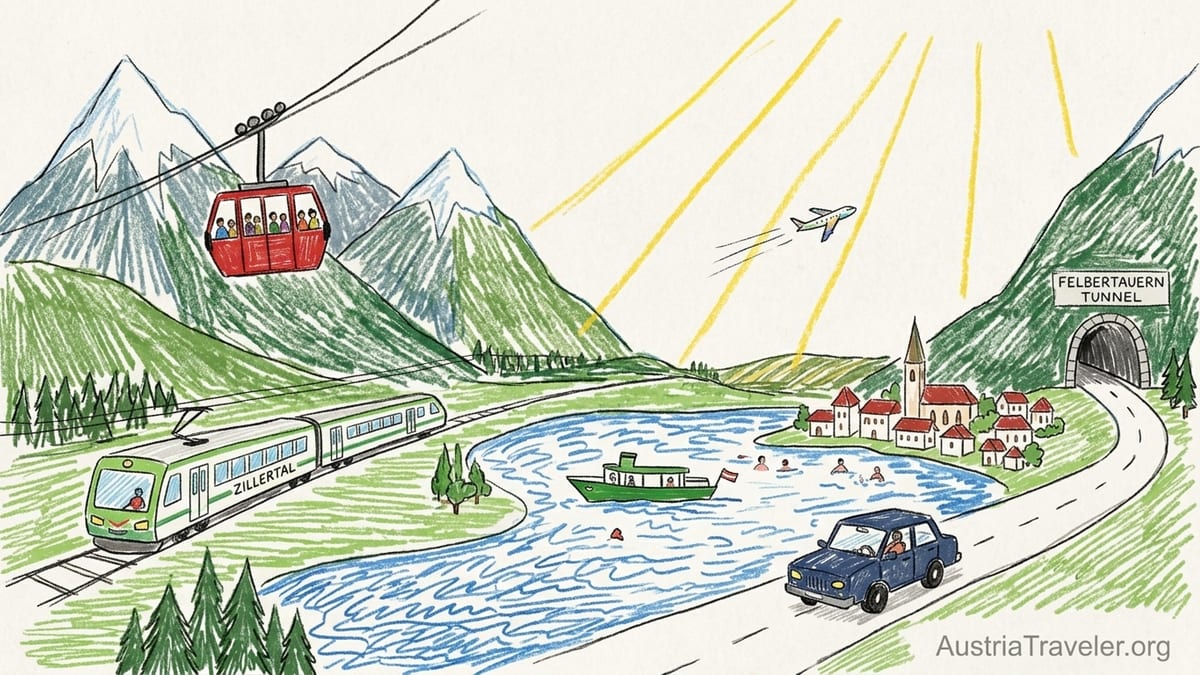
How I Traveled Through the Austrian Alps
My first real immersion in the Austrian Alps began by train, rolling in from Munich to Jenbach in late June, with an onward local train up the Zillertal. I based in Mayrhofen for five nights, using cable cars like the Penkenbahn and Ahornbahn to explore ridges above 2,000 meters. Two years later I came back by rental car in early September, entering Austria from Germany near Kufstein and working my way through the Wilder Kaiser region, the Saalbach and Zell am See area, then across into East Tyrol via the Felbertauern tunnel, spending about ten nights divided between three valleys. A third, shorter trip took me west by rail to the Arlberg, with a three-night stop in St. Anton and two nights on the quieter Lech side in early July.
Across these trips I tried both styles: a fixed base and a point-to-point road journey. I used long-distance trains to move between regions, local trains or buses for valley travel where they were good, and a car where they were not. I saw the Alps in midsummer heat and during moody shoulder-season storms. Before the first trip, I expected a fairly uniform experience from valley to valley. Instead, every move of 30 or 40 kilometers changed the feel of the trip: scenery, culture, prices and how easy it was to reach the high mountains all shifted.
Each choice had consequences. When I chose Mayrhofen I got excellent lift access but busy streets in the evening. When I booked on the wrong side of a lake I spent too much time in the car. When I stayed too few nights in a valley, I felt rushed and never really learned its rhythm. The value of traveling across multiple regions is that you quickly see what kind of Alpine environment actually suits you, rather than what the brochures suggest you should want.
This article is not a list of “best” places by province. Instead, it follows the kinds of places you will actually move through: broad valleys, high-mountain platforms, lake towns, farming hamlets and bigger resorts. Along the way I will point to concrete details like cable car schedules, tunnel tolls, guest cards and typical accommodation patterns in 2026, so you can turn impressions into a realistic plan.
Broad Valleys and First Impressions: Life on the Valley Floor
Most Austrian Alpine journeys start at the bottom of a broad valley. Mine began in the Zillertal, the kind of place many visitors use as a first base. The local train from Jenbach took just under an hour to reach Mayrhofen, trundling past fields, small sawmills and clusters of guesthouses. The valley floor here feels wide and busy, with a proper supermarket, sports shops and outdoor outfitters in nearly every town. As a traveler, that means you can arrive with minimal gear and buy what you need on site, from hiking poles to lightweight rain jackets.
Practicalities do matter in valleys like this. In the Zillertal, the Mayrhofen guest card that every overnight visitor receives is free and valid for the duration of your stay. It brings discounts on local attractions and, in the 2026 winter season, can even be used as a ticket for free arrival and departure on the Zillertalbahn between Jenbach and the valley, although in summer you still buy normal rail tickets. In other areas, such as around Lake Wolfgang in SalzburgerLand, guest mobility tickets are being expanded so that from May 2026 many visitors can ride regional public transport across the province without extra cost. These cards reduce the need for a car on days when you stay within a single valley.
The first mistake I made here was booking an apartment on the outskirts of town, thinking it would feel more “authentic.” In practice it meant a 20 to 25 minute walk to the Penkenbahn in hiking boots, or a short but crowded bus ride at opening time. If you plan to ride cable cars on multiple days, being within a ten-minute walk of a main lift station or train stop transforms your mornings. In a valley floor town you will share the streets with day-trippers who arrive on coaches and leave by late afternoon, but the trade-off is easy access to shops, rental gear and public transport hubs.
Driving the broad valleys in Tirol or SalzburgerLand is usually straightforward. Roads are well maintained, often with overtaking sections, and signed clearly in German and English. The real challenges are timing and parking. In popular valleys like the Zillertal or Saalbach, free parking beside cable car stations is limited; several garages now charge daily rates that, while not extreme by big city standards, still add up over a week. On one trip I arrived at a lake parking lot at 11:00 and circled for 30 minutes, eventually paying for a private field parking area run by a local farmer. Had I started earlier and used a base closer to lifts or docks, I would have saved both time and money.
High Mountains and Glacier Platforms: Riding the Cable Cars
If the valley floor is where you organize your days, the high-mountain platforms are where the Alps really show their scale. My first exposure to this was at around 2,000 meters above Mayrhofen. In summer 2026, the Penkenbahn and Kombibahn Penken are scheduled to operate from late May into early October, running roughly from 8:30 to 17:00, while the Ahornbahn has its own summer and autumn timetable with an earlier start on certain days. Checking these operating periods before booking fixed travel dates is essential. On one June visit I arrived a week before a secondary lift opened and lost access to an entire ridge I had hoped to hike.
Similar patterns apply in other regions. Above Zell am See, the Schmittenhöhebahn begins its summer season around mid May, with other lifts like areitXpress and Sonnkogelbahn starting later and closing earlier in autumn. In the Arlberg, lifts such as the Galzigbahn are usually in summer operation from early July to early October, with some scheduled closure days. Even non-glacier areas can sit above 2,000 meters and feel like high mountain terrain. If your trip sits at the very start or end of the summer season, plan for some lifts or hiking routes to be unavailable, and build in an extra day as insurance.
The highest platform I reached in Austria was on the Kitzsteinhorn above Kaprun. The K-onnection system links the village at around 768 meters to a viewpoint over 3,000 meters, using up to six connecting lifts. In 2026, the key 3K K-onnection section between Kaprun and the glacier area is scheduled to operate from late June to mid September. Stepping out there in midsummer, I went from shorts weather in the valley to near-freezing temperatures and strong sun reflected off old snow patches. My borrowed windproof layer and hat were the only things between comfort and cutting the visit short.
High-mountain weather is the second big source of mistakes. On my first trip I underestimated how quickly storms build after lunch. I set off on an exposed ridge trail from a lift station at 12:30, enjoying blue sky, and was turned back by thunder less than two hours later. Many of these routes are clearly signed with estimated times and difficulty, but the risk is in assuming those times are generous. In reality they are often realistic for fit locals. If you are not used to hiking at altitude, cut those distances or start earlier in the day.
Alpine huts are one of the genuine joys of traveling in the high mountains. Even at busy hubs like Kitzsteinhorn or Schmittenhöhe, you can usually find a hut ten or twenty minutes’ walk from the main lift station where the crowd thins out. Meals are not cheap, but they are rarely extortionate, and the fact you can buy a hot soup or simple pasta at 2,000 meters in poor weather is more than a convenience. It is a safety net when your day goes wrong. Traditional huts deeper in the mountains can feel very different from the modern self-service restaurants at top stations, with wood-panelled dining rooms and quieter terraces. Those were the places where Austria’s mountain culture felt most grounded and least commercial to me.
Lakes, Boats and Mountain Roads: The Water Side of the Alps
My mental postcard of the Austrian Alps before visiting featured as many lakes as peaks. The reality depends heavily on where you go. In SalzburgerLand and Carinthia you will find entire regions structured around lakes, while parts of Tirol feel more like pure valley-and-peak country. I first met the lake side of Austria on a detour to the Salzkammergut, then more fully around Zell am See and in Carinthia around Ossiacher See.
A key planning detail at lakes is the interplay between shore roads, boat services and parking. Around Ossiacher See in Carinthia, for example, there are fourteen separate excursion spots linked by a hop-on hop-off boat service and lakeside walking paths. The regional map shows parking areas, bus stops, piers and lift stations as one integrated network. In practice, this meant I could leave the car parked near a cable car in the morning, ride up to a panoramic ridge, return for a swim in the lake and use the boat to reach a different village for dinner without moving the car again.
Not all lakes work that smoothly. At one smaller Tyrolean lake I booked a guesthouse that looked close to the water but sat on the wrong side of a steep hillside road. Walking to the shore involved a narrow, winding lane with little shoulder and fast local traffic. It was not dangerous in an absolute sense, but it did not feel like the peaceful lake holiday I had imagined. This is one place where inspecting satellite imagery before booking is worth the extra effort. On a map, 500 meters can look trivial; in reality, if those 500 meters involve a climb or a busy road, you will reach for the car more often than you wanted.
Mountain roads are less frightening than many first-time visitors assume. The toll road to the Steinplatte plateau in the Tirol region is a good example. In 2026 the Steinplatte mountain road and its Triassic Park attraction are due to remain open until early October, which makes it a viable option for late season visits. The climb is steady, well signed and punctuated by parking bays where you can pull over for views. More intimidating are the long tunnels that link some regions. The Tauern Autobahn, for example, includes the Tauerntunnel and Katschbergtunnel, a special toll section where a single car journey in 2026 costs in the mid-teens of euros in addition to the regular Austrian motorway vignette. For me, these tunnels were less about fear and more about budgeting; a multi-valley road trip can accumulate tunnel fees steadily if you chase the fastest routes.
On one journey I opted to detour through the Felbertauern tunnel between Salzburg province and East Tyrol instead of driving a longer pass. The tunnel itself is drama-free, but the approach roads are narrow enough that I was glad to have started early in the day to avoid heavy traffic. The lesson was simple: in lake districts and on cross-Alpine axes, leave extra time for slower vehicles and for spontaneous stops. Many of the best lake and roadside viewpoints are not obvious from the map, and you will regret racing past them to meet a fixed check-in time.
Ski Villages, Quiet Farming Hamlets and Mountain Cities
The biggest surprise on my trips was how sharply the character of places changed across short distances. In winter-famous ski villages like Saalbach, Ischgl or parts of the Arlberg, summer brings a strange mix of quiet streets and large, empty hotels. In St. Anton in early July, for example, a few main hotels and restaurants on the pedestrian core were busy with hikers and mountain bikers, but many winter-oriented venues stayed closed or operated on very limited hours. Cable cars like the Galzigbahn and Rendlbahn ran regularly according to the published summer schedule, yet the nightlife that these towns are known for in winter was almost entirely absent.
Just a few kilometers away, smaller farming hamlets and side valleys felt very different. In the Lech valley, staying in a family-run guesthouse meant breakfast with farmers who spent the rest of their day on the slopes tending to cows, returning in the evening with stories of weather and pasture rather than lift queues. Prices here tended to be a little lower than in marquee resorts, but the bigger distinction was rhythm: early mornings, quiet afternoons, and a sense that tourism and agriculture coexisted instead of one dominating the other. The downside was reduced evening options; if you like to wander between several bars or restaurants at night, a hamlet like this can feel limiting after two or three nights.
Then there are what I think of as “mountain cities,” like Innsbruck or, at a smaller scale, Zell am See. In Innsbruck you get a full urban environment with museums, shopping streets and a university crowd, but you can also ride a cable car from near the river up to the Nordkette in a matter of minutes. Zell am See is less of a city but still offers a compact historic center around the lake, with multiple lifts such as the Schmittenhöhebahn and boat services fanning out in summer. In 2026, several of those lifts are scheduled to operate from mid May or late May right through to early October, which gives lake-and-mountain travelers a longer shoulder season than some higher, snow-reliant resorts.
From a traveler point of view, the commercial feel varies accordingly. I found the central strip of Mayrhofen and the lakeside promenade in Zell am See more commercial than I personally liked: souvenir shops, international fast food, tour groups clustering in front of ice cream stands. At the same time, these were the easiest places to arrange rental bikes, last-minute paragliding flights or family-friendly attractions without preplanning. Conversely, a quieter valley like the Defereggental in East Tyrol felt more traditional and less polished. Restaurants there served mostly regional dishes, menus had fewer translations, and opening hours followed local patterns, with some kitchens closing relatively early. These are wonderful places if you want to feel that you are in someone else’s home region; they are frustrating if you expect resort-level service and English spoken everywhere.
One of the more subtle differences lies in evenings after the day-trippers have gone. In bigger resorts, the streets stay bright and fairly busy, with hotel guests strolling and music drifting from terraces. In hamlets, dusk was marked by a drop in human noise and a rise in the sound of streams and cowbells. Sitting on a guesthouse balcony in a side valley near the Wilder Kaiser, looking across to lit farmhouses and dark forest beyond, felt more “Alpine” to me than the postcards from the major resorts. Which you will prefer is a question of temperament, but it is worth sampling more than one environment on a single trip to find out.
Logistics: Trains, Guest Cards, Tunnels and Trail Access
The Austrian Alps are one of the easier mountain regions in Europe to move around without a car, as long as you pay attention to how local systems fit together. My first trip, which avoided driving entirely, worked because long-distance trains connected Munich to Innsbruck and Jenbach, and from there to the Zillertal and on toward Salzburg. The Tauern Railway remains a vital north-south spine, with long-distance services running through its tunnel section and car-shuttle trains linking the Gastein valley with Carinthia. On my later car-based trip, knowing that there was a functioning rail alternative felt like a safety net in case of road closures.
Guest cards and regional passes are the second pillar of logistics. In the Zillertal, for example, the Zillertal Activcard in 2026 is valid from late June to early October and bundles daily cable car rides, access to outdoor swimming pools and free use of most public transport in the valley for several days. In other regions, such as the SkiWelt Wilder Kaiser Brixental, a Mountain Experience Card offers one pass for multiple lifts and mountain theme parks, with day tickets starting in the low twenties of euros in summer 2026. If you plan to ride at least one lift most days, these passes usually pay for themselves quickly and simplify decisions: you just go where the weather suits you.
Trail access is generally excellent. Popular routes are clearly signposted from lift stations and many valley towns, with difficulty levels and estimated times. But some newer attractions, like themed family trails or high-altitude viewing platforms, may open or close independently of classic hiking routes if a lift is undergoing maintenance. Before heading to Steinplatte in late September, I checked that the toll road and Triassic Park would still be open until early October. Similarly, at lower but still exposed areas such as the Feuerkogel above Ebensee, the cable car’s summer 2026 season is set to run from early May to early November, but specific facilities on the plateau can have their own shorter seasons or weather closures.
Tunnel and motorway rules are another reality of road travel here. Austria requires a vignette for most motorways, sold in various durations, and additionally charges special tolls for certain sections like the Tauerntunnel and Katschbergtunnel. As of early 2026, the fee for that combined stretch was in the mid-teens of euros per car for a one-way journey. Other crossings, like the Felbertauern route, have their own tolls collected near tunnel portals. None of this should deter you, but it is wise to add a line item in your budget for tolls and to decide early whether you want to avoid them by driving slower, more scenic pass roads. I alternated between the two: using toll tunnels when I wanted to reach a new base quickly, and hunting out passes when I had a full day and good weather.
Finally, evenings and access. One of the less obvious planning points is how you will get back to your base if you stay for sunset on a ridge or at a lake. Cable cars almost always stop in late afternoon or early evening. In Mayrhofen, for instance, last descents in summer tend to be around 17:00. On the Schmittenhöhe, summer closing times are similar, with some lines running slightly later at peak season but dropping to 16:00 in late autumn. There are no half-empty “bonus rides” after closing time. If you want golden-hour views high up, you need to book an overnight at a mountain hut or pick a road-accessible viewpoint you can drive back from after dark. I misjudged this once, arriving at a top station mid-afternoon assuming I could watch the sunset, and instead watching the staff sweep the terrace empty as I queued for the last gondola down.
Common Mistakes and What I Would Do Differently
Looking back across several trips, the same mistakes replay in slightly different forms. The first was moving bases too often. On my road journey through Tirol and SalzburgerLand I tried to cover too many valleys in ten nights, planning three bases and multiple day trips from each. In reality, check-in and check-out days devoured more time than I expected. Every move meant repacking, cleaning an apartment kitchen, navigating a new parking system and losing a morning of potential hiking or lake time. If you want to see three distinct regions, I would now recommend at least fourteen nights instead of ten, or dropping one region and spending longer in the other two.
The second recurring error was underestimating mountain weather. In early September I booked a balcony room in a lakeside town, picturing warm evenings outside. Instead I hit a week where clouds clung to the slopes and rain came in pulses. Higher lifts closed for wind or lightning on several days. Because I had spread my nights across three valleys, it was harder to simply wait out the bad days; each base change came with sunk costs. If your schedule is fixed and you cannot add days, concentrating your stay in one valley with varied altitude options can soften the blow of bad weather. You can go low on stormy days and high when windows open.
Another mistake, as mentioned earlier, was booking accommodation too far from lifts or docks. In Mayrhofen I stayed once in an apartment that looked like a fifteen-minute walk to the Ahornbahn on paper. In hiking boots, with a daypack, in light rain, it consistently took closer to twenty-five. It does not sound like much, but multiplied over several days, those extra minutes at both ends of each excursion added a quiet friction to the trip. Now, when I know I will use a particular lift several times, I search within a specific radius of its valley station, or deliberately choose lodgings near the valley railway station to leave the car parked for most of the week.
Driving distances can also mislead. One valley I chose for a supposedly central base required much more driving than expected because the central road ran along the valley floor, while the most scenic hiking trailheads branched off up side roads that wound for many extra kilometers. Distances that looked short on the map translated into 30 to 40 minutes of narrow, slow driving. If you plan to use your car for daily excursions, look closely at contour lines, not just road distances. Ask hosts how long they actually take to reach common trailheads, and pay attention to their answers rather than to navigation app estimates.
Finally, there is the temptation to attempt too much in a single day. On my first Kitzsteinhorn visit I tried to combine a glacier viewing platform, a mid-station hike, lunch at a hut and a late afternoon swim in the lake back in Kaprun. The result was that every stop felt rushed. These mountains are not going anywhere. It is better to pick one or two focal points for each day and leave room for spontaneous coffee breaks, changing weather and small discoveries like a side path to a waterfall or a wayside chapel. Some of my clearest memories now are not of the marquee viewpoints but of quiet half-hours on a hut terrace or walking an unspectacular but empty meadow path back into town.
The Takeaway
So what is it actually like to travel through the Austrian Alps? It is less a single experience and more a set of overlapping worlds. The same week can contain a busy resort town where gondolas hum overhead, a lakeshore village where life revolves around the boat timetable, and a side valley where cows outnumber visitors and the loudest sound after dark is a river. What ties these places together is solid infrastructure, a clear seasonal rhythm and a culture that still takes the mountains seriously, even in heavily touristed areas.
If you come expecting just chocolate-box villages and empty trails, you may be disappointed by the crowds in headline resorts. If you come ready for a mix of polished and plain, for weather that does what it wants and for journeys that take a little longer than the map suggests, you will find that Austria makes mountain travel relatively easy without smoothing away all its texture. My strongest recommendation is to give yourself time, both in total days and in how you structure them. Stay at least three nights in most bases, spend a few evenings in places that feel slightly outside your comfort zone, and build one or two full rest days into longer trips.
The other takeaway is that the biggest joys hide in the small margins of planning. Checking cable car operating windows for your exact travel dates, choosing accommodation within a short walk of lifts or stations, and understanding how guest cards and regional passes work in 2026 can turn a good trip into a relaxed one. The more of those details you resolve beforehand, the more mental space you will have on the ground to simply look up and absorb the scale of the mountains.
In the end, my mental image of an Austrian mountain holiday is no longer one neat village in a postcard valley. It is a sequence of mornings in clear air on different balconies, the quiet clunk of cable car doors, train windows filled with new ridgelines, and the particular stillness of Alpine evenings after the last bus has gone. If you plan with both ambition and humility, those will likely be your memories too.
FAQ
Q1. Do I need a car to travel through the Austrian Alps?
In major valleys like the Zillertal, around Innsbruck or Zell am See, you can combine long-distance trains, local rail lines, buses and cable cars without needing a car, especially if your accommodation is close to a station or lift. In more remote side valleys and lake districts, a car offers much more flexibility, particularly for early-morning trailheads and smaller swimming spots.
Q2. How far in advance should I book accommodation in summer?
For July and August, booking three to six months ahead is sensible in popular resorts, especially if you want apartments or family rooms near lift stations. In June, September and early October, you can often find good options with less notice, but the most convenient locations near lakes or cable cars still fill first.
Q3. Are guest cards and regional passes really worth it?
If you plan to ride lifts, use public transport and visit swimming pools or simple attractions most days, regional passes such as the Zillertal Activcard or Mountain Experience Cards in places like the SkiWelt usually pay off. Even basic guest cards, which are free with overnight stays in many regions, can bring useful discounts and, in some areas, free public transport during defined seasons.
Q4. How reliable is the weather in the Austrian Alps in summer?
July and August often bring stable mornings and more afternoon thunderstorms, while June and September can swing between warm sun and autumnal chill. Even on seemingly stable days, conditions above 2,000 or 3,000 meters can change quickly, so you should always carry layers, rain protection and check local forecasts before heading onto exposed trails.
Q5. What should I know about cable car operating times?
Cable cars in summer generally open between late May and mid June, then close sometime between late September and early November depending on altitude and region. Daily operating hours are usually from mid-morning to late afternoon, with last descents commonly around 16:00 to 17:00. Always check the 2026 schedules for specific lifts shortly before your trip, as some lines have planned closure days or shorter shoulder-season hours.
Q6. Is driving in the Alps difficult for first-timers?
Main valley roads and access routes are well built and signed, and local drivers are used to sharing the road with visitors. Steeper toll roads and narrow side valleys require more attention, but they are generally protected with barriers and frequent pullouts. The bigger adjustment is to pace; journeys are slower than the distance suggests, and parking near lifts and lakes can be limited at peak times.
Q7. How expensive are tunnel and motorway tolls?
You will need a motorway vignette if you use Austrian motorways, which is sold in various durations. On top of that, special tolls apply to certain tunnels such as the Tauern and Katschberg section, which in 2026 cost roughly in the mid-teens of euros for a one-way car journey. Other crossings like the Felbertauern route have their own fees, so it is wise to set aside a modest budget line for tolls if you plan a multi-valley road trip.
Q8. What kind of footwear and clothing do I need in summer?
Sturdy walking shoes or light hiking boots with good grip are essential for most marked trails, even those starting from cable car stations. Pack breathable layers, a windproof or waterproof jacket, a sun hat and a warmer layer for high-altitude platforms, where temperatures can be close to freezing even when the valley is warm. For lakes, simple water shoes can make rocky shores more comfortable.
Q9. How many nights should I stay in each base?
Three nights is a good minimum for most bases, giving you two full days to explore without losing time to arrivals and departures. For areas with both lakes and high mountains, such as Zell am See and Kaprun, or for large valleys with multiple side trips like the Zillertal, four to five nights can feel more relaxed and reduce the temptation to overpack each day.
Q10. Are the Austrian Alps suitable for travelers who do not hike?
Yes. Many cable cars give access to panoramic platforms, short level walks and huts with terraces reachable in a few minutes. Lakeside towns offer boat trips, promenades and swimming areas, while larger centers like Innsbruck combine museums and historic streets with easy mountain access. You will still benefit from good shoes and a basic tolerance for uphill walking, but you do not need to be an experienced hiker to enjoy the region.