


I learned how not to plan an Austrian Alps trip the hard way. On my first serious mountain holiday in Austria, I tried to connect too many valleys, rode too many cable cars, and underestimated how much energy it takes simply to move between hotel bases. By the time I finally sat beside a lake with a coffee, I realised what I should have done with 5, 7 and 10 days in the Alps, and how to think about distances, weather and fatigue before you ever click “book.”
The Real Trip That Taught Me To Slow Down
My test case was a 9-night trip that I had optimistically sketched as “Innsbruck and three valleys.” On paper it looked elegant: three nights around Innsbruck with day trips into nearby Stubai and Seefeld, three nights in the Zillertal based in Mayrhofen, and three nights in Zell am See to get a taste of Salzburg’s high Tauern peaks and lake life. It meant four bases across three federal states, about 500 kilometres of driving, and a long list of cable cars and hikes I was determined to squeeze in.
The geography tempts you into this kind of overreach. Innsbruck sits roughly between several classic Tyrolean valleys such as Stubai, Ötztal and Zillertal, while the Zell am See region in Salzburg lies about two hours’ drive away in normal traffic, depending on route and conditions. That sounds manageable from a North American road-trip mindset. What I had not internalised was that mountain driving, afternoon thunderstorms and cable car schedules would slice into that apparent flexibility.
My goal was to “combine everything”: glacier scenery on the Stubai Glacier, a mellow plateau walk above Seefeld, a big day hike in the Zillertal, then lakes and balcony trails around Zell am See and neighbouring Kaprun. I also assumed I could check out after breakfast, drive to the next base, squeeze in a half-day hike, and still feel fresh enough for another big route the following morning. On a spreadsheet, it worked. On the ground, it was too much.
What actually happened was a masterclass in realistic pacing. I lost one hiking day completely to thunderstorms, burned another half-day to a delayed road closure in the Inn valley, and arrived at one hotel too late in the afternoon to make meaningful use of the nearby cable car system. Instead of elegantly sampling three regions, I found myself constantly checking weather radar, cable car closing times and my own legs. That is the experience that shapes the time-allocation advice in this article.
Why Alpine Weather and Lifts Dictate Your Rhythm
In high summer, much of the Austrian Alps follows a reasonably predictable pattern of clear or lightly cloudy mornings followed by building convection and a strong chance of showers or thunderstorms in the afternoon, especially in July and August. Local mountaineering and hiking advice consistently recommends starting bigger routes early in the day and aiming to be off exposed ridges by mid afternoon. That daily weather rhythm effectively shortens your hiking window, even on apparently sunny days.
On my first full day in Stubai, I had a classic plan: take the morning bus up-valley, ride the lift to a mid-station and follow a four to five hour ridge route to a hut. By the time the cable car opened, I queued, rode up, checked waymarks and set off, it was almost 10:30 a.m. Clouds were already building. By 2:30 p.m., thunder was echoing across the cirque and I was cutting my loop short to drop back into the valley. The lesson was harsh but simple: the later you start, the smaller your realistic hiking radius becomes in summer.
The lift systems add another constraint. Many summer cable cars in regions like Stubai, Mayrhofen or Zell am See run from roughly 8:30 or 9:00 a.m. until late afternoon, with last descent often around 4:00 or 4:30 p.m. depending on the line and season. A missed last gondola can add an unplanned two-hour descent on tired knees. That closing time also limits what you can reasonably tack on after a travel day. On one transfer from Innsbruck to Zell am See, I imagined we could check in around 14:00, ride the Schmittenhöhe cable car and complete a panoramic loop. A traffic delay on the motorway and a slow check-in meant we reached the valley station after 15:30. With storms building and the last gondola only a couple of hours away, we settled for a short out-and-back and a coffee at the top. It was pleasant, but not the ambitious hike I had planned.
When you overlay this lift and weather reality onto a multi-region itinerary, your usable hiking days shrink quickly. Any time you spend checking out, driving a couple of hours, finding parking and checking in again is time you are not on the trail in that valuable morning window. That is why, when people ask how to split 5, 7 or 10 days in the Austrian Alps, I now start not with a list of famous valleys but with how many true hiking mornings they actually have and how often they want to repeat the check-out drive check-in routine.
How Hotel Changes Quietly Eat Your Trip
Changing base looks harmless on a map. In reality, moving even 80 to 150 kilometres between Alpine regions can easily consume half a day. On my trip, the drive from Innsbruck to Mayrhofen in the Zillertal took around an hour, but it still cost us a proper hiking goal because of everything wrapped around that journey: packing, breakfast, check-out, a supermarket stop in the valley, navigating a busy car park in Mayrhofen and then waiting for the Penkenbahn queue to die down. By the time we reached the top station, our realistic options were short loops rather than the longer traverse we had planned.
Longer hops have an even greater impact. Depending on route and traffic, the connection from Innsbruck to Zell am See typically runs close to two hours by car. That does not sound dramatic, but once you stack it next to hotel logistics, it turns an entire morning into transport. After one such transfer, we arrived in Zell am See mid-afternoon, too late to commit to a multi-hour ridge circuit, and were pushed into an improvised lakeside walk instead. It was beautiful, but it drove home that each new base costs one prime half-day in the mountains.
Check-in and check-out also create mental friction. Each move means learning a new parking situation, finding the nearest supermarket or bakery, studying a new local trail map and cable car network, and adjusting to slightly different guest card systems that might cover local buses or lifts. In Stubai, the valley’s guest card offered discounts and free use of certain mountain lifts during summer. In Zell am See and Kaprun, a different card included local buses and some lake attractions. Switching between these systems added just enough administrative detail that I felt like I was always reading brochures instead of looking at the peaks.
After this trip, I set myself a strict rule: in the Austrian Alps, an ideal base deserves a minimum of three nights, and I avoid planning more than two full hotel changes in a 7-night trip. With fewer nights, I would rather accept day-trip drives of up to an hour from a single hub, particularly around Innsbruck where several valleys radiate outward, than fragment the stay into a string of one and two-night stops that never quite let me settle.
Learning to Use Rest Days and Lakes Strategically
The happiest surprise of my overstuffed itinerary came not from a summit but from admitting defeat to the forecast. Midway through the trip, after two consecutive big hikes, the next day’s prediction showed a high chance of afternoon thunderstorms and lower cloud filling the high ridges. Instead of pushing on with another 1,000-metre climb, we pivoted to a lake day at Achensee in Tyrol, about an hour’s drive from Innsbruck. That unplanned shift completely changed the mood of the holiday.
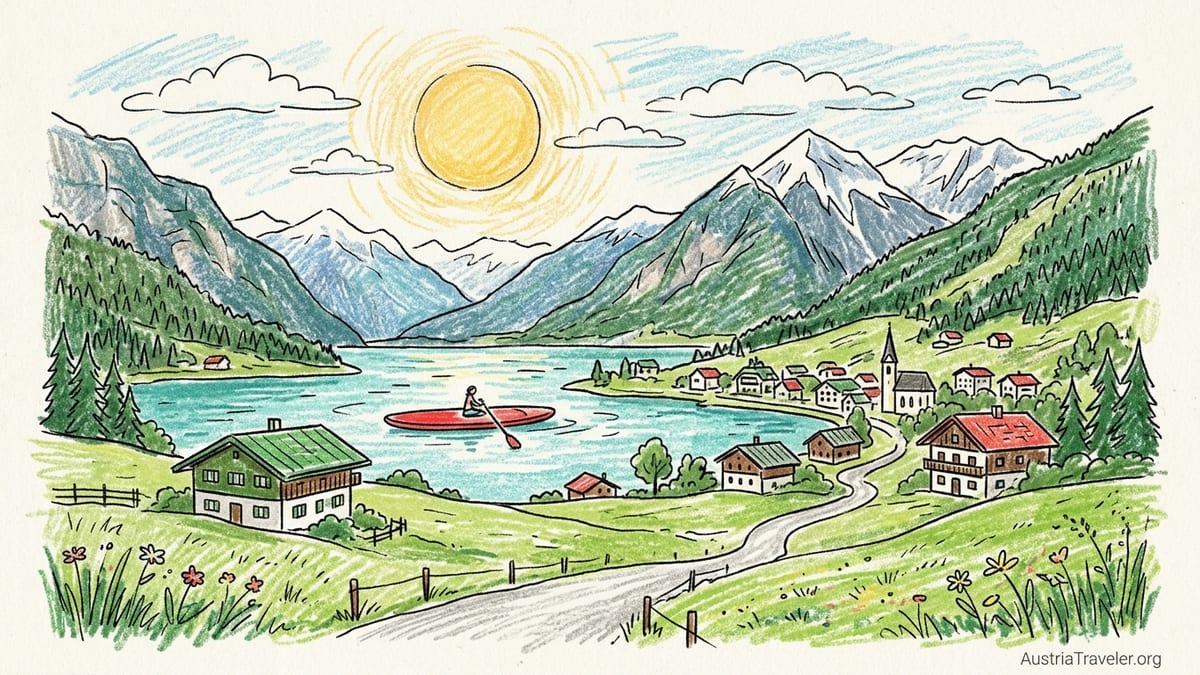
Achensee is a long turquoise lake trapped between steep flanks of the Karwendel and Rofan ranges, with small villages like Pertisau and Achenkirch strung along its shores. In summer, visitors can rent stand-up paddleboards, kayaks or pedal boats, or simply pay a modest fee to enter lakeside lidos with lawns, piers and access to the water. One public complex, Atoll Achensee near Eben, adds indoor and outdoor pools and saunas to the lakefront, turning a grey or stormy day into something genuinely relaxing rather than a compromise activity.
Later in the trip, Zell am See played a similar role. The town hugs a small mountain lake backed by ridges and glacier views from nearby Kitzsteinhorn. When another afternoon forecast threatened storms, we traded our planned high traverse for swimming at one of the lidos on the lakeshore, where guarded swimming areas, children’s play zones and rental options like pedal boats and paddleboards softened the blow of giving up an alpine route. The water was cool but refreshing, and the chance to float and simply stare up at the slopes we had been crossing all week felt like a reset.
Those lake interludes also kept our legs and joints happier. Before this trip, I often stacked three hard hikes in a row because the weather looked good or my ambition outpaced my training. Somewhere around the third descent, my knees would start to protest and every step on steep gravel would feel deliberate. Now I deliberately limit myself to at most two significant mountain days back-to-back before inserting either an easy valley stroll or a genuine rest day built around a lake or spa. In regions like Tyrol and Salzburg, where serious peaks sit within easy reach of swimmable lakes, those rest days can feel like highlights rather than compromises.
If You Have 5 Days: Commit to One Region
With the benefit of hindsight, I am convinced that a 5-day Austrian Alps trip has room for only one primary mountain region if you actually want to relax. A second micro-region might fit as a day trip from your base, but a mid-trip hotel change will cost too much precious hiking time. Think about it as four full days and one arrival or departure day, then subtract one more half-day for weather or fatigue, and the space for unnecessary driving simply disappears.
In Tyrol, that might mean basing entirely in or near Innsbruck and using regional buses and trains to access nearby valleys like Stubai or Seefeld for day hikes, returning to the same hotel every night. It could also look like four or five nights in Mayrhofen in the Zillertal, using its cable cars and post buses to reach side valleys and reservoirs without ever packing your bags. In Salzburg, it might be Zell am See or a village in the Salzkammergut such as Bad Goisern or Gosau, where lake and mountain options radiate out from a single hub.
If a traveller insisted on splitting a 5-night stay, I would limit it to two nights in a gateway city like Innsbruck or Salzburg and three nights in one mountain base, working the city stay at the beginning or end of the trip. Even then, I would accept that one of those partial days is effectively lost to checking in and out. The alternative, which I attempted on my longer trip, is to pretend that you can link Tyrol, Salzburg and perhaps even Carinthia in a neat loop. In five days, that loop turns into a car tour with alpine backdrops rather than a mountain holiday.
With just 5 days, I would also be ruthless about hike selection. Rather than scheduling four “big days,” I would plan two serious mountain outings, one gentler panoramic or hut walk using a cable car to gain elevation, and at least one partial day near a lake or river. That might look like a demanding ridge hike off a lift near Mayrhofen, followed by a boat and swim day at Achensee, then a second ambitious tour in a different side valley. The idea is not to underuse your time but to recognise that every hour you burn packing or driving is an hour you cannot be on the trail before the weather turns.
If You Have 7 Days: Two Bases, Not Four States
Seven days unlock more variety, but it does not suddenly make it wise to trace a huge loop through Tyrol, Salzburg, Carinthia and Vorarlberg. The temptation is strong because the names come up repeatedly in guidebooks and online searches. In practice, chasing all four federal states in a week would mean a string of one and two-night stays, constant packing, and a blur of cable cars with little depth in any one valley.
Based on my 9-night experiment, if I had exactly 7 days I would allow myself a maximum of two bases, ideally three and four nights. One logical pattern is to split between a valley or city hub and a lake or high-mountain resort. For instance, three or four nights near Innsbruck or in a Tyrolean valley such as Stubai or Zillertal, then three or four nights around Zell am See or another lake region. This arrangement keeps each transfer to about two hours or less while still delivering distinct scenery and hiking styles.
In such a 7-day plan, I would aim for four significant hiking days, one or two moderate days, and at least one day that can become either a rest or a weather buffer. That buffer day can be spent in the old town of Innsbruck, on a lake promenade, or in a spa complex such as those found near Achensee or in various Tyrolean resort villages. The key is to design it as a low-stakes day that you can move or repurpose when the forecast shifts or your legs complain.
Another advantage of keeping to two bases over seven days is that you become familiar with the local transport, guest cards and trail networks just as you might in a city break. In Zillertal, for example, a few days are enough to understand which post buses connect to which reservoirs and side valleys, how long the gondola lines tend to be after breakfast, and where you like to buy picnic supplies. That familiarity reduces the time overhead each morning and quietly gives you more actual mountain time across the week.
If You Have 10 Days: Three Bases and Built-In Flex
Ten days is where the Austrian Alps really open up, provided you still resist the urge to bounce across every famous corner. With this much time, I would personally allow for three bases at most, with a minimum of three nights each. This might look like a city plus two valleys, or two valleys and a lakeside region, or even three distinct mountain areas inside the same state if you are particularly focused. The key is not the number of federal states visited but the number of times you unpack your bag.
A classic 10-day pattern could be three nights near Innsbruck to taste urban Austria and sample an easy nearby valley like Seefeld, followed by three or four nights in a more intensely alpine valley such as Stubai or Zillertal, then three or four nights in a lake and glacier region like Zell am See and Kaprun. Another approach would be to keep everything within Tyrol, for example splitting time between the Innsbruck region, Achensee and an eastern valley closer to the Kitzbühel Alps. Critics might say this looks conservative on a map, but in terms of hiking quality and recovery, it feels luxurious.
With 10 days, I am comfortable scheduling runs of two or even three big hikes in good weather, knowing that I have space to insert a spa or lake day, or to sacrifice a route entirely when thunderstorms or low cloud roll in. On my own 9-night trip, a single day of all-day rain in Zillertal forced us to cancel a high panoramic hike. Because we had another three days in the valley, we simply reshuffled, sliding that itinerary into a later, clearer slot. Had we booked only two nights there, that route would have moved from the “maybe later” list to the “never saw it” list.
Crucially, 10 days allows you to give one base four nights without guilt. That length transforms the experience. In Zell am See, four nights meant two substantial mountain days using the cable cars, one flexible lake day that doubled as a weather hedge, and still enough time for an evening walk through the old town and along the lakeside promenade. Instead of feeling like we had “used up” the area, we left knowing we had both highlights and a few reasons to return, which is how a mountain trip should end.
The Takeaway
Looking back, my original plan to string together several Tyrolean valleys and then bolt on Salzburg’s Zell am See region inside 9 nights was not disastrous, but it was inefficient. Too many mornings disappeared into packing and transfers, and we relied on forgiving weather to salvage routes that would have been simple to schedule with a bit more slack. The mountains themselves were never at fault. The culprit was my refusal to respect the real costs of distance, weather and fatigue.
If I could rewind, my rule of thumb would be this: in a 5-day trip, one genuine mountain region with a single base is enough. In 7 days, pick two bases linked by at most a two-hour transfer and give each at least three nights. In 10 days, three bases are viable, but only if at least one of them gets four nights and you deliberately include at least one day that can become a weather buffer or complete rest. Anything more fragmented tends to feel like transit with photo stops rather than time in the Alps.
Within each base, I now cap myself at two major hikes in a row, followed by either a lake or spa day or a lighter valley walk. I view afternoon thunderstorms and lift closing times not as obstacles but as structural features of the trip that force good planning. Rest days are no longer what happens when I am too tired to move; they are what allow me to still enjoy the final descent on day eight or nine. That mindset is the quiet difference between a mountain holiday that feels like an endurance event and one that sends you home already dreaming about which valley to choose next time.
FAQ
Q1: How many Austrian Alpine regions can I realistically visit in 5 days?
With 5 days, it is sensible to focus on a single main region and one hotel base, perhaps adding a nearby valley as a day trip rather than moving hotels midweek.
Q2: What is the minimum number of nights you recommend per mountain base?
I now give each base at least three nights, even on longer trips, because anything less tends to lose too much time to packing, driving and learning a new area.
Q3: How many big hikes in a row are reasonable without a rest day?
For most reasonably fit hikers, two substantial mountain days back to back is comfortable, but a third can feel punishing without a lighter valley or lake day in between.
Q4: Why is a weather-buffer day so important in the Austrian Alps?
Summer often brings afternoon thunderstorms and low cloud, so a buffer day lets you reshuffle plans when lifts close early or high routes become unsafe or unpleasant.
Q5: Is it better to stay in a city like Innsbruck or directly in a valley?
For shorter trips, a city base like Innsbruck works well because several valleys are reachable by public transport, but for longer stays a dedicated valley base offers more immersion.
Q6: How far is too far for a day trip between Alpine regions?
Once a drive approaches ninety minutes each way, it will eat heavily into your morning hiking window, so I treat anything beyond about an hour as a candidate for an overnight base instead.
Q7: Should I prebook cable cars and mountain activities?
Lift tickets are generally bought on the day at valley stations, but accommodations that include regional guest cards can reduce costs, so booking lodging in advance is more important than prebooking lifts.
Q8: How do lakes fit into a mountain-focused itinerary?
Lakes like Achensee or Zell am See are perfect rest-day anchors, with swimming, boat rentals and promenades that let you recover without feeling like you have left the mountains.
Q9: Can I cover Tyrol, Salzburg, Vorarlberg and Carinthia in a 10-day trip?
You could touch all four, but doing so would create a rushed itinerary; in practice, three bases within one or two neighbouring states provide a richer experience.
Q10: What is the best season for this type of flexible Alpine itinerary?
Late June to early September usually offers open lifts and mostly snow-free high trails, though building afternoon clouds mean early starts and a weather-buffer day still matter.