


I learned to ski embarrassingly late. Over three winters in Austria I went from cautious snowplough on nursery slopes to linking confident turns on long blue runs. I did it not in famous headline resorts but in smaller, quieter areas that Austria Tourism now highlights as ideal for beginners. This is an honest look at what actually made learning easier for me and my partner, what frightened us, and which Austrian resorts I would now choose for a first ski week.
Why Smaller Austrian Resorts Helped Me Progress Faster
Before I booked my first ski trip I did what many beginners do: I almost chose a big-name area because it looked impressive on piste maps. Austria Tourism now explicitly encourages many first-timers to do the opposite and consider smaller, manageable resorts such as Almenwelt Lofer, Wildkogel-Arena, Hochzeiger, St. Johann in Tirol and Brandnertal. That advice matches my own experience. In the big interconnected regions I later visited, I often felt like a slow-moving obstacle in motorway traffic. In the smaller places where I actually learned, I felt like the resort had been designed with people like me in mind.
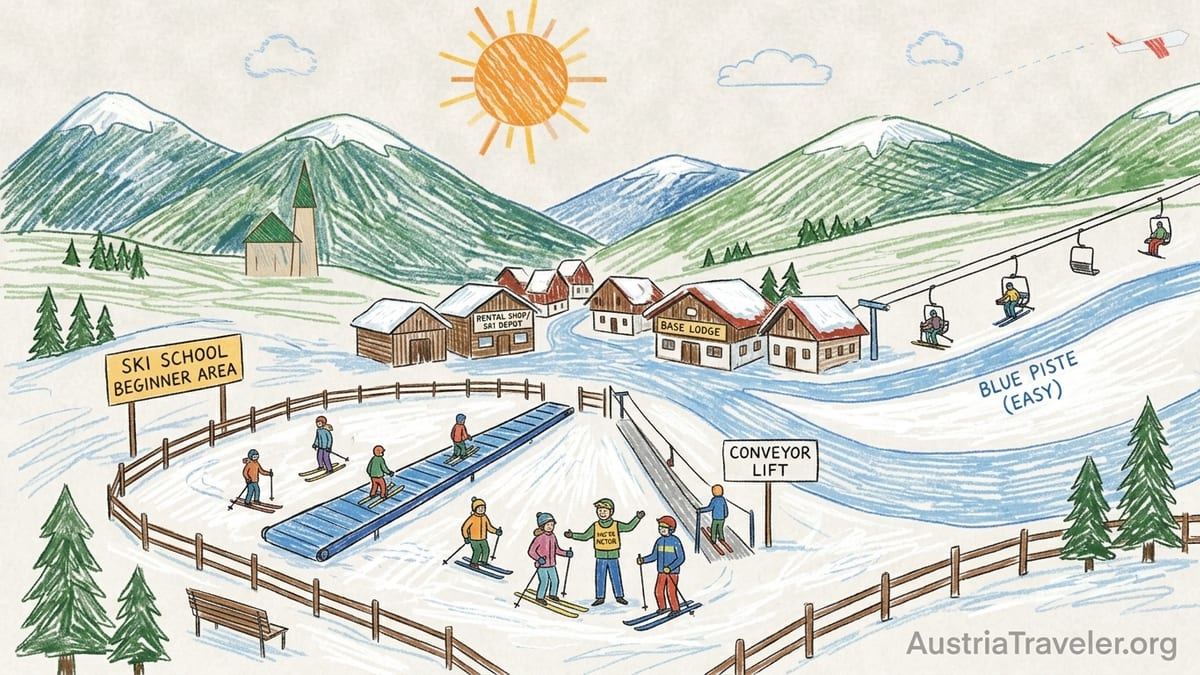
The difference was not the number of blue pistes but how the beginner terrain connected, how intimidating the lifts felt and how crowded the slopes were. In the compact areas I tried, the nursery slopes sat right next to the main base buildings, ski schools and rental shops. There were clear lines of sight so I could see exactly where I would end up if I slid down a little too fast. Conveyor belts and gentle drag lifts ran over very mellow gradients, so I had time to think rather than just react. That psychological breathing space mattered more than any statistic about kilometres of piste.
I also noticed how quickly stress built when the layout forced beginners to use busy connecting pistes or complex lift stations. On one early day in a larger Tyrolean resort, I had to exit a gondola straight into a convergence of several red runs. Faster skiers shot past on both sides and I froze. By contrast, in the friendlier areas described below, the transitions from nursery slope to easy blue runs were usually short, well signposted and never felt like being dumped into a highway.
Across three winters I ended up spending most of my true beginner and returning-skier time in Brandnertal in Vorarlberg, Almenwelt Lofer in Salzburger Saalachtal and Wildkogel-Arena above Neukirchen and Bramberg in Salzburg. All three now appear in official Austrian beginner-friendly recommendations, and for good reasons that I felt under my skis.
Brandnertal: Gentle Slopes and a Calm Learning Bubble
Brandnertal, in Vorarlberg, was where I finally clicked from defensive snowplough to something resembling real skiing. The ski area has around 64 kilometres of pistes with a clear emphasis on gentle terrain: roughly 20 kilometres are classed as easy, with the rest intermediate and only a small fraction marked as difficult. More important for me was how the beginner zone in the village of Brand formed a self-contained bubble. The Kinderland and dedicated beginner area sit right by the main base, with very flat, wide slopes, conveyor belts and a short drag lift that never feels steep. I could step out of the rental shop, see the whole area in front of me, and know I would never accidentally end up somewhere over my head.
My first proper week of lessons there was with the long-established local ski school in Brand. Group adult beginner lessons were advertised as week-long courses from Monday to Friday, typically three hours per day. When I last checked, a five-day adult group class cost in the region of a few hundred euros, while private lessons started around a little over 200 euros for two hours, similar to the publicly listed prices for private instruction at the partner Brandnertal ski school. I booked group lessons both for cost reasons and for confidence: being surrounded by other nervous adults made me feel less self-conscious when I fell over getting off the beginner lift.
The teaching area layout made a surprising difference. Brandnertal uses both conveyor belts and a very short T-bar in the nursery zone. The conveyor was my first step and felt like a moving carpet in an airport, just on snow. Loading was as simple as shuffling onto a marked line and letting it carry me uphill. Only after two days did our English-speaking instructor move us to the T-bar. It started almost completely flat, so the main task was to stay balanced, not to fight against the pull of gravity. The ski school meeting point was a clearly signed fenced-off circle beside the conveyor. I could see it from the bus stop, which reduced my beginner’s fear of getting lost in my gear on the first morning.
Crowding at Brandnertal was another positive. Even in school-holiday weeks the beginner area never felt chaotic. There were plenty of children’s classes, but they stayed mostly to one side, with another conveyor and play features. I rarely had anyone blasting past close enough to startle me. When we finally ventured onto the main blue piste served by a chairlift, that run was wide, with consistent gradient and obvious slow-skiing signs near the lift. I never felt that terrifying switch from flat to suddenly steep that I later encountered in other Austrian resorts where a “blue” run pinched into a narrow, scraped chute just before the bottom.
Lofer: Sunny Meadows and Straightforward Progression
Almenwelt Lofer, above the village of Lofer in Salzburger Saalachtal, was where my partner, a total first-timer, took her first turns. Austria Tourism now cites it as a model of a family and beginner-friendly area, with around 46 kilometres of pistes, ten lifts and notably gentle terrain. The practical experience matched that headline. After parking in the valley and taking the gondola up, we stepped into a sunny plateau where almost everything we could see was either an easy blue run or a dedicated practice slope.
The nursery slopes near the top gondola station included a fenced children’s area used by ski schools like Sport Sturm, which combines ski school, rental and depot under one roof. That set-up turned out to be invaluable. My partner rented her boots and skis in the same building where she checked in for lessons. The staff there spoke good English, patiently re-fitted her boots twice when she felt pressure spots and never made her feel rushed. Having the ski depot downstairs also meant we could leave the rental skis and boots by the lift each afternoon instead of dragging them back to our guesthouse in town.
She joined a beginner group course aimed at adults but mixed with some confident teenagers, running Sunday to Thursday for a few hours each day. Pricing for children’s group lessons in Lofer during the 2025–26 season was publicly listed around the low to mid hundreds of euros for six days, with adults somewhat higher depending on duration and high or low season. Lift passes were also comparatively gentle on the wallet. For example, a six-day ticket for both parents and one child up to 18 years in the main season was listed at a little under 680 euros, and a one-day ticket for that family combination around the mid 140s. That relative affordability reduced the financial pressure to “get our money’s worth” each day, which in turn made it easier to quit early when tired.
From a psychological point of view, what helped us most in Lofer was the clear, low-stress progression. The first two days were on a conveyor-belt nursery slope directly beside the meeting point. The gradient was so mellow that sliding backwards felt almost impossible, and the run-out at the bottom was long and flat. When the instructor judged the group ready, they moved to an easy blue that looped back to the same area. That blue stayed consistently gentle along its length, without surprise steep pitches or narrow funnels under lift pylons. Even where it intersected with other pistes, signage made it obvious who had priority. My partner reported that the scariest moment of her week was not the gradient but the first time she had to shuffle into line for a chairlift; once she realised the lift slowed right down for loading, the fear faded.
Lofer’s compactness also helped our confidence off the snow. The top area is essentially one open bowl with gentle ridges rather than deep valleys. On cloudy days we could still orient ourselves by a handful of visible huts and lift stations. That meant my partner felt safe enough by day four to ski a couple of laps on her own while I ventured briefly onto a slightly steeper blue. She knew that every lift she took would eventually bring her back to the same central plaza where we agreed to meet, without the risk of ending up three valleys away in the wrong village.
Wildkogel-Arena: Returning as a Nervous Skier
After a gap year with no skiing, I returned to the sport in the Wildkogel-Arena above Neukirchen am Großvenediger and Bramberg am Wildkogel. Austria now promotes this area as ideal for relaxed turns, with around 75 kilometres of pistes and a reputation for wide, enjoyable runs rather than extreme terrain. Coming back as a rusty intermediate, I was looking less for magic carpets and more for forgiving blue pistes that would not punish my mistakes.
The base villages are at relatively modest altitude, with gondolas whisking you up to a high plateau around the mid-mountain level. Near the top stations there are again dedicated beginner zones, including a children’s land in Bramberg and easy slopes served by short lifts. However, what struck me most was how gentle many of the main blue pistes felt once we left the pure nursery areas. Long, rolling runs followed broad ridges and open slopes rather than committing you to narrow traverses above steep drop-offs. In several places the resort had installed slow-skiing zones and fun features which naturally kept speed in check and encouraged cautious skiers to stay to the edges where they could take their time.
Because Wildkogel-Arena is linked to the wider Zillertal ticket system for multi-day passes, the lift prices were broadly comparable to other medium-sized Austrian areas aimed at families. When I checked a recent tariff sheet for the Zillertal Superskipass, which also covers Wildkogel from two days upward, a six-day adult ticket was priced in the mid to high four hundred euro range, with reductions for youths and children. For my return trip, I decided instead to buy a shorter local Wildkogel-only pass for a couple of days and focus on regaining confidence rather than chasing value across multiple valleys.
On the psychological side, Wildkogel-Arena was where I first realised how much compact lift infrastructure reduces beginner stress. At the top of the main Neukirchen gondola, the lift exits, ski school meeting point and nearest beginner slopes form a triangle within a few hundred metres. There are clear signposts, wide waiting areas and relatively calm queues outside peak holiday weeks. I never felt that panicked shuffle at a crowded funnel into a high-speed chair. The resort also operates ski buses linking the valley villages to the lifts, so even if you end your day in the “wrong” base area you can easily ride back without complex navigation.
One potential challenge at Wildkogel for absolute first-timers is that the most extensive beginner terrain is up the mountain rather than right in the village. This means day one can feel like a big step: rental, ticket, gondola ride and then arriving into a relatively high, sometimes windy environment. For me as a returning skier that felt exciting. For a true novice it might be worth booking a private lesson for the first afternoon to have an instructor guide you through those logistics and keep nerves in check on the initial ride down.
What Actually Helped Me Learn: Terrain, Lifts and People
Across these Austrian resorts, several specific factors consistently made learning easier, beyond the vague concept of “good for beginners.” The first was truly gentle gradient where it mattered most: right at the top of the beginner slopes and at the points where you exit lifts. In Brandnertal, the first ten metres off the conveyor belt are almost flat, so you have time to find your stance before gravity takes over. In Lofer, the exit from the main learner chairlift feeds into a broad plateau, not a steep roll-over. Those small design choices gave me mental space to remember my instructor’s tips instead of simply fighting to stay upright.
Lift design also played a big role in my stress levels. Conveyor belts were the ideal starting point. Short T-bars with very gentle pull came next. Fixed-grip chairlifts that slowed noticeably in the station and had staff on hand to help were manageable within a few days. The only times I truly panicked were at high-speed six-packs where the loading felt rushed and the queues packed. In the three resorts described here, those big lifts tended to serve more advanced terrain, so as a beginner I could avoid them entirely for most of the week.
English-language instruction was not an issue in any of the ski schools I used, but there were subtle differences. In Brandnertal and Lofer, both group and private lessons were easy to book in English. In my Brandnertal group there was a mix of German, Dutch and British guests; the instructor switched languages smoothly, but always repeated technical explanations in English for those who needed it. In Lofer my partner’s group was officially “international,” and on days when the group was dominated by German speakers she found that she had to ask for a little extra clarification in English, which the instructor gladly provided. If you are anxious about this, a private lesson on day one is a good investment.
Rental-shop fitting turned out to be more important than I expected. In Lofer, where rental, depot and ski school shared a building, we received calm, methodical boot fittings. Staff encouraged us to walk around, climb a small step and test how the flex felt. One afternoon my partner’s toes started to go numb on the nursery slope. She went back to the shop, which swapped her boots without any hint of blame. In a different, busier resort on another trip I experienced the opposite: a rushed fitting where no one checked my ability level or foot shape, resulting in shin pain that made me cut lessons short. For a first Austrian trip I would now always favour resorts where the main rental outlets advertise close cooperation with the ski school and have the time and space for careful fittings.
The Psychological Side: Crowds, Confidence and Compact Villages
As an adult learner, the psychological hurdles often felt higher than the physical ones. Crowding, speed differences and confusing layouts could undo a morning’s progress in a single scary moment. In Austria’s huge flagship areas it is common to share wide blue home runs with fast locals straight-lining to the bar after work. In my early days that was deeply intimidating. By contrast, in Brandnertal, Lofer and Wildkogel, I noticed more patient behaviour and clearly marked slow zones near ski-school areas. Fast skiers still existed, of course, but they were more likely to give you space.
Compactness of both the resort and the village helped my confidence every day. In Brandnertal, the main beginner slope, ski school office, lift pass counter and bus stop all sit within a short, almost flat walk. Carrying skis in chunky boots is hard enough without navigating long, icy streets. In Lofer, the valley gondola, rental shops and ticket office are clustered together, and the gondola ride delivers everyone to the same central plateau. That meant we never had to worry about being “stranded” in an unfamiliar corner of the mountain. Just knowing that we would always end up back at a single hub significantly reduced background anxiety.
My worst psychological moments came when a blue run suddenly narrowed or steepened without warning, especially near lift stations where crowds bunched. In one large Austrian resort not covered here, a supposedly easy home run dived into a short but intimidating steep pitch right before the bottom. The snow there was often scraped into ice by the afternoon, and I watched several fellow beginners slide down on their backsides. In the three focus resorts, I rarely encountered that kind of trap. When a blue run did become steeper, the section was usually short, straight and clearly visible in advance, so I could stop, breathe and plan my line.
Finally, having realistic expectations about energy and fear was key. In my first week in Brandnertal, five half-days of group lessons were enough. I spent the afternoons repeating the same easy slopes with my partner or simply resting. Trying to ski full days from the beginning would have left me exhausted and tense, which is when injuries happen. Most Austrian ski schools in these resorts scheduled adult beginner groups for two to three hours per day, which fits that pattern well. I would now recommend beginners plan for at least three consecutive days of lessons, ideally five, and treat progress outside lessons as a bonus rather than a goal.
What I Would Choose Now for a First Austrian Ski Week
Looking back, if I were organising a first-ever ski week in Austria for friends, I would deliberately avoid the famous mega-resorts and instead choose a place very much like Brandnertal, Lofer or Wildkogel-Arena. All three offered what mattered most in practice: simple layouts, generous beginner zones, calm lift loading and ski schools used to teaching in English. None required complicated lift combinations just to reach the learning slopes, and all had valley bases with accommodation that did not demand eye-watering budgets.
If the group included small children and absolute first-timers, Lofer would probably be my first pick. The sunny plateau, fenced children’s parks and combined ski school plus rental buildings took so much friction out of our days there. The pricing for family lift passes in recent seasons has also been relatively favourable compared with larger, higher-altitude destinations. That makes it easier to book private lessons or an extra day off without feeling that you are wasting an enormous investment.
For adult beginners who value a quieter, more alpine landscape and maybe want to mix skiing with winter walking, Brandnertal would be high on my list. Its village atmosphere, tree-lined slopes and compact beginner zone in the middle of Brand created a cocoon where I could focus on the basics. The clear split between very gentle beginner terrain and more challenging but still manageable blue pistes made it easy to step up gradually. English-speaking instruction was simple to arrange, and private lessons, while not cheap, were still more affordable than in some of Austria’s headline-name resorts.
For returning skiers who once skied comfortably on blues but feel rusty or nervous after a long break, Wildkogel-Arena is a strong candidate. Its long, rolling blue runs allow you to rebuild technique without fighting steep gradients, and its link with wider ticket networks offers the option to explore elsewhere later in the week if confidence returns quickly. However, for a true first-timer, the fact that most beginner terrain is up the mountain rather than in the village may add an extra layer of logistics on day one.
Whichever of these Austrian resorts you choose, the common threads that made learning easier for me were clear: nursery slopes with very gentle gradients and conveyor belts, beginner lifts that never felt violent or confusing, ski schools with visible meeting points and patient English-speaking instructors, and blue runs that remained genuinely easy without surprise narrow or steep sections. If those boxes are ticked, the exact number of kilometres on the piste map matters a lot less than many brochures suggest.
FAQ
Q1. How many days of ski lessons should a beginner book in Austria?
For most adult beginners, three to five consecutive days of group lessons, two to three hours per day, worked best for me and the people I skied with. In Brandnertal and Lofer I saw many first-timers become comfortable on gentle blue runs by the end of a five-day course, while one or two days often left people still struggling with basic control.
Q2. How much do beginner ski lessons cost in Austrian resorts like Brandnertal or Lofer?
Recent publicly listed prices in these areas put a five or six-day children’s group course roughly in the low to mid hundreds of euros, with adult group courses somewhat higher and private lessons starting from a little over 200 euros for a couple of hours. Exact prices change each winter, so it is worth checking the current season’s ski school tariffs when planning.
Q3. Are English-speaking instructors easy to find in Austrian beginner resorts?
In Brandnertal, Lofer and Wildkogel-Arena I had no trouble finding instructors who could teach in English. Group courses were often described as “international,” and private lessons could be specifically requested in English. In my experience, communication was never a barrier to learning in these resorts.
Q4. Do I need to worry about using difficult lifts as a beginner?
In the resorts where I learned, beginner areas relied mainly on conveyor belts and gentle drag lifts, with easy fixed-grip chairs serving the first blue runs. High-speed chairlifts and more complex gondola connections tended to serve steeper terrain, so I could avoid them until I felt ready. It is still worth telling your instructor on day one if lift loading makes you anxious so they can choose appropriate routes.
Q5. How crowded are beginner areas in Austrian family resorts?
In my experience, crowd levels in Brandnertal, Lofer and Wildkogel-Arena were manageable even in busier weeks, especially in the dedicated nursery zones, which often had separate conveyors or sections for ski school classes. The main pistes did get busier near lift stations and in the last hour of the day, but I rarely felt overwhelmed in the way I later did in some of Austria’s largest ski areas.
Q6. Is it better to rent ski equipment in advance or on arrival?
I found it easiest to reserve equipment with a rental shop that works closely with the local ski school, then finalise fitting on arrival. In Lofer, where rental, ski school and depot shared a building, staff had time to adjust my partner’s boots until they were comfortable. Booking online in advance often secures a discount, but the real value comes from a calm, careful fitting session on site.
Q7. How steep are the beginner slopes in these Austrian resorts?
The nursery slopes I used in Brandnertal, Lofer and Wildkogel-Arena felt very gentle. They were wide, with a shallow gradient that allowed me to practise basic snowplough turns without picking up excessive speed. When moving to blue runs, the best ones remained consistent in steepness and avoided sudden narrow or icy sections, which made them feel much less intimidating than their colour might suggest.
Q8. Are smaller Austrian resorts cheaper for beginners than big-name areas?
Smaller resorts like Lofer and Brandnertal often have more approachable pricing for lift passes and accommodation than high-profile mega-resorts. For example, recent published family pass prices in Lofer undercut many larger destinations, which reduced pressure to ski all day every day. While lessons themselves cost broadly similar amounts across Austria, the overall holiday budget in these quieter areas can be easier to manage.
Q9. Can I learn to ski in my 30s or 40s in Austria, or is it mainly for children?
From what I saw in these resorts, plenty of adults in their 30s, 40s and beyond were learning alongside children. My own beginner group in Brandnertal consisted entirely of adults, many of them complete first-timers. Austrian ski schools are very used to teaching older learners and generally structure adult classes with realistic pacing and lots of encouragement.
Q10. Which type of Austrian resort should I choose for my very first ski trip?
Based on my experience, I would choose a smaller, beginner-focused resort where nursery slopes, ski school and rental shops sit close together and where the first blue runs are wide and consistently gentle. Places like Brandnertal, Almenwelt Lofer or Wildkogel-Arena fit that description well and helped me build skills and confidence without the stress of navigating a huge, complex ski network on day one.