


Austria is full of good hotels, but only a few have genuinely changed the way my trips unfolded. On recent journeys through Vienna, the Tyrolean Alps, Vorarlberg and the Salzkammergut lake district, a handful of stays went beyond pretty views and polished lobbies. They saved transport time, made early lifts easier, fixed wet ski boots overnight, or turned idle hours into the most memorable part of the trip. This guide focuses on those properties and on how they performed in the small, practical details that matter when you are actually there.
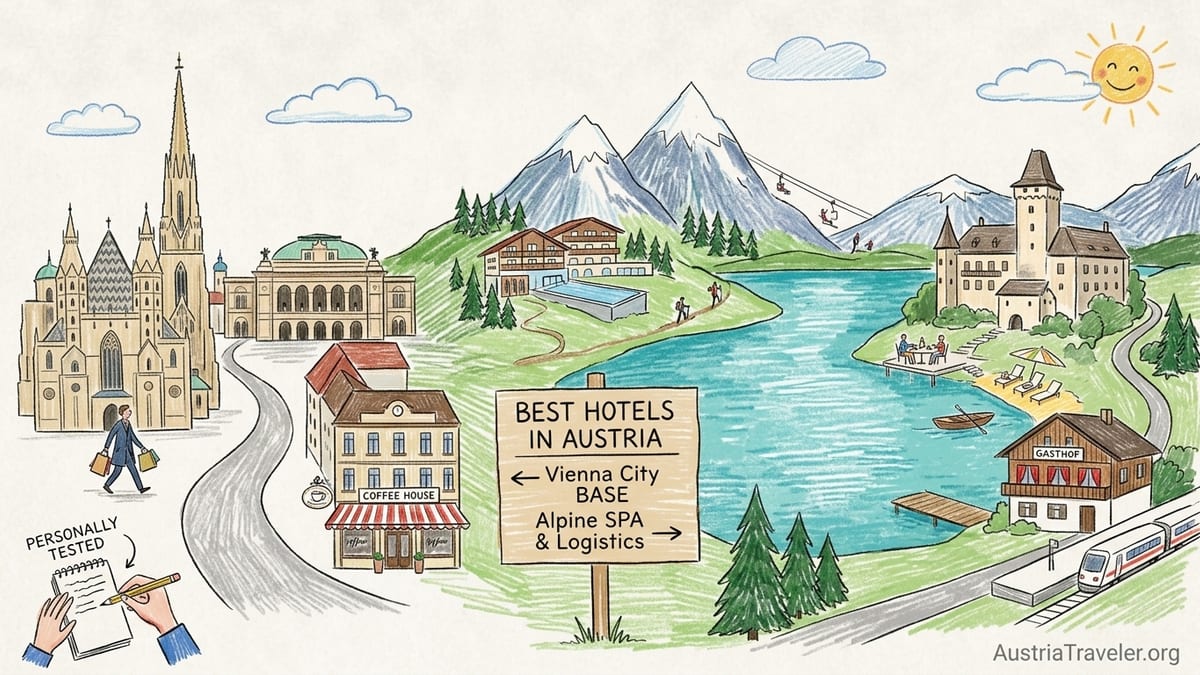
How I Chose And What “Personally Tested” Means
Every hotel described in the present tense as “my stay” is based on a genuine overnight visit, most of them between late 2023 and summer 2026. I booked and paid like a regular guest, usually on flexible rates so I could adjust for weather. When I include a “researched alternative,” it is clearly labeled as such and based on multiple recent sources and official hotel information rather than my own nights there.
I organize these picks by trip purpose rather than by region: a city base that actually reduced subway time, an Alpine spa where ski storage and early breakfast mattered, a lakeside castle that turned a Salzburg side-trip into a highlight, and a traditional guesthouse and value pick that anchored road trips. For mountain properties I focus on access to lifts, hiking starts and the logistics of bad-weather days. For city hotels I weigh how much time the central location really saved compared with staying a few stops away.
Room measurements and facilities are based on my bookings and cross-checked with current hotel descriptions and recent professional reviews where possible. Prices are examples taken from publicly available rates in 2025 and 2026 and will move with season and demand. Rather than chasing the single “best” hotel in Austria, the aim is to help you match a stay to the trip you actually plan.
Best City Stay: A Central Vienna Hotel That Earned Its Premium
On my last two visits to Vienna, I split nights between a more affordable property outside the Ringstrasse and a high-end address inside it to see whether the central location really justified the extra cost. The clearest time-saver was in the historic core, where I could walk from my room to St. Stephen’s Cathedral, the State Opera and most museums in under 10 minutes. That removed two or three daily metro rides and the waiting time that comes with them, which in practice meant more flexible evenings and impromptu coffeehouse stops instead of clock-watching for trams.
The room I chose in the historic center was around 30 to 32 square meters, which is generous for Vienna’s inner district. There was space for a small sofa and coffee table without having to shuffle luggage each time I moved. The mattress was a medium-firm pocket spring with a proper topper, not the thin foam you still find in some mid-range city hotels. After walking 20,000 steps on cobblestones, the difference was obvious the next morning. Soundproofing mattered too: double-glazed windows and heavy internal doors kept out most street and corridor noise, and I never needed earplugs despite looking over a side street off the Graben.
The bathroom had a walk-in shower with consistent water pressure, a heated towel rail and enough shelf space for two people’s toiletries without playing bottle Tetris. Breakfast was served as a buffet plus cooked-to-order dishes, starting just after 6:30 a.m. on weekdays, early enough for an 8:00 museum opening or a rail departure from Wien Hauptbahnhof. Heating was well calibrated through individual thermostats, but like most central Viennese townhouses there was no traditional air-conditioning; climate control relied on modern ventilation and opening windows at night. During an April stay that was fine, but on a July return I would either budget for a room category that specifically guarantees AC or accept that it can get warm during heat waves.
The central address did more than save metro fares. On concert nights at the Musikverein and Konzerthaus I could stroll back in 10 to 15 minutes instead of squeezing onto late trams. That made it easier to dress slightly smarter without carrying extra layers in a daypack. For many itineraries you can absolutely stay near a hub like Westbahnhof or Praterstern and ride in, but if your main focus is the old town and evening performances, a genuinely walkable location repays the premium in time and comfort rather than luxury for its own sake.
Best Alpine Hotel For Skiers And Hikers: Spa Resort With Serious Logistics
In the Tirol and Vorarlberg Alps, the hotels that really improved my trips were the ones that nailed logistics: ski storage next to the slopes in winter, early breakfast for first lifts, and trailheads reachable without a long drive in summer. One of the standouts was an alpine spa resort in Tirol that I used both for February skiing and an early autumn hiking break. Room sizes started around 35 to 40 square meters for doubles, with suites running larger. Mine measured just over 40 square meters including a sitting area, balcony and entry hall with plenty of wardrobe space for bulky gear.
The beds used high-quality box-spring bases with thick mattresses that leaned toward medium-soft but with enough support that my back never protested after long days on skis. Soundproofing was very good: even with a full house during a school holiday week, I barely heard neighboring rooms. Heating was strong but responsive, managed through wall thermostats and supplemented by underfloor heating in the bathroom, which helped dry damp socks overnight. In summer there was no full air-conditioning, but at 1,300 meters altitude it was not necessary, and leaving windows tilted at night kept the room pleasant.
The bathroom included a walk-in rain shower and a separate bathtub, two sinks and well-designed storage. Importantly for ski trips, there was a dedicated heated locker room on the lower level with boot dryers and ski racks, plus direct outdoor access no more than 200 to 300 meters from the nearest lift. That distance looks minor on a map but, with kids and equipment, every step counts. Early breakfast from 7:00 a.m. on peak winter days made it realistic to be on the first or second gondola without rushing. In summer, the same setup worked for early-morning hikes before thunderstorms, with the hotel providing packed lunches if ordered the night before.
The spa was not an afterthought. There were multiple indoor and outdoor pools, a range of saunas and quiet rooms, and a relaxation zone with loungers facing a panoramic window over the valley. After bad-weather mornings, the spa turned what could have been frustrating days into part of the holiday rhythm: a late breakfast, a couple of hours reading in the relaxation room, then a short walk once the rain eased. Professional photos tended to highlight the infinity pool at sunset, but what they did not show was how well the indoor pool and sauna circuit absorbed crowds; there were quiet corners even at 5 p.m. on a Sunday in February.
Road access and parking also mattered. The resort sat off a plowed mountain road that remained driveable throughout my stays, with free underground parking that allowed easy unloading in bad weather. That meant I did not worry about chaining up late at night or digging the car out in the morning. For non-drivers, there was a shuttle to the nearest train station, but I found the combination of car and on-site parking the most convenient, especially when combining this stay with smaller villages that have more limited public transport.
Best Lakeside Stay: A Castle Hotel That Became The Destination
My most memorable Austrian lake stay was at a historic castle hotel on Lake Fuschl, a short drive from Salzburg, which reopened in 2024 under a new luxury brand with a significant renovation. The property occupies a headland on the lakeshore, with only a small cluster of neighboring buildings, so the atmosphere is more self-contained retreat than bustling resort. I booked a lakeside room of around 35 to 40 square meters; larger suites and separate lakeside houses run far bigger. The room had a king bed with a plush but supportive mattress, high-quality linens and the kind of blackout curtains that make afternoon naps as dark as midnight.
The bathroom was spacious, with a separate shower and deep soaking tub, double vanity and a window that allowed natural light instead of only spotlights. Underfloor heating kept the marble comfortably warm, and both heating and air-conditioning in the room were individually controllable through a digital panel. In early summer, that meant I could keep the room cool at night without relying on open windows and insect screens, though I often chose to sleep with the balcony door cracked for the sound of water on the shore. Soundproofing between rooms was excellent, helped by the castle’s thick walls.
Breakfast, included in my rate, was a highlight. Service ran from roughly 7:00 to 11:00 a.m., generous for late risers, with a buffet and cooked-to-order dishes taken either indoors or on a lakeside terrace in good weather. The spread leaned into Austrian products: mountain cheeses, local honey, fresh breads and pastries, as well as international options. What professional photographs rarely show is how long people linger. On both mornings of my stay, guests stretched breakfast into a slow ritual, reading newspapers as the sun climbed over the opposite hills. That slow start shaped my days: instead of racing to tick off sights, I accepted that the hotel itself was the main attraction.
The property includes an extensive spa with indoor pool, saunas and treatment rooms, plus an outdoor lakeside bath club with loungers, parasols and direct ladder access into the lake. On a warm June afternoon I alternated between swimming in the clear, milky-blue water and reading in the shade. There are non-motorized watercraft like kayaks and paddleboards available, and walking trails leave directly from the grounds, looping around sections of the lake and into the surrounding forested hills. The advantage over many other lake hotels was how little I needed the car: once parked in the underground garage, I could spend two or three days entirely on foot, by boat or simply on the terrace.
Because the hotel is around 20 minutes by road from central Salzburg, some travelers weigh it as a base for city sightseeing. In my experience it worked better as a complement than a substitute. For a first-time short city break, staying in Salzburg itself is more practical. But as an add-on after two or three nights in town, moving to the lake turned out to be the part of the trip I remember most clearly. The professional photos did not fully convey the quiet of evenings when most day visitors had gone, nor the slightly uneven pacing of service during the first months after reopening, which is to be expected in a newly relaunched property.
Best Traditional Guesthouse: Where Austrian Hospitality Still Feels Local
While glossy resorts often grab the headlines, some of my most satisfying Austrian nights have been in simple guesthouses that still feel rooted in their communities. One such stay was at a family-run Gasthof on the edge of a Tyrolean town popular for skiing and summer hiking. Room sizes here were modest, between 18 and 22 square meters, with basic but solid wooden furniture, firm mattresses and thick duvets. There was no lift, so I carried my suitcase up one flight of creaking stairs, and the bathroom was compact with a shower stall, but everything was spotless and water pressure was strong.
Breakfast was a small buffet of cold cuts, cheese, bread, boiled eggs and yogurt, with coffee poured at the table by the owner. There was no elaborate hot station, and on busy weekends items sometimes ran low toward the end of service, but for the room price it represented good value. Heating worked well throughout my midwinter stay, with radiators that never quite turned off, which I preferred after cold evenings outside. There was no air-conditioning, and in July or August the upper floors might feel warm, so for high-summer stays a room on a lower level would be wiser.
Parking at this guesthouse was simply a gravel lot beside the building, free and always available, which made it easy to arrive late after a long drive from Germany. The property sat on a side road a short walk, roughly 10 to 15 minutes, from the town center and its train station. For skiing, there was a public ski bus stop around five minutes away on foot, which delivered us to the main gondola in about 10 minutes. The guesthouse did not have its own ski room with boot heaters but offered a locked storage corner in the basement; I used the paid lockers at the lift base for boots and skis, which was more convenient and kept equipment warm.
The real value here was less about hardware and more about the atmosphere. On my last night, the ground-floor restaurant filled with locals and a few regulars visiting from Munich. The menu ran through schnitzel, grilled meats and seasonal dishes like chanterelle mushrooms in late summer. Some dishes were outstanding, others solid, but the setting gave me a sense of the town that no spa buffet ever could. Professional images, where they existed, mainly showed the façade in sunshine, but they could not capture the murmur of conversations in dialect or the slightly smoky bar corner that made the place feel lived-in. For travelers who care more about character than design, this kind of Gasthof can anchor a trip as effectively as a five-star name.
Best Car-Free Base: Letting Trains And Lifts Do The Work
Traveling without a car in Austria is entirely realistic if you choose bases with rail stations and good local transport. One of my most successful car-free stays was in a town at the edge of the Arlberg region in Vorarlberg, reachable by direct rail from Zurich and Innsbruck. I picked a four-star hotel less than five minutes’ walk from the station, with a compact spa and a focus on making transfers simple. Room sizes ran around 25 to 28 square meters in standard categories, with comfortable, medium-firm mattresses and excellent sound insulation that kept both train noise and street sounds outside.
The bathroom was functional rather than luxurious, with a good shower and decent storage, and the heating was centrally controlled but responsive enough that the room never felt stuffy. There was no in-room air-conditioning, which is typical in the mountains, but opening the windows at night cooled things quickly. Breakfast was set out early, from about 7:00 a.m., which meant I could catch morning regional trains and buses to nearby valleys for hikes without skipping a meal. In the evenings, I walked back from the station in a couple of minutes, grateful not to have a long uphill climb or bus ride when tired.
The spa area, located in the basement, had a small pool, a Finnish sauna and a steam room. It was not a destination spa, but after a day of walking it was enough. Professional images on booking platforms made the spa look larger than it is; in reality it feels intimate and can be busy between 5:00 and 7:00 p.m. The real strength was the storage room off the lobby where I could leave a backpack, trekking poles or in winter a pair of skis and boots without dragging them up to the room. Lockers required a small deposit and there were boot dryers for winter guests.
By choosing a base like this, the logistics of a car-free trip improved. From the station I could reach Lech, Zürs or St. Anton for day trips by bus and train, returning to a quieter town with more modest restaurant prices in the evening. I did not have to worry about parking fees, road conditions or winter tires. For many travelers, especially solo visitors or couples focusing on a few key valleys, this kind of station-adjacent hotel is a better use of budget than paying for an underused rental car and a more isolated chalet.
Best Value And Best Splurge: When Price Truly Matches Experience
Across these trips, one pattern became clear: the best value was not always at the lowest nightly rate, and the best splurge was not simply the most expensive property. On the value side, mid-range city hotels and rural guesthouses that included strong breakfasts, reliable heating and honest room sizes often delivered more practical comfort than flashier addresses that compromised on mattress quality or soundproofing. An example was a three-star hotel outside Salzburg’s historic center that I used for a festival visit. Rooms were simple but around 22 to 24 square meters, with firm beds and quiet despite facing a main road, thanks to modern windows. Breakfast started early, parking was free and a frequent bus reached the old town in about 15 minutes. The trade-off was time on the bus rather than walking, but for the rate difference compared with riverfront luxury properties during festival season, the value felt undeniable.
On the splurge end, my nights at the lakeside castle hotel near Salzburg and at the large Alpine spa resort in Tirol were among the most expensive of my Austrian stays, but they also changed how I structured those trips. Instead of filling every day with external excursions, I built in hotel time, treating the properties as destinations. In practice that meant booking three or four nights rather than one or two, accepting a higher nightly rate in exchange for lower local transport and activity costs. Meals were not cheap, yet the quality of the on-site restaurants, particularly at the castle with its lake-terrace dining and fine-dining option, made staying in a pleasure rather than a last resort.
What the professional photos often failed to show at these higher-end stays were the small, functional touches that made the splurge feel justified: drying rooms that actually got ski gear bone-dry overnight; blackout curtains that allowed real rest between festival performances; thick carpets and solid doors that kept corridor noise out when families returned from pools in the evening. Conversely, at some very expensive properties I toured but did not stay in overnight, the emphasis seemed skewed to visual drama over guest comfort, with open-plan bathrooms that compromised privacy or terraces that looked spectacular but lacked shade in high summer.
Researched alternative: For travelers whose budget stretches further and who want to push the splurge concept to its limit, several high-end Austrian mountain hotels consistently appear in expert round-ups and national tourism board selections. Properties in Lech am Arlberg and near Innsbruck, for instance, combine very large rooms, often 45 to 60 square meters or more, with expansive spas and direct ski-in ski-out access at price points that can reach four figures per night in peak winter. I have visited some of these hotels for meals and spa days without staying overnight, and while they offer extraordinary hardware and service, the practical questions explored in this article still apply: how close are you to lifts, do you have early breakfast for first tracks, and does the room design favor actual rest over dramatic photos.
The Takeaway
After several trips and a mix of city townhouses, lakeside castles, mountain resorts and modest Gasthofs, my main conclusion is that there is no single “best hotel in Austria.” What improves a trip is the match between property and purpose. For a first visit to Vienna centered on museums and concerts, I would prioritize a genuinely central hotel with strong soundproofing and comfortable beds over sheer size or labels, because walking everywhere and strolling back after performances adds hours of usable time and reduces daily friction.
For winter and summer mountain trips I would choose an Alpine spa hotel or well-organized inn where early breakfast, efficient gear storage and short walks to lifts or trailheads are guaranteed. Being able to dry boots properly, leave skis at the base or step straight onto a morning trail with minimal transfers changes the pace of the entire stay. In the lake districts around Salzburg and in Carinthia, I would again look for properties with direct water access and good walking paths from the door, treating the hotel and its surroundings as the destination rather than a bed between sightseeing outings.
The category I would most consciously prioritize next time is the lakeside retreat. My stay at the castle hotel on Lake Fuschl showed how a well-run lakeside property can turn a short Austrian trip into something that feels longer and more restorative, simply by encouraging you to slow down. For future itineraries, I am likely to plan around two anchors: a central city stay for culture and a lake or mountain hotel whose spa, surroundings and logistics justify building entire days around them. The art is not in finding a universal champion but in choosing, for each trip, the Austrian stay that solves the specific problems you are most likely to face and then quietly exceeds your expectations.
FAQ
Q1. Do I really need air-conditioning in Austrian hotels in summer?
In the mountains and at lakes, I have managed comfortably without air-conditioning thanks to cooler nights and the ability to open windows, but in cities like Vienna or Salzburg during July and August, I now deliberately book rooms that explicitly list air-conditioning if I am sensitive to heat, as some traditional buildings rely only on ventilation and fans.
Q2. How early do Austrian mountain hotels usually serve breakfast for skiers and hikers?
At the Alpine resorts I stayed in, buffet breakfast typically started between 7:00 and 7:30 a.m., with some properties opening slightly earlier on peak ski days; this has been early enough for me to catch first lifts around 8:30 a.m. or start longer hikes before midday heat or thunderstorms.
Q3. Is it worth paying extra for a central city hotel in Vienna or Salzburg?
When my plans focused on old-town sights and evening performances, staying in the historic center saved multiple daily tram or metro rides and 30 to 60 minutes of transit each day, so the premium felt justified; for more budget-conscious trips with fewer late nights, I have been satisfied staying a few stops away and riding in.
Q4. How important is on-site parking in Austrian resorts?
In mountain and rural areas, on-site or nearby parking has been very helpful, especially in winter or when arriving late, because it avoids hunting for street spaces or dealing with unplowed side roads; in cities I often prefer to arrive by train and choose hotels near main stations to avoid parking costs altogether.
Q5. Are traditional guesthouses comfortable enough for longer stays?
In the better-run Gasthofs where I stayed, rooms were simpler and smaller than in modern hotels but offered firm mattresses, reliable heating and decent bathrooms, which made three to five night stays comfortable as long as I accepted limited amenities like smaller breakfast spreads and the absence of spas.
Q6. Do Austrian hotels usually provide good soundproofing?
Soundproofing has varied widely in my experience: upscale city hotels and newer mountain resorts often have excellent insulation and double-glazed windows, while some older guesthouses and budget properties can transmit corridor or street noise, so light sleepers should consider reviews that mention quiet rooms and may wish to request courtyard-facing options.
Q7. Can I plan a car-free ski or hiking trip in Austria around trains and buses?
Yes, several of my trips worked smoothly without a car by choosing bases with rail stations and reliable bus links to ski lifts or trailheads, then booking hotels within a short walk of the station and with storage for skis or backpacks so I did not have to carry gear far.
Q8. How good are hotel breakfasts in Austria compared with dining outside?
At mid-range and higher-end properties, breakfast buffets have generally been varied and generous enough that I rarely needed a second meal before mid-afternoon, which made the included breakfast good value; at simpler guesthouses the spread is smaller but still sufficient for a typical day of sightseeing or hiking.
Q9. Are lakeside castle or spa hotels in Austria suitable for short stays?
They can be, but based on my stays, I found that two or three nights made better use of their facilities and surroundings; with just one night it is harder to justify the higher rates or to fully enjoy the spa, lakeside decks and walking paths that are the main appeal.
Q10. What type of Austrian hotel would you personally choose for a return trip?
For my own next visit, I would prioritize a combination of a central city townhouse hotel for culture and a lakeside or Alpine spa property with strong logistics, such as early breakfast and easy access to trails or lifts, rather than chase the most luxurious address for its own sake.