


Austria markets itself as a year-round destination, and after several trips in very different seasons I can confirm that this is not just tourism-board optimism. I have sweated through July heat in Vienna, swum in Carinthian lakes in August, picked my way along muddy but empty autumn trails, and queued for Christmas-market punch with snowflakes collecting on my scarf in December. Each trip felt like a different country. There is no single “best month” for Austria; there are only better or worse months for the specific trip you have in mind.
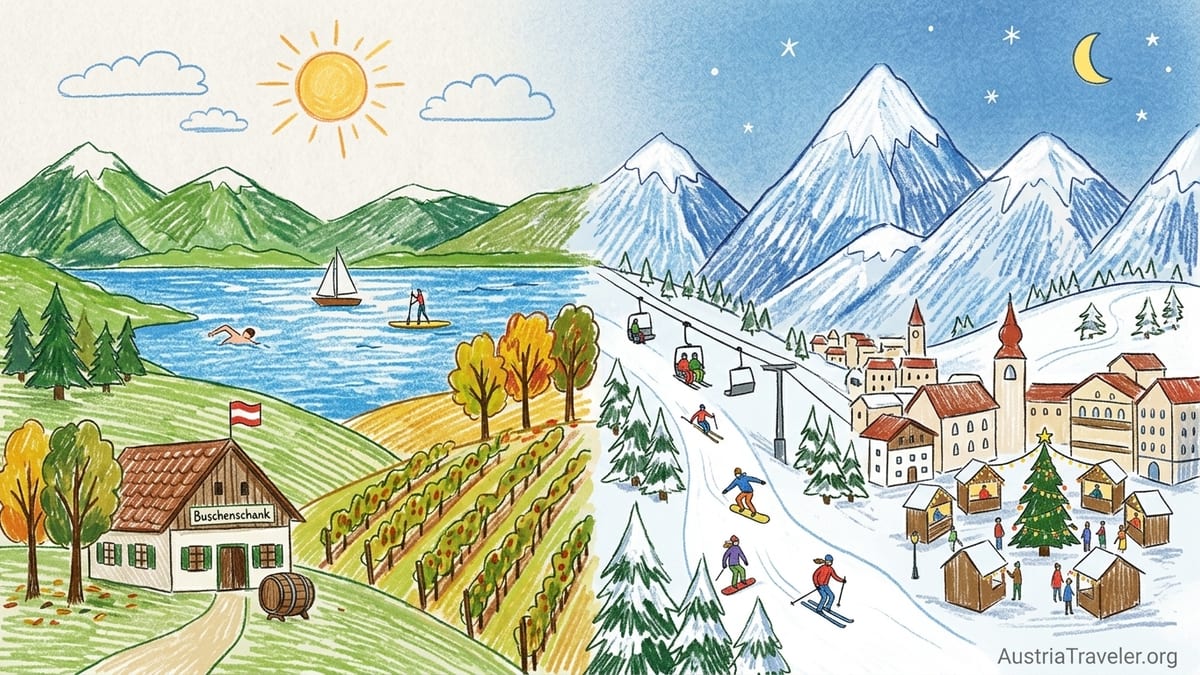
How Austria Really Feels in Different Seasons
On my first summer trip to Austria I split time between Vienna and the Salzkammergut lake district. In Vienna in late July, afternoon temperatures sat around the high 20s to low 30s Celsius, roughly the low to mid-80s Fahrenheit, with a sometimes heavy, close heat on still days. The stone courtyards of the Hofburg and the broad Ringstrasse avenues held the warmth well into the evening, and shade under café awnings felt as valuable as a museum ticket. By contrast, two hours away at Lake Attersee, evenings cooled enough for a light sweater, especially if you sat right by the water.
In August in Carinthia, near the Wörthersee, lake swimming was solidly in the “refreshing, but stay in as long as you like” category. Official measurements put warm Carinthian lakes in the low to mid-20s Celsius in high summer, and that aligned with the way my skin adjusted after a brief shock and then relaxed into the water. Families stayed in for long stretches, and local guesthouses advertised lake access just as proudly as they might a sauna in winter.
Winter felt like another country entirely. In December I based myself first in Vienna and then in a high-altitude ski area in Salzburger Land. Vienna in the run-up to Christmas was cold more than brutal, often hovering around freezing by day and a few degrees below at night, with that damp air you feel in river cities. A week later in the mountains, daytime highs some days stayed well below freezing and nights felt sharply colder, especially when the wind picked up on exposed chairlifts. The snow underfoot on groomed pistes was grippy and chalky in the morning and turned more packed and, later in the season, occasionally slushy on sunny afternoons lower down.
On an autumn visit to the wine-growing hills of southern Styria, the contrast was again striking. Early October brought chilly mornings where you could see your breath in the vineyards, but by mid-afternoon, sitting on a Buschenschank terrace among the vines, I was comfortable in just a long-sleeved shirt. The hills showed the first real autumn colors, and daylight lasted long enough for an afternoon walk through the rows after a late lunch.
Summer: Lakes, Heat in the Cities, and High-Altitude Hiking
Summer in Austria is a split personality: dense, often hot cities and fresh, watery countryside. In Vienna in July and August, pavement heat builds by early afternoon, and air-conditioning is not universal. Some newer hotels and international chains are fully cooled, but many traditional pensions and older apartments rely on fans and thick walls. On the hottest days, I structured my time with early-morning walks around the Innere Stadt, a long lunch indoors, and museum visits or coffee houses through the peak heat, only returning to outdoor sightseeing after 5 p.m.
By contrast, in the lake regions, summer warmth is exactly what you are there for. On the north shore of Attersee and around Mondsee and Wolfgangsee, my experience in August was that lake temperatures felt cool when you first stepped in but allowed for long, comfortable swims. Floating a few hundred meters from shore, I could see the steep slopes plunging straight into the water, and in sunny spells the surface warmed noticeably compared with deeper sections farther out. Paddlers, small sailboats, and stand-up paddleboards shared the bays without feeling crowded except on peak weekends.
Higher up, in areas like the Dachstein region or around Bad Gastein and the Gastein valley, June to early September brought mostly stable hiking conditions on marked summer trails. In my experience, mornings started fresh and sometimes slightly cool, especially above 1,500 meters, then warmed to T-shirt weather by late morning. Afternoon thunderstorms, however, were a real consideration. On more than one occasion in July I saw dark clouds building over the main Alpine ridge by mid-afternoon. I learned to set off early, aim to be descending by 2 p.m., and always carry a light waterproof even on apparently settled days.
Cable-car operations in these hiking areas mostly followed clearly advertised summer seasons, often running daily from late May or June through late September or early October. On one June trip to a smaller lift system, I found that midweek operations started later in the month than peak-season schedules, which meant an extra hour of uphill walking before I could access the panoramic paths. Larger resorts, such as those in Tyrol and Salzburger Land, were more reliable in early summer, with gondolas carrying a mix of hikers, downhill bikers, and families with strollers to mid-mountain plateaus.
Winter: Snow, Ski Traffic, and Christmas-Market Pressure
Winter in Austria is really two parallel seasons: pre-Christmas urban sparkle and deep-winter mountain skiing. In Vienna and Salzburg in December, the Christmas markets define the rhythm of the day. From late afternoon onwards, squares around city halls, cathedrals, and historic palaces filled with people. On Friday and Saturday evenings in the first half of December, I found popular markets nearly shoulder-to-shoulder from about 6 p.m. onward, with queues forming at the most photographed punch stands and food stalls. Visiting midweek, especially earlier in the evening, meant being able to wander without constant jostling.
In terms of hotel prices, my December stays showed a clear pattern. The first days of the month were relatively gentle on the budget in Vienna, with mid-range hotels still offering rooms at their “winter, not yet Christmas” rates. As the Advent weekends approached and especially from around 8 December, prices rose significantly, sometimes by half again for the same room category compared with late November. Booking three to four months in advance for those weekends made the difference between central locations and compromises on the city fringe.
Up in the ski resorts in December and January, snow conditions depended heavily on altitude and exposure. In a high, snow-reliable area such as Obertauern, which sits largely above 1,700 meters, I encountered a good base even before Christmas, with groomed pistes fully covered and off-piste areas showing a mixture of rock-free snow and some early-season hazards. In contrast, when I visited a lower resort closer to 1,000 meters early in the season, valley runs were reliant on snowmaking, and some forest trails showed thin, patchy cover, especially after a mild spell. By February on a return visit, those same runs held deep artificial bases topped up by natural snowfall.
Ski traffic peaked at predictable times. Over New Year and the February school holidays, lift lines in popular family resorts lengthened considerably between about 10 a.m. and 2 p.m. I found that starting skiing the moment lifts opened, typically around 8:30 a.m., allowed for several quick, uncrowded runs even in busy weeks. Lunchtime crowds hit on-mountain restaurants between noon and 1:30 p.m., with empty tables hard to find in the most scenic huts. Sliding my lunch to 11:30 a.m. or after 2 p.m. made the experience far more relaxed.
Spring and Autumn: Shoulder-Season Trade-Offs
Austria’s shoulder seasons in my experience were both rewarding and slightly tricky. In late March and early April, on a spring ski trip in Salzburger Land, I woke to hard, frozen corduroy on the pistes that softened into forgiving, carvable snow by late morning. By early afternoon, particularly on lower south-facing slopes, the snow often turned to wet, heavy slush that made the final run to the base a leg-burner. On cloudy or cooler days, however, skiing stayed pleasant deeper into the afternoon. Above about 1,800 meters, the base remained solid, and higher chairs and gondolas stayed the focus for most skiers once temperatures rose.
Trail accessibility for non-skiers in early spring was very mixed. On one March visit I planned a low-level valley hike on what looked like clear paths from below, only to find long shaded sections still icy and compacted from old snow. Local tourist offices and hotel reception staff were invaluable in pointing me toward genuinely clear walking paths, often sun-exposed loops near villages or lakes, rather than the more dramatic but still winter-bound mountain trails.
In autumn, my experience centered on the wine regions and lower Alpine foothills. Early October in southern Styria brought mostly dry weather with a mix of hazy sunshine and soft, grey days. Vineyards were busy with harvest, and many wine taverns, known as Buschenschanken, were open extended hours to handle both locals and visitors. That said, some higher-mountain lifts and alpine huts were already closing or operating only on weekends, making spontaneous high-altitude excursions more difficult. Around Salzkammergut lakes in late October, I found many small lakeside kiosks and rental booths already shut for the year, while year-round cafés and hotels remained open but noticeably quieter.
Prices in shoulder season were generally kinder to my budget. In both spring and autumn I was able to book good-quality, centrally located pensions and smaller hotels in places like Graz, Linz, and Klagenfurt for significantly less than peak summer or December rates, often with flexible cancellation policies. On the flip side, some seasonal restaurants in mountain villages were simply closed between the last hikers of autumn and the first skiers of winter, so I learned to check opening times carefully rather than relying on every marked restaurant sign along a road actually being open.
Vienna City Break vs Mountain Trips: Very Different “Best Times”
For an urban cultural break in Vienna, my personal sweet spots have been late April to early June and late September to mid-October. In late spring, days are comfortably mild, outdoor café terraces are already lively, and daylight stretches well into the evening, which makes post-opera or post-concert walks along the Ring pleasant. Museums, palaces, and concert halls are fully open year-round, so your main seasonal consideration is walking comfort and crowd levels, not access. In autumn, the city feels more local again after the height of summer tourism, and hotel prices often ease slightly compared with June.
In deep winter, Vienna’s charm lies in its interiors and festive atmosphere. On a December trip, I balanced time at the major markets around Rathausplatz and Schönbrunn with long hours inside the Kunsthistorisches Museum, the Albertina, and the opera. The cold outside made the cloakrooms and thick red carpets of imperial interiors feel especially inviting. The trade-off is shorter daylight; in December, by the time mid-afternoon rolled around, light was already fading, and if you like photography or outdoor strolling, you need to plan earlier starts.
In the mountains, the calculus is very different. For a dedicated ski trip, my experience pushed me toward January through early March for the best combination of reliable snow depth and reasonably long daylight. December had the advantage of Christmas atmosphere but carried more risk of thin lower slopes in warmer years, especially below about 1,500 meters. By late March and April, as I experienced, skiing became more about catching the right time of day on the right aspects, enjoying sunny terrace lunches, and accepting that afternoons were for spa visits rather than hard-charging laps.
For summer lake and hiking trips, July and August provided warm water and fully open infrastructure, but also the highest family crowds and premium pricing. I found June and early September to be gentler: lifts and lakeside services were operating, but trails were less busy, and the chance of a quiet cove on a big lake like Wörthersee or Attersee was noticeably higher midweek. In the wine regions, by contrast, late September and October felt ideal, with harvest in motion, grape must on menus, and golden slopes under soft light, even though swimming and high-mountain hiking season were essentially over.
How Easy Is It to Get Around in Each Season?
Austria’s rail and road networks worked well for me in every season, but the ease of moving around varied more than I expected. In summer, long daylight windows made travel days feel forgiving. I could take a morning train from Vienna to Salzburg, enjoy a few hours in the city, then catch a regional connection to a lake village and still arrive before dinner in full daylight. Construction works, which often happen in the warmer months, occasionally meant replacement buses on secondary railway lines, but signage and staff guidance were clear in my experience.
Winter required more deliberate planning. On December and February ski trips, I noticed that weekend trains into major ski gateways such as Salzburg and Innsbruck were busy, with reserved seats selling out in advance on some popular long-distance services. Luggage space filled quickly with ski bags. I learned to reserve seats where possible and to allow generous transfer times between long-distance trains and local buses up to resorts, especially when snow was falling and roads slowed. Nightfall before 5 p.m. in midwinter also shortened the practical arrival window if you preferred not to navigate new mountain roads in the dark.
In shoulder seasons, public transport remained reliable, but some tourist-focused services reduced frequency. Lake boats in Salzkammergut, for example, shifted from hourly or half-hourly summer timetables to a handful of daily departures in spring and autumn. On one October day, this meant timing a hike to ensure I returned to the jetty for the last boat of the afternoon rather than counting on a later crossing that only ran in July and August. Rental-car availability was never a major issue in my case, but I found that combining rail with local buses or taxis was usually more relaxing for mountain visits in winter, avoiding the need to think about snow chains or early-morning road ice.
Overall, the season that felt easiest for moving around the country was late spring into summer. With long daylight hours, frequent transport connections, and most tourist infrastructure open, I could plan relatively loosely and still end up where I needed to be. The period that demanded the most planning was December into early January. Between Advent weekends, Christmas closures, peak ski traffic, and winter driving considerations in the Alps, I needed to lock in trains, accommodation, and at least a rough dining plan well ahead of travel.
Where I Am Relying on Research Rather Than Personal Experience
There are corners of the Austrian seasonal calendar I have not yet experienced directly, particularly very early-season skiing in November and late-autumn conditions in some higher Alpine regions. For these periods, I draw on official information and broader research rather than personal impressions. High-altitude ski areas in Austria often aim to open from late November if snow cover and temperatures allow, with some glaciers offering even longer seasons. Data gathered over recent winters shows that resorts with ski terrain concentrated above roughly 1,800 to 2,000 meters, including several in Tyrol and Salzburg, build an early base more reliably than lower-lying, forested hills. However, even at these elevations, warm spells in early winter can affect valley runs, and no resort is guaranteed full coverage every season.
Similarly, for mid to late November city visits, my understanding is based on climate data and event calendars rather than direct stays. Average temperatures in Vienna at that time sit in the single digits Celsius by day, slipping toward freezing at night. Early Christmas markets sometimes begin by mid to late November, which can add atmosphere but also create specific weekend crowd spikes. Daylight is already limited compared with October, and rain is a frequent visitor, so November city trips lean more heavily on indoor cultural attractions and cafés than on long park walks.
In late April and May in the higher Alps, I have only passed through rather than staying overnight. From discussions with local hoteliers and information from regional tourism offices, this appears to be a transition period. Some ski lifts may still operate in high, north-facing bowls, while lower hiking trails are only gradually opening as snow retreats. Mountain huts often use this time for rest and maintenance before the summer hiking rush. Travelers who specifically want either reliable skiing or fully open hiking networks will generally be better served by targeting the core winter window or waiting until early summer.
Austria’s national and regional tourism organizations explicitly frame the country as a year-round destination, highlighting skiing and winter sports in the cold months and hiking, cycling, and swimming in the warmer ones. National tourism data emphasizes the breadth of outdoor options, from tens of thousands of kilometers of hiking and cycling routes to hundreds of lakes and mountain huts spread across the Alpine provinces. That official positioning matched my overall impression on the ground: there is always something compelling to do, but the “what” and the “how easy” shift substantially with the calendar.
The Takeaway
Across my trips, one message emerged clearly: Austria does not have a single best month to visit, only better months for specific kinds of journeys. A July week spent splitting time between Vienna and the Salzkammergut lakes will feel entirely different from a late-February ski holiday, and neither resembles an October wine-country escape or a Christmas-market tour. Weather, daylight, crowds, and prices all move on their own seasonal tracks, and there is no way to have peak lake-swimming temperatures, guaranteed deep snow, colorful vineyards, and quiet city museums all at once.
If you dream of warm water and high-alpine hiking, aim for mid-summer or the edges of it, accepting some heat in the cities in return for open trails and lively lakesides. For skiers, the heart of winter from January to early March offers the most dependable snow and daylight, with December adding extra magic but more need for careful planning. City-break travelers who focus on Vienna’s cultural life might find their happiest days in late spring or early autumn, when temperatures are gentle and crowds manageable, while food and wine enthusiasts will gravitate toward harvest season in the south and east.
The most important step is to decide what kind of Austria you want this time: blue lakes or white slopes, festive markets or harvest tables, museum marathons or panoramic hikes. Once you answer that, the calendar starts to narrow itself. Rather than hunting for a mythical “perfect” month, think in terms of matching your trip style to the season that supports it, then plan just enough to let the country’s year-round strengths show through.
FAQ
Q1. What is the best month to visit Austria overall?
There is no single best month for Austria. July and August favor lakes and hiking, January and February suit skiing, and April, May, September, and October work well for cities and wine regions.
Q2. When is the best time to ski in Austria for reliable snow?
From my experience and research, January through early March offer the most reliable combination of snow depth and daylight, especially in higher resorts above about 1,500 meters.
Q3. How hot does Vienna get in summer?
In July and August, Vienna afternoons often reach the high 20s to low 30s Celsius, so expect warm to hot city conditions and seek shade or indoor sights at midday.
Q4. Is summer a good time to visit Austrian lakes for swimming?
Yes. In July and August, lakes in regions like Carinthia and Salzkammergut are warm enough for long swims, with water typically in the low to mid-20s Celsius in sheltered bays.
Q5. Are Christmas markets in Austria very crowded?
In major cities like Vienna and Salzburg, Christmas markets get very busy on Advent weekends and evenings. Visiting midweek or earlier in the evening is noticeably calmer.
Q6. When are hotel prices lowest in Austria?
Prices are often lower in shoulder seasons, such as March, April, and October, and in early December before peak Advent weekends and the Christmas to New Year period.
Q7. Is it easy to get around Austria in winter without a car?
It is possible and often comfortable using trains and resort buses, but busy ski weekends and short daylight hours mean advance seat reservations and careful timing help a lot.
Q8. Which season felt easiest for moving around the country?
For me, late spring into summer felt easiest, thanks to long daylight, frequent transport connections, and most tourist services operating on full schedules.
Q9. Which season required the most planning?
December into early January demanded the most planning because of Advent crowds, higher demand for ski resorts, holiday closures, and winter travel conditions in the Alps.
Q10. Is autumn a good time to visit Austrian wine regions?
Yes. Late September and October are excellent for wine-country trips, with harvest under way, seasonal dishes on menus, and comfortable walking temperatures in the hills.