

I thought I knew Austrian Christmas markets before I moved beyond Vienna’s famous Rathausplatz stalls. After several seasons of looping between grand city squares and tiny Alpine villages, I learned that the real magic is not choosing “the best market,” but understanding how each type of market feels on a cold Advent night and building a trip around those contrasts. This is what stood out to me on the ground, and how you can use it to plan your own Christmas market journey across Austria.
How Austria’s Christmas Markets Actually Feel On The Ground
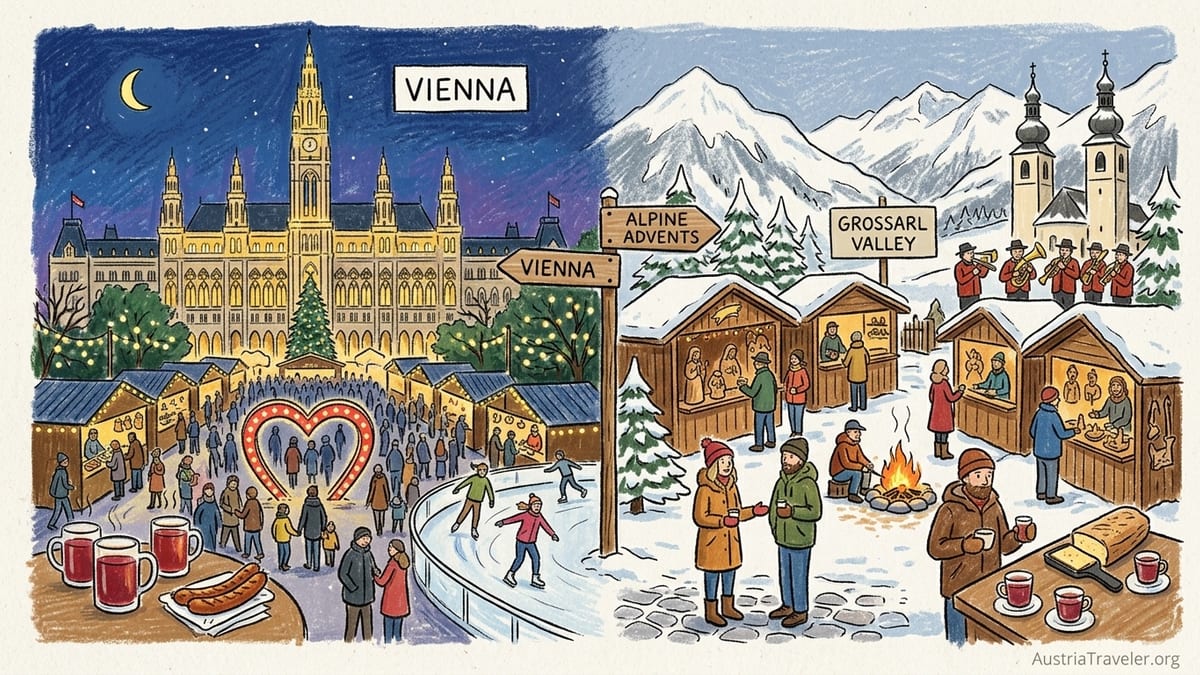
On paper, many Austrian Christmas markets look similar. They all promise wooden huts, twinkling lights, hot punch, and brass bands. Standing in the middle of them, though, the experiences could not be more different. In Vienna, the Christkindlmarkt at Rathausplatz wraps around the neo-Gothic city hall. Floodlit facades, a skating track curling through the park, and crowds taking photos under giant heart-shaped lights make it feel more like a winter festival than a neighborhood gathering. After an hour there on a Saturday night, I had visited fewer stalls than I had people-watched, simply because the human tide carried me along.
In Salzburg, the Christkindlmarkt spread across Domplatz and Residenzplatz felt tighter and older. The cathedral towers loomed dark against the sky, and the market was hemmed in by Baroque facades. Instead of a light park, there were choral concerts echoing off stone walls and the faint sound of church bells folding into brass band sets. Staying an hour there often turned into two, because the square invited lingering with a second punch instead of rushing for another photo angle.
Then there are the village Advent markets. In Grossarl’s Salzburger Bergadvent in SalzburgerLand, I found something different again. The market runs on Advent weekends, not every day, and it feels like the whole valley shows up. Snow squeaked underfoot, the stalls sold beeswax candles and carved nativity figures, and more people were speaking broad regional dialect than standard German. I stayed until closing without meaning to, simply because friends of stallholders kept stopping to talk and share local tips. That kind of unplanned conversation is rare in the big-city showpiece markets.
After moving back and forth between these settings, what stuck with me was not which market had the tallest tree or the prettiest mugs. It was how willing I was to slow down and stay put. In the smaller and regional markets, it became normal to linger for two or three hours, return on multiple nights, and recognize faces. In the flashier ones, I was usually ready to move on in about an hour, especially when the crowds thickened and the atmosphere turned more transactional than local.
Atmosphere, Darkness and Weather: Why Timing Your Visit Matters
The same market can feel entirely different at 3 p.m. in drizzle and at 7 p.m. under fresh snow. In Vienna, I learned to avoid the city’s best-known markets in the mid-afternoon if I wanted atmosphere. At Rathausplatz and Schönbrunn, twilight usually settles in by around 4 p.m. in December, and the moment the sky tips into navy blue, the entire setting shifts. The ornate facades become backdrops, fairy lights appear deeper, and even moderate crowds feel more festive and less like a street fair. On a cloudy day, I sometimes arrived just before dusk, took a slow lap as the last daylight faded, then settled in at a punch stand once the tree was fully lit.
Weather plays an even bigger role in the mountains. In Grossarl and Radstadt in SalzburgerLand, I visited on weekends when temperatures slipped well below freezing in the evening and light snow was falling. The cold air made the smell of chestnuts and smoke from open fires more pronounced, and the snow softened the sound of footsteps on the cobblestones. It also cut visits a bit shorter if I misjudged my layers. On one particularly raw night in Radstadt, with a stiff wind funneling down the valley, I stayed just over an hour. On calmer nights with light snow, I lingered much longer, warmed constantly by punch and the glow of braziers.
The extended Advent calendar in Austria gives you flexibility. In Vienna, major markets typically start opening in mid-November and run through Christmas or even into early January in the case of Schönbrunn and some New Year’s markets. In Salzburg, the main Christkindlmarkt by the cathedral usually opens on the penultimate Thursday in November and runs until New Year’s Day, while smaller markets around the region open on specific Advent weekends. That means you can pair a midweek city visit, when crowds are milder, with a weekend detour to a village Advent market that might only exist for a handful of evenings.
I came to favor cold, dry evenings around the middle of Advent, ideally from Thursday to Sunday when the Alpine markets were running but long before New Year’s crowds arrived. The darkness arrives early, but that also means more time when the markets are at their best. A 5 p.m. arrival leaves plenty of room for two or three hours of wandering before bedtime, and you can still catch a late train back to a regional base like Salzburg if you are day-tripping to a village market.
Food, Drink, Mug Deposits and Real-World Prices
Across Austria, food and drink prices at Christmas markets are high compared with supermarket shelves, but they are relatively consistent once you understand the system. In both Vienna and Salzburg, a standard 0.2-liter cup of Glühwein or fruit punch at a major market has recently hovered around 5 to 6 euros. On my last visits to Rathausplatz, Schönbrunn and the markets by Stephansplatz and Belvedere, I repeatedly paid in that range, with stronger liquor-based variations like rum punch adding roughly 1 euro.
The mug deposit, or Pfand, was almost always separate. In Vienna’s larger markets and in the Salzburg city market, I usually paid a deposit of around 3 to 4 euros per mug. That amount is added to the price of your drink, then refunded in cash when you return the mug to any participating stand. In some of the smaller markets in SalzburgerLand, deposits were slightly lower, around 2 to 3 euros, but the idea was the same. Only once, in a particularly tourist-focused stall near a photo spot, did I see a deposit push slightly higher, and it was clearly marked on the price board.
Food follows a similar pattern. In Vienna, a basic Käsekrainer sausage with bread at a Christmas stall cost me roughly 6 to 7 euros, with more elaborate plates climbing towards 10 to 12 euros. In Salzburg and at village markets like Grossarl, savory snacks such as raclette bread or local specialties like Pongau-style meat pockets tended to run between 5 and 9 euros depending on portion size. Sweet treats such as Kaiserschmarrn portions, waffles, or gingerbread hearts were typically a little cheaper, in the 4 to 7 euro range. I found that a modest dinner built entirely from market stalls for one person usually landed somewhere around 15 to 20 euros, including one drink and a dessert.
If you want to keep costs under control, the key is to understand how the deposit can quietly tie up cash. Ordering round after round of punch and keeping the mugs as souvenirs will quickly inflate your evening. Over several seasons, I settled into a habit: keep one or two mugs that really meant something, return the rest immediately, and share larger savory dishes between two people to sample more without overspending. This worked best in smaller markets where stallholders were more relaxed about cutting slices or splitting plates between friends.
Crowds, Music and How Long I Actually Wanted to Stay
The biggest surprise for me was how sharply my preferred “stay time” changed with crowd levels. In Vienna’s flagship markets, particularly Rathausplatz, Saturday nights in December could feel borderline overwhelming. There were moments when moving a few meters took a patient shuffle, and it was hard to hear the recorded music over the hum of conversation. Under those conditions, I rarely stayed more than an hour at a stretch. I would do one deliberate circuit, buy a drink and a snack, take in the main tree and ice skating area, then escape to a smaller side market like Am Hof or Freyung for some breathing room.
On weekdays, especially Mondays to Wednesdays in late November, those same spaces were transformed. The market by Schönbrunn’s palace courtyard, which felt packed and selfie-heavy on weekend evenings, became atmospheric but manageable on a Tuesday night. I happily stayed for two hours, tasting a few different snacks and browsing handcraft stalls without constantly sidestepping tripods. The softer classical background music and occasional live choir performances were actually audible, and I could appreciate the palace facade as more than a backdrop for photos.
In Salzburg’s cathedral market, crowds were steady but more manageable. Even on December weekends, I could usually find room around tall standing tables to rest my cup and chat. Brass bands played traditional carols from a stage or balcony, and the sound carried clearly through the square. I commonly spent between 90 minutes and two hours there, often split across an early evening wander and a quick return later that night for one more drink. The atmosphere was social but not frenetic, which made it easy to linger.
In Grossarl and Radstadt, I did not check my watch much at all. Music there took the form of local choirs, folk musicians, and small brass ensembles rather than amplified pop soundtracks. The smaller scale meant you could stand a few meters away and still hear everything clearly without raising your voice. In Grossarl’s valley setting, the surrounding slopes blocked some of the wind, and fires around the square offered warm-up spots. I had evenings when I arrived soon after opening, around dusk, and realized only when stalls started closing that three hours had slipped by. Those markets made it easy to forget about schedules, which turned out to be one of their biggest luxuries.
Comparing Large Urban Markets With Regional and Alpine Advents
Looking back at my notes and memories, the differences between Austria’s flagship city markets and its regional or Alpine Advent markets fall into a few clear patterns. Big-city markets in Vienna and Salzburg excel in spectacle. Rathausplatz has a skating rink under floodlit Gothic spires, Schönbrunn offers an imperial backdrop, and Salzburg’s Domplatz market is framed by a cathedral and fortress. Their stall lineups lean toward a mix of food, drink, and gifts aimed at both locals and a very international crowd, from handmade soaps and candles to mass-produced ornaments.
The smaller markets, especially in SalzburgerLand, trade some of that spectacle for locality. In Grossarl, Radstadt, and other village Advents I visited, the crafts stalls were more likely to sell items made within the region, like honey from nearby beekeepers, wooden decorations carved by craftspeople whose workshops were a short drive away, and hand-knit wool hats labeled with the maker’s name. There was little sense of repetition across markets. What you saw reflected the valley and its traditions more than a national template for “Christmas market goods.”
Music and programming also diverged. Urban markets, particularly in Vienna, often have rotating stages that feature choirs, school groups, and performances tied to tourism calendars. They can be delightful, but they also feel curated for a broad audience. In contrast, village markets felt more like community events that visitors were welcome to join. In Grossarl, I listened to local schoolchildren singing in dialect, watched families greet each other repeatedly, and noticed that many visitors were clearly from neighboring villages. It felt less like a seasonal attraction and more like the valley’s living room.
When friends ask whether the famous city markets are “worth it,” my answer is yes, but not as the whole trip. Vienna’s and Salzburg’s main markets are genuinely special if you accept them as festive, crowded, polished events. For many travelers they will deliver the archetypal Christmas-market moment. Yet the smaller regional and Alpine markets felt more authentic to me: quieter, more rooted in local craft and customs, and more conducive to long, unhurried evenings. The sweet spot for a first-time visitor is not choosing one over the other, but designing an itinerary that lets you feel both sides without burning out on repetition.
Toilets, Transport and Other Practicalities Nobody Talks About
Practical details can make or break a Christmas market evening, especially in the cold. In Vienna, almost all the major markets I visited had a mix of options for toilets. At Rathausplatz and Schönbrunn, there were fixed public facilities nearby as well as portable units at the edges of the market area. Some charged a small fee at the entrance, often around 0.50 euro, while others were covered by the city. Lines could build just after dark and before closing, so planning ahead was wise. Smaller inner-city markets like Am Hof relied more on nearby cafes and restaurants, where you might need to buy a drink in order to use the restroom.
In Salzburg’s old town, the cathedral market benefits from being integrated into a compact city center. I often ducked into nearby cafes or used well-maintained public facilities signposted off Residenzplatz. In village Advent markets like Grossarl, dedicated toilet containers and facilities in community buildings handled the traffic, and I rarely waited more than a few minutes. The overall standard was decent to good, with the usual winter market caveat that portable units feel colder and less comfortable later in the evening.
Public transport is one of Austria’s great advantages in Advent. In Vienna, the U-Bahn network brings you within a short walk of most major markets. Rathausplatz is an easy stroll from stations on the U2 and U3 lines, and Schönbrunn is served directly by the U4. Trams connect markets like Belvedere’s courtyard to the rest of the city, which meant I could string together three or four markets in one evening without resorting to taxis. In Salzburg, the cathedral market is reachable on foot from the main station in about 20 to 25 minutes or by trolleybus, and suburban Advents such as Hellbrunn run special shuttle services during the season.
Reaching the mountain markets requires more planning, but regular regional trains and buses make it feasible. I combined day skiing with evening market visits in Grossarl by using the valley’s ski bus network and regional bus lines from St. Johann im Pongau. For Radstadt, I paired a train ride on the line between Salzburg and the ski areas with a short walk into the walled old town. The key is to check the last return times in advance, especially on Sundays, and to be realistic about how punch consumption affects your energy and decision-making. More than once, good sense told me to take an earlier bus and end the night in my guesthouse bar instead of trying to squeeze in one last round.
Building a Christmas Market Trip Across Austria
Austria’s stretched-out Advent calendar makes it ideal for a multi-destination Christmas market trip. After several seasons of experiments, the pattern that worked best for me was to base in one city with excellent rail connections, typically Vienna or Salzburg, and then add one or two nights in a regional hub that gave easy access to smaller markets. The aim was never to see every market, but to curate a mix that offered variety without fatigue.
One itinerary that balanced things well started with three nights in Vienna from a Thursday to Sunday in late November. Arriving on a Thursday allowed me to experience Rathausplatz and Schönbrunn before peak weekend crowds hit, then use Friday or Saturday afternoons for inner-city markets like Am Hof, Freyung, and Belvedere. From there I took a Railjet to Salzburg for two or three nights, timing my stay so that it overlapped with one of the early Advent weekends when the cathedral market was already open and at least one village Advent nearby was in full swing.
From Salzburg, I added a day or overnight trip into SalzburgerLand. Grossarl’s Salzburger Bergadvent, which operates on the four Advent weekends and additional days like December 8, is a strong candidate. You can travel by regional train and bus, arrive by mid-afternoon, and watch as the valley slips into darkness and the market warms up. If schedules aligned, I also targeted Radstadt on another evening, since its atmospheric old-town square transforms beautifully with lights, local food stands, and musical performances. Returning to Salzburg late that night gave me the best of both worlds: an Alpine Advent evening and a city base with more accommodation options.
If you prefer to minimize hotel changes, the reverse approach also works. You can stay the entire time in Vienna or Salzburg and add Alpine markets as day trips, though winter daylight and transport schedules make that more intense. What matters most is to build in recovery evenings where you visit just one or two nearby markets slowly rather than racing through a checklist. After trying both approaches, I now structure any Advent trip in Austria with alternating “heavy” and “light” evenings, so I never string together three high-crowd nights in a row.
The Takeaway
Visiting Austrian Christmas markets beyond the famous ones taught me that there is no single “most authentic” experience. Vienna’s showpiece markets deliver scale, spectacle and convenience that are hard to beat, especially if it is your first Advent trip to Europe. Salzburg’s cathedral market wraps that atmosphere in a baroque old town that feels built for December evenings, with church towers and fortress walls framing the scene. Yet it was in the smaller markets of SalzburgerLand, in valleys like Grossarl and walled towns like Radstadt, that I found the longest, most relaxed nights and the strongest sense of place.
Planning a memorable Christmas-market trip across Austria means embracing those contrasts instead of choosing sides. Use the long urban season, from mid-November through the New Year period, to anchor your itinerary in Vienna or Salzburg. Then weave in regional and Alpine Advent markets that run on selected weekends, where the stakes are lower, the craftwork is more local, and the chances of ending up in a spontaneous conversation over a steaming mug are far higher.
If you give yourself the time and the flexibility to drift between grand squares and quiet village streets, you will discover that Austria’s Christmas markets are not a single attraction to tick off, but a whole season of different ways to stand in the cold with a warm drink and feel briefly, genuinely part of the winter around you.
FAQ
Q1. When do Austria’s main Christmas markets usually run?
Most major city markets in Vienna and Salzburg typically open in mid to late November and continue through Christmas, with some, such as palace and New Year markets, running into late December or early January. Smaller village and Alpine Advent markets often operate only on the four Advent weekends and certain holidays, so always check the current year’s dates before you travel.
Q2. How expensive are food and drinks at Austrian Christmas markets?
In recent seasons I have regularly paid around 5 to 6 euros for a standard cup of Glühwein or punch in big-city markets, with stronger versions slightly more. Simple savory dishes like sausages or raclette bread usually cost between 6 and 10 euros, while desserts such as waffles or gingerbread fall in the 4 to 7 euro range. A filling market meal with one drink typically lands near 15 to 20 euros per person.
Q3. How does the mug deposit system work?
When you order a hot drink, you pay both the drink price and a refundable deposit for the ceramic mug, usually around 3 to 4 euros in major markets and somewhat less in some village markets. You get the deposit back in cash when you return the mug to a participating stall. If you decide to keep the mug as a souvenir, you simply forfeit the deposit.
Q4. Are the famous Vienna and Salzburg markets really worth the crowds?
Yes, as long as you know what you are going for. Places like Vienna’s Rathausplatz and Schönbrunn or Salzburg’s cathedral squares are magical for their backdrops, lights and sheer energy, but they can be very crowded in December evenings. I recommend visiting them on weekdays or earlier in the season and balancing them with time in smaller neighborhood or regional markets where the pace is slower and the atmosphere more local.
Q5. How can I include Alpine or village Advent markets without renting a car?
It is practical to combine city markets with regional ones using trains and buses. For example, you can base in Salzburg and use regional trains and valley buses to reach places like Grossarl or Radstadt on Advent weekends, then return to the city the same night. The key is to check last departure times and to avoid planning long, late connections after an evening of punch and Glühwein.
Q6. What is the best time of day to visit the markets?
Twilight into early evening is when markets look and feel their best. Arriving around 4 to 5 p.m. in December lets you watch the lights come on and enjoy two or three hours of atmosphere before temperatures bite too hard. If you do not like dense crowds, avoid Saturday evenings in big-city hotspots and choose weekday nights or earlier in Advent instead.
Q7. Are there decent toilet facilities at Austrian Christmas markets?
In cities like Vienna and Salzburg, major markets usually offer a mix of public facilities and portable toilets, sometimes for a small fee, and nearby cafes also help. In village and Alpine Advents, dedicated restroom containers or facilities in community buildings are common. Standards are generally good, but it is wise to plan short visits before long train rides or bus journeys.
Q8. How cold does it get, and what should I wear?
Evening temperatures in Advent can sit around or below freezing, and it feels colder when you stand still with a drink. I was comfortable when I wore warm boots, thermal layers, a proper winter coat, hat and gloves, and occasionally hand warmers for Alpine markets. It is easier to enjoy the atmosphere and stay longer when you dress for a proper winter night rather than just a city stroll.
Q9. How many markets can I realistically see in one evening?
In compact city centers such as Vienna’s inner districts or Salzburg’s old town, it is realistic to visit two or three markets in a single evening, especially if they are within walking distance or a short tram or metro ride apart. Once you add Alpine or regional Advents to the mix, I recommend focusing on just one market per night so you are not racing transport timetables and can relax into the atmosphere.
Q10. What is a good length of stay for a Christmas-market-focused trip to Austria?
A week to ten days gives enough time to enjoy both major city markets and at least one or two regional or Alpine Advents without rushing. For example, you might spend three or four nights in Vienna, two or three nights in Salzburg, and one or two nights positioned for village markets in SalzburgerLand. With less time, prioritize depth over quantity and choose one city base plus a single well-timed day trip to a mountain or village market.