


From a distance, Austrian lakes all look like the same dreamy turquoise or mirror-flat blue. Up close, in swim shorts or a wetsuit with toes on a cold ladder, they could not feel more different. Over several recent summers and into September 2026, I have swum my way across the country, from Carinthia’s almost Mediterranean-feeling lakes to the sharper chill of Tyrol’s Achensee. This is not a catalog of “best lakes,” but a practical account of what the water, entries, beaches and lidos were really like, so you can match your swim to your body, not just your Instagram feed.
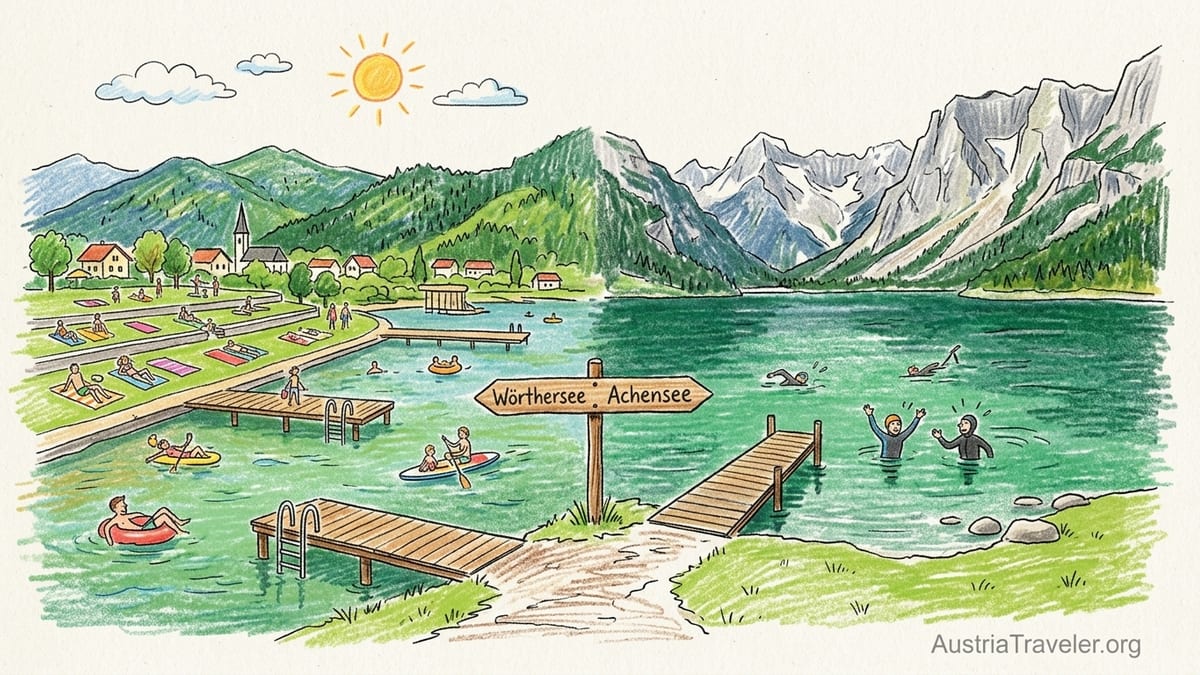
Why Austrian Lakes Feel So Clean, Yet So Different
Before talking about individual lakes, it helps to understand the baseline. Austria monitors around 260 official bathing sites, and recent European Environment Agency figures show that roughly 96 to 97 percent of these are rated “excellent” for water quality. In practice, that means crystal-clear water at most designated swimming spots, with almost no visible pollution and a reassuring lack of warning signs. The big differences for swimmers are not about cleanliness but about temperature, depth, shore profile and how you actually get in and out of the water.
For visitors, it is also useful to know that official bathing sites often have better infrastructure than a random patch of shore. The national bathing-water database, available via the Austrian health portal and local apps, lists individual sites with recent measurements, including water temperature during the main season. I leaned on those readings repeatedly in 2025 and 2026 trips, cross-checking my impressions against actual numbers on the day. Still, statistics do not tell you how it feels to tip your face into 20 degree water on a grey morning, or how crowded a lido jetty gets when the air hits 30 degrees. That part you only learn by getting in.
Across several summers I focused on a few contrasting lakes. In Carinthia, I swam in Wörthersee, Millstätter See and Klopeiner See, all known for warmer water. In Tyrol, I used Achensee as my main cold-water benchmark. Within each lake I tried at least one public lido or Strandbad, and at least one free-access stretch of shore where that was possible. What follows is a comparison of those sessions, not as a checklist of attractions but as a set of very physical impressions: how the water felt on bare skin, what the bottom was like underfoot, and how easy it was to linger.
Wörthersee: Warm Water, Social Swimming in Carinthia
My first long swim in Wörthersee was near Klagenfurt, at the municipal Strandbad on the eastern shore. On a sunny late August afternoon, the official display board at the lido entrance showed 25 degrees for the water, consistent with regional reports that Wörthersee can hold well above 20 degrees through late summer. Stepping down the stainless-steel ladder into the lake felt more like a heated outdoor pool than a mountain lake. There was no gasp, no shock, just an immediate sense that I could stay in for an hour without thinking much about cold tolerance.
The entry here is mostly via ladders and a few gently sloping ramps from floating platforms. Near shore the depth drops surprisingly fast. Within three or four strokes I could no longer touch the bottom, and under the diving tower it felt like open water. The clarity is excellent, with a pale green-blue hue, but this is not a shallow, sandy lake. When I did stand up near the cordoned-off shallow zone, the bottom was fine gravel with a few patches of silt, pleasant enough underfoot. For families with small children, the roped-off shallows at the very edge are the only area where you can stand comfortably, so non-swimmers tend to cluster along that strip.
The Strandbad itself is classic Austrian lakeside infrastructure. Behind the waterline there are broad grass terraces, mature trees offering shade, and a narrow pebble and gravel beach at the lake edge. Changing cabins are plentiful, with both open cubicles and lockable lockers, and there are proper indoor-style toilets and hot showers included in the entry price. In summer 2026, the day ticket for adults was just under 10 euros, with afternoon and evening discounts. There were lifeguards perched on raised chairs along the main swimming zone, whistles in use whenever someone drifted past the buoys. Food options ranged from a basic self-service restaurant doing schnitzel and fries to an ice-cream kiosk that never seemed to have a quiet moment once school was out.
By mid-afternoon, the water here became busy rather than serene. The surface was dotted with inflatable rings, children in arm bands, serious lane swimmers doing freestyle along the outer rope, and paddleboarders gliding just beyond. If you enjoy social swimming, drafting behind other people and never being far from a ladder, Wörthersee at a large lido is ideal. If you crave solitude or hate navigating through crowds, you will probably prefer an early-morning session, when the air is still a little cool but you can have a whole lane of lake to yourself.
Millstätter See: Deep Blue, Quick Drop-Off and Quieter Corners
Millstätter See, also in Carinthia, feels different as soon as you step in. At the Seeboden Strandbad on the north-west shore, an electronic board showed 23 degrees on my early September visit in 2026, which matched regional reporting that the lake was still comfortably swimmable in late season. Yet compared with Wörthersee, the first impression in the water was cooler, and the color was a slightly darker blue. The lake is deep, and that depth seems to register on your skin once you move away from shore.
The entry here combines a narrow, gritty beach with a long, wooden jetty. Walking in from the beach, the water stays knee-deep for only a few steps before it drops to waist and then chest depth. Fine gravel underfoot gives way to softer sediment, and I occasionally felt small stones and plant stems as I waded out. Water clarity was still excellent, but there is more of a lake smell, a reminder that you are in a large natural basin rather than a manicured pool. Off the end of the jetty, there is no chance of standing; it is straight into deep water, which suits stronger swimmers and anyone training for open-water events.
Behind the shore, the Seeboden lido is less built-up than its Wörthersee counterparts. There are grassy lawns, some tall trees for shade, a modest children’s play area and a single main service building. Basic changing rooms, toilets and pay-per-use warm showers are tucked under the structure. When I visited, the day ticket for adults was slightly cheaper than at Wörthersee, a bit under 8 euros, and there was free parking in a gravel lot a short walk away until it filled up in the late morning. A small cafe handled coffee, pastries and light lunches. There were no very elaborate restaurant terraces or nightlife vibes, which kept the general feel calmer.
In the water, the crowd thinned noticeably beyond the roped-off shallows. Most families stayed near shore, while a loose line of more confident swimmers traced back and forth between buoys several dozen metres out. Without heavy boat traffic in the immediate area, the surface stayed relatively smooth, making it an easy place for longer, rhythmical sessions. If you are comfortable with 22 to 23 degree water and do not mind losing sight of the bottom beneath you, Millstätter See offers a very satisfying, almost meditative swim, especially on clear mornings when the surrounding hills reflect in the dark surface.
Klopeiner See: Almost Bath-Like Warmth at a Compact Lido
Klopeiner See is often mentioned as one of Austria’s warmest bathing lakes, and my experience there at the southern Sportstrand confirmed the reputation. On a mid-September 2026 visit, the on-site display and regional monitoring both showed water temperatures around 24 to 25 degrees on my swim day, after peaks over 26 degrees earlier in the month. That is a remarkable figure for a natural lake at this latitude. When I stepped down from the jetty, there was virtually no thermal shock. It felt very close to an indoor pool set to a comfortable training temperature.
The entry at Sportstrand Süd combines a short concrete apron, a narrow strip of pebbly shore and several jetties with ladders. Near shore the bottom is fine sand mixed with small stones, firm and pleasant underfoot. It stays shallow for a little longer than at Wörthersee or Millstätter See, giving children a larger area where they can stand. Even beyond chest depth, the water remains unusually warm, which encourages long, lazy swims parallel to the shore. Visibility is high, with a greenish tint that glows on sunny days, and I could clearly see the line where reeds and aquatic plants began closer to the banks.
The lido infrastructure here is compact but efficient. There is a large grassy area just behind the water with plenty of space for towels, plus a few small trees and parasols for hire. The facilities block houses separate men’s and women’s changing areas, flush toilets and basic showers, with an extra coin-operated hot shower by the exit. In 2026, the day entry fee was in the lower single digits for adults, noticeably cheaper than the biggest Carinthian lidos, although operators adjust prices slightly each summer. Parking near the entrance was paid but not expensive, and several local guesthouses offered their own private strips of shore for guests, usually accessible only with a room key or wristband.
On warm afternoons the water at Klopeiner See gets dense with people. This is a social lake, with pedalos, stand-up paddleboards and children’s inflatables all competing for space. Lifeguard presence at the municipal or public-access lidos keeps things reasonably organised, but it is not a place for solitary contemplation in peak season. If you are sensitive to cold, though, or want to introduce hesitant swimmers to alpine-lake bathing, Klopeiner See is a strong candidate. It rewards people who enjoy bobbing, playing and staying in for very long periods without ever worrying about numb fingers.
Achensee in Tyrol: Cold, Clear and Demanding on the Body
Achensee, Tyrol’s largest lake, could hardly feel more different from the Carinthian trio. At around 930 metres above sea level and surrounded by the Karwendel and Rofan ranges, it behaves like a true alpine lake. Regional tourist information describes typical summer temperatures near shore around 20 to 22 degrees during July and August, which match the values I found on local boards. That is a comfortable figure for many swimmers, but the overall impression is still cooler and more bracing than the warmest Carinthian waters, especially outside the very peak of summer.
My most telling swim here was at Buchau lido near Maurach in late August. The official thermometer at the ticket desk gave a reading just over 20 degrees. On paper, that sounds similar to an average indoor training pool. In practice, stepping down from the jetty into the emerald water felt significantly colder. Achensee is deep and fed by mountain streams, and the temperature drops quickly with distance from shore. Within the first few strokes my face and hands prickled, and after ten or fifteen minutes of continuous swimming without a wetsuit I could feel the early stages of cold creeping into my shoulders and forearms.
The entry at Buchau is a combination of short sand and gravel beach with a broad jetty. Near shore the lake bed is light-coloured gravel that gives way quickly to steep depth. Visibility is striking, with underwater rocks and fish visible several metres down. This looks beautiful but can mislead visitors who judge warmth by colour alone. Children paddled happily in the shallows, but very few adults stayed in beyond fifteen or twenty minutes unless they were committed open-water swimmers or wearing neoprene. At another free-access spot near Pertisau, where there is no lifeguard and only a simple grassy bank, the same pattern held: inviting surface, cold core.
Facilities also vary sharply between official lidos and free stretches. At Buchau lido, my day ticket included access to proper changing rooms, toilets and warm indoor showers. There were lifeguards on duty during posted hours and a small kiosk selling snacks and hot drinks, which felt essential after time in the water. The fee in 2026 was in the mid single digits for adults, and the car park alongside the lakeside road required a separate parking ticket from the machine. In contrast, at the unstaffed free-access point I used near Pertisau, there was no changing cabin, no toilet and only a litter bin. I changed behind a towel, got in via the natural stony shore and kept my swim short, knowing there was nowhere warm to recover nearby except my car.
Achensee reinforces an important lesson about cold-water tolerance. Many reasonably fit people can enjoy short swims at 18 to 20 degrees, but continuous distance swimming in this range demands acclimatisation, extra body fat or neoprene. The water here feels alive on the skin, almost electric around wrists and ankles. For some, that sensation is invigorating and addictive. For others, it is simply uncomfortable. No matter how spectacular the mountain backdrop, this is not the best choice for those who want to spend an hour casually floating without thinking about getting chilled.
Free Shores, Municipal Lidos and Private Hotel Strips
Across these lakes, the same pattern repeats in different forms. There are three main types of access: free natural shore, municipal Strandbad or lido, and private access attached to hotels or campsites. Each offers a very different bathing experience, regardless of the lake itself. Understanding the trade-offs is as important as choosing the right region or water temperature.
Free access along a natural shore gives you the most freedom and often the quietest swims. On Millstätter See I found a small, unsigned patch of public shore between two houses, marked only by a municipal “Badeplatz” board. There was a simple metal ladder embedded in the bank, a grassy strip just wide enough for a towel, and no built structures. The water was identical in quality to the nearby paid lido, but there were no changing rooms and no toilets. This kind of spot is perfect if you travel by car, are comfortable changing discreetly, and plan shorter dips rather than full beach days.
Municipal and commercial Strandbäder are the familiar workhorses of Austrian lake tourism. At Wörthersee’s large lidos and at the Seeboden Strandbad on Millstätter See, I could expect manicured lawns, shade trees, solid toilets and showers, snack bars and sometimes restaurants, supervised children’s areas, lifeguards during the main season, and secure entry control. The trade-off is cost and crowding. Day entry prices for adults on the major lakes commonly sit somewhere between 5 and 12 euros depending on the scale and extras, and on hot weekends it can feel like half the region has turned up by lunchtime. For families or anyone who values showers and changing cabins, the structure is worth it. For minimalist swimmers who just want an early dip, it can feel excessive.
Private hotel access lies somewhere in between. On Klopeiner See, several hotels advertised “private lake access” with jetties, small sunbathing lawns and direct ladders into the water reserved for guests. I stayed one night at a mid-range guesthouse with such a strip. There was no lifeguard, and facilities were limited to sun loungers and a simple outdoor shower, but the convenience of stepping out of a room and into the lake within two minutes was undeniable. Access felt calmer and more controlled than at the large public lido, even when the main water surface was busy. The limitation is that you only have this access while you are paying for a room, and it can make you less likely to explore other entry points around the lake.
Matching Lake Temperatures to Your Own Cold-Water Comfort
One of the most common mistakes visitors make is to pick lakes primarily on scenery, without considering how long they actually want to stay in the water. A turquoise mountain lake looks inviting in photos, but if you are used to indoor pools above 26 degrees, even an official reading of 20 to 22 degrees can feel shockingly cold after ten minutes. There is no universal line between “comfortable” and “too cold,” because it depends on body size, insulation, swim intensity and experience. Recent research on open-water swimming has even suggested that safe exposure time changes dramatically with relatively small shifts in temperature when you factor in wind, wave action and individual physiology.
Through trial and error, I found that my own comfort band for longer, relaxed swims without a wetsuit sits around 22 to 26 degrees. Within that range I can stay in 30 to 45 minutes without much thought. At Wörthersee on a 25 degree day and at Klopeiner See around 24 to 25 degrees, I actually had to remind myself to get out for sunscreen and hydration breaks. At Millstätter See at 23 degrees, I felt fine but aware of the water on my skin in a pleasant, alert way. Achensee at 20 degrees, on the other hand, demanded more discipline. After fifteen or twenty minutes my hands grew noticeably cooler, and I was glad to have a warm layer waiting on shore.
For anyone planning a trip, it helps to think of Austrian lakes in rough temperature bands rather than single numbers. Carinthian bathing lakes such as Wörthersee, Millstätter See and Klopeiner See often reach mid-twenties in high summer and can remain above 20 degrees well into late August or early September, as confirmed by regional tourism boards and local measurement apps. Alpine lakes like Achensee sit a few degrees lower on average, which makes them refreshing and ideal on hot days but more demanding in cloudy or windy conditions. Within each category, factors like depth, inflow and shading of the basin further shape how the water feels when you get in.
Practical preparation matters too. If you aim for colder lakes or early and late season swims, bring a warm, windproof layer to put on immediately after getting out, and consider neoprene caps or shorty wetsuits if you plan to clock serious distances. On the warmest Carinthian lakes these extras are unnecessary in high summer and might even feel stifling, but they can make the difference between a quick dip and a genuinely enjoyable session in places like Achensee or higher, smaller reservoirs.
The Takeaway
Swimming in Austrian lakes is not a single experience but a spectrum. At one end are warm, sociable bathing lakes in Carinthia where the water can feel almost like a holiday resort pool, with lidos that provide everything from shaded lawns and ice cream to hot showers and lifeguards. At the other are colder, high-altitude lakes such as Achensee, where breathtaking clarity and mountain views come with a sharper chill that rewards acclimatised swimmers more than casual dippers. In between lie quieter, deep blue lakes like Millstätter See, where you can combine contemplative distance swims with modest but functional infrastructure.
If you like lingering in the water, aim for lakes with recorded temperatures in the mid-twenties and choose a Strandbad or hotel access that matches how much structure you want. If you are drawn to the idea of crisp, invigorating water and do not mind getting cold fingers, then alpine lakes and free-access shores offer a powerful, elemental version of wild swimming, at the cost of comfort and facilities. Either way, what will shape your memory is not only the Instagram view, but the feel of the lake bed under your feet, the time you could stay in before shivering and the ease with which you could rinse off, change and warm up afterwards.
Official figures highlighting that roughly 96.9 percent of Austria’s monitored bathing waters are classed as excellent are reassuring. Yet on a personal level, the decision of where to swim should depend less on abstract quality scores and more on the precise, practical details: entry point, depth near shore, water temperature on your chosen day, crowding in the swim zone and the kind of access you prefer. Ask yourself whether you want to play, to float, to train or simply to dip. Then pick the region, lake and entry type that gives your body the best possible answer.
FAQ
Q1. Are Austrian lakes really clean enough for regular swimming?
Yes. Official monitoring across around 260 designated bathing sites consistently reports that the vast majority meet the highest European water quality standards, which matches what I saw in the clarity and lack of pollution at Wörthersee, Millstätter See, Klopeiner See and Achensee.
Q2. Which Austrian lakes feel warmest for long, relaxed swims?
In my experience, Carinthian lakes such as Wörthersee, Millstätter See and especially Klopeiner See offer the warmest conditions in summer and early autumn, with water temperatures often in the low to mid-twenties, which suits long, easy sessions without a wetsuit.
Q3. How cold is Achensee compared with the Carinthian lakes?
Achensee typically sits a few degrees cooler, with summer near-shore readings around 20 to 22 degrees. It feels noticeably more bracing than Carinthia’s warmest lakes and is better suited to shorter dips or more acclimatised swimmers.
Q4. Do I have to pay to swim in Austrian lakes?
No. There are free-access stretches of shore on many lakes, including Achensee and Millstätter See, but these may lack changing rooms, toilets and lifeguards. Municipal Strandbäder and commercial lidos charge entry, usually a few to around ten euros for adults, in exchange for fuller facilities.
Q5. What is the difference between a Strandbad and a hotel’s private lake access?
A Strandbad is a public or municipal lido with structured facilities, lifeguards in season and paid entry. Private hotel access is reserved for guests, often quieter and closer to your room, but usually with fewer services and no public admission.
Q6. Are there lifeguards at Austrian lakes?
Many larger lidos and Strandbäder at lakes like Wörthersee, Millstätter See and Klopeiner See have lifeguards during the main season and posted hours. Free natural access points and small hotel jetties typically do not, so you swim there at your own risk.
Q7. How crowded do Austrian lake lidos get in summer?
On hot weekends and during school holidays, popular Strandbäder on Wörthersee or Klopeiner See can become very busy by midday, with packed lawns and dense traffic in the shallows. Early mornings and evenings are quieter, and smaller lakes or less-developed shores usually feel calmer.
Q8. What should I bring if I plan to swim in colder lakes like Achensee?
Bring a warm, windproof layer to put on immediately after your swim, and consider a neoprene cap or shorty wetsuit if you want to stay in longer. Warm drinks and a dry change of clothes make a big difference to comfort once you leave the water.
Q9. Is it safe for children to swim in these lakes?
Designated bathing areas at major lidos usually have roped-off shallows, gentle entries and lifeguards, which makes them suitable for families. However, the water can still be deep and cold beyond those zones, so children should be supervised closely and stay within the marked areas.
Q10. How can I find up-to-date water temperatures before I go?
You can check regional tourism boards, local lake information services and national bathing-water databases and apps, which publish current or very recent readings for many bathing sites, especially during the main season, so you know roughly what to expect before stepping in.