


I thought choosing an Austrian lake holiday would be simple: pick some emerald water backed by mountains, book a guesthouse, and bring a swimsuit. After several trips that split my time between warm Carinthian bathing lakes like Wörthersee and cooler high-Alpine lakes such as Achensee in Tyrol, I realised the decision runs much deeper. Water temperature, wind, prices, nightlife and even how often you use your car all shift dramatically between these two styles of lake. What surprised me most was that the lakes that look “better” in the brochure were not always better for how I actually travel.
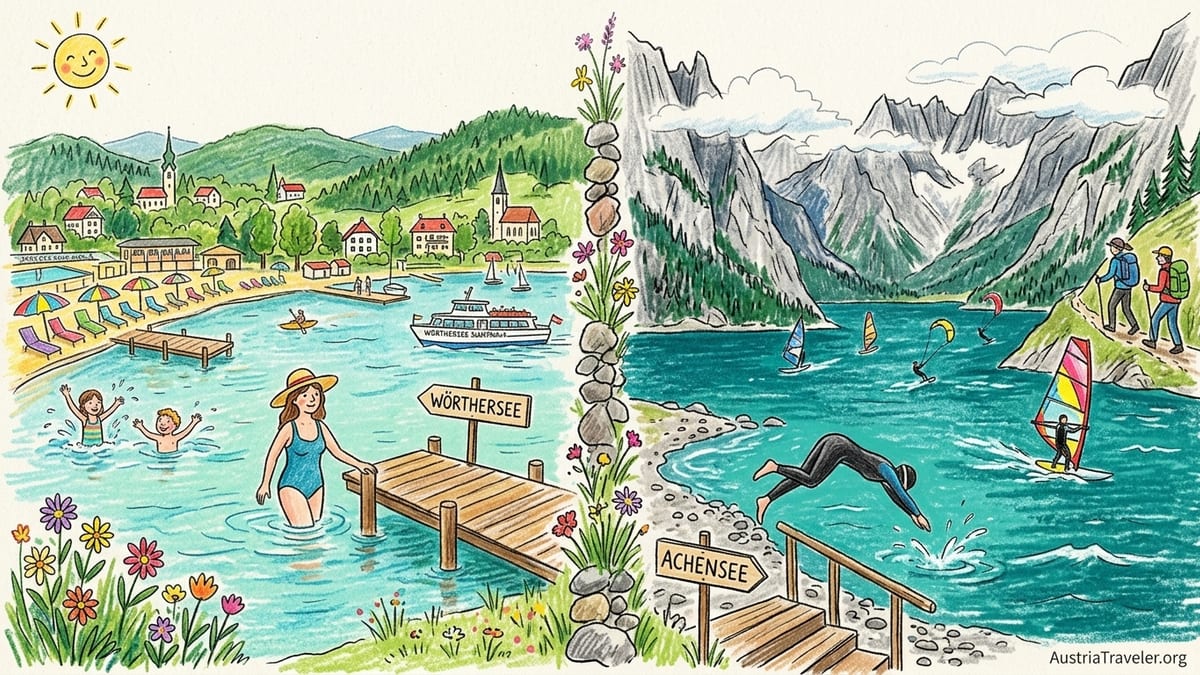
How the Water Really Feels: Warm vs Alpine Cold Shock
On paper, the difference between a warm Carinthian lake and a high-Alpine lake sounds small. Official figures put Wörthersee’s upper water layer in summer at up to around 25 degrees Celsius, helped by its sheltered position and relatively low inflow. Achensee, sitting at about 929 metres between the Karwendel and Rofan ranges, typically lingers closer to 20 to 22 degrees near the shore in July and August. In the brochures those numbers look similar. In the water they are not.
On a July afternoon in Velden am Wörthersee, I could wade straight in from the lido jetty, gasp once and then comfortably stay in for twenty or thirty minutes without moving much. My shoulders relaxed, and after a while I was simply floating, watching the motorboats pass the Schlosshotel and the historic villas on the opposite shore. The water felt more like a cool but welcoming pool. Children around me were still happily splashing after an hour.
At Achensee, near Buchau on the southern shore, the first plunge felt very different. The colour is a deep, glacial turquoise and the clarity is astonishing, with visibility of several metres. The moment I dived in, a sharp chill wrapped around my chest. Even in late July, without swimming laps I was out again within ten minutes. Locals in wetsuits sailed and windsurfed past while I stood on the pebble beach deciding whether to go back in. Here, it is true that on many days the water barely reaches 20 degrees once you swim away from the very shallow bays.
That contrast became the first big lesson of my Austrian lake summers: a few degrees of water temperature makes the difference between lazy, social bathing and something that always feels a little bit like a cold plunge. If your ideal holiday involves staying in the water for a long time, playing with kids or just floating on an inflatable, the warmer Carinthian lakes are in a different league to the higher Alpine ones.
Scenery vs Comfort: What I Actually Looked At
When I look back at my photos, the high-Alpine lakes easily win on raw beauty. Achensee looks like someone blew up a Norwegian fjord and dropped it into Tyrol. Sheer grey cliffs from the Karwendel on one side and green slopes of the Rofan on the other plunge straight into the turquoise water. Clouds pile up behind jagged peaks, and even from the lido in Pertisau you feel cradled in a high mountain amphitheatre.
By comparison, Wörthersee is softer and more cultivated. The hills around the lake are lower and forested, with villas and hotels strung along the shore between Velden, Pörtschach and Klagenfurt. The water is a milky turquoise rather than glass-clear, and instead of wild rock faces you see church spires, the Pyramidenkogel viewing tower high above the southern shore, and private jetties lined with loungers. In the evenings the shoreline becomes more about lights from bars, boat houses and promenade cafes than about mountain silhouettes.
The surprise for me was what I actually looked at during the day. At Achensee I found myself gazing constantly at the ridges and the changing sky. Clouds caught on the Karwendel peaks, or cleared to reveal new folds in the rock. It was impossible not to think about hikes and ridgelines. I took far fewer photos on Wörthersee, yet I probably enjoyed being physically in the water more. Much of the time at Wörthersee my view was close: friends on the jetty next to me, a stand-up paddler sliding past, a brightly painted “Wörthersee Schifffahrt” cruise boat crossing the bay.
In the end, if you are a photographer or someone who feeds off dramatic landscapes, the Alpine lakes offer a kind of theatre that the lower lakes simply do not. But my body often had a better time in Carinthia, where the water welcomed long swims without the shock.
Weather, Season Length and How Long I Stayed In
Weather amplifies the temperature difference. In Carinthia, by late June I have already swum comfortably in Wörthersee and nearby smaller lakes like Faaker See. On a typical July or August day, air temperatures often sit in the high twenties or low thirties. That combination of warm water and warm air means you can just roll in and out of the lake all afternoon and dry off in minutes on the grass or wooden jetty.
Up high at Achensee, the season feels shorter and more fragile. Even in mid-summer it is not unusual to have a day where clouds hang low on the surrounding peaks and the air temperature hovers in the low twenties. On those days, the idea of spending long periods in 20 degree water loses its charm, especially if a cool breeze picks up across the water. I remember one July afternoon when I managed two short dips between rain showers, then spent the rest of the time wrapped in a towel on the lido terrace watching windsurfers speed past.
The pattern repeated often enough that I started planning my days differently. In Carinthia, I was happy to commit an entire oversized towel and paperback novel day to the lido. At Wörthersee’s Strandbad Klagenfurt there are diving boards, long lawns and enough warmth to justify an all-day ticket. At Achensee, I learned to mix shorter swims with other activities. A typical day there might be an early hike up to a viewpoint like the Seebergspitze, lunch at a mountain hut, and then a quick, bracing swim or paddle in the late afternoon when the sun is strongest.
If you need your holidays to guarantee many hours actually in the water, the lower Carinthian lakes win. If you are happy with quick, refreshing dips framed by more active mountain days, the high-Alpine lakes feel like a more complete alpine experience.
Hiking, Cycling and What Filled My Afternoons
As a hiker, the mountains around the higher lakes were irresistible. From Achensee’s western shore, paths head straight into the Karwendel. A short climb from Pertisau leads to gentle balcony trails with constant lake views, while more committed routes tackle summits like the Bärenkopf and Seebergspitze. On the eastern side, the Rofan cable car takes you up to a plateau with limestone peaks, alpine meadows and family-friendly loop trails. The transport connections make it simple to combine a morning on the mountain with a quick swim below.
Around Wörthersee, hiking felt more like pleasant hill walking than serious mountain touring. I enjoyed strolling a section of the Wörthersee circular trail between Pörtschach and Velden, dipping in and out of lakeside forest and quiet bays, but I rarely spent entire days in the hills. Instead, cycling came into focus. There are well-marked bike routes that weave through vineyards and small Carinthian villages, and several hotels offer free or rental bikes for guests, which made spontaneous afternoon rides appealing.
Because I personally like combining swimming with at least one or two full hiking days, Achensee suited my activity level better. I remember returning from a hike along the Karwendel valleys, legs buzzing, and jumping into the icy water off the Pertisau pier. It felt like switching on a natural cold tub. At Wörthersee, by contrast, my swims were less about recovery and more about lingering. I would cycle gently along the southern shore, then stop at a public access point for a warm, lazy swim that drifted into sunset.
For travellers who define a good holiday by the kilometres they log on hiking apps, the high-Alpine lakes are hard to beat. Those who see the lake itself as the main stage rather than a post-hike reward may feel more at home in Carinthia.
Beaches, Lidos and What You Pay For a Swim
Carinthia’s reputation as Austria’s “land of bathing lakes” appears the moment you arrive at the shore. Around Wörthersee, purpose-built lidos line much of the accessible waterfront, especially in towns like Velden, Pörtschach and Klagenfurt. Strandbad Klagenfurt, for example, is a large complex with lawns, changing facilities, playgrounds, restaurants and long wooden jetties. Typical adult day tickets at comparable Carinthian lidos in recent seasons have been in the rough range of 6 to 9 euros, with discounts for evening entry or guests with local cards, though exact prices can vary by municipality and year.
The upside of that lido culture is comfort. At Wörthersee I could rent a lounger and umbrella, store my valuables in a locker, and have lunch at a lakeside restaurant without ever leaving the complex. These places are designed for families who want to settle in for the day, with shallow areas, slides and lifeguards. The downside is cost. A family of four visiting several days in a row in high season will feel those entry fees, especially if you add sunbed rentals and snacks on top.
At Achensee, the waterfront feels more open and less monetised. There are lido-style areas in Achenkirch, Maurach and Pertisau, some with free entry and others associated with lakeside facilities, but long stretches of the shore remain accessible without paying a gate fee. On one visit I spent an entire afternoon at the grassy public area near Buchau, walking straight from the lakeside car park down to the beach. There were toilets and a small kiosk, but no turnstiles or ticket desks. That makes it easier to justify shorter swims. You can stop for a quick dip between hikes or bike rides without feeling obliged to “get your money’s worth.”
However, the open access also means fewer creature comforts in some spots. At Achensee, I spent more time sitting on a picnic blanket among locals with cool boxes than reclining on ordered rows of loungers. If you want spa-style facilities, you seek them out specifically, for example at the Atoll Achensee complex in Maurach, which combines a lido with pools and a wellness area and charges separate admission.
Watersports, Boats and How Wind Changes Everything
I went into my first Achensee trip focused on hiking and came away almost more impressed by the wind. Locals call it the Tyrolean sea for a reason. In summer, a regular pattern develops where lighter winds in the morning build into stronger northwesterly breezes in the afternoon. On one stay in Pertisau I watched sailing school boats heel sharply, colourful windsurf sails whip across the water and kitesurfers play in whitecaps while most swimmers hugged the shore.
That wind is a dream for anyone focused on sailing, windsurfing or kitesurfing. Several watersports centres around Achensee offer lessons and rental gear. At one rental in Buchau I noted prices for stand up paddleboard hire in summer 2024 at around 15 euros for one hour and approximately 30 euros for two hours. Pedal boats and small electric boats generally cost more, with one operator on the lake listing electric boat rentals for four people at around 30 to 35 euros per hour. These are not bargain prices, but the consistent wind and large open water make Achensee feel like a genuine watersports destination.
On Wörthersee, my time on the water felt calmer and more varied. The lake is warm, more sheltered and ringed with marinas, so the dominant activities are motorboating, waterskiing, wakeboarding and stand up paddling close to shore. Several hotels around Velden and Pörtschach have their own jetties and offer SUP boards or small pedal boats to guests, sometimes included or at modest additional cost. Public rentals tend to be clustered near the big lidos, at broadly similar prices to Achensee for simple craft like SUPs or pedal boats.
Personally, I found Achensee’s conditions almost too good. I am an intermediate paddler and occasional sailor, not a wind-chaser, and I often felt that the afternoon chop limited how far I wanted to venture on a SUP. At Wörthersee I felt much more relaxed drifting across a glassy bay in the late evening, even if the water itself was less spectacularly clear. If your main holiday goal is consistent wind for serious watersports, the high-Alpine lakes like Achensee make much more sense. If you prefer gentle paddling, family-friendly boating and swims that do not end with waves in your face, the warmer, quieter Carinthian lakes win.
One more practical note: at both types of lake, motor-driven rental craft and organised watersports add up quickly over a week. For travellers who expect to be in the water daily on boards or small boats, buying or bringing your own inflatable SUP can pay off after only a handful of rental sessions.
Evenings, Atmosphere and Who I Shared the Shore With
Evenings at Wörthersee felt almost Mediterranean. In Velden, the waterfront promenade fills with people in summer dresses and linen shirts strolling between gelato stands and bars. The lights of the casino and lakeside hotels reflect on the warm water. Boat taxis zip across to private jetties. In Pörtschach, live music drifts from lakeside terraces, and the last swimmers linger on the jetties until dusk. It felt social, a place where the lake is as much about seeing and being seen as it is about swimming.
By contrast, Achensee’s villages wind down earlier and more quietly. Pertisau has several hotels with lakefront terraces where you can sit with a beer and watch the last windsurfers come in, but the mood is more alpine resort than Riviera. On many nights I found that by ten o’clock the village streets were almost empty, especially outside peak holiday weeks. Maurach and Achenkirch felt similar. For couples like me who enjoy a quiet drink and an early night before a hike, this calm suited us perfectly. Friends who joined on one trip, however, missed the buzz and options for a later evening out.
The mix of people also differs. Around Wörthersee, particularly on the Velden side, I noticed more weekend visitors and day-trippers from nearby cities, plus a sprinkling of higher-end guests at luxury hotels with private bathing jetties. Families were everywhere, but so were groups of friends and couples dressed for dinner. Achensee, on the other hand, attracted more hikers and outdoor-focused families, often in technical clothing even at dinner. Breakfast conversations were about routes and weather windows more than restaurants and events.
Prices mirror that difference in ambience. Lakeside drinks and dinners around Wörthersee’s most fashionable spots consistently came in higher than equivalent meals in Achensee’s villages. In both regions you can still find simple Gasthäuser serving hearty dishes at moderate prices if you step one or two streets back from the waterfront, but it is easier to spend more in Velden or Pörtschach without trying.
Getting Around and How Dependent I Felt on the Car
Car dependence was one area where my expectations were flipped. I assumed that the high-Alpine setting of Achensee would mean more isolation and therefore more driving, but both shores are lined by a main lakeside road with reasonably frequent buses linking Jenbach, Maurach, Pertisau and Achenkirch. During summer, lake steamers stop at several piers, creating a pleasant boat-and-bus loop that makes it feasible to leave the car at the accommodation for days at a time.
On one stay based in Maurach, I spent three days without touching the car. I took the boat to Pertisau for hikes into the Karwendel valleys, then returned by bus in the evening after a swim at the local lido. The next day, I biked along the western shore on the cycle path as far as Achenkirch and hopped on a boat back. The compact shape of the lake, combined with the single access road, makes orientation simple even for first-time visitors.
Wörthersee is larger and more built-up, with the A2 motorway and a mainline railway running along its northern side and local trains stopping in Klagenfurt, Pörtschach and Velden. In theory this should make car-free travel easier. In practice, I still used the car more here. Public lakeside access is fragmented by private jetties, hotels and campsites, so reaching quieter swimming spots or specific lidos often meant short drives and parking fees. I also found myself tempted to drive into Klagenfurt for city sightseeing or out to other lakes in Carinthia, which meant more time in traffic.
For visitors determined to go car-free, both regions can work, but Achensee felt more self-contained. Once I arrived, the combination of one lake, three or four villages and clearly signposted paths made it easier to settle into a rhythm of walk, swim, eat and sleep without reaching for the keys.
So Which Lake Style Worked Better for Me?
After several summers, I realised that my idea of a perfect lake and my idea of a perfect trip are not exactly the same thing. As a pure body-in-water experience, I preferred the warm, silky feel of Carinthian lakes like Wörthersee. I could swim early, late and for long stretches without numb fingers. The lidos made lazy days simple, especially when I wanted to share them with friends who have children.
Yet when I think of the holidays that left me feeling most satisfied, I keep coming back to Achensee and other high-Alpine lakes. The cold water added a sense of ritual to every swim. I would hike, sweat, descend, and then brace myself on the stony shore before plunging into water that stole my breath. Ten minutes later, I would be wrapped in a towel, watching peaks turn gold as the wind rustled the surface. The scenery and the active rhythm of the days suited the way I like to travel, even if the water itself was objectively less comfortable.
There were also moments when the “better” lake in theory was worse in practice. One August weekend at Wörthersee, hot weather and an event in Velden meant the main lidos were packed. Music blared from bars, jet skis buzzed beyond the swimming buoys, and every patch of grass seemed taken. The water was warm and perfect, but the atmosphere felt crowded and hectic. A week later at Achensee, in slightly cooler weather, I took a solitary early-morning swim from a quiet stretch of shoreline with only cow bells audible from the slopes above. The water was biting cold, but the experience felt far closer to what I actually wanted from a lake holiday.
In the end, I stopped trying to decide which type of lake was “better” and started matching each to the kind of trip I wanted that year. What follows is how I would steer different travellers based on my time at both Wörthersee and Achensee.
The Takeaway
For serious swimmers who want long, comfortable sessions in the water, warm Carinthian lakes like Wörthersee are the clear choice. You can realistically stay in for twenty minutes or more without moving much, train for distance along the buoys at lidos, and combine swimming with relaxed lounging on lawns and jetties. If you dislike cold shock or are travelling with less confident swimmers, the extra few degrees at lower-elevation lakes make a real difference.
For dedicated hikers and trail runners, high-Alpine lakes such as Achensee work better as a base. The surrounding Karwendel and Rofan mountains provide enough routes for a full week without repeating yourself, from balcony paths to full-day peaks. Swimming becomes a brief, rewarding ritual rather than the main event. Choose this style of lake holiday if you are happiest when the view from your breakfast table includes a summit you might stand on by late afternoon.
Families with younger children often gravitate towards Carinthia for good reason. The water at lakes like Wörthersee and nearby family-focused lakes in southern Carinthia stays pleasantly warm in mid-summer, there are purpose-built lidos with shallow areas and playgrounds, and many accommodations include free or discounted lake access. The trade-off is cost and crowds in peak weeks, so it pays to book early and consider staying slightly away from the most famous resort towns for more space.
Couples and travellers seeking quiet, arm-in-arm evening walks might find more romance at the higher lakes, provided they do not need nightlife. A simple guesthouse balcony overlooking Achensee at sunset, with cow bells in the distance and the last sails on the water, felt more intimate to me than any cocktail terrace in Velden. At the same time, couples who enjoy dressing up for dinner, strolling a lively promenade and having multiple bars within walking distance will likely feel more at home on Wörthersee’s northern shore.
Watersports travellers should choose based on the specific activity. If reliable wind for sailing, windsurfing or kitesurfing is non-negotiable, high-Alpine lakes like Achensee offer conditions that justify the cooler water. If your focus is on gentle SUP sessions, pedal boating and occasional waterskiing in warm water, the sheltered Carinthian lakes are a better match. Budget for equipment hire either way, or consider bringing your own board if you plan daily sessions.
Finally, photographers and landscape lovers will probably fall hardest for the Alpine lakes. The way light hits the cliffs around Achensee at dawn, the morning mist clinging to the surface and the contrast between turquoise water and grey rock create images that feel almost unreal even in an unedited snapshot. Carinthian lakes photograph better as lifestyle scenes: children jumping off jetties, friends gathered at lakeside bars, soft hills behind bobbing boats. Ask yourself whether your dream photo has a dramatic peak or a sunset cocktail in the frame, and choose accordingly.
For my own travels, the answer turned out to be seasonal. When I crave comfort, long swims and social evenings, I point myself back to Carinthia and its warm bathing lakes. When I need fresh air, effort and a landscape that makes me feel small, I return to the harsher, colder beauty of lakes like Achensee. Rather than chasing the single “best” lake, I now see Austria’s waters as offering two complementary styles of holiday, each perfect in its own way when matched to the right trip.
FAQ
Q1. Are warm Carinthian lakes like Wörthersee really that much warmer than high-Alpine lakes?
Yes, in mid-summer Wörthersee’s surface water can reach the mid-twenties in degrees Celsius, while high-Alpine lakes such as Achensee usually stay closer to around 20 to 22 degrees near the shore.
Q2. Can I swim comfortably in Achensee without a wetsuit?
In July and August many people swim in regular swimwear, but most do shorter dips. If you want to stay in for a long time or swim early and late in the season, a thin wetsuit makes it more comfortable.
Q3. Do I need to pay to access the lakeshores in Carinthia and at Achensee?
Around Wörthersee many of the most comfortable lidos with facilities charge admission, while some small public access points remain free. At Achensee there are both free public bathing areas and lido-style sections associated with facilities, so you can choose based on budget and comfort.
Q4. Which region is better if I will not have a rental car?
Achensee works surprisingly well without a car, thanks to a simple road layout, bus connections and lake boats linking the main villages. Wörthersee has good rail access, but fragmented public shoreline means you may ride buses or walk more to find suitable bathing spots.
Q5. Is Wörthersee too crowded in summer?
In late July and August, especially around Velden and major lidos, it can feel very busy on hot days. Visiting in June or early September, choosing less central towns, or using smaller public access spots can reduce that sense of crowding.
Q6. Where will I find better hiking directly from the lake?
High-Alpine lakes such as Achensee offer more substantial hiking right from the shore, with direct access into the Karwendel and Rofan ranges. Around Wörthersee, hiking is pleasant but more like rolling hill walks and lakeside paths than high-mountain routes.
Q7. Are there family-friendly facilities at Achensee too, or only at Carinthian lakes?
Achensee also has family-friendly lidos with playgrounds and shallow zones, and some areas like the shallow southern bays are popular with children. The big difference is the cooler water, which tends to limit how long younger kids want to stay in.
Q8. How expensive are watersports rentals at Austrian lakes?
Recent summer prices I encountered were roughly in the range of 15 euros per hour for a basic stand up paddleboard and higher for pedal boats or small electric boats. Exact costs vary by operator and location, so it is worth checking locally.
Q9. Which style of lake is better for couples looking for nightlife?
Couples wanting promenades, bars and a lively atmosphere will feel more at home around Wörthersee, especially in Velden or Pörtschach. Achensee’s evenings are quieter and better suited to early starts for hiking than to late nights out.
Q10. If I am mainly travelling for photography, where should I go first?
If dramatic landscapes excite you, start with a high-Alpine lake such as Achensee for its cliffs, changing light and clear water. Visit a warm Carinthian lake later when you want to capture more relaxed lifestyle scenes and sunset swims.