


Over seven days I crossed Austria from Vienna to Bregenz without ever renting a car, following a classic rail loop that tourism officials often showcase: Vienna to Linz to Salzburg, into the Salzkammergut, then on to Achensee, Innsbruck and finally Bregenz on Lake Constance. I booked the same ÖBB Railjet, Intercity and regional trains that any visitor can buy, tested discount products like the Vorteilscard Classic and Einfach-Raus-Ticket, dragged a suitcase through big-city stations and tiny alpine platforms, and counted every bus and taxi I still needed. Here is what actually worked, what did not, and how to decide if an Austria-wide rail trip makes sense for your itinerary.
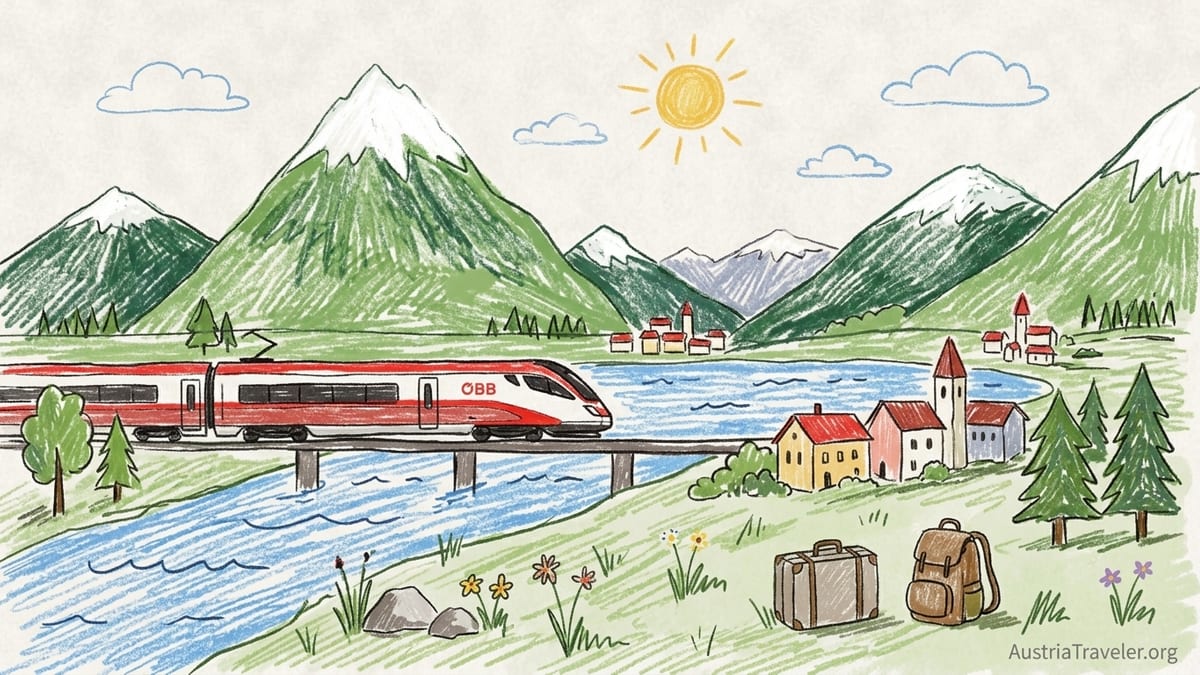
Planning an Austria-Wide Rail Itinerary
I started with a clear brief: no rental car anywhere in Austria. That meant every intercity move and almost all local travel had to be by rail, with buses or taxis only where tracks simply do not exist. To keep things realistic for international visitors, I chose a route that the Austrian National Tourist Office regularly promotes as a one-week “by rail” showcase: Vienna to Linz to Salzburg, into the Salzkammergut lake district, onward to Achensee, then Innsbruck and finally Bregenz on Lake Constance. This chain strings together capital-city culture, baroque river towns and high-alpine scenery along lines that are heavily used by locals, not just tourists.
On paper it is straightforward. ÖBB’s long-distance map shows frequent Railjet and Intercity services along the Westbahn corridor between Vienna, Linz and Salzburg, then a web of regional routes radiating into the lakes and Tyrol. Railjet is the flagship train category, reaching up to about 230 km/h on upgraded sections, and forms the spine between major cities. Intercity trains cover important secondary routes, while regional trains and S-Bahn services link smaller towns. The question was not whether trains exist, but whether they are practical when you are hauling luggage, changing platforms in unfamiliar stations and trying to make hotel check-in times.
Before looking at tickets, I mapped out each segment in the ÖBB online timetable and app, plugging in the exact dates, approximate departure times and the fact that I would carry one medium suitcase and a backpack. For each leg I checked whether there was a direct train or a change, whether I could use fast Railjet or only regional services, and where buses were unavoidable. Only then did I look at price options, because the value of a discount card depends heavily on how many of these specific journeys you will actually take.
The final itinerary involved at least one long-distance train almost every day, plus short hops into side valleys: Vienna to Linz by Railjet, Linz to Salzburg on another Railjet, Salzburg to Attnang-Puchheim by Railjet and then into the Salzkammergut on a regional line, on to Jenbach for Achensee, then Innsbruck to Bregenz along the Arlberg line. This mix of fast, slow and scenic legs turned out to be ideal for testing both the comfort of Austria’s trains and the sometimes-complicated ticketing landscape.
Buying Tickets: Standard Fares, Vorteilscard and Einfach-Raus
Austria’s national operator ÖBB sells tickets through its website, mobile app, station machines and staffed counters. For my trip I used a combination of the app and station machines so I could see how an occasional visitor might handle things. The booking flow is similar across platforms: you enter origin, destination and date, choose a connection and then see a list of available fares and products. Crucially, any discounts linked to your account, such as a Vorteilscard, can be applied automatically once stored in your profile.
The starting point for price comparisons is the standard ticket. ÖBB publishes a guide for domestic travel that confirms standard tickets are fully flexible on the chosen day and can be combined with discount cards. On top of this base fare, passengers can add seat reservations on long-distance trains and choose between economy, first class and, on some Railjets, a premium business class. For a Vienna to Salzburg Railjet trip booked without promotions, I saw standard second-class fares around several dozen euros one way, with upgrade and reservation fees on top, though exact prices shift with distance and occasional promotions.
To test whether a Vorteilscard Classic pays off, I purchased the card before travel. ÖBB’s official information confirms that the Vorteilscard Classic currently costs 73 euros per year and gives approximately 50 percent off standard one-way tickets within Austria for the cardholder. The validity is one year from the date of issue, and the discount applies regardless of whether you buy online, in the app or at a counter. I linked the card to my app profile so every fare was shown with and without the discount, which makes it very easy to see savings in real time.
On my week-long loop, the Vorteilscard clearly paid off because I covered long distances nearly every day. The cumulative standard fares for Vienna to Linz, Linz to Salzburg, Salzburg to Jenbach, Jenbach to Innsbruck and Innsbruck to Bregenz easily exceeded the 73 euro upfront cost. With roughly half off each leg, I reached the breakeven point around the middle of the week. For a shorter or more regional trip, the math is different. If you were only doing Vienna to Salzburg and back, plus one or two regional day trips, you might not recoup the full card cost, so it is important to total your likely standard fares before you commit.
I also tested the Einfach-Raus-Ticket, ÖBB’s group day ticket that covers most regional trains and S-Bahn services for two to five people traveling together. According to ÖBB’s current description, it is valid on regional, regional express and S-Bahn trains operated by ÖBB and Raaberbahn within Austria, with a few local exclusions, and is priced as a flat fee that becomes cheaper per person as your group grows. Independent summaries in German note that in 2025, example prices were in the range of roughly 37 to 49 euros for two to five people, though exact current prices may differ and must always be checked at the moment of purchase.
Because the Einfach-Raus-Ticket is valid for unlimited regional travel on a single day (with time-of-day restrictions on weekdays), it shines on days when you are stringing together several short legs, such as exploring the Salzkammergut or shuttling between Innsbruck and smaller Tyrolean villages. On my journey, it did not beat the Kombination of Vorteilscard-discounted point-to-point tickets on the long intercity days, but it offered clear savings on one intensive regional day of lake hopping. The key lesson was simple: for a primarily long-distance, one-direction itinerary, the Vorteilscard brought the biggest discount, while Einfach-Raus made sense only for specific heavily regional days, preferably with at least two travelers.
On Board Railjet, Intercity and Regional Trains
From the first departure out of Vienna Hauptbahnhof it was obvious that not all Austrian trains are created equal. Railjet sets, ÖBB’s flagship long-distance trains, are wide, air-conditioned and divided into economy, first and business classes, with at-seat power outlets in most seats and Wi-Fi available on board. Official and manufacturer information confirms that these trains can reach up to 230 km/h on suitable tracks, and you feel that speed between Vienna and Linz whenever the line straightens. Even then, accelerations and braking are gentle enough that walking to the restaurant car with a coffee in hand feels secure.
Seat reservations on Railjet are optional but highly recommended on busy days. On my Vienna to Linz leg I traveled with only a standard ticket and spent a few minutes checking for unreserved seats, watching the overhead screens that mark which seats are reserved on each segment. On a later Salzburg to Jenbach Railjet I added a seat reservation for a modest extra fee through the app, which immediately assigned a carriage and seat number. Being able to roll up, find your designated window seat and stow luggage in the overhead rack or at carriage ends is well worth the small cost on peak days.
Intercity (IC) trains sit just below Railjet in the hierarchy. My Linz to Salzburg segment used a Railjet, but on other days I sampled IC rolling stock on parallel routes. Interiors were slightly older in places but comfortable, again with clear signage and luggage space at carriage ends. The main difference was service frequency and the occasional lack of a full restaurant car. For city-to-city hops on main lines, both categories worked fine. Where Railjet pulled ahead was in speed and the general sense of space, which matters when you are carrying a suitcase and sharing the carriage with locals and tourists alike.
Regional trains were more variable but still reliable. On the Salzkammergut railway line between Attnang-Puchheim and Bad Ischl, and further toward Hallstatt and Obertraun, I rode single-deck regional units with large windows, bicycle spaces and basic but clean interiors. Timetable information shows that this line sees a roughly two-hourly pattern of regional and regional express services, with one daily Intercity running the full distance from Vienna to Stainach-Irdning. This meant that for the lakes, unlike the big cities, planning around a specific timed train mattered more. Comfort was entirely adequate for journeys of one to two hours, but luggage storage shrank compared with Railjet, and carriages could feel crowded when groups with backpacks and bikes boarded on summer weekends.
Handling Luggage, Transfers and Station Layouts
Traveling Austria by train without a car is only as practical as the stations and transfers allow. Vienna, Linz, Salzburg, Innsbruck and Bregenz all have modern main stations with lifts, escalators, clear signage and covered platforms. Rolling a medium suitcase from platform to concourse usually took only a few minutes, and connections of ten minutes between long-distance trains felt achievable without rushing. Ticket machines are scattered throughout the concourses and are multilingual, and I never needed to queue more than a few minutes at a counter when I had a question.
The true test came on smaller interchange stations that serve as gateways to tourist regions. Attnang-Puchheim, the junction for much of the Salzkammergut, has several island platforms linked by an underpass. When my Railjet from Salzburg arrived, I had nine minutes to change to a regional train heading along the lake line. The connection was posted in the app as an official transfer, which usually means ÖBB will hold the regional train briefly if the long-distance arrival is a bit late. That promise did not need to be tested; the Railjet arrived punctually and the transfer was simply a matter of lifting my suitcase down a few steps and up again. Travelers with heavy luggage or mobility issues should still factor in extra time at these junctions, but in practice the movements were manageable.
At lake and valley stations the experience was more basic but still functional. At places like Bad Ischl and Jenbach, platforms are shorter and shelters simpler, yet information screens and audio announcements still clearly mark upcoming departures. In Jenbach, the gateway for buses and a local railway into the Achensee valley, changing from a Railjet or regional train to onward transport took less than ten minutes, as the bus stops and narrow-gauge stations are just outside the mainline platforms. With a suitcase, the key discipline was to consolidate luggage so that you only needed one hand for pulling and one free hand for stairs or doors.
Punctuality was a consistent strong point on this journey. ÖBB reported punctuality of local services in the mid-90 percent range in recent years, and what I experienced matched that impression. Across a week that involved more than a dozen individual trains, only one regional service departed more than five minutes late, and none of my intercity transfers were missed. Austria’s mixed geography of plains and mountains always carries some risk of weather or engineering disruptions, but for the standard routes described here, the timetable felt dependable enough to plan museum entry times and dinner reservations around scheduled arrivals.
Testing the Vienna → Linz → Salzburg → Salzkammergut → Achensee → Innsbruck → Bregenz Route
The heart of this project was seeing whether the flagship week-long route promoted by Austrian tourism authorities can actually be done comfortably and efficiently without a car. The sequence turns out to be more than marketing; it is a very workable skeleton for first-time visitors who want variety without excessive complexity. Each segment had its own character and its own balance between rail and last-mile links.
Vienna to Linz to Salzburg is a showcase for Railjet. From Vienna Hauptbahnhof to Linz Hauptbahnhof, Railjet services run at least hourly during the day, cruising along the upgraded Westbahn corridor. The ticket check came early, Wi-Fi worked reliably in my carriage and luggage found a home in overhead racks without drama. The onward hop to Salzburg was similar, with scenery shifting from flat Danube landscapes to more rolling hills. On both legs the station locations made staying in the city centers very convenient: hotels in Vienna’s Quartier Belvedere and around Linz’s main square were within a 10 to 15 minute tram or walk of the Hauptbahnhof, and Salzburg’s main station connects directly to trolleybus lines that fan out toward the old town and riverfront.
Salzburg into the Salzkammergut showed where rail remains superior to driving and where it still needs help. From Salzburg to Attnang-Puchheim I stayed on a Railjet for speed, then switched to the Salzkammergut regional line. Here the views exploded: the train runs along lakes and through wooded valleys, with glimpses of Traunsee and surrounding peaks. For towns like Gmunden and Bad Ischl, stations sit close enough to town centers that you can comfortably walk to many guesthouses. For Hallstatt, however, the mainline station is on the opposite shore of the lake from the village. A small ferry meets trains and crosses in about ten minutes, which is charming but means rail alone cannot deliver you door to door. This is a fine example of rail being the most scenic and stress-free way to reach a region, while the last kilometer still requires a boat or bus.
Continuing west, the segment from the Salzkammergut toward Achensee involved one of the most interesting interchanges. From Bad Ischl or another lakeside town you first retrace to Attnang-Puchheim, then ride a Railjet or Intercity toward Tyrol, getting off at Jenbach. Jenbach station itself is a compact hub: on one side stands the mainline ÖBB platforms, on another the station of the Zillertalbahn, and just beyond that the lower station of the Achenseebahn heritage railway or buses heading up to the lake. When the heritage railway is running, the combination of mainline train plus cog railway is unforgettable, but even with only buses the transfer is short and intuitive. Achensee’s villages sit against the lake and steep slopes, where parking is limited in high season, so arriving by train and bus felt more relaxed than threading a rental car along the narrow lakeside road.
From Achensee to Innsbruck and then Bregenz, rail once again becomes the obvious choice. Buses down from Achensee deliver you back to Jenbach, where frequent regional and Railjet services run to Innsbruck in under half an hour. Innsbruck Hauptbahnhof is just a few minutes’ walk from the old town and riverside, and nearly every central hotel can be reached by short tram or on foot. The final arc from Innsbruck to Bregenz crosses some of Austria’s most dramatic rail scenery on the Arlberg line, threading high valleys and tunnels before descending to the shores of Lake Constance. Trains here are a mix of Railjet, Intercity and regional sets, with long-distance services offering the best comfort for this several-hour journey. In Bregenz the station faces directly onto the lake promenade, and reaching lakeside hotels on foot is easy, something that would be less straightforward if you were searching for parking after a long drive.
Where Rail Beats Driving, and Where It Does Not
After a week of lived experience, there were clear patterns in where Austria’s rail network was superior to driving and where it still required supplementary modes. On intercity corridors the verdict was decisive. Between Vienna, Linz, Salzburg, Innsbruck and Bregenz, fast trains running up to about 230 km/h on some sections made progress that would be hard to match on motorways that cap at around 130 km/h. More importantly, using trains avoided city-center traffic and parking costs. Arriving at Salzburg Hauptbahnhof and walking or riding a trolleybus into the historic core was smoother than navigating one-way streets and limited-parking hotel zones.
Rail also provided a more relaxing way into alpine regions where driving can be tiring. The journey from Salzburg into the Salzkammergut, and later across the Arlberg toward Vorarlberg, let me actually look at the mountains instead of watching hairpin bends. In winter, rail has the additional advantage that snow and ice management happen at network scale, while drivers may face chains and slow-moving convoys. On several days, I worked on a laptop for part of the journey, something that would not be possible behind the wheel.
The limitations appeared at the “last mile.” Hallstatt’s lakeside ferry, buses from Jenbach to Achensee, and local buses or occasional taxis from smaller Salzkammergut stations to hotels on side hills all counted as extra layers. None were difficult, but each added a little uncertainty and a bit of waiting time, especially in the shoulder season when timetables thin out. For travelers carrying bulky sports gear or traveling with small children, these hops can feel more cumbersome than loading everything into a car once and driving directly to a guesthouse door.
For rural stays where accommodation lies several kilometers from the nearest station without a good bus link, a car remains significantly more convenient. I met hikers who used trains to reach hubs like Bad Ischl or Zell am See, then rented a car locally for a few days to explore trailheads and side valleys. This hybrid model may be the best compromise if your plans involve very remote locations. For city-focused itineraries with well-known excursions, however, rail held its own remarkably well.
Do Discount Products Really Save Money?
Price is often the deciding factor in choosing between rail and a rental car. Fuel, tolls and parking add up, but so can long-distance fares if you buy everything last minute at full price. My deliberate experiment with the Vorteilscard Classic and the Einfach-Raus-Ticket suggested that discount products can make Austria-wide rail travel competitive, but only if used intelligently.
The Vorteilscard Classic, at 73 euros per year for adults with no special eligibility requirements, gave approximately 50 percent off every standard ticket I bought within Austria. On a route that covered multiple four to six hour intercity segments, it reached its breakeven point within a handful of journeys. Put simply, if your Austria stay involves two or more long trips like Vienna to Salzburg, Salzburg to Innsbruck or Innsbruck to Bregenz, plus some shorter hops, this card is likely to save money even over a single holiday, and it remains valid if you return within a year.
The Einfach-Raus-Ticket behaved more like a tactical tool. It does not offer a percentage discount off a base fare but instead gives you a flat-price day of travel on regional and S-Bahn trains for a small group. For one of my days in the Salzkammergut, where I rode multiple regional services between lakeside towns, the flat price would have undercut several separate regional tickets bought with a Vorteilscard, especially if shared between two travelers. However, on my long intercity days, Einfach-Raus was not valid on the Railjets and Intercity trains I needed, so it had no role.
Travelers should therefore resist the temptation to buy every product at once. Before your trip, sketch your likely train usage. If it consists primarily of two or three long intercity rides plus perhaps one regional exploration day, the Vorteilscard plus ordinary point-to-point tickets will usually be enough. If you are a small group planning several days of intensive regional use, especially in states like Upper Austria or Styria, then factoring in group products like Einfach-Raus on those specific days makes sense. As conditions and exact prices can change, it is essential to check the latest rules in the ÖBB app or at a ticket counter before committing.
Against the cost of a rental car, especially once insurance and fuel are included, a well-planned mix of Vorteilscard-discounted long-distance tickets and occasional regional day tickets can be very competitive for one or two people. For families or larger groups planning to stay in one remote valley, a car may still come out ahead in money and time, but for a classic cross-country tour that hops between cities and major resort areas, the rail-based approach held its own.
The Takeaway
After a week of crossing Austria without a car, my overwhelming impression was that the country’s rail network is not just picturesque but genuinely practical for visitors who plan ahead. The promoted Vienna to Bregenz route via Linz, Salzburg, the Salzkammergut, Achensee and Innsbruck proved more than a brochure line; it worked smoothly in real life with one suitcase and a backpack, and only occasional reliance on ferries, buses and short walks.
ÖBB’s Railjet, Intercity and regional trains formed a coherent hierarchy. Railjet and IC trains delivered high-speed, comfortable links between major cities, with station locations that dropped me within easy reach of hotels and sights. Regional trains extended that reach into lake and mountain regions, admittedly with tighter timetables and less luggage space but still reliable punctuality. Where the tracks stopped, well-coordinated buses and boats usually picked up, especially in tourism-heavy areas like Hallstatt and Achensee.
Discount products mattered. The Vorteilscard Classic, at 73 euros per year, proved its worth on a single intensive week of long-distance travel, while the Einfach-Raus-Ticket was best used surgically on specific regional days and only when traveling with at least one companion. Even without memorizing every tariff rule, the ÖBB app’s ability to show you the cheapest applicable options for a chosen day and route made it possible to travel smartly on the fly.
For prospective visitors weighing rail against a rental car, the conclusion is nuanced but encouraging. If your itinerary centers on Vienna, Salzburg, Innsbruck, Bregenz and major lake regions and you are comfortable with one or two mode changes per day, an Austria-wide rail trip genuinely works and often enhances the journey with stress-free scenery and city-center arrivals. If your plans instead revolve around remote farm stays or scattered trailheads far from any station, then a hybrid approach or a car will still be hard to beat. The key is to be honest about where you want to sleep and how much you enjoy transfers; Austria’s trains will do the rest.
FAQ
Q1. Do I need seat reservations on ÖBB Railjet trains in Austria?
Seat reservations on Railjet are optional but strongly recommended on busy travel days or for longer journeys. Without a reservation you can still board with a valid ticket and look for unreserved seats, which are clearly marked on overhead displays, but families and travelers with luggage will appreciate the certainty of having specific seats assigned.
Q2. Is the Vorteilscard Classic worth buying for a short holiday?
The Vorteilscard Classic costs 73 euros per year and gives roughly 50 percent off standard ÖBB fares within Austria. It usually pays off if you plan at least two or three longer trips, such as Vienna to Salzburg and Innsbruck to Bregenz, during a single stay. For very short visits with only one intercity journey, it may not reach its breakeven point.
Q3. Can I use the Einfach-Raus-Ticket on Railjet and Intercity trains?
No, the Einfach-Raus-Ticket is designed for regional travel and is valid on ÖBB regional, regional express and S-Bahn trains, not on Railjet or standard Intercity services. It is best reserved for days when you will make several shorter trips on regional lines, especially when traveling as a duo or small group.
Q4. How practical is rail for reaching the Salzkammergut lake district?
Rail works very well for core Salzkammergut towns such as Gmunden and Bad Ischl, which have stations close to their centers. For Hallstatt the mainline station lies across the lake from the village, and a small ferry meets most trains to complete the journey, so the final access involves a short boat ride in addition to the train.
Q5. Do Austrian stations make it easy to travel with luggage?
Major stations like Vienna, Linz, Salzburg, Innsbruck and Bregenz are equipped with lifts, escalators and clear signage, so rolling a suitcase between platforms and city transport is straightforward. Smaller junctions and rural stops may involve more stairs and shorter platforms, but transfers are still manageable with a single suitcase and backpack.
Q6. Are Austrian trains generally punctual enough for tight connections?
ÖBB reports high punctuality rates and, in practice, most long-distance and regional trains arrive within a few minutes of schedule on main tourist routes. Official timetables build in realistic transfer times at key junctions, and my own week of travel across more than a dozen trains did not result in any missed connections.
Q7. How does train travel compare to renting a car for an Austria-wide trip?
For itineraries focused on cities and major resort areas, trains often win on stress reduction, city-center arrivals and overall travel time, especially along upgraded high-speed corridors. A rental car becomes more attractive if you plan to stay in remote villages far from stations or want maximum spontaneity on back roads without relying on bus or ferry timetables.
Q8. Can I reach Achensee entirely by train?
You can get very close to Achensee by train, typically traveling to Jenbach on a Railjet, Intercity or regional service. From Jenbach you complete the last leg to the lake by heritage railway when in season or by regional bus, so rail covers the bulk of the distance but a short onward ride is still required.
Q9. Is it easy to buy tickets as an English-speaking visitor?
Yes, ÖBB ticket machines, the mobile app and the main website all offer English-language interfaces, and station staff in major hubs generally speak good English. You can compare fares, apply discount cards like the Vorteilscard and add seat reservations without needing to speak German.
Q10. Does an Austria-wide rail trip work well for families?
For families staying mainly in cities and established resort towns, rail works very well and can be less tiring than long drives, particularly when children can move around on board. Discount cards such as Vorteilscard Family and regional day tickets can lower costs, but parents should factor in the extra complexity of buses or ferries needed for some last-mile legs.