


When I first started planning a long trip around Austria, I assumed I would have to rent a car. Mountain lakes, little villages, last cable cars of the day: it all sounded like the kind of itinerary that begged for a set of keys. Then I looked at how proud Austria is of its train and bus network, and how clearly the official tourism boards say a car is not necessary for many trips. In the end, I tried both in a meaningful way: one section almost entirely by train, another as a proper road trip with a rental car. What follows is not theory or price tables, but what actually worked on the ground, in my legs and in my stress levels.
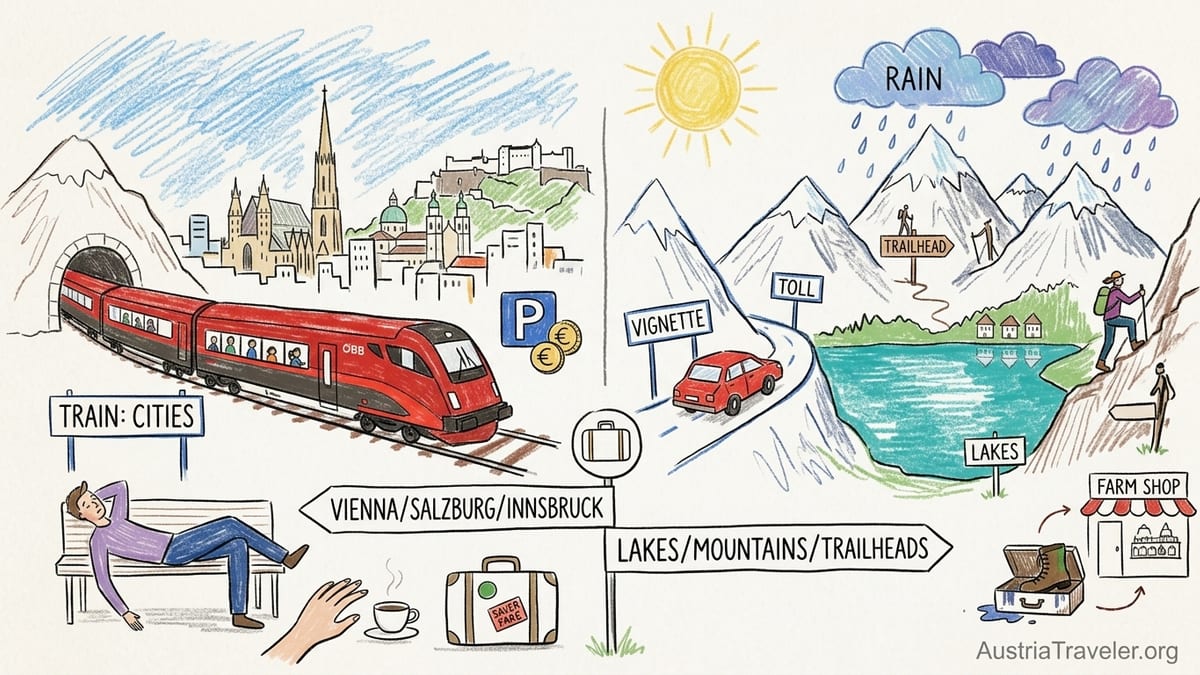
How I Tested Both: Two Real Austrian Itineraries
My first experiment was a city-and-culture loop built around trains. I flew into Vienna, spent a few days in the capital, then took ÖBB Railjet and regional trains in a triangle: Vienna to Salzburg, Salzburg to Innsbruck, then back to Vienna. On this segment I deliberately avoided renting a car to see how far the national rail and bus network could take me. Distances were not small. Vienna to Salzburg is around 300 kilometers, and the train covers it in less than two and a half hours on the main Railjet route. Salzburg to Innsbruck takes from just under two hours on the faster Railjet or Railjet Express services, which have been promoted as time saving along this western corridor. I added side trips by train and bus, such as a day in Hallstatt from Salzburg and a tram up to the Nordkette mountains directly from Innsbruck’s center.
My second experiment flipped the script. I picked up a rental car in Salzburg after a few car-free days and drove into the lakes and mountains. Over ten days, I made a loop that is typical for many visitors who focus on nature: the Salzkammergut lake district, the Dachstein region near Schladming, several valleys in Tirol, and side trips to panoramic Alpine roads. This meant using Austrian motorways that require a vignette, paying a separate toll to drive the Tauern Autobahn tunnels south of Salzburg, and working out hotel parking in small historic towns and high valleys. I also deliberately chose a couple of remote trailheads and guesthouses that are awkward or impossible to reach by public transport, to understand where the car really makes sense.
Across both trips, I tracked more than just point-to-point costs. I wrote down departure and arrival times, parking fees, how far I had to wheel a suitcase, how often I thought about the weather forecast, and, most importantly, how I felt at night. On some days I closed my eyes at 10 p.m. with that heavy driving fatigue after a long stretch on wet motorways. On others I arrived in a new city rested enough after a train ride to head straight out for a concert. These are the details that quietly matter when you try to choose between Austria’s very capable rail network and the undeniable flexibility of a car.
When the Train Clearly Won: My Vienna–Salzburg–Innsbruck Loop
On paper, driving from Vienna to Salzburg looks straightforward. It is motorway almost the entire way. In practice, the train was faster and dramatically less stressful for me. Leaving Vienna’s central station, I boarded an ÖBB Railjet with a reserved seat and a coffee from the on-board bistro. The journey to Salzburg took around two hours and twenty minutes on the main high-speed line, with long stretches at up to 200 kilometers per hour through gently rolling countryside. ÖBB has highlighted that its punctuality in recent years has been in the mid‑90 percent range, and my train followed that pattern: we arrived almost to the minute.
Door to door, the time advantage over a car became clear. I stayed in Vienna near the Ringstrasse and in Salzburg at the edge of the old town. With trains, my only extra segments were short tram and bus rides. Had I rented a car from the airport, I would have needed to cross central Vienna’s traffic, find parking at my hotel (which quoted around 25 to 30 euros per night for a garage) and then deal with Salzburg’s tight, often full car parks around the historic center. Instead, I stepped off the train, walked ten minutes to my hotel along the Salzach River, and never once thought about one‑way streets or low emission zones.
Costs on this leg also tilted toward rail. Booking a few weeks in advance on ÖBB’s website, I found Sparschiene Austria saver fares in second class between Vienna and Salzburg that started around the mid‑20s of euros on less popular departures and more commonly around 30 to 40 euros on the times I actually wanted. A standard full‑flex fare runs higher, but my combination of saver tickets and a Vorteilscard discount card kept the total well below what a rental car, fuel, motorway vignette and several nights of city parking would have cost a solo traveler. Even for two travelers, the savings were noticeable once I included parking and city surcharges.
Luggage and tiredness were where the train really impressed me. I was carrying a checked suitcase and a daypack, the typical load for a couple of weeks. Austrian long-distance trains are fitted with overhead racks and larger luggage shelves at carriage ends, and boarding from level platforms made rolling the bag easy. There were no weight limits to worry about, no need to ever leave bags alone in a parking garage, and no packing of the car every morning. More subtly, I was not mentally drained when I arrived. I could work, read or simply stare at the mountains approaching Salzburg and later Innsbruck. When I stepped into Innsbruck after another smooth ride along the Inn valley, I was fresh enough to hop on the Hungerburgbahn funicular uphill and still enjoy the sunset instead of needing a nap to recover from the drive.
Where the Car Shone: Lakes, Valleys and Weather‑Dependent Plans
The equation changed when I switched to a rental car for the lake and mountain portion. I picked up a compact car near Salzburg’s station after several car-free days. Daily rental prices fluctuate, but browsing offers for shoulder season dates, I found compact manual cars in the range of roughly 50 to 70 euros per day from major brands, with automatic transmissions often higher. On top of that, I needed a motorway vignette, either as a physical sticker or the increasingly common digital vignette. Austria requires this for vehicles up to 3.5 tonnes on its motorways, and a ten‑day vignette for cars has recently been listed in the low‑teens of euros, with annual vignettes in the low‑hundreds. I also had to pay separate section tolls for roads such as the Tauern Autobahn tunnels, which for a passenger car cost in the mid‑teens of euros for a single drive through the combined Tauern and Katschberg tunnels.
Why go through this if the trains were so good? The first answer came at a trailhead outside the village of Gosau, in the Salzkammergut. Public transport would have got me as far as Gosausee, the well‑known lake, but the guesthouse I had booked and the lesser‑known hiking start point further up the valley were served only by a handful of seasonal buses. With a car, I watched the weather in the morning, decided to delay my hike by a couple of hours to avoid low cloud, and simply drove when the peaks cleared. There was a small fee to park at the trailhead, but it was the difference between a day of wet, socked‑in hiking and an afternoon with clear views of the Dachstein range.
Flexibility also mattered on a day of unsettled weather in Tirol. I was staying in a smaller side valley off the Inn, well beyond the main railway line and at the point where bus timetables thin out. Mid‑morning, thunderstorms rolled in. I waited them out in my guesthouse, then drove over a secondary pass road once the rain slowed, switching plans from a long ridge hike to a short lake walk and a detour to a village cheese dairy. I could stop by a farm shop at the side of the road, pull over at an unmarked viewpoint and change my entire day based on how the clouds behaved. None of that would have been impossible without a car, but it would have needed timetable watching and more rigid planning than I wanted on a trip built around nature.
The car also came into its own for heavy grocery runs and carrying bulkier gear. When I moved between apartments for longer stays, it felt luxurious to load everything into the boot, from hiking poles and wet boots to several days’ worth of food from a supermarket outside town. On trains, there is technically no problem carrying shopping, but maneuvering rolling bags, a backpack, and multiple grocery bags through a station is uncomfortable. For family travelers in particular, I could see how a car in Alpine regions acts as a rolling storage locker for strollers, snacks, spare jackets and toys. After a series of damp days, the ability to toss muddy gear into the back and drive straight to a laundromat in the next town felt like a practical, meaningful advantage.
Costs, Time and Hidden Extras: What I Actually Spent
Comparing the total cost of car versus train in Austria is tricky because it depends on the number of people and the routes, but my real numbers show some clear patterns. On the Vienna–Salzburg–Innsbruck loop, using a mix of saver fares, a discount card and occasional seat reservations, my train travel came to roughly a mid‑three‑figure amount in euros over nearly two weeks, including some regional side trips. This covered three long intercity rides and multiple shorter segments. Seat reservations on long‑distance ÖBB trains within Austria carry an extra but relatively modest charge per person; I chose them for peace of mind on busier Friday afternoon departures but went without on quieter morning trains.
Had I rented a car for this entire period and driven the same distances, basic arithmetic shows the likely costs would have climbed significantly for a solo traveler. Even assuming a competitive rental rate of about 60 euros per day including mandatory insurance, ten days of rental already land well into three digits. Add a ten‑day vignette for motorways, several section tolls for Alpine tunnels, multiple refuellings at current Austrian fuel prices, and parking in Vienna, Salzburg and Innsbruck where hotel garages often ranged from roughly 20 to 35 euros per night. Suddenly the car is no longer even in the same cost category as a set of advance train tickets.
On the flipside, during my pure road trip in the lakes and mountains, the car costs felt more justifiable. I was often staying outside the most expensive resort towns, where accommodation came with a parking space or charged only a token nightly fee. I used the motorway network less and spent more time on regular federal and provincial roads, which do not require a vignette. That reduced tolls and made my daily driving cheaper. More importantly, the alternative in some places would have required either a taxi from the nearest station or much more limited access to early‑morning or late‑evening trailheads. When I counted not only the direct expenses but also the value of extra hiking time and easier access, the car’s higher cash outlay felt like a reasonable price.
Timewise, trains usually matched or beat the car between major cities. Vienna to Salzburg and Salzburg to Innsbruck were both faster by rail once I factored in breaks, traffic near city approaches, and a realistic driving pace with weather in mind. Train stations sit in the heart of these cities, while motorways skirt them, so the time spent entering and leaving the urban core is built into the car journey. By contrast, on some Alpine routes with multiple changes or infrequent buses, the car was hours quicker. To reach certain valleys from Salzburg or Innsbruck by public transport involved either complex transfers or arrival times that left little margin for spontaneous stops. With a car, I left when I wanted and arrived with time to spare before dinner.
Stress, Fatigue and Weather: The Parts You Feel, Not Just See
Travel decisions often get framed in terms of money and minutes, but what I most remember from these Austrian journeys are the two kinds of tired I felt. After long train days, such as Vienna to Innsbruck with work done en route, I stepped off feeling slightly mentally fuzzy from screen time but physically relaxed. Austrian long‑distance trains are heated and air conditioned, and the ride quality on upgraded tracks is smooth enough that I could type or read without concentrating on the next curve. Even when a connection was a little tight, station signage was clear, and staff were visible on the platform to answer questions.
Behind the wheel, tiredness took a different form. Austrian motorways and expressways are generally in very good condition, but long stretches in wet or snowy weather amplify the mental load. During one October drive between Tirol and Salzburg, heavy rain and low cloud on an Alpine motorway section made me grip the wheel tighter and focus intently for hours. By the time I parked at my guesthouse, I felt the classic road‑trip fatigue: stiff shoulders, dry eyes, and no desire to get back in the car until the next morning. That is not unique to Austria, but it is worth factoring in if your trip involves consecutive long drives through mountains where weather changes quickly.
Weather risk influenced how I planned too. With trains, I worried less about snow or rain disrupting my travel days. Austria’s main rail arteries are designed to run in winter, and while extreme weather can cause delays, I felt the responsibility was shared between the operator and the conditions, not on my driving judgment. In the car, I had to check forecasts more often, especially near higher passes, and adjust routes when snow was in the air. Winter and shoulder seasons bring mandatory winter equipment and sometimes special conditions for mountain roads, and while rental agencies can equip cars with winter tyres, that comes with additional fees. Crossing a high pass in marginal conditions also demands confidence in your driving skills, which not every visitor has or wants to test on holiday.
Parking and navigation added minor but recurring stress points in cities. Even medium‑sized towns in Austria often have resident parking zones, underground garages with tight spaces and maximum heights, and pedestrianized centers where cars are out of place. I found myself spending extra minutes circling for a spot or walking from a park‑and‑ride area on the outskirts. Public transport, by contrast, was often integrated with my accommodation: tram stops outside city hotels, bus stations next to guesthouses in smaller towns, and in some Alpine regions, overnight stays that included guest cards giving free use of local buses and lifts, as Austrian tourism organizations actively promote car‑free mobility packages.
City Itineraries vs Alpine Escapes: How the Choice Changes
After experiencing both modes, the pattern that Austrian tourism boards describe made intuitive sense. For city‑heavy trips that knit together Vienna, Salzburg, Innsbruck, Graz and perhaps Linz, the train and bus network is not only sufficient but in many cases superior to having a car. Intercity trains run at least hourly on the main corridors, city stations are central, and local public transport is dense enough that I rarely waited more than ten minutes for a tram or bus. In Vienna, the combination of U‑Bahn, trams and buses made the idea of driving anywhere in the center seem pointless. In Salzburg and Innsbruck, compact centers meant I largely walked, using buses only to reach outlying sights or cable car stations.
In contrast, once I aimed for a trip that was mostly about lakes, high valleys and trailheads, the balance shifted. Car‑free holidays in Austria are both possible and encouraged in many regions, and guest cards often include free or discounted local buses, lifts and regional trains. However, the coverage and frequency that feels effortless in cities naturally thins out as you move into more remote valleys and side roads. If your Alpine plans revolve around a few well‑served areas such as the main valley near Zell am See, the Stubai valley with its glacier resort, or popular lakes like Achensee, you can still rely on buses and occasional trains. If you want to chase lesser‑known peaks, photograph sunrise at remote viewpoints, or string together multiple valleys in a single day, a car begins to feel less like a luxury and more like the only practical tool.
Another way the decision changes is how often you change bases. In my city‑focused trip, I tended to stay three nights or more in each place, making day trips out and back. Trains supported that rhythm beautifully. I could sit in one hotel in Vienna and take a day trip to the Wachau valley by regional train and boat. In Salzburg, I could ride a bus to nearby lakes and be back for dinner. On the road‑trip segment, I moved more frequently, sometimes staying only one or two nights in a given valley before driving on. Lugging baggage on and off trains that often would have been tiring, but loading the car each morning felt manageable. The car encouraged a linear, exploratory route, while the trains rewarded hub‑and‑spoke planning.
Finally, there is the question of comfort type. On trains, comfort meant being able to walk to the dining car, stretch my legs and use clean onboard restrooms, even in second class. In the car, comfort meant climate control set to my preference, choosing my own music and stopping whenever I wanted. Families and groups often seem to value that private space more highly, especially with younger children. Solo travelers and couples who like to read or work often gravitate to the train environment. In Austria, both options are well supported; the choice largely comes down to where you plan to spend your days and what kind of comfort you prefer.
Decision Scenarios: Matching Transport to Your Austrian Trip
By the end of these journeys, I realized that there is no single winner between car and train in Austria, only better and worse matches for specific types of trips. Here is how I would now decide, based on the routes I actually traveled and the trade‑offs I felt.
For a city‑and‑culture itinerary, I would choose trains without hesitation. A classic route might be five nights in Vienna, three in Salzburg and three in Innsbruck, with day trips to places like Melk Abbey, the Salzburg lake district and the Nordkette mountains. Long‑distance trains connect these cities in fast, frequent services, and urban public transport plus walking covers almost everything else. You avoid parking fees that can quietly exceed 20 or 30 euros per night in central hotels, and you arrive at each city’s main station within walking or short tram distance of the old town. Here, a car would add stress, cost and complexity without unlocking many new experiences.
For an Alpine hiking trip centered on a single region, the answer is more nuanced. If you plan to stay a full week in a well‑served valley, perhaps using a guest card that includes free buses and lifts, you can feasibly arrive by train and bus and stay car‑free. In places where I tested this approach, I found that I had to pay closer attention to timetables but gained a quieter, slower rhythm and less worry about driving after long hikes. If, however, your hiking plans hop between multiple valleys that are not neatly aligned along a single rail corridor, or if you prioritize sunrise and sunset photography at specific spots, I would seriously consider a car for at least part of the trip.
For a family holiday with children, I lean slightly towards a hybrid strategy. Arrive in a major city like Vienna or Salzburg by train to avoid the stress and cost of city driving. Enjoy a few days car‑free with strollers, playgrounds and museums all accessible on foot or by tram. Then pick up a rental car from a city or suburban office once you are ready to move into the countryside. In my experience, this splits the difference between high‑stress urban driving and the convenience of a car packed with snacks, spare clothes and toys for mountain days. It also often saves money, since you are paying for the car only on the days when you truly need it.
Trip length matters too. On a short seven‑day trip built mainly around Vienna and Salzburg, I would almost always choose trains and buses. The time you save by not dealing with rental contracts, driving directions, parking and fuel stations is precious on such a tight schedule. On a longer trip of two or three weeks that includes both cities and more remote Alpine areas, I have had the best results by combining both modes. Using trains for the city legs and picking up a car for a concentrated period in the mountains let me enjoy Austria’s excellent public transport where it shines and benefit from road flexibility where it truly adds value.
The Takeaway
After trying both car and train across Austria on real routes, my conclusion is that the country’s official message is accurate: you do not need a car for many classic itineraries, particularly those built around cities and major resorts. The long‑distance rail network, backed up by regional trains and buses, handles city‑to‑city travel and many popular day trips with less stress, often less cost and usually less fatigue than driving. At the same time, a car is not a foolish choice in Austria. For remote valleys, flexible weather‑dependent hiking plans and complex loops through multiple Alpine regions, it can transform what is realistically possible in a day.
If you love the idea of stepping off a train in central Vienna or Salzburg and wandering straight into the old town with a single suitcase, lean into the rails. If your dreams are full of empty trailheads at dawn and little guesthouses halfway up forgotten side valleys, consider budgeting for at least a few days of driving, with vignette and toll costs built in. The most satisfying Austrian trips I have taken have mixed both modes: trains where they are clearly better and cars only where they add real value. The right choice is not about loyalty to one way of moving, but about matching Austria’s very capable infrastructure to the specific trip you want to build.
FAQ
Q1. Is it cheaper to travel around Austria by car or by train?
For solo travelers and many couples on city‑heavy routes, advance‑purchase train tickets plus local transport usually work out cheaper than car rental, fuel, vignette, tolls and city parking. For families or groups staying in rural areas with free parking, a shared rental car can be cost‑competitive, especially if you avoid long motorway stretches and expensive garages.
Q2. Do I really need a car to visit the Austrian Alps?
No, not always. Many major Alpine destinations such as Innsbruck, Zell am See and popular valleys have good train and bus connections, and regional guest cards often include local transport. You are more likely to truly need a car if you want to stay in smaller side valleys, reach quiet trailheads at off‑peak times or link several remote regions in a single trip.
Q3. How much does the Austrian motorway vignette cost for cars?
Austria requires a vignette for cars on motorways, available in short and long validity periods. Recent official price lists show ten‑day vignettes for cars in the low‑teens of euros and annual vignettes a little above one hundred euros, with small year‑to‑year adjustments. Many rental cars already include a vignette, but you should always check before driving onto a motorway.
Q4. Are there extra tolls on top of the vignette?
Yes. Several Alpine motorway sections, such as the combined Tauern and Katschberg tunnels, charge separate tolls for cars, roughly in the mid‑teens of euros per passage. These are payable at toll plazas or via electronic systems and are in addition to the general vignette requirement for the rest of the motorway network.
Q5. How reliable are trains in Austria, especially in winter?
Austria’s main train operator reports punctuality figures that place it among the more reliable networks in Europe, and the core routes are designed to operate through winter conditions. Heavy snow or storms can still disrupt services, but for most travelers, trains remain a dependable option year‑round, especially on the busy east‑west corridors linking Vienna, Salzburg and Innsbruck.
Q6. What about luggage if I travel only by train?
Long‑distance Austrian trains have overhead racks and larger luggage spaces near doors, and platforms are generally level, so rolling bags is straightforward. You do have to handle your own luggage during transfers, so packing light helps. In cities, staying within walking distance of the station or using short tram and bus hops makes luggage handling much easier.
Q7. Is parking difficult in Austrian cities and towns?
In central Vienna, Salzburg and Innsbruck, parking can be costly and sometimes scarce, with resident zones, time‑limited spaces and underground garages that charge per hour or per night. Smaller towns often include parking with accommodation or charge only modest nightly fees, but you still need to pay attention to local rules. Using park‑and‑ride facilities on the edge of cities and switching to public transport is a common and practical strategy.
Q8. How does driving in the Austrian mountains compare to highways?
Highways and main roads in Austria are well built and clearly signed, but mountain roads can be narrow, steep and winding, with hairpin bends and changing weather. In good summer conditions, confident drivers usually manage without difficulty, but in rain, fog or snow the mental load increases significantly. Visitors without experience on such roads may prefer to rely on trains and buses for the highest or most demanding sections.
Q9. Can I combine trains and a rental car on the same trip?
Yes, and this often works very well. Many travelers take trains between major cities, then pick up a rental car from a city or regional office for a few focused days in the mountains or countryside. This approach avoids expensive city parking and most motorway miles, while preserving the flexibility of a car where it adds the most value.
Q10. For a one‑week trip to Austria, what do you recommend: car or train?
For a seven‑day itinerary built mainly around Vienna and Salzburg with perhaps one additional city, trains and local transport are usually the best choice. If your one week is focused almost entirely on a rural Alpine region with limited buses, a rental car can make sense, but you will get the most from it if you base yourself in a single area and plan your drives carefully rather than attempting an overly ambitious loop.