


On my first long trip through Austria I did exactly what Austria’s tourism board now promotes in its official seven-day Vienna to Bregenz rail itinerary: I tried to cross the entire country in a single week, ticking off Vienna, Salzburg, lakes, Alpine valleys and a final sunset over Lake Constance. Trains and cable cars mostly ran on time. I, on the other hand, was constantly watching the clock, repacking my bag and arriving in postcard-perfect places already too tired to enjoy them. Since then I have returned multiple times, slowed my pace, and learned the hard way what actually fits into 7, 10 or 14 days once you factor in hotel moves, mountain weather and real train schedules.
What I Tried to Do in One Trip Across Austria
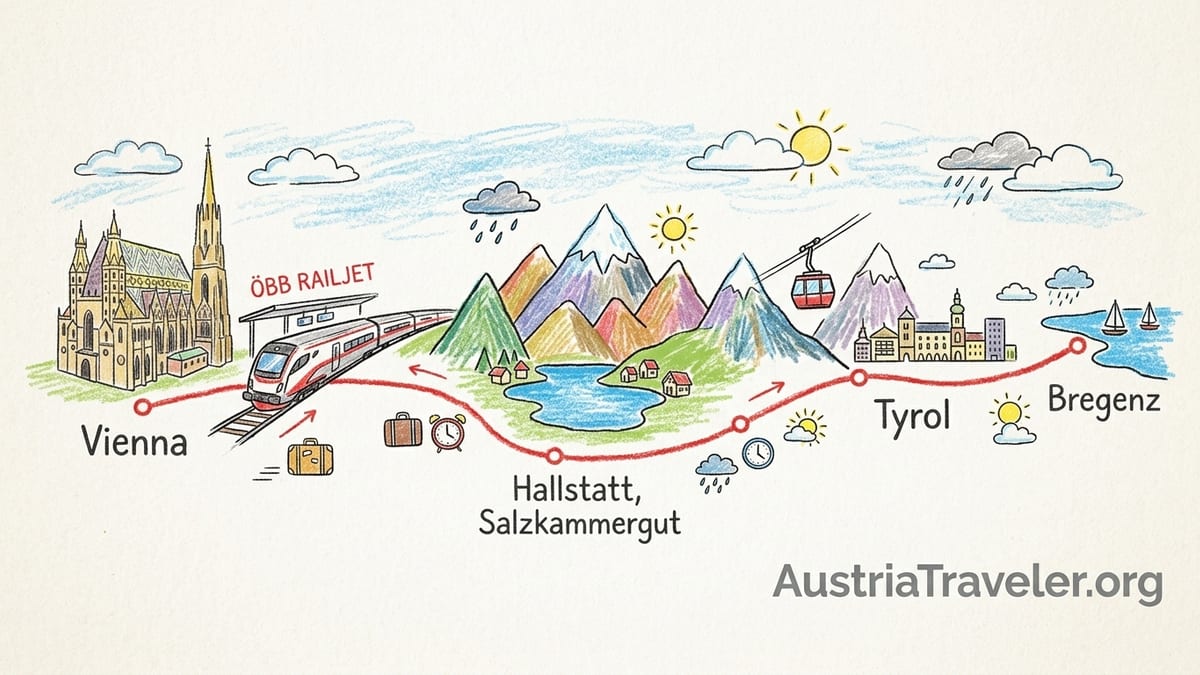
My original route looked excellent on paper: Vienna for two nights, then Salzburg, a day around the Salzkammergut lakes, onward to Innsbruck, and finally Bregenz on Lake Constance, broadly mirroring the national tourism board’s own seven-day Vienna–Linz–Salzburg–Salzkammergut–Achensee–Innsbruck–Bregenz rail journey. The logic was clear. High-speed Railjet and RJX services link Vienna with Salzburg in about 2 hours 30 minutes, and continue via Innsbruck to Bregenz in roughly another 4 hours. With that kind of backbone, it is easy to convince yourself that you can see “all of Austria” in a week.
In practice, those smartly printed timetables translated into repeated half-days lost. Vienna to Salzburg, for example, meant checking out of a hotel by 10:00, a 10 to 20 minute tram or metro ride to Wien Hauptbahnhof, a 2.5 hour train, a taxi queue at Salzburg Hauptbahnhof, and a 15:00 or 16:00 check-in at the next hotel. I had burned the core sightseeing hours of a day simply shifting my luggage from one wardrobe to another. I then walked into the historic centre feeling as if I had arrived at the tail end of my own holiday.
The same pattern repeated in the mountains. I based myself in Salzburg but tried to fold Hallstatt and the Dachstein West area into single day trips. An early-morning regional train towards Attnang-Puchheim and on to Hallstatt station, the small ferry across the lake, then the funicular and salt mine above the village, already filled most of the daylight hours. The combined ticket for mine and funicular currently costs about 49 euros for adults and children’s tickets around half that, which makes you feel you ought to squeeze every minute of your slot on the mountain. That pressure, added to return train times, meant my “relaxed” lakes-and-Alps day became a precision-timed exercise.
On that same trip I also tried to use Innsbruck as a springboard for quick tastes of the Nordkette ridge and nearby Zillertal. The Nordkette cable car system lifts you from the city centre to high alpine terrain at over 2,200 metres in about 20 minutes, using a funicular and two cable cars in sequence. One clear morning made it a perfect use of time. The next day heavy clouds and wind forced higher lifts to close. My notebook still shows a page where I had sketched alternative walks and side trips, all of which evaporated once the mountain shut and regional trains were disrupted by afternoon storms.
Why Moving Beds Too Often Breaks a Short Trip
Austria is compact by global standards. From Vienna in the east to Bregenz in the far west is under 600 kilometres as the crow flies, and the main rail route links them neatly. That geographic scale tempts travellers to keep moving. What my first itinerary underestimated was how each hotel change eats into your usable hours, and how mountain logistics create extra friction around those moves. In city centres, stations are conveniently central, but even then you can bank on at least half a day disappearing with every relocation.
Consider a transfer from Salzburg to Innsbruck when you are staying in the pedestrian Altstadt on both sides. Even with a morning Westbahn or ÖBB Railjet, you are leaving one hotel by late morning and realistically not settled into the next until mid-afternoon. If you then want to ride the Nordkette lifts, you are working within operating hours that vary by season. In summer the system usually runs into the early evening, sometimes extended by a “Happy Hour,” but in shoulder seasons last rides can be late afternoon. One delayed train or a slow check-in can turn a much-anticipated mountaintop afternoon into no more than a quick viewpoint photo before the last cabin heads down.
The problem amplifies in lake regions such as the Salzkammergut. Reaching Hallstatt involves at least one change of train, then a short ferry timed to specific arrivals, followed by the funicular up the Salzberg if you want the Skywalk or salt mine. Each element has its own timetable. If you try to wrap that into a single day from Salzburg while also moving hotels at either end, you are not travelling through a landscape so much as chasing a sequence of departure boards. When you factor in current round-trip funicular and Skywalk prices near 29 euros per adult, plus boat crossings and local buses, cutting a day short because of a late start feels particularly wasteful.
Even when you drive, the effect is similar. Parking in popular Salzkammergut spots is concentrated in designated lots with day tariffs that can sit around 15 euros or more, and those lots fill quickly in high season. A hotel move that lands you in the region around lunchtime can mean circling for spaces or parking further out and relying on shuttle buses. Your supposed extra flexibility with a car is reduced, and you still spend your best daylight hours in transit clothes with bags in the trunk.
Seven Days in Austria: Choosing One Big Theme
With only one week in Austria, I now think in terms of a single dominant theme plus a short contrasting chapter, rather than trying to criss-cross the country. You might choose cities with a taste of nearby hills and lakes, or an Alps-focused week anchored in one valley with a day trip to a historic centre. Either way, seven days forces you to prioritise. Vienna, Salzburg, Hallstatt, Innsbruck, the Salzkammergut and multiple Tyrolean valleys do not all sit comfortably in one itinerary without feeling like a train commercial.
On later trips I found that two main hotel bases in seven days work far better than four or five. A simple pattern could be four nights in Vienna and three in Salzburg. From Vienna you have enough time not only for the Hofburg, Schönbrunn and the museums, but also for at least one slow day in neighbourhoods like Neubau or the Prater rather than sprinting between palaces. Then you move once, by direct train, and settle in Salzburg for the remainder. From there you can add a single full-day excursion, perhaps to a closer lake area such as Wolfgangsee or to an easily accessed viewpoint like the Katrin cable car above Bad Ischl, whose valley station is connected by frequent regional trains or buses.
Seven days based largely in Salzburg and one lake region can also work if your priority is landscapes rather than imperial architecture. In that case I would place three or four nights in the Salzkammergut itself and three in either Salzburg or Innsbruck, but not both. Use your longer base as a hub for short, weather-sensitive trips. For example, if you wake to low cloud over Hallstätter See, you can skip the salt mine and Skywalk, whose higher sections can sit in thick fog, and instead take a train to Bad Ischl for spa time and Imperial Villa gardens that are pleasant even under grey skies.
The crucial shift for seven-day planning is to treat at least two calendar days as pure travel and logistics days. These are the days you arrive in Austria and switch between bases. They are not bonus half-days of sightseeing, and in my notebooks I now block them off as such. The result is that a one-week trip effectively gives you about five full days on the ground. Once I accepted that, my lists for each stop shrank to something enjoyably human.
Ten Days: Enough Time for Real Contrast
With ten days you can add contrast without returning to the frantic pace of my first cross-country attempt. I now aim for three bases in ten days, not more. One workable pattern is four nights in Vienna, three in Salzburg or the Salzkammergut, and three in a Tyrolean base such as Innsbruck or a nearby valley town like Seefeld or Mayrhofen, depending on whether you prefer an urban atmosphere or a more purely Alpine setting.
The extra time allows at least one transfer day to be more than a blur. For example, travelling from Vienna to the Salzkammergut, I once routed via Linz and stopped for several hours to visit the Ars Electronica Center and the riverside promenade, stowing my luggage in station lockers. The main Vienna to Linz leg on a fast train is around 1 hour 15 minutes, and Linz to Attnang-Puchheim or Bad Ischl adds roughly another hour. By planning a long lunch and museum visit in between, that travel day felt like a bonus city stop rather than dead time.
Ten days also give mountain weather room to misbehave. During one early summer trip I spent four nights in Innsbruck, which looked excessive when I booked it. In reality it allowed me to choose the clearest morning for the full Hungerburg–Seegrube–Hafelekar sequence on the Nordkette, and to use cloudier days for river walks, the Hofkirche and evening food markets. Cable cars up to around 2,200 metres can experience temperature drops of about 10 degrees compared with the valley, so being able to shift that high-altitude day to a sunny window made the ticket price feel worthwhile rather than grudging.
On another ten-day itinerary I based for three nights in St. Gilgen on Wolfgangsee, which put me a short boat ride or bus trip from St. Wolfgang and the Schafberg Railway, and still within easy reach of Salzburg for a day visit. The Wolfgangsee boats and the Schafberg cog railway operate on seasonal schedules, with dense service in July and August but more limited departures in spring and autumn. Having a three-night window meant I could pick the combination of lake cruise and mountain outing that fitted the day’s first clear spell, instead of shoehorning everything into a single date that might turn wet.
The key for ten days is to define in advance which train days count as real itinerary days. I typically treat the Vienna to lakes transfer as a flexible sightseeing day with a deliberate stop somewhere on route, while the lakes to Tyrol train is reserved as a genuine rest and reset day. That way I do not resent the hours between Salzburg and Innsbruck, which on direct trains can be around 2 hours, because I have not promised myself castle tours for that same afternoon.
Fourteen Days: A City-and-Alps Trip Without Constant Packing
Two weeks unlock a much calmer version of a classic Austria loop. With 14 days you could feasibly travel from Vienna towards Bregenz as the tourism board suggests, but rather than changing hotels every night, you can structure the journey around four bases of three to four nights each. On my most satisfying long trip I used Vienna, the Salzkammergut, Innsbruck and the Lake Constance area as those anchors, and made a conscious decision not to sleep in every pretty town that caught my eye.
In Vienna I stayed five nights, partly to fight jet lag and partly to give myself margin around museum hours and special exhibitions. Major sights such as the Kunsthistorisches Museum or the Belvedere can fill most of a day if you include coffeehouse stops and walks along the Ringstrasse, so packing them into a two-night stay would have been false economy. Those extra days also allowed a spontaneous evening at the Volksoper and a leisurely morning in the Prater park that would never have fit into a compressed schedule.
From Vienna I moved to the Salzkammergut for four nights, basing in Bad Ischl rather than Hallstatt itself. That choice traded the most photographed view for better train and bus connections and more manageable crowds. From there I could day-trip to Hallstatt, adjusting for the ongoing pattern of timed ferries and funicular and salt mine hours. I visited the mine one year when the Salzberg was fully open and another year when renovation closures pushed all the focus down into the village and along the lakeshore. In both cases, being 40 to 60 minutes away by public transport meant I could choose my day for Hallstatt rather than being locked into whatever the weather did on a single overnight visit.
In Innsbruck I limited myself to three nights on that same 14-day route, after having previously tried to squeeze the city into a one-night stop. One night had meant arriving in the late afternoon, walking into the Old Town for a rushed dinner and Golden Roof photo, then catching an early funicular the next morning and leaving straight afterwards. Three nights transformed the experience. I rode the Nordkette on the clearest day, used a cloudy one for the Tirol Panorama and Wilten Basilica, and kept a final day for a short train to a nearby village without fretting over departure times.
The last three nights in Bregenz completed the east to west journey without the cumulative fatigue I had felt on my earlier Vienna-to-Bregenz-in-a-week attempt. Railjet and InterCity trains connect Innsbruck and Bregenz in around 2.5 hours. On my more measured trip I left Innsbruck mid-morning, had lunch in Feldkirch between trains, and reached Lake Constance by late afternoon. Those last days were dominated by slow lakeside walks, a ride on the Pfänderbahn cable car above the town, and time on the floating stage used for the Bregenz Festival, rather than anxiously counting down to another checkout.
How Many Hotel Bases, and When One Night Is Enough
Looking back across several itineraries, the pattern that emerges is simple. In seven days, two hotel bases are ideal. In ten days, three. In fourteen days, three or four. Each base should earn its place with at least two full days of activity within straightforward reach. That does not mean you must never book single-night stays, but they work best in very specific contexts and locations.
I have had good one-night experiences at major rail junctions that also happen to be attractive cities in their own right, such as Linz or Graz, when I was already passing through for timetable reasons. In Linz I arrived from Vienna around lunchtime, spent an afternoon at the riverside Lentos Art Museum and walked up to the Schloss for sunset views, then left on a mid-morning train the next day. Because the station was close to the centre and my onward train to the Salzkammergut was relatively short, that single night felt unrushed.
By contrast, I regret almost every one-night booking I have made in lake or mountain towns that involve connecting buses, limited ferry services or cable cars with strict operating windows. A single night in Hallstatt, for example, may look romantic, but between timed check-in, luggage storage and early-morning departures, you can lose much of the possible magic to practical concerns. Add current prices for the funicular and mine combination tickets, lake boat tours and meals with lakeside markups, and compressing it all into a single calendar day can feel like poor value.
As a broad rule, I now treat any place where I plan to use cable cars, cog railways or lake cruises as deserving of at least two nights, preferably three, so that one bad-weather day or technical closure does not wipe out my main reason for being there. That applies just as much to alpine lift systems like Nordkette or the Gosaukammbahn in the Dachstein West region as it does to scenic railways such as the Schafberg Bahn above Wolfgangsee. In cities with dense all-weather attractions and frequent train connections, I am more comfortable with shorter, even overnight, stays.
Comparing My Pace With the Official Seven-Day Vienna–Bregenz Route
Austria’s own tourism board promotes a seven-day rail journey from Vienna to Bregenz, with stops in Linz, Salzburg, the Salzkammergut, Achensee and Innsbruck. On paper it is a compelling argument for how easy rail travel in Austria has become. Distances are short by international standards, and fast trains cover each leg in roughly two to three hours. The itinerary breaks the trip into daily hops, showing how you can wake by the Danube one day and fall asleep beside Lake Constance a week later.
Having tested a similar pace myself, I can say that it is possible, but not necessarily enjoyable in the way most leisure travellers imagine. The official route assumes that every day you will check out in the morning, take a mid-day train, then enjoy an afternoon and evening in your next stop. That rhythm leaves little room for the inevitable delays that creep into real travel, from waiting at hotel receptions to misreading a platform display. It also treats activities such as a salt mine visit above Hallstatt or a cable-car trip at Achensee as half-day add-ons that neatly fit around your transfers. My experience is that they rarely line up so neatly.
On the day the tourism board suggests travelling from Salzburg into the Salzkammergut, for instance, my own variation saw me snatching glances of Wolfgangsee through rain-smeared bus windows, because I was anxious about reaching my guesthouse before reception closed. The next morning I watched clear skies reflect on the lake but had to catch an early train instead of renting a boat or taking a lakeside walk, because my schedule said “Innsbruck” in capital letters. The problem was not with Austrian transport, which generally ran on time, but with the expectation that a new bed every night would still deliver a sense of rest.
When I compare that to my later 14-day route along a similar east–west corridor, the difference feels more like a change in travel philosophy than simply extra days. Instead of rating a place by how many of its famous postcard views I could collect, I began to judge my time by how many mornings I woke up without the phrase “check-out” at the front of my mind. That change also improved small but telling details: eating at a neighbourhood restaurant a second time because the staff recognised me, learning when the late-afternoon crowd thins on a lakeside promenade, or being able to choose the best weather window for a cable car trip rather than resigning myself to clouds.
The Takeaway
If I were planning my first Austria trip again, knowing what I know now, I would spend seven days between two hotel bases, ten days between three, and fourteen days between three or four at most. I would accept that arrival and long transfer days are not real sightseeing days, and I would stop pretending that I can meaningfully “do” a salt mine, a high-alpine cable car and a three-hour rail journey all in the same relaxed afternoon. That shift alone would thin my checklist and deepen my memories.
I would also treat mountain and lake excursions as fragile, weather-dependent privileges rather than guaranteed bullet points. Any place where a cable car ticket costs 25 to 50 euros, or where a ferry or cog railway runs to a limited seasonal timetable, earns a minimum of two nights in my plan so that I can move that experience to the right day. Cities with dense indoor attractions and frequent trains still reward longer stays, particularly at the start of a trip when jet lag and travel fatigue are strongest.
Perhaps most importantly, I would resist the urge to match the pace of Austria’s official Vienna-to-Bregenz-in-seven-days rail narrative. That journey proves what is technically possible with a Railjet network and coordinated regional connections. My bones, notebooks and photo folders now prove something else: that a handful of carefully chosen bases, repeated morning coffee orders and a few spare hours to wait out mountain clouds make for a more satisfying trip. Detailed day-by-day plans for Vienna, Salzburg, Tyrol and the Salzkammergut deserve their own dedicated guides. The principles that shape how many places you sleep in, and how much of your calendar you hand over to trains and cable cars, are the real backbone of any Austria itinerary.
FAQ
Q1. Can I visit Vienna, Salzburg, Hallstatt and Innsbruck in just seven days?
It is technically possible if you change hotels almost every night, but it is not pleasant. You would spend a significant share of your daylight hours in transit or checking in and out, and mountain excursions would be highly vulnerable to bad weather or limited lift schedules. Focusing on two main bases in seven days, for example Vienna plus either Salzburg or a lake region, offers a far more relaxed and memorable trip.
Q2. How many hotel bases make sense for ten days in Austria?
For ten days, three bases usually work best. A common pattern is splitting time between Vienna, a lake region such as the Salzkammergut, and a Tyrolean base like Innsbruck or a nearby valley town. That structure provides urban culture, lakes and mountains without turning your route into a daily packing exercise. It also leaves room for at least one travel day to double as sightseeing, for instance by stopping in Linz on the way between Vienna and the lakes.
Q3. When is a single-night stay a good idea in Austria?
One-night stays work best in cities with central stations and compact centres, such as Linz or perhaps Graz when it fits naturally between two longer legs. In those cases you can arrive by midday, explore on foot for an afternoon and evening, and leave the next morning without feeling rushed. Single nights are much less satisfying in lake and mountain areas, where cable cars, ferries and buses all follow specific timetables and weather can change quickly.
Q4. How should I treat travel days when planning my itinerary?
It helps to count arrival and major transfer days as real itinerary days in their own right, not as bonus half-days of sightseeing. A train from Vienna to Salzburg or from Salzburg to Innsbruck might only take two or three hours, but by the time you add check-out, station transfers and hotel check-in, most of the day’s prime sightseeing window has gone. Planning with that in mind reduces frustration and makes your daily activity lists more realistic.
Q5. Is it better to base in Hallstatt or somewhere else in the Salzkammergut?
Hallstatt offers the famous lakeside view, but it comes with limited space, concentrated day-trip crowds and fixed ferry and funicular timetables. Basing in a better-connected town such as Bad Ischl, St. Gilgen or Gmunden often provides more flexible train and bus links, a wider choice of accommodation and easier escapes when weather turns poor. You can then visit Hallstatt as a focused day trip, choosing the best available weather window during your stay.
Q6. How much does mountain weather really affect cable car plans?
Mountain weather has a major impact. Lifts such as the Nordkette above Innsbruck or the Gosaukammbahn in the Dachstein region can close or limit operations in high winds, storms or very low cloud, and temperatures at over 2,000 metres are often about 10 degrees cooler than in the valley. Having at least two or three nights in any base where you plan a significant cable car or high-alpine excursion gives you essential flexibility to pick a safe and enjoyable day.
Q7. Should I rent a car or rely on trains and buses?
Austria’s rail network is strong, with frequent fast trains between major cities and solid regional connections into many lake and mountain areas, so travelling without a car is entirely feasible. A car may help in more remote valleys or for travellers who want to reach trailheads and small guesthouses beyond regular bus routes, but it also introduces parking fees, one-way rental charges and stress in busy seasons. For first-time visitors following a city-and-lakes route, public transport plus occasional taxis usually strikes the best balance.
Q8. How far in advance should I book train tickets inside Austria?
For long intercity legs, booking a few weeks ahead can secure discounted advance fares, especially on popular routes between Vienna, Salzburg and Innsbruck during holiday periods. However, trains on these main corridors run frequently, so you are not obliged to commit months in advance unless you are travelling at absolute peak times. For short regional hops within a lake or mountain region, buying tickets close to the day of travel is usually sufficient.
Q9. What is a sensible budget for cable cars and mountain transport in a week?
Prices vary by region and season, but many major cable cars and combined tickets for attractions such as salt mines, scenic platforms or cog railways now sit in the rough range of 25 to 50 euros per adult for a return trip. In a seven-day trip where mountains are a highlight, it is realistic to plan for two or three significant paid mountain outings, plus smaller local lifts or boats, and to ring-fence a few hundred euros specifically for those experiences.
Q10. How should I decide between adding more destinations or adding more nights?
The most reliable test is to imagine losing half a day at each stop to rain, a train delay or simple tiredness. If that mental picture means you would hardly see anything in a given destination, you are probably spreading yourself too thin. Adding nights deepens your experience, gives you resilience against the unexpected and makes higher-cost activities like cable cars or boat tours feel far better value. In Austria, depth generally beats breadth, especially when mountains and lakes are part of the plan.