


On my most recent circuit around Austria, I deliberately planned the trip around bases instead of a frantic city-a-night itinerary. I used four main bases over 18 nights: Vienna for 4 nights, an Alpine valley town in Tyrol for 5 nights, a lake region base in the Salzkammergut for 5 nights, and a final 4 nights in the Wachau wine and river region. I mixed city hotels with a family-run mountain guesthouse and a vineyard stay. That meant fewer hotel changes, easier day trips and less time lost repacking. If anything, I slightly regretted the one mid-trip one-nighter I squeezed in to “see one more valley.” Everything else reinforced a lesson I now recommend to readers: Austria rewards choosing strong bases and staying put long enough to really use them.
How Many Bases Does Austria Really Need?
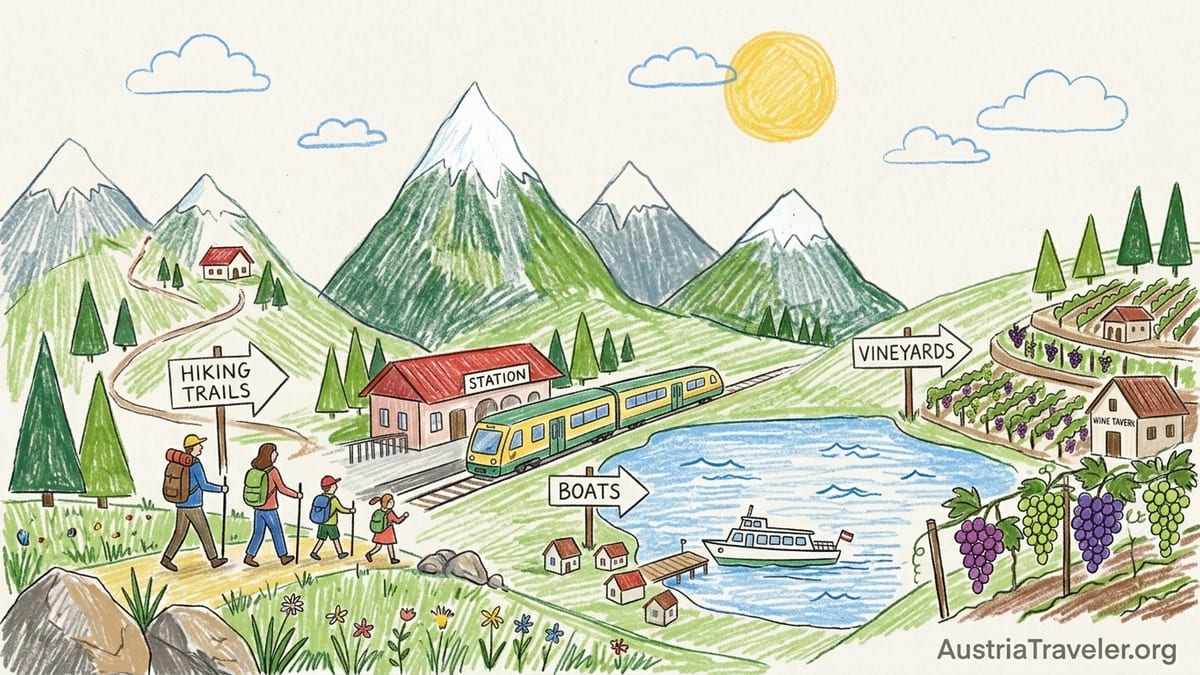
The first big decision on any Austria itinerary is not Vienna versus Salzburg, but how many separate beds you want to sleep in. On a typical 10 to 14 day trip that combines culture, mountains and lakes, most travelers are best served by two to four bases. Fewer than that and you may spend too long commuting to sights. More than that and you burn precious mornings checking out, hauling luggage and figuring out new bus timetables.
On my 18-night route, four bases worked well because they each opened up a distinct region: Vienna for imperial sights and big-city culture, a Tyrolean valley for Alpine hiking, a Salzkammergut lake for swimming and mellow boat trips, and the Wachau along the Danube for wine and small towns. That gave me full days that started and ended in the same place, with no need to haul my suitcase onto regional trains every other day.
Austria’s rail network, plus dense webs of Postbus routes around Salzburg and Tyrol, mean you can often pick one well-connected town and cover a large surrounding area on day trips. For example, staying in Zell am See puts you a short walk from the train station in the middle of town, with direct trains along the Salzach and a scenic narrow-gauge line deeper into the valley. The platforms are minutes from the lake promenade and boat piers, so you can be hiking in the mountains in the morning and back at a restaurant by the water that evening without ever moving hotels.
If you only have a week, a realistic plan might be two bases: Vienna plus one mountain or lake base, or Salzburg plus a nearby Alpine valley. With 10 to 12 days, three bases begin to make sense: a city, an Alpine valley or lake, and either a second mountain region or a wine and river area. Once you are above 14 days, a fourth base like I used is comfortable if each move genuinely unlocks a new landscape.
Using Vienna or Salzburg as Urban Anchor Bases
Most trips to Austria start in Vienna or Salzburg, and both cities work well as anchor bases if you think of them as hubs rather than single destinations. In Vienna, I stayed near the central station, Wien Hauptbahnhof. This kept airport transfers easy and meant that regional trains to the Wachau, the Semmering railway or even day trips into Slovakia all left from platforms a short walk from my hotel. In the evening, I could still be in the Ringstrasse area for concerts or dinner, then ride a quick tram or U-Bahn back without dragging luggage through narrow streets.
Vienna as a base is particularly strong if you want to mix museum days with one or two countryside excursions. Fast trains reach Krems an der Donau, the eastern gateway to the Wachau’s terraces and wine villages, in about an hour. From Krems you can step off the train into a small historic city with hotels, wine bars and river boats heading deeper into the valley, then be back in your same Vienna room that night if you prefer city evenings over quiet countryside. This is a case where not moving hotels saves time and lets you enjoy late-night Vienna food and culture.
Salzburg plays a similar role on the western side of the country. The main station sits a 15 to 20 minute walk or short bus ride from most central hotels, and the key lake and mountain routes fan out from there. Postbus 150 runs from Salzburg past Fuschlsee and along the Wolfgangsee to Bad Ischl, forming a spine through the Salzkammergut. That means you can sleep in Salzburg, enjoy its compact old town evenings, and take full-day trips to St Gilgen, St Wolfgang or even as far as Bad Ischl and back, as long as you accept an early start and late return on bus and boat timetables.
Urban bases like Vienna and Salzburg are usually comfortable choices: abundant restaurants, late-opening supermarkets, wide hotel choice and easy luggage storage on check-in and check-out days. The trade-off is that you may spend an extra hour each way reaching the trailheads or lakes you came for. My own conclusion after several trips is that these cities are excellent first or last bases, but if hiking or lake time is central to your trip, you gain a lot by moving at least once into the mountains or onto a lake shore.
Alpine Valley Bases: When Sleeping in the Mountains Pays Off
For my mountain segment, I based myself in a Tyrolean valley town comparable to Mayrhofen or Seefeld, both of which sit in broad valleys with train access and cable cars rising directly from or just outside town. In this kind of base, I did not need a car: I could walk from the guesthouse to the station in about 10 minutes, ride short regional trains to nearby villages, and still be at the cable car valley station in another 10 to 15 minutes on foot or via a local bus.
Using a valley base cut my daily “transport overhead” dramatically. On one hiking day, I left my guesthouse just before 8:00, walked 10 minutes to the lift, rode up to the start of the trail and was already on the ridge at 9:00. If I had tried to do that from a city, the same hike would have involved an early train, a bus transfer and precious time lost to queues. Towns like Mayrhofen, with the Penkenbahn lift right on the main street and the larger Ahorn cable car at the south end of town, typify this arrangement: hotel, lift and evening restaurants are all within a compact, walkable area.
Breakfast timing matters in these bases. Many Alpine hotels in Austria advertise breakfast buffets running from around 07:00 to 10:00, which is early enough for most hikers. In my Tyrolean guesthouse, breakfast started promptly at 7:00 and staff were used to guests appearing in boots and technical clothing, filling thermos flasks and asking for an extra roll wrapped up “for the trail.” In higher mountain guesthouses, some even sell a small hiking snack or packed lunch for early risers so that you are not dependent on finding a hut that is open before noon.
Parking and luggage logistics also tend to be easier in valley bases than in tiny car-free resorts. Many family-run guesthouses have on-site parking included in the room rate, and luggage storage is informal and flexible. On my departure day, I checked out, left my suitcase in a side room next to the dining area and spent a final half-day hike above town. I showered at a public pool near the station and boarded my evening train freshly changed. This ease of coming and going is a strong argument for picking one good valley base and radiating out, rather than hopping from village to village every night.
Lake Region Bases: Salzkammergut and Zell am See
For lakes, I used a base in the Salzkammergut, the lake district east of Salzburg, and later used Zell am See on a different trip. Both regions illustrate why a lakeside base can be more efficient than trying to see several famous villages as separate overnight stops. Around Wolfgangsee, for example, St Wolfgang is a resort village with a cog railway up the Schafberg and boat connections along the lake, while St Gilgen, at the other end, is quieter and linked to Salzburg by bus and to the Zwölferhorn peak by cable car. You can sleep in one of these villages and still comfortably visit the other and Bad Ischl as day trips.
In the Salzkammergut, staying directly in Hallstatt is the classic dream: pastel houses between lake and cliff, but it comes with trade-offs. The village core is essentially car-free, with visitors’ cars directed to car parks outside the center. Arriving by train means disembarking at the station across the water and taking a ferry over the lake. This is very atmospheric on arrival, but it complicates early starts and luggage drops. When I based myself in a nearby lakeside village with easier parking and less foot traffic, I could visit Hallstatt by morning boat, walk the alleys before the tour buses arrived, and be back in my quieter base by evening.
Zell am See works differently but points to the same lesson. The train station there is in the middle of town, a short walk from the lakefront and the historic core. This makes it unusually practical to arrive by rail, wheel your suitcase along level streets and check into a hotel a few minutes away. From there, boats circle the lake, and lifts and buses head into the surrounding mountains and to Kaprun. By staying in Zell itself rather than in a spread-out suburb or distant village, I saved time every morning and could still enjoy an almost resort-like atmosphere on the promenade at sunset.
Lakeside bases are also about evening atmosphere. In St Wolfgang and Zell am See I found that dinners felt relaxed because I was already on the water; I did not have to race for a last train back to a city. Even when the day crowds thinned, a core of hotel guests lingered on terraces and in lakeside bars. That lingering, in my experience, is one of the main rewards of picking a lake base rather than visiting on a tight there-and-back schedule from Salzburg.
Wine and Rural Bases: Wachau and the Danube
For my final base, I wanted vineyards and a slower pace, so I headed to the Wachau, the Danube valley between Melk and Krems that is known for terraced vineyards producing Riesling and Grüner Veltliner and for its small baroque towns. I had previously day-tripped here from Vienna, but staying in the valley itself changed the experience. Previously, I had rushed from a Danube boat to a castle walk and then back to the train. Based in the region, I could time my boat rides for quieter hours, hike a full stage of the Welterbesteig trail between villages and linger over wine tastings without calculating the last fast train back.
On one visit, I stayed in Krems, a small city at the eastern end of the Wachau. Krems combines a medieval core with a modern rail station that anchors regular trains to Vienna and into the valley. The station sits within walking distance of most hotels, and local buses fan out to nearby villages. Even without a car, this gave me flexibility. One day I took a morning boat upstream to Dürnstein, recognizable by its blue-towered abbey church and castle ruins. I hiked part of the Welterbesteig through vineyards and forest and returned to Krems by late-afternoon train, back to a wider choice of restaurants and shops than I would have had in a tiny village.
On another stay, I based myself directly in a wine village further up the valley, in a guesthouse run by growers. Here, the gain was atmosphere and immediate landscape. Vineyards began behind the house, and a short walk led straight into the terraced slopes. Evenings were quiet, with one or two village inns serving hearty food and the producers’ own wines. There were fewer formal services than in Krems and the last bus passed earlier, but the ability to step into the vines before breakfast and to walk home from a heuriger wine tavern without ever seeing a main road made the base deeply satisfying.
The choice between a larger town like Krems and a smaller village reflects a broader trade-off across rural Austria. Larger bases often have better rail and bus connections, more consistent restaurant hours and easier logistics for luggage and car rentals. Smaller villages offer immersion and charm but may require you to plan around limited bus frequency and earlier closing times. In the Wachau, it can make sense to split the difference: use Krems or Melk as a first or last night for convenience, and spend your main wine days in a central village base where you can walk to tastings and viewpoints.
Staying in or near Famous Destinations
Every Austria itinerary seems to include one place that is “on every poster.” Hallstatt, the classic example, looks exactly like the pictures from across the lake. So do the lakeside facades of St Wolfgang or the lakeshore in Zell am See. The question is whether to sleep inside those postcards or slightly outside them. In my experience, staying inside the famous village makes sense when first-light and last-light experiences really matter to you, or when early access saves you from queues at a cable car. Sleeping just outside can improve value, quiet and parking, and sometimes adds only a few minutes of extra travel.
For Hallstatt, I tried both strategies on different trips. When I stayed in the village itself, waking early and walking through the near-empty lanes at 7:00 felt magical, and I could be at the salt mine funicular entrance or on the lakeside photo points before the first tours arrived. However, I also needed to follow the village’s parking system, leaving my car in a designated lot and relying on shuttle arrangements to reach the hotel, and I had to time my departure to match ferry and bus schedules back to the mainline trains. When I based in a nearby lakeside village linked by bus and lake ferry, I had less postcard perfection at my doorstep but more flexibility and a noticeably lower room rate.
A similar pattern applies in the Wachau. Dürnstein is a small town and one of the most visited spots in the valley, with limited room supply and very high demand in autumn wine season. Staying there means stepping out of your door directly into an old town next to the Danube and having the ruined castle on the hill almost to yourself in the early morning. The trade-off is fewer evening restaurant choices and a higher risk of fully booked inns. Staying downriver in Krems or in a quieter wine village gives you more options, easier last-minute booking and often better value, but you will need to factor in a 20 to 30 minute boat or bus ride to be back in the postcard views.
My rule of thumb is simple: stay in the famous place itself if you plan at least two full days there and you care deeply about sunrise, sunset or the particular mood after day-trippers leave. Otherwise, use a near base for flexibility. In Austria, “near” is often very near indeed. Small distances, frequent trains and well-timed buses mean that a base 15 or 20 kilometers away may add only half an hour each way to your day, while significantly improving your sleep quality and restaurant choice.
Practical Base-Planning: Access, Food and Daily Rhythm
Regardless of which combination of city, valley, lake and wine bases you choose, success in Austria comes down to how the details of each base fit your travel style. Station access is crucial if you are traveling by train. In Vienna and Salzburg, consider staying within a 10 to 15 minute walk or a single tram ride of the main station so that arrival and departure days are smooth. In smaller towns like Zell am See or Krems, check how far hotels sit from the station so that you are not facing steep hills or long cobbled stretches with luggage.
If you are renting a car, parking can be a hidden deciding factor. Alpine valley towns and rural inns often include on-site parking, which makes them forgiving bases. Famous lake and river villages, in contrast, may funnel visitors into peripheral lots. Knowing in advance whether your hotel offers reserved parking, and how far that is from the entrance, can spare you a frustrating first hour after a long drive. On one trip, choosing a guesthouse with its own small courtyard in the old town meant that we rolled our suitcases a few meters instead of shuttling from a crowded multi-story car park outside the center.
Food rhythms matter just as much as scenery. In cities, restaurant kitchens often serve hot food into the evening and some advertise “throughout warm kitchen,” meaning you can eat a late lunch without issue. In smaller mountain and wine villages, lunchtime service can finish mid-afternoon and many kitchens will only start again for dinner. Planning your base with at least one or two reliable inns within a short walk helps avoid long, hungry searches after a hike. Hotel breakfasts in both cities and countryside are commonly included and tend to be generous buffets. If you are an early hiker, look for places that begin breakfast around 7:00 and ask whether they can prepare a small snack or sandwich for you to take onto the trail.
Finally, think about evening atmosphere. Ask yourself what you want to do after dinner. In Vienna or Salzburg, you may prefer a glass of wine in a modern bar or a late concert. In Zell am See or St Wolfgang, you might end the day listening to water against the lake wall. In a Wachau wine village, the evening might mean a heuriger courtyard with local white wine and apricot dessert specialties. The right base is the one where your typical evening looks and feels the way you imagine your Austria trip should, without you needing to check a train timetable before ordering dessert.
The Takeaway
Across several circuits of Austria, the pattern has repeated itself. The trips that feel spacious, relaxed and memorable are not the ones where I add the most dots on the map. They are the ones where I choose a handful of strong bases, stay put long enough to settle into local rhythms, and use Austria’s reliable trains, buses, lifts and boats to explore around them.
On a first or second visit, two to four bases across the whole country are usually enough. A city like Vienna or Salzburg can anchor the start or end of your trip. An Alpine valley base unlocks ridge walks, hut lunches and easy lift access. A lakeside base in the Salzkammergut or around Zell am See delivers water, views and family-friendly options. A wine or rural river base in the Wachau or a similar region slows the rhythm at the end. How you combine them depends less on the exact towns and more on your appetite for hotel moves versus day-trip commuting.
If you keep an eye on practicalities like station access, parking, breakfast times and how long it takes to walk from your pillow to the trailhead or boat pier, Austria becomes one of Europe’s easiest countries to explore through bases. Decide what you want your average day to feel like, pick the bases that match that feeling and then resist the temptation to keep moving just because the map shows another famous name an hour down the line.
FAQ
Q1. How many bases should I plan for a 10-day trip to Austria?
For around 10 days, most travelers are comfortable with three bases, for example Vienna, one Alpine or lake base near Salzburg or in Tyrol, and a final base in a wine or rural region such as the Wachau.
Q2. Is it worth staying overnight in Hallstatt, or is a day trip enough?
Overnighting in Hallstatt is worth it if you value the early morning and late evening atmosphere once day-trippers leave, but nearby lake villages with easier parking and lower prices work well if you are content with a long day visit.
Q3. Should I base in Salzburg or on a nearby lake in the Salzkammergut?
Salzburg is best if you want evening culture and easy rail access, while a lake base like St Gilgen, St Wolfgang or another Salzkammergut village is better if you prioritize swimming, boat trips and waking up directly by the water.
Q4. Do I need a car to use Alpine valley bases in Austria?
Not necessarily. Many Alpine towns, such as those in the Ziller or Inn valleys, have train stations in or near the center and local buses or cable cars starting close by, so you can hike for several days using public transport and lifts.
Q5. What time do hotel breakfasts usually start in Austrian mountain or lake towns?
In most mid-range hotels and guesthouses in mountain and lake regions, breakfast buffets typically start around 7:00 and run until 9:30 or 10:00, and many hosts will prepare an early coffee or simple snack if you ask in advance.
Q6. Is it better to stay in Dürnstein or Krems when visiting the Wachau Valley?
Dürnstein offers a picture-book village experience right on the Danube but has limited rooms and higher prices, while Krems is a larger, more practical base with better transport links, more restaurants and easier last-minute availability.
Q7. How close to the station should I try to stay when using trains in Austria?
In cities, staying within a 10 to 15 minute walk or a short tram ride of the main station keeps arrival and departure days manageable, and in small towns it is convenient if your hotel is close enough to reach on foot without steep climbs or long cobbled stretches.
Q8. Are rural and wine-region bases suitable without a car?
Some are. Larger towns like Krems or Melk have good train and bus links, while smaller wine villages can be reached by a combination of rail, local buses and Danube boats, although you will need to plan more carefully around timetables.
Q9. Will I miss too much if I choose not to stay in Vienna at all?
Skipping Vienna entirely is possible if your focus is purely on mountains and lakes, but most first-time visitors benefit from at least two or three nights in the capital to see its main sights and to adjust to the country before heading into the countryside.
Q10. How far in advance should I book bases in popular Austrian regions?
For famous spots such as Hallstatt, Dürnstein, St Wolfgang or peak season Alpine towns, it is wise to book several months ahead, especially for summer, autumn foliage and Christmas markets, while larger cities and towns often have more last-minute availability.