


I learned how little actually fits into an Austrian winter itinerary the hard way. On my last December trip I tried to combine Vienna, Salzburg, a ski village and a spa town in nine nights. On paper, the distances looked short and the train network looked flawless. In reality, early sunsets, snow storms, Christmas market hours and winter timetables quietly erased half the things I thought I could see. This guide is the itinerary I wish I had planned instead, built from that route and what went wrong, with realistic suggestions for how I would now divide 5, 7 or 10 days in Austria in winter.
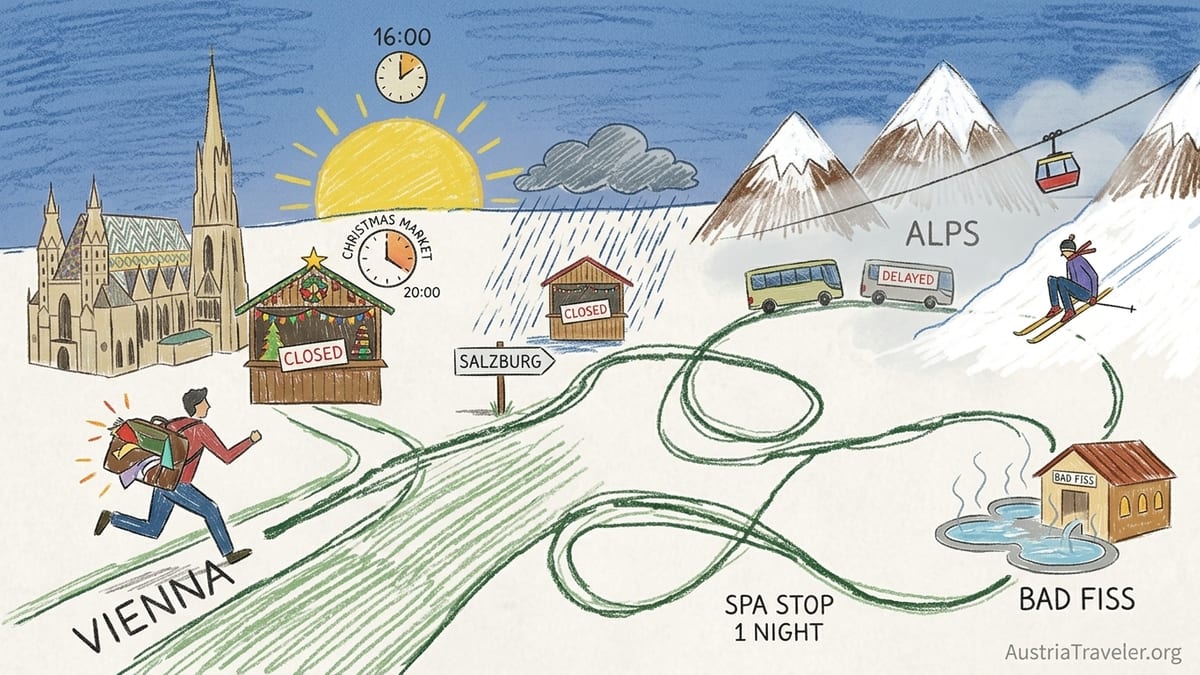
My Real Winter Route Through Austria, And What Went Wrong
On my last cold-season visit I built a classic “see-everything” route: three nights in Vienna, two in Salzburg, three in an Alpine village and one final night in a spa town near Vienna. I arrived in early December, chasing Christmas markets, snow and a bit of skiing. The bases were Vienna, Salzburg, a ski village in the Salzburgerland region and then a spa stop on the return. In theory it was a compact loop with minimal backtracking. In practice, winter conditions turned it into a lesson in slowing down.
The first shock was daylight. In early December in Vienna the sun sets around 16:00 and you get roughly eight and a half hours of usable light. Official tables show sunset hovering near 16:00 for the entire month, with the shortest day just before the solstice. That meant anything I did after 15:30 was in the dark or in blue twilight. Museum visits, coffeehouses and markets work well in that light. Viewpoints, hiking and big palace gardens did not. I had blocked out “afternoon walks” at Schönbrunn after 16:00 as if it were May, and they simply did not happen.
Weather took the second bite out of my plans. One travel day between Salzburg and the mountain base coincided with a heavy snowfall. Trains still ran, but regional connections slowed and some alpine buses were delayed or cancelled for safety. A journey I thought would take under three hours door to door turned into closer to five, with time spent waiting on platforms and creeping along snowy roads once I reached the valley. On another day, fog swallowed the views I had planned from a cable car. I could have rebooked that ride for another day if I had built a buffer into the schedule. I had not.
Then logistics piled on. Christmas markets in Vienna and Salzburg often open late morning and close between early and late evening, usually around 20:00 or slightly later, but many shut earlier on December 24 and some end entirely by December 23 while others run to January. On my trip, I arrived into Salzburg one evening just as the market was closing, lost another night to heavy rain, and realized that “two nights in Salzburg” translated into only one dry, fully open market session. Add in the realities of winter driving laws, the need for proper winter tyres between November and April, the toll vignette for motorways, and the slower pace of walking on icy streets, and I suddenly felt as if I was always rushing and still missing things. That is why I now plan fewer hotel changes, more rest days and very honest daily goals.
How Winter Realities Shrink Each Travel Day
Once you put concrete winter constraints on the table, Austrian days become much shorter than they look on your calendar. In December and early January you typically have sunrise after 7:30 and sunset around 16:00 in Vienna and Salzburg, with mountain valleys feeling darker even earlier because of surrounding peaks. Factor in the time you need for breakfast, layering up, walking to tram or U-Bahn stops, and queuing for attractions, and a “full day” may only have five or six truly active sightseeing hours.
Bad weather can effectively erase full days of your original plan. On my trip, a forecast of light snow in the Alps turned into heavy snowfall that closed a minor pass and forced drivers onto slower valley routes. Road authorities remind visitors that in winter conditions such as snow, slush or ice, cars must be equipped with winter tyres or snow chains between November and April, and driving without proper equipment can result in fines. More important than the fine, though, is the speed. Even with winter tyres, you simply drive slower on snow and take longer to reach trailheads, cable car stations or small villages.
Public transport is a clear advantage in Austrian winter, but it does not cancel out the need to slow down. Intercity trains between Vienna and Salzburg can be as fast as about 2 hours 20 minutes, but once you transfer to regional trains and buses into the Alps, winter timetables and occasional delays matter. On my journey from Salzburg to a ski area, a missed connection meant an extra hour of waiting in a small station, which ate directly into afternoon ski time. I learned to treat any travel day that involves a significant train or bus leg as a “half sightseeing day” at most.
Christmas market hours also shape what fits. In Vienna, flagship markets near the Rathaus, Schönbrunn and Stephansplatz open in late morning and close in the evening, but some end before Christmas, some run until December 26 and a few continue through New Year and the first week of January. In Salzburg, the main Christkindlmarkt at Dom and Residenzplatz typically opens from late November to January 1, with daily hours that shorten on December 24. When one of my sightseeing days overlapped with December 24, I found that shops closed in the early afternoon and markets shut by late afternoon, leaving the city festive but quiet. Without a clear plan for museum visits or a long cafe stop, that evening would have felt empty. The lesson was simple: markets are not twenty-four-hour attractions, and neither are shops.
How Many Hotel Changes I Would Now Tolerate
Looking back at that nine-night itinerary, the biggest mistake was packing in too many bases. Four different beds in nine nights meant I was either checking in, checking out or riding a train on almost every other day. In summer, that might be acceptable. In winter, repacking in a small room while wet clothes hang over a heater, then dragging a suitcase across slushy streets to a station in near darkness, felt like a recurring punishment. I now set a clear limit: on any winter trip of 10 days or less in Austria, I will only plan two, at most three, hotel bases.
For a five-day trip I would choose a single base or, at most, one city and one mountain base. That might mean five nights in Vienna with a day trip to the nearby Vienna Woods thermal spa town, or three nights in Vienna and two in a small resort like Zell am See reached by train. I would not attempt a Vienna–Salzburg–Alps triangle in five days anymore. The transfers chew up too much precious light, and every check-in cuts into the hours I could spend in a museum or at a Christmas stall.
On a seven-day trip I am comfortable with two main bases, for instance Vienna and Salzburg, or Salzburg and an Alpine valley. If I want to add a spa town near Vienna, I now treat it as a day trip from the capital instead of a separate overnight stop. That way I avoid packing everything up again just for a single night. When I did spend a night at a spa hotel between the Alps and Vienna, the pools and saunas were a delight, but check-in did not happen until late afternoon, and I left again the next morning. The net result was only a few hours of true relaxation in exchange for the effort of changing hotels.
On a 10-day itinerary a third base can make sense if the jumps are efficient, like Vienna to Salzburg to a single alpine valley on a direct line. Even then, I would try to stay at least three nights in each place. Arriving late because of snow or delays is far less stressful when you know you have two or three more full days in that base. That stability also allows for spa sessions or lazy mornings without feeling that every minute must be productive sightseeing.
Weather Buffers, Rest Days And How Many Outdoor Days In A Row
I did not schedule a proper weather buffer on my first winter loop, and I regretted it. One heavy snow day in the Alps closed hiking paths I had marked on my map and made the idea of a panoramic chairlift ride very unattractive. If I had built in one unplanned day anywhere in the mountain portion of the trip, I could have swapped activities and waited for clearer skies. Now, whenever I include alpine scenery or skiing in Austria between December and March, I try to keep one flexible day for each three or four days in the mountains.
The second lesson was about physical tiredness. Winter outdoor days are surprisingly draining. Between the weight of boots, extra layers, cold air and the mental effort of walking without slipping on ice, I found that three intensive outdoor days in a row was my maximum. That might include a half-day of skiing followed by an afternoon walk, then a winter hike the next day, then a long day exploring Salzburg’s hilly old town and fortress on foot. By the fourth day, I appreciated any excuse to sit in a tram or a thermal pool. When you plan your own itinerary, assume that a string of high-effort outdoor days will require a slower day to follow.
City and spa days were what saved my trip from exhaustion. In Vienna, a morning spent in the Kunsthistorisches Museum followed by a long afternoon in a traditional coffeehouse turned into an ideal rest day after the Alps. In the spa town, a single evening in warm pools and saunas cut through the accumulated chill of a week of cold walks. If I were rebuilding my route, I would deliberately alternate days: mountain scenery or outdoor touring, then a softer day in a city or spa. The alternation kept me from getting too tired and meant I could actually enjoy the evenings rather than collapsing as soon as I got back to the hotel.
When I now sketch itineraries, I also think about mental rest. Constantly changing towns and learning new tram systems or bus lines takes quiet energy. Staying three nights in one city lets you memorize one or two tram routes and get familiar with a couple of cafes or bakeries. That familiarity becomes its own kind of rest and is particularly welcome when the weather encourages you to retreat indoors regularly.
How I Would Now Plan A 5-Day Winter Trip
Five days in Austria in winter forces real choices, and I now see that as a benefit. On my first trip, I tried to give those five days a bit of everything: Vienna, Salzburg, a ski village and a spa. In hindsight, that approach only guaranteed a lot of hours on trains and almost no depth anywhere. If I were planning again for a friend with five days in December or January, I would ask them to choose one priority: cities and Advent atmosphere, or one historic city combined with one mountain base.
For a city and Advent focus, five nights in Vienna can be an excellent choice. You can use a 72-hour transport pass to cover trams, buses and the underground and spend your short daylight window on a few big sights such as Schönbrunn, the historic center and one major museum. Late afternoons and evenings can then go to the Christmas markets that cluster around Rathausplatz, Stephansplatz and other squares. Markets usually open in late morning, but they feel most atmospheric after dusk, which arrives conveniently early. With a single base, you do not spend time checking out and catching intercity trains.
If someone insists on including both a city and a mountain setting, I now advise three nights in Vienna and two in an accessible alpine town on a direct rail line from either Vienna or Salzburg. That might be a lake town with winter walks and a cable car, or a small family ski resort. What I would not do in five days is squeeze in both Salzburg and Vienna plus the Alps. Something has to give, and Salzburg is easier to pair with the Alps on a longer trip. A short itinerary benefits from the international flight connections and cultural density of Vienna, plus perhaps a quick visit by rail to a nearby thermal spa for half a day.
The main rule I apply to a five-day plan is “no more than one hotel change.” With such a short trip, the cost of repacking, navigating a new city from its station and adjusting to a new neighborhood is simply too high in winter. It is better to accept that some places will wait for another journey than to arrive home with memories of platforms and suitcases more vivid than palaces and mountains.
How I Would Divide A 7-Day Winter Itinerary
Seven days provide enough space to combine culture and winter scenery without constant packing, as long as you respect the season’s limits. After my own experience, my preferred structure is two bases of three or four nights each. The most natural pairing is a larger city such as Vienna or Salzburg and a mountain region that offers both snow activities and poor-weather alternatives such as indoor pools or historic villages.
One example would be three nights in Vienna followed by four in the Salzburg region. You could arrive in Vienna, spend two full days exploring key sights and markets, then travel to Salzburg in just under three hours by direct train. From Salzburg, you could enjoy one full day in the city’s old town and fortress, one day trip to a nearby lake region or smaller Christmas market if the season is right, and one day reserved for a mountain excursion by train or bus, perhaps to a small ski resort or viewpoint. The seventh day becomes your flexible buffer in case of heavy snow or rain.
The critical planning decision with seven days is where to place your weather buffer. Austria’s cities can feel moody but still rewarding in drizzle or light snow, because museums and coffeehouses stay open and transport usually runs on adjusted timetables even during the holidays. Alpine cable cars and ski runs are more vulnerable to wind and avalanche risk. For that reason I would keep one unplanned day somewhere in the mountain portion of the week, and I would avoid booking nonrefundable mountain excursions far in advance.
In terms of hotel changes, I now know that two bases in seven days are manageable in winter, while three are not. You can arrive, settle in for three nights, move once by train to your second base and settle there for the remaining four. That pattern leaves room for one slower spa or city day in each base. On my original trip I effectively treated Salzburg only as a transfer point between Vienna and the Alps, which meant I saw the Christmas market lights but never wandered across the river into quieter neighborhoods. With seven days and only two hotels, small discoveries like those become possible.
Stretching To A 10-Day City–Mountain–Spa Trip
With 10 days, the idea of a balanced city–mountain–spa itinerary in Austria becomes realistic, as long as you still limit bases and respect winter fatigue. My initial nine-night attempt at four bases taught me that the country’s rail network is excellent, but winter travelers do not benefit from testing it daily. Today, if I had 10 nights in December, I would pick three bases at most and keep them on a relatively straight line.
One workable structure would be four nights in Vienna, three in Salzburg or another mid-sized city and three in a nearby mountain or spa town. The first four nights let you arrive, shake off jet lag, and adjust to the early sunset while visiting major sights. The three nights in the second city provide variation and access to a different set of day trips, perhaps to a lake region, a smaller Advent market, or a nearby fortress town. The final three nights in an Alpine or spa base near that second city give you time for a couple of winter outdoor days plus at least one half or full day devoted almost entirely to pools and saunas.
In the mountains, I would plan no more than two demanding outdoor days in a row. That might mean a ski day followed by a snowshoe hike, or a long winter walk followed by a cable car ride and panoramic restaurant lunch. By day three, I would either slow down with a lighter walk and a spa session, or retreat entirely indoors to rest. On my own trip, the afternoon I spent doing very little in a hotel spa turned out to be one of the most memorable, because it finally gave me time to absorb everything I had seen instead of racing to the next view.
Transport planning across 10 days also benefits from current information. Austrian motorways require a vignette toll sticker or digital registration for vehicles under 3.5 tons, and between early November and mid-April, winter equipment rules apply whenever you drive into wintry conditions. Because of those regulations and the calm of sitting in a heated carriage as snow falls outside, I now default to trains for most of the long legs, only considering a rental car for the final approach to a remote valley if train and bus connections truly do not work. Even in that case, I would aim to pick up and drop off the car in the same region to avoid winter highway driving on tight schedules.
Even with 10 days, I avoid scheduling every hour. Markets, in particular, are better enjoyed unhurried, with room for spontaneous detours into side streets, small churches or cafes when fingers and toes go numb. A longer itinerary shines when you can accept that some days will be low-key, focused on one or two highlights, without anxiety that you are wasting precious time.
Revised Rules: How Much Austria Actually Fits Into Winter Travel
After moving through this route and rethinking it at my desk later, I came away with a different set of rules for planning winter trips in Austria. The most important rule is that short daylight and winter weather cut your capacity in half. If a summer guidebook suggests you can see four or five major sights in a day, plan on two or three in December or January. That might look like one museum, one neighborhood walk and one Christmas market visit, not a full cross-city checklist.
The second rule is to assign a realistic cap on hotel changes. For a five-day trip, I now treat one base as ideal and two as an upper limit, and only if there is a clear logic such as Vienna plus an easily reached mountain town. For seven days, two bases are ideal. For 10 days, three bases are the most I will consider, and only if the route does not require crisscrossing the country. Any more than that, and the hours spent on platforms and in check-in queues overshadow the charm of cobbled streets and snow-covered roofs.
The third rule is that a weather buffer is not optional if mountains are involved. It can be a day with nothing scheduled in an Alpine town, or a flexible block in a nearby city where you are happy to swap indoor and outdoor activities as forecasts change. Without that buffer, you will almost certainly face a choice between going ahead with a compromised experience, such as a foggy viewpoint or a half-open trail, or skipping it entirely.
The fourth rule is that winter outdoor days need to be rationed. In my own case, three strenuous outdoor days in a row felt like a hard maximum before I wanted a spa or museum day. Another traveler might tolerate two or four, but everyone has a limit. Planning for alternating “heavy” and “light” days keeps the second half of your trip from dissolving into fatigue. The spa and city days are not indulgent extras; they are what make it possible to enjoy the snow days fully.
Finally, I now accept that not every major attraction belongs in a single winter itinerary. Vienna alone can keep a visitor busy for a week of museums, palaces, markets and concerts. Salzburg’s compact old town deserves at least two or three unhurried days. The Alps and the spa towns could fill another week. The honest approach is to choose one or two of these themes per trip rather than stacking them all and hoping the trains, clouds and daylight cooperate. Austria rewards repeat winter visits, and leaving something for next time is a better souvenir than a folder full of rushed photos.
FAQ
Q1. Is December or February better for a winter trip to Austria?
December offers Christmas markets and Advent atmosphere but very short days and busy weekends, while February usually has more reliable snow in the Alps, longer daylight and fewer city crowds.
Q2. How many cities can I realistically visit in 5 winter days?
In five days it is most realistic to focus on one base, usually Vienna, or at most one city and one nearby mountain town connected by a straightforward train ride.
Q3. Do I need a rental car for Austrian winter travel?
For most itineraries between Vienna, Salzburg and major alpine regions, fast trains and regional buses are sufficient, and they avoid winter driving and toll vignettes.
Q4. How many hotel changes are comfortable in a 7-day winter itinerary?
Based on my experience, two bases are comfortable in seven days, while three start to feel rushed once you factor in short daylight and possible weather delays.
Q5. Should I plan a full spa day or just an evening visit?
If you have been outdoors for several days, a full spa day can be restorative, but even a single evening in pools and saunas can noticeably reduce winter fatigue.
Q6. How much sightseeing fits into one winter day in Vienna or Salzburg?
Allow time for two or three main activities at most, such as one major museum, a historic walk and an evening market visit, rather than trying to tick off every landmark.
Q7. How many consecutive winter outdoor days are manageable?
On my trip, three demanding outdoor days in a row felt like the maximum before I needed a lighter city or spa day to recover both physically and mentally.
Q8. Is it worth including both Vienna and Salzburg on a short trip?
With seven or more days, combining them can work well, but on a five-day trip I would usually choose Vienna alone or Vienna plus a closer mountain excursion.
Q9. Do Christmas markets stay open after Christmas Day?
Some major markets in Vienna and Salzburg run until around New Year or early January, but others close before or just after December 24, so exact dates need checking.
Q10. How far in advance should I book trains between Vienna and Salzburg in winter?
Timetables are typically published months ahead, and booking a few weeks early can secure better fares and seat reservations on popular pre-Christmas and holiday dates.