


I have spent multiple winters in Austria, splitting my time between Vienna, Salzburg, Innsbruck and nearby ski areas, mostly in December, January and February. Over the years, these trips have taught me that choosing the “best” winter month in Austria is not theoretical. It depends very precisely on what you want from your trip, and on how the season is unfolding in that specific year. This guide is based only on what I have actually experienced on the ground, not on long-term averages or postcard promises of guaranteed city snow.
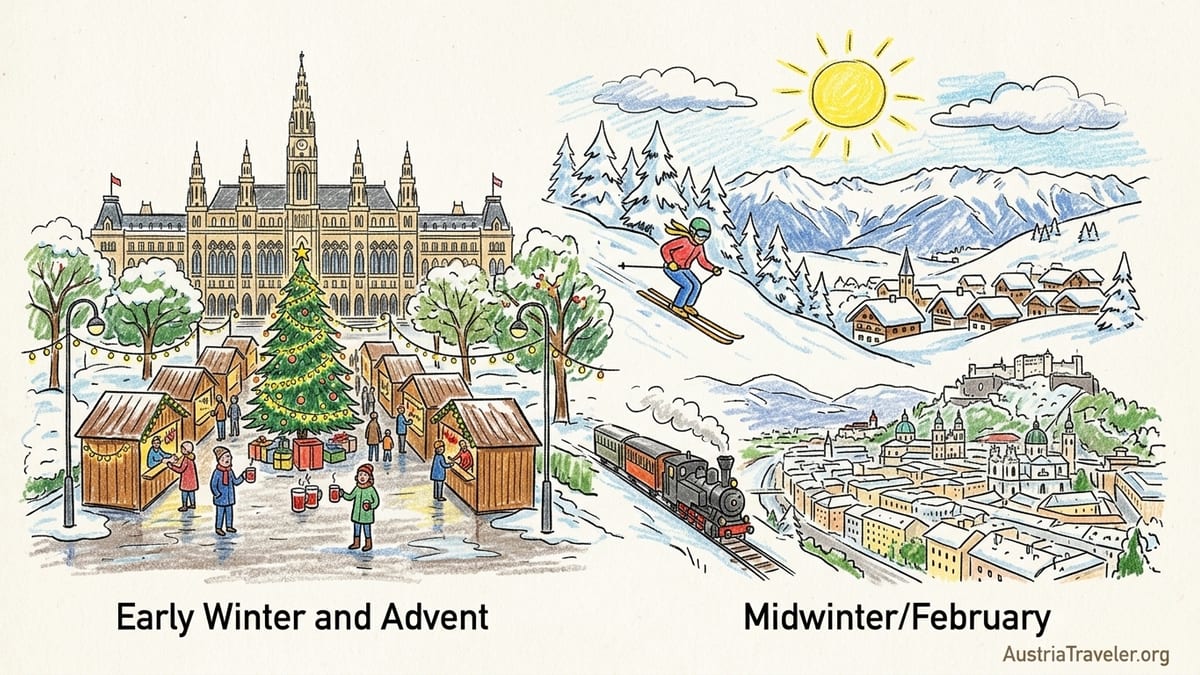
How Winter in Austria Really Feels: Early December to Late February
Across my trips, early winter in Austria has usually started to feel serious by late November and early December, though not always with snow in the cities. In Vienna and Salzburg, I have walked under twinkling Advent lights in temperatures just above freezing with bare pavements, then returned a year later to find the same streets under slush after a sudden cold snap. On one early December visit to Vienna, the day started around 5 °C with mist and drizzle, and only the distant hills showed a dusting of white. A different year, the first weekend of Advent brought wet snowfall that stuck on cars and park lawns but quickly turned to ice at street level. Those contrasts shaped how much time I actually wanted to spend outdoors and how magical the evenings felt.
In the mountains, my early December experiences have been very different. Around Innsbruck and the Tyrol ski areas such as Nordkette and Patscherkofel, I have stood on groomed pistes under clear sun while the valley below was brown or only lightly frosted. Artificial snow made early-season skiing possible, but natural snow depth was still thin, with some rockier sections off-piste clearly exposed. By the time January rolled around on later trips, the same slopes felt properly covered, and in February I have more than once skied through fresh powder while tree branches sagged under snow at mid-mountain level, even if the valley floor had already started to show patches of grass.
Daylight has been one of the biggest surprises for many winter visitors I have met. In December, especially around Christmas, it has felt like Austria’s cities switch abruptly from blue morning twilight to afternoon dusk. I remember leaving a Vienna café near the Ringstrasse at 3:45 pm and noticing street lights already glowing, while in Salzburg just before New Year the Hohensalzburg Fortress was a silhouette by 4:15 pm. By late January and into February on my later trips, the extra hour or so of light in the late afternoon made winter walking and day trips much more relaxed, even when temperatures were technically colder.
Across all these stays, one constant has been the unpredictability of snow at low altitude. In Vienna in particular, locals have told me that regular snow cover has become rare, and my own visits support that. I have had one stay in December when light snow stuck for two days and turned Rathauspark into a children’s playground of snowmen, and another when mid-December felt almost like November in northern Italy, damp and grey with not a flake in sight. In Salzburg, I have seen more frequent snowfall, especially in January and February, but even there the Old Town often alternated between postcard snow and bare cobbles within a single week.
Early Winter and Advent: Late November to Early December on My Trips
Early winter in Austria has, for me, meant the days when the markets switch on but the deep winter cold has not yet fully arrived. In Vienna, that has been mid to late November and the first week or so of December. I have visited when the Christmas market in front of Schönbrunn Palace was already operating with its full ring of wooden huts, glühwein kettles steaming in the chill, while the lawns in the palace gardens still showed green patches between frosty pathways. Crowds were lively in the evenings but noticeably thinner than later in December. At midday on weekdays, I could still find an empty standing table to sip punch at Rathausplatz without elbowing my way through tour groups.
Snow in the cities during this early phase has been the exception in my own experience, not the rule. In Vienna I have mostly walked on wet pavement and heard locals grumble that “real” snow will not come, if it comes at all, until later. In Salzburg on an early December trip, I woke up one morning to a brief burst of wet snow that coated the baroque church domes for a photograph or two before turning to rain by lunchtime. Sidewalks quickly became slick, and by evening the snow was only visible on the nearby hills. In the mountains above Innsbruck during roughly the same calendar window on another trip, the ski lifts were running over a mix of artificial and early natural snow. Pistes felt hard but skiable, and off-piste still looked thin and better avoided.
Daytime temperatures in early winter on my visits have typically hovered between just below freezing and about 6 or 7 °C in the cities. That has meant that winter walking remained comfortable with a decent coat and hat, especially in Vienna’s central districts where wind tunnels can make it feel colder than the thermometer suggests. The short daylight was more limiting than the cold. In late November Vienna felt atmospherically dim by mid-afternoon, which was perfect for Christmas lights but less ideal for longer park walks or photography beyond the blue-hour mood.
Hotel prices during this early Advent phase have been a mixed experience. In Vienna and Salzburg, midweek stays in late November have occasionally been noticeably cheaper than the week leading up to Christmas, with city hotels offering what they labeled “Advent specials” that undercut high-season December rates. However, weekends even in late November filled up quickly around the big markets, and I had to book central rooms near the Ringstrasse and Salzburg’s Old Town weeks in advance to avoid paying significantly more or being pushed out to less convenient neighborhoods. In mountain resorts, early December has sometimes meant modestly lower prices than the peak holiday weeks, but the tradeoff was the risk of limited natural snow.
Christmas and New Year: My December Market and Holiday Experiences
The heart of Austrian winter, at least emotionally, has been Advent and Christmas. I have visited Vienna and Salzburg several times between about 10 December and the days just after New Year, and those trips have felt very different from early winter. In Vienna, the cluster of major markets around the center, from Rathausplatz to Maria-Theresien-Platz and the courtyards off Am Hof and Freyung, were all fully operational and at their busiest. On weekend evenings before Christmas I found Rathausplatz so crowded that moving from one side of the square to the other could easily take twenty minutes, and queues formed for the most popular punch stands and novelty food stalls.
Snow during these Christmas visits has varied wildly. One December in Vienna brought a short but dramatic snow event: I walked out of the U-Bahn to find fat flakes swirling around the Rathaus spires, settling in the park and creating exactly the scene many winter visitors dream of. By the next afternoon, the snow had partly melted into slush around the tram tracks, and walking between markets became messier but still atmospheric. On another Christmas-season stay, temperatures hovered above freezing and the only “snow” in sight was the artificial kind around a few market displays. Locals pointed out that this was increasingly common and that anyone promising guaranteed city snow in December was running on nostalgia, not reality.
In Salzburg during this same mid-December to New Year window, I have had slightly better luck with winter weather. The main Christkindlmarkt on Cathedral and Residenz squares, which in recent years has run roughly from the third week of November into early January, felt moodier on evenings when light snowfall dusted the cobblestones and the fortress looked hazy above the town. On a New Year’s visit, however, the city was dry and cold, and side streets were more icy than snowy after earlier flurries had been compacted by crowds. The surrounding hills often held more snow, and short bus rides or funicular trips quickly changed the landscape from bare stone to white trees.
Daylight at Christmas is at its shortest, and I have felt that strongly. In both Vienna and Salzburg, sightseeing days needed conscious planning. On one trip, I remember racing through Schönbrunn’s gardens in a narrow window between a grey late-morning start and a 3:30 pm dusk, then going straight into the market for food. Walking remained enjoyable because the cities are compact and well lit, but long riverside strolls or extended hiking near Salzburg had to wait for a later winter trip when daylight improved. Temperatures during my Christmas stays ranged from slightly below freezing to just above, which was fine as long as I kept moving and ducked into cafés when fingers started to stiffen around my cup.
Holiday crowds and prices are where December has felt most extreme. In Vienna, the nights leading up to Christmas have been among the busiest urban travel periods I have experienced in Europe outside summer. Hotels near the Innere Stadt were heavily booked, and even mid-range options charged holiday premiums. The same pattern held in Salzburg, especially for stays that included Christmas Eve or New Year’s Eve. Trains between Vienna and Salzburg also filled early, and I learned to reserve seats for late December travel rather than assuming I could just board with a standard ticket.
Deep Midwinter: My January Trips for Skiing and Quiet Cities
January has been my reliable choice when the goal was more about snow in the mountains and less about Christmas markets. I have spent several Januaries based in Innsbruck and smaller Tyrolean resorts while still making side trips to Salzburg and Vienna. On these trips, the contrast between valley and mountain has been strongest. I have woken up in Innsbruck to bare or lightly frosted streets and then, within half an hour on a gondola, found myself in a fully white landscape at Nordkette, where snow depth at altitude felt solid and off-piste sections, while still needing caution, were genuinely wintry.
In ski areas like those around the Zillertal and Stubai valleys that I have visited in January, the snow has usually felt more dependable than in early December. Some seasons have delivered consistent cold, with well-groomed pistes and occasional fresh snowfalls that refreshed conditions overnight. On one January week in a Tyrolean village, I had two days of steady snow that left cars buried along the main street and made walking between guesthouse and lift station feel like strolling through a snow tunnel. Another year, there were a few warmer spells, and south-facing slopes softened in the afternoons, but even then the combination of altitude and snowmaking kept the main runs in good condition.
In Vienna and Salzburg in January, my experiences have leaned toward cold, often dreary days with limited but real chances of snowfall. I have seen Vienna under a thin layer of snow that turned quickly to grey ice at intersections, as well as periods where high pressure brought clear, very cold nights and bright but frigid days. Daytime highs have often struggled above freezing, and overnight temperatures dropped well below zero. While this was less photogenic than December’s lights, it had its own appeal: fewer tour groups, quieter museums, and easier last-minute hotel bookings in central locations at noticeably lower prices than Christmas week.
Daylight in January has felt like a small but significant improvement. On my mid-January stays there was enough light to complete a late-morning museum visit and still manage a decent city walk before dusk. In Salzburg, that meant being able to ride the funicular to the fortress, explore the ramparts with views over the snowy or frosty rooftops, and then return to the Old Town for coffee without rushing. In the mountains, the combination of longer days and better snow made January my favourite month for ski-focused trips, even if festive vibes were largely gone and many Christmas markets had closed by early in the month.
Crowds reflected this shift in purpose. In Vienna and Salzburg, tourist numbers dropped sharply compared with December, and restaurants that had turned people away during Advent could often seat me without a reservation in January. In ski resorts, however, weekends and school-holiday weeks still felt busy. I have shared gondolas with families on winter break and heard lift staff comment on holiday crowds, especially around the first week of January when some Christmas and New Year visitors were still on the slopes.
Late Winter and the Turn Toward Spring: My February Visits
February in Austria has been a transition month on my trips, with conditions shifting between deep winter in the mountains and early hints of spring in the cities. In Innsbruck and nearby ski regions, I have enjoyed some of my best combined experiences of snow quality and daylight in February. Pistes were usually well established, snow depth at altitude felt reassuring, and the sun climbed just high enough to offer longer, more comfortable ski days. On one February visit, I spent a bluebird afternoon at Nordkette with bright, dry snow on north-facing slopes while the city below basked in sun and looked nearly snow free.
Not every February has been perfect. In one recent season, I saw signs of thinner than usual snow at lower elevations, with some grassy patches showing up near village-level runs and ski schools moving beginners to higher slopes where coverage was still better. However, even that year, mid-mountain and high-altitude areas retained enough snow for satisfying skiing, and fresh snowfalls were still possible. The main difference compared with January was that afternoons could feel a bit warmer in the sun, and outdoor café terraces in ski villages started to fill with people sitting without hats for the first time since November.
In Vienna and Salzburg in February, my trips have felt more like late winter city breaks than holiday pilgrimages. Christmas markets were gone, and streets, while still decorated in some places, had lost the Advent intensity. I experienced a mix of conditions: a few days of raw damp cold with fog along the Danube, and others when clear sun melted any remaining snow quickly, leaving only piles of dirty ice in shaded corners. Walking remained enjoyable as long as I dressed for the wind, and daylight stretched toward 5 pm and beyond, which made river walks and extended neighbourhood explorations more realistic than in December.
Prices and crowds in February reflected this shoulder feeling. In Vienna, I found central hotels offering attractive winter promotions, especially outside of key event dates. Booking a room near the Ringstrasse or in Neubau felt easier and cheaper than in December. In Salzburg, too, accommodation availability improved compared with Christmas, though ski resorts within easy reach could still get busy on weekends. Overall, February has suited trips that combine a few days of skiing with city time, without the specific Christmas focus or highest peak-season premiums.
Matching Your Trip Purpose to the “Best” Winter Time
What my winters in Austria have made clear is that the best month depends completely on your main reason for going. When my priority was Christmas markets in Vienna and Salzburg, late November and the first three weeks of December worked well. Markets such as Vienna’s Rathausplatz, Schönbrunn and the Salzburg Cathedral squares were open and fully decorated, but midweek crowds in late November and very early December were more manageable than the final Advent weekends. I could browse stalls, talk with artisans, and actually see the stands without being swept along in a dense flow of people.
If your main aim is Christmas markets and atmosphere, I would personally choose a stay that falls roughly between the second half of November and about 20 to 22 December, based on my own visits. That captured the full market experience on my trips without the heaviest holiday travel spikes around Christmas Eve and New Year. I would not plan such a trip expecting guaranteed snow in Vienna or even downtown Salzburg, though. My own Decembers have included everything from slushy fairy-tale evenings to completely snowless streets. Treat any snow in the cities as a bonus, not a promise.
For skiing or snowshoeing, my experiences have pointed to later winter. January gave me the most consistently solid snow in the mountains, while February added better daylight and sometimes slightly milder afternoons, though with the risk of thinner cover at the lowest elevations in warmer years. If your priority is deep, reliable snow, I would target from early January to mid-February and base yourself near higher and more snow-sure ski areas, using Innsbruck, the Zillertal, or Stubai as gateways rather than relying on very low-lying hills.
If you want a mix of city culture and winter activities without the crush of Christmas crowds, my best stays have been in mid to late January and February. On those trips, Vienna and Salzburg were quiet enough that I could walk into major museums and some popular cafés without queues, hotel rates were softer than during Advent, and day trips into snowy surroundings were still easy. One February, I spent three days in Innsbruck skiing under near-perfect conditions, then took the train to Vienna for three nights of museums and evening concerts, all without feeling like I was competing with holiday tour groups for every table and ticket.
Practical Lessons From My Winter Trips: Roads, Walking and Expectations
Road conditions have varied across my winter journeys, but a few patterns stand out. In and around Vienna, even on snowy days in December and January, municipal crews generally kept the main roads and tram routes functioning. I have occasionally walked along narrower side streets that were packed with snow or ice for a day or two after a storm, but city transport remained reliable. In Salzburg, the compact Old Town can become slick quickly when snow turns to slush and refreezes overnight, and I learned to wear boots with real tread rather than smooth-soled city shoes. Driving into higher Tyrolean valleys on my ski trips, winter tires were non-negotiable, and I saw roadside signs reminding drivers about chains on steeper passes in heavier snow years.
Winter walking remained one of the great pleasures of my trips, provided I accepted seasonal limits. In early Advent, strolling through Vienna’s Prater or along the Ringstrasse in the late afternoon felt festive rather than harsh, especially on dry days. Around Christmas and New Year, walking between markets in Vienna or exploring Salzburg’s lanes required more frequent café stops to warm up, particularly when temperatures dipped below freezing with humidity. In January and February, I appreciated the longer daylight and slightly drier cold on clearer days, but I also encountered more patches of black ice where snow had partially melted and refrozen. Good footwear and a slower pace kept it enjoyable.
Another lesson has been to remain flexible. On one December trip to Salzburg, a forecast that suggested steady snow turned into three days of rain in the city. Instead of pushing for outdoor activities, I spent more time in museums, churches and cafés and shifted my scenic walking plans to a colder, sunnier day later in the week. In the Tyrol, a January stay that began under grey skies and flat light on the slopes transformed after a midweek storm, and I ended up with two remarkable powder days. Building a margin into your schedule has paid off more often than not in my own planning.
Finally, I have learned not to rely solely on climate charts when setting expectations. Historical averages may show that January is the snowiest month or that Salzburg has more winter precipitation than Vienna, but my real visits have delivered warm spells in January, bare streets in December, and icy mornings in February. Treat those numbers as background, then prepare for both milder and harsher possibilities. Layers, waterproof shoes, and a willingness to swap plans around current conditions have mattered more than any specific monthly statistic.
FAQ
Q1. Will I definitely see snow in Vienna if I visit in December?
Based on my own December visits, no. I have experienced everything from brief, photogenic snowfalls that melted within a day to completely snowless streets. Treat snow in Vienna as a welcome bonus rather than a guarantee, even in the heart of Advent.
Q2. When have I found the Christmas markets most enjoyable?
My favourite visits were in late November and the first half of December on weekdays, when markets such as those at Vienna’s Rathausplatz and Schönbrunn and Salzburg’s Cathedral squares were fully open but not yet at their most crowded. Weekend evenings close to Christmas felt much busier and less relaxed.
Q3. Which month has given me the best ski conditions in Austria?
Across my trips, January has delivered the most consistently good snow in the mountains, with February also strong but sometimes showing thinner cover at the very lowest elevations in warmer years. Early December has worked for skiing only at higher-altitude resorts and often relied more on artificial snow.
Q4. Is January too dark and cold for enjoyable city sightseeing?
January is certainly cold and often grey in Vienna and Salzburg, but I have still enjoyed city breaks then. The key advantages were quieter streets, shorter queues at museums, and lower hotel prices than at Christmas. Daylight is limited but slightly better than in late December, and warm indoor attractions are abundant.
Q5. How crowded were Austrian cities during Christmas and New Year on my trips?
On my December and New Year visits, central Vienna and Salzburg were among the busiest winter destinations I have experienced. Markets, hotels and popular restaurants filled up, and I often needed reservations for dinners near Christmas and New Year’s Eve, especially in the Innere Stadt and Salzburg’s Old Town.
Q6. Did winter walking feel safe and pleasant in the cities?
Most of the time, yes. With good boots and a warm coat, I found walking in Vienna and Salzburg enjoyable in all three winter months. The only real challenges were brief periods of slush and ice after snowfall, particularly on older cobblestones and side streets that were cleared more slowly than main roads.
Q7. Are hotel prices always cheaper in January and February than in December?
In my experience, yes for city stays, with some exceptions around major events. Central hotels in Vienna and Salzburg were noticeably more expensive and busier in the Advent and holiday weeks than in late January and February, when winter promotions and last-minute deals were much easier to find.
Q8. If I want both Christmas markets and skiing, when would I go?
On trips where I wanted both, I have split my time between early or mid-December in Vienna or Salzburg for markets and then moved to higher-altitude ski areas for a few days. Alternately, early January has worked well for ski-focused days with a quick city stop, accepting that the main markets have usually closed by then.
Q9. How early in the season have I found mountain snow good enough for skiing?
On my own trips, early December skiing in Austria has been possible but variable and usually best at higher elevations with strong snowmaking. Natural snow cover improved noticeably by early January, and overall I have been more satisfied with conditions from January onward than in the first weeks of the season.
Q10. What is my personal “best time” overall to visit Austria in winter?
For pure Christmas atmosphere and markets, my choice is late November to mid-December. For skiing and reliable mountain snow, early January to mid-February has worked best. For quieter, good-value city breaks with a winter feel but fewer crowds, I have preferred late January and February.