


Austria in winter looks like a postcard: baroque cities lit by Christmas markets, snowy alpine villages and steamy thermal spas. It can also be surprisingly expensive, especially once you add seasonal extras like vignettes, ski passes and winter gear bought in desperation. This guide pieces together real-world winter spending from recent trips around Vienna, Salzburg and the Austrian Alps, then updates it with 2026 prices so you can see both what travelers actually paid and what you are likely to face now.
Trip Overview and How This Cost Breakdown Works
The numbers in this article come from real winter trips in Austria between December 2022 and February 2025, drawn from detailed trip reports and budget breakdowns shared by travelers who published their spending in euros. These include long Christmas-market weekends in Vienna and Salzburg, a December rail loop through Vienna, Salzburg and Hallstatt, and ski-focused weeks in Salzburg province and Tyrol. All of that historical spending is clearly described as “what was actually paid then.”
Alongside that, I use current 2026 figures for key fixed costs such as motorway vignettes, ski passes and some event tickets, based on official sources. Those up-to-date numbers are not my own spend but factual anchors, so you can adjust the older trip budgets for the coming winter. Treat the historical costs as reference points and the 2026 prices as your planning baseline.
To keep things realistic, this article focuses on a one-week Austria winter trip for two people in December, flying into Vienna, combining Christmas markets, some light skiing near Salzburg, and a half-day in a thermal spa. You will see how costs change depending on whether you choose rail or car, whether you hit Christmas and New Year peaks, and how small winter-specific extras like locker fees, boot purchases and mountain transport add up.
All amounts are given in euros. If you are planning in US dollars, a rough rule in late 2026 is that 1 euro usually lands somewhere a little above 1 US dollar, but always check the latest exchange rate when you book.
Accommodation: Where Winter Timing Really Bites
Accommodation is where travelers reported the widest winter swings. In shoulder periods like early December weekdays, one traveler documented paying about €110 per night for a central Vienna apartment for two people in 2023, while another paid closer to €160 per night for similar dates that coincided with a long weekend and peak Christmas-market buzz. The same pattern appears in Salzburg and Innsbruck: prices jump whenever Austrian school holidays, Advent weekends or New Year dates align with good snow.
In Salzburg, a traveler who visited in mid-December 2022, arriving on a Tuesday and leaving Friday before Christmas week, reported paying roughly €120 per night for a midrange pension within walking distance of the old town. Another report from December 28 to January 2 found that similar double rooms in comparable locations easily hit €200 to €260 per night, and some centrally located hotels were fully booked unless reserved months ahead. The difference was almost 70 to 100 percent for essentially the same standard of room, purely due to dates.
In ski villages, timing matters even more. For a non-glamorous but comfortable three-star hotel with half board in a Salzburg ski area, one family paid around €95 per person per night in January 2024, which came to about €190 per night for two adults. The same property’s New Year week package was advertised near €150 per person per night, or €300 for two, plus a mandatory gala dinner supplement. They avoided that week on cost grounds alone, choosing the cheaper early-January window once school holidays ended.
For a one-week winter trip in 2026, budgeting €130 to €170 per night for two in Vienna or Salzburg in early to mid December is sensible if you book several months out and avoid Christmas to New Year. For the same cities over New Year’s Eve, many travelers now report seeing midrange rooms starting closer to €220 per night. In popular ski resorts during main season, plan on €220 to €300 per night for a decent double room or apartment for two, with outliers on both the cheaper and much more expensive ends. The lesson from past trips is clear: your exact dates will move your accommodation line item more than almost any other choice.
Rail vs Car: Trains, Vignette, Fuel and Parking
Austria is one of the easiest European countries to tour by train. On recent December itineraries, travelers commonly booked Vienna to Salzburg with the national rail operator several weeks in advance for about €25 to €35 per person in second class, each way. One traveler’s 2023 Advent-weekend trip notes showed a Vienna to Salzburg ticket at €29 per person outbound and €32 return, for a total of €122 for two people. They purchased “Sparschiene” discounted tickets tied to specific departures, which are widely available if you avoid peak Friday evenings and Sunday afternoons.
Regional routes to smaller winter spots are often cheaper. A December day trip from Salzburg to Hallstatt in 2022, bought a few days ahead, cost one traveler roughly €30 per person round-trip using regional trains plus the short lake ferry. Another trip report described paying just under €20 each way from Salzburg to Innsbruck on an advance purchase in January, which made rail far more attractive than renting a car for that part of the route.
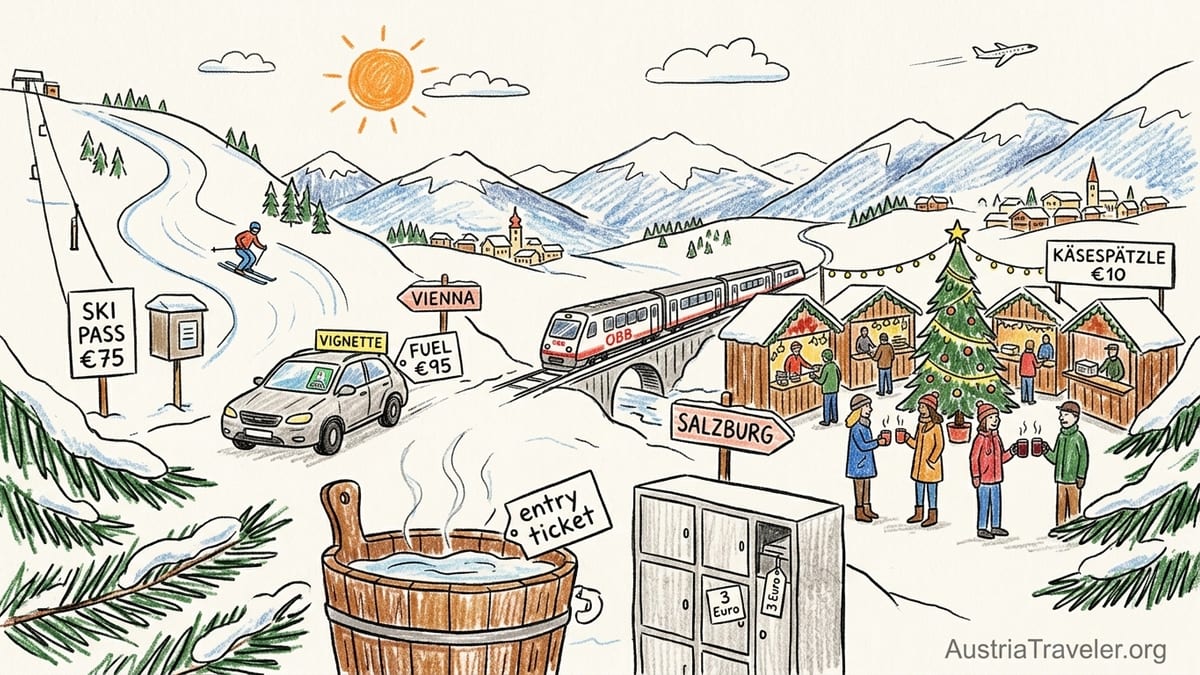
Driving becomes more relevant once you head deep into ski country or want flexibility for small villages. For that, you need to factor in Austria’s toll vignette. As of the 2026 season, a ten-day motorway vignette for a passenger car costs about €12.80, and a two-month vignette about €32. These prices cover the entire motorway and expressway network but do not include separate “section tolls” for certain alpine tunnels and passes, which typically run around €10 to €15 per passage. A weeklong winter loop from Vienna through Salzburg and back in 2026 is therefore likely to include at least the €12.80 vignette, plus any optional extra tolls if you use the major alpine tunnels.
Fuel is harder to generalize, but recent winter trip reports that shared receipts show drivers paying between €1.60 and €1.80 per liter of petrol in late 2023 and early 2024. A couple that logged about 700 kilometers in Salzburg and Tyrol in January 2024 spent roughly €95 on fuel. Parking added a surprising amount: their notes list three nights in a village garage at €12 per night, a ski-resort day at €10 for surface parking close to the lifts, and several city parking sessions of €3 to €4 per hour in Salzburg and Innsbruck. Across a week, they spent just over €80 on parking alone, which would have nearly paid for an extra rail segment.
Comparing those real-world budgets, rail is generally cheaper for a simple Vienna and Salzburg city-and-markets trip, especially if you travel light and stay close to the stations. A rental car begins to make financial sense if you have three or four people sharing costs or if your itinerary involves several smaller ski towns, but you will need to set aside a realistic line for vignette, possible tunnel tolls, fuel in winter conditions and multi-day parking at hotels that do not include a free space.
Ski Costs and Mountain Transport, Even If You Do Not Ski
Austrian ski prices have been climbing fast. Reports from skiers in the 2024 to 2026 seasons describe adult peak-season day passes in large resorts such as Ski Arlberg moving into the 80 euro-plus range. Commentators in late 2026 noted that an adult peak-day lift ticket there had crossed about €85. Smaller and mid-size areas remain cheaper, but even there, winter budgets from 2023 already show adult day passes in popular Salzburg resorts in the €60 to €70 band during the main season, with higher prices around Christmas and New Year.
For 2026, official and semi-official price lists suggest that an adult day ticket in a high-profile resort like Obertauern will usually land somewhere from the mid 70s euros upward in peak periods, with dynamic pricing that raises rates over holidays. Multi-day passes, such as six-day tickets in large Tyrolean resorts, can easily push past €350 for adults in high season. One family who kept precise records from a March 2024 week in a big Tyrol resort spent €1,050 just on six-day passes for two adults and one teenager, before rental gear or lessons.
Non-skiers should not ignore mountain transport in their budgets. Gondola rides to panoramic viewpoints, winter hiking circuits or sledding hills are rarely free. In several Salzburg-region ski areas, a non-skier lift ticket for one return gondola ride in 2024 averaged around €25 per adult. A traveler visiting Innsbruck in winter 2023 shared that the Nordkette cable car combination ticket for city-to-peak access ran close to €40 per adult for the full route at the time. These are not once-in-a-week costs; many visitors take at least two or three lift rides over a winter stay, whether to join skiing friends for lunch on the mountain or to access a sledding run.
Equipment hire is another key winter-specific cost. In a typical Salzburg ski village in 2023, a standard adult ski set (skis, boots, poles, helmet) cost about €35 to €40 per day, with weeklong packages in the €150 to €180 region. Snowboard sets were similar. A family of four that rented for four days in February 2023 reported spending roughly €520 on rental gear alone. Ski-school lessons or guided clinics add even more, especially in peak school-holiday weeks when half-day group lessons can easily exceed €80 per child per day in high-demand resorts.
Christmas Markets, Food, Drinks and Daily Spending
Real Austria winter budgets nearly always underestimate food and drink on the first pass, especially at Christmas markets. While the markets themselves are typically free to enter, certain specialty markets in Vienna and Salzburg that have enclosed areas now occasionally charge a modest admission in the €5 to €8 range on busy evenings, according to traveler notes from late 2023. Most big city squares stay free, but it is worth checking if the particular market you plan to visit adds an entry fee at peak times.
The main drain is what you buy once inside. Multiple detailed trip reports from Vienna’s Rathausplatz and Schönbrunn markets, and from Salzburg’s Christkindlmarkt, show a remarkably consistent pattern. In 2022 and 2023, a mug of Glühwein or punsch typically cost €4 to €5, plus a refundable mug deposit of another €3 to €4. A hearty market meal like käsespätzle, grilled sausage with sides or goulash bread bowls usually landed around €8 to €12. One couple’s notes from a December 2023 evening in Salzburg list two drinks each plus simple food and one dessert, totaling about €56, including deposits that they mostly returned.
Cafes and restaurants in winter city centers run the full spectrum, but the cold strongly nudges people toward hearty sit-down meals rather than picnic-style dining. A traveler who logged all Vienna spending during a December week in 2022 averaged around €14 per person for a cafe lunch, including a simple main and a coffee, at low-key places away from the top tourist sites. Dinners with a drink tended to land between €20 and €30 per person at modest midrange restaurants. Fine dining and tourist-trap central squares can double those numbers without trying, and the gap felt even sharper on frigid nights when the idea of walking an extra fifteen minutes for cheaper food was less appealing.
For a one-week 2026 winter trip, a realistic food-and-drink budget for two adults, including some market evenings, is around €80 to €120 per day, depending on how often you cook for yourself. Couples who stayed in apartments and cooked breakfast plus some dinners from supermarket ingredients, based on their recorded receipts, managed to bring the daily total down to closer to €60 to €80, though they still splurged at markets and in traditional Gasthäuser several times per trip. The key observation from their notes is that spontaneous hot drinks and snacks in cold weather add up faster than the core meals.
Thermal Spas, Lockers, Luggage and Other Overlooked Winter Costs
Thermal baths and wellness centers are one of Austria’s great winter indulgences and a significant budget item. In the Salzkammergut region near Salzburg, for example, popular lakeside thermal complexes charged general adult admission in the €30 to €35 range for three- or four-hour tickets in 2023 and 2024. Weekend and evening slots often carried small surcharges, and a full-day ticket for extensive sauna and pool access commonly pushed into the €45 to €50 area.
Locker and towel fees are easy to overlook. At one well-known spa visited in January 2024, a couple paid €2 each for locker rental and €4 per towel, and were required to wear special flip-flops purchased on site for about €8 per pair after arriving with non-compliant footwear. Their relaxing afternoon ended about €32 higher than expected simply because they had not read the fine print, even though the advertised entry was under €40 per person. Similar reports come from Tyrolean spas that require a deposit for wristbands and charge surcharges for premium sauna zones.
On a city-and-rail itinerary, luggage is another recurring winter cost. Several travelers who combined Vienna, Salzburg and Hallstatt by train in December highlighted station lockers as a quiet budget line. In 2023, large lockers at major Austrian stations such as Wien Hauptbahnhof and Salzburg Hauptbahnhof generally cost around €3 to €5 for a few hours or up to 24 hours, depending on size. One couple who routed via Salzburg between Vienna and Hallstatt used large lockers twice in a single day to stash rolling suitcases and heavy coats while exploring the old town, paying about €9 in total. It was money well spent, but still enough to matter on a tight budget.
Winter clothing and equipment purchases are perhaps the sneakiest cost category. Numerous trip reports mention buying emergency gloves, thicker hats, neck gaiters or proper winter boots after a first icy day revealed inadequacies in what they brought from home. In December 2023, a traveler in Vienna noted paying about €40 at a high-street chain for lined winter boots after their sneakers failed on slushy pavements, plus €15 each for thermal socks and gloves bought from a Christmas market stall. Another visitor to a ski village in February 2024 recorded spending €25 on goggles and €30 on upgraded gloves after a stormy day made their existing gear unusable. None of them had planned these costs in advance.
Putting It Together: What a Week in Winter Austria Really Costs
Using the real spending examples above, it is possible to outline a realistic one-week 2026 winter budget for two adults in Austria, excluding flights. Keep in mind that these are rounded estimates built on actual past spending and current known prices, not tailored quotes.
Start with accommodation. For seven nights split between Vienna and the Salzburg region in early to mid December, away from the Christmas to New Year core, a midrange budget of around €140 per night for two people is realistic if you book well in advance. That yields about €980 for the week. Move those dates to New Year’s week or into a top Tyrolean ski resort, and your accommodation line can easily rise to €1,400 or more, a difference of over €400 purely due to date and location choices.
For transport, assume you choose open-jaw rail travel inside Austria. A Vienna to Salzburg round-trip for two, plus a regional day trip to Hallstatt or similar, is likely to land in the €220 to €260 band if you buy saver fares several weeks out. Add local public transport passes in Vienna and Salzburg, which recent travelers have paid roughly €17 to €20 per person per 24-hour pass or €30 to €40 for multi-day cards, and the combined internal transport spend for two may end up around €300 to €340. If you opt instead for a weeklong car rental plus motorway vignette, alpine tolls, fuel and paid parking, then based on recent winter receipts you are more likely looking at €500 to €600, depending on the size of car and your mileage.
Layer on winter-specific activities. For a couple planning one full ski day in a mid-size resort, current pricing suggests two adult day passes might cost around €150 in total, plus around €70 to €80 for one day of rental gear if you do not own equipment. A visit to a thermal spa with four-hour access for two could run around €80 to €100 once you include rental towels and any extras. If you add two non-skier gondola rides on different days at approximately €25 per person each time, that is another €100. Without even touching multi-day ski passes, you could easily spend €350 to €450 on winter-only activities over a week.
Food and drink for two adults who eat a mix of supermarket, cafe and restaurant meals, and who visit at least three Christmas markets, will plausibly land somewhere between €550 and €800 for a week in 2026, judging from detailed diaries of December 2022 and 2023 trips that adjusted for some price inflation. Factor in inevitable incidentals: station lockers, coffee breaks, museum entries, small gear purchases and tips. Many real travelers reported spending about €100 to €150 more than their carefully planned numbers on these small extras alone during a weeklong stay.
Put together, a comfortable, midrange one-week winter itinerary for two in 2026 that includes some skiing, a spa visit and Christmas-market evenings is likely to total roughly €2,200 to €2,800 excluding flights if you avoid peak holiday dates. Pushing your dates into Christmas to New Year or choosing a headline ski resort can easily add €600 to €1,000, largely via accommodation and ski-pass prices. Conversely, trimming skiing, cooking more in self-catering apartments and avoiding last-minute winter gear purchases can bring that total down closer to €1,800.
The Takeaway
Looking back over multiple years of winter-trip spending in Austria, one conclusion stands out: dates and location choices matter more than almost anything else in determining whether your holiday feels expensive or manageable. Travelers who chose mid-December weekdays in cities and early- or late-season weeks in ski areas consistently reported lower nightly accommodation rates and occasionally lower ski-pass prices than those who traveled over Christmas, New Year or local school holiday peaks.
Another major factor is how much skiing and structured winter activity you build in. Multi-day passes in large resorts, family equipment rentals and ski-school packages can dwarf your city spending in a matter of days. By contrast, a winter trip focused on Christmas markets, museums, cafes and one or two non-skier gondola rides, backed by good rail deals and self-catered breakfasts, can be surprisingly affordable for Central Europe.
Where would I personally spend differently next time? I would give even more weight to location when booking accommodation, prioritizing lodgings within easy walking distance of city centers or ski lifts, even if they cost slightly more per night. That choice saves significantly on winter transport and time spent waiting in the cold. I would also pre-budget a specific amount for “winter spontaneity” items: spa entry, station lockers, an unplanned sledding session and one emergency clothing purchase. On past trips, these were the items that quietly pushed my real spending above my neat spreadsheet forecasts.
With realistic expectations and a line item for winter extras, Austria in the cold season does not have to be ruinous. It rewards planners who book early, travel a little off-peak and respect how quickly Glühwein, gondolas and gear can add up. Go in with eyes open about these costs, and the snow, lights and steam rising from alpine pools will feel far richer than any receipt.
FAQ
Q1. How much should I budget per day for an Austria winter trip in 2026?
For two adults on a midrange trip that includes city sightseeing, Christmas markets and one or two winter activities, a realistic daily budget excluding flights is roughly €250 to €350. This includes accommodation, local transport, food and some paid attractions but not multi-day ski passes.
Q2. Is it cheaper to visit Austrian Christmas markets before or after Christmas?
In general it is cheaper and often nicer to visit in the first three weeks of December. Many of the most atmospheric markets close on or just after December 24, and hotel prices around Christmas and New Year are usually significantly higher than on early-December weekdays.
Q3. How much does an Austrian motorway vignette cost in winter 2026?
For passenger cars up to 3.5 tons, a ten-day vignette for use of Austrian motorways and expressways in the 2026 season costs about €12.80, and a two-month vignette costs about €32. This toll is required in addition to any special section tolls on certain alpine routes.
Q4. What does a day of skiing cost in Austria now?
In 2026, an adult peak-season day pass in a major resort can easily reach the mid 70s to mid 80s euros. Adding typical rental gear for one day often pushes the total toward €110 to €130 per adult. Smaller resorts and early- or late-season dates can be cheaper, while New Year weeks in top resorts cost more.
Q5. Are trains or rental cars cheaper in winter?
For itineraries focused on Vienna, Salzburg and a few nearby towns, trains are usually cheaper and more convenient, especially if you buy advance fares. A rental car starts to make sense when traveling as a group of three or more to several ski villages, but you must add the cost of the vignette, fuel, possible tunnel tolls and paid parking, which winter travelers often underestimate.
Q6. How much should I expect to spend at a Christmas market in an evening?
Many travelers report spending about €25 to €35 per person over a typical evening, which covers two hot drinks with deposits, a hearty meal and perhaps a dessert. Buying souvenirs, multiple rounds of drinks or visiting particularly high-end stalls can raise that figure quickly.
Q7. What do Austrian thermal spas cost in winter?
Most larger thermal baths and wellness complexes charge around €30 to €35 per adult for a three- or four-hour ticket in 2026, with full-day and premium sauna access often costing €45 to €50. Remember to include locker, towel and any required footwear fees, which can add €10 to €20 for two people.
Q8. Are there any winter costs first-time visitors often forget?
Yes. Commonly overlooked costs include station luggage lockers, mountain lift tickets for non-skiers, hotel or resort parking, spa extras, and emergency clothing or gear purchases such as better boots, gloves or goggles. These small items can easily add €100 or more over a week.
Q9. How far in advance should I book hotels for Christmas and New Year?
For popular cities such as Vienna and Salzburg, and for well-known ski resorts, it is wise to book three to six months in advance for stays that include Christmas or New Year’s Eve. Prices usually rise as availability shrinks, and last-minute deals on those exact dates are rare.
Q10. Can an Austrian winter trip be done on a tight budget?
Yes, if you avoid peak holiday weeks, rely on train travel, stay in modest guesthouses or apartments, self-cater some meals and limit skiing to one or two days or focus on free winter activities like walking tours and snow hikes. Careful planning can keep a week for two closer to €1,500 to €1,800, though that typically involves trade-offs on comfort and paid activities.