


I spent recent winters crossing Austria almost entirely by train: gliding between Vienna and Salzburg on high speed Railjets, hopping regional services into the Tyrolean Alps, and rolling my suitcase and ski bag through snow-covered platforms. I wanted to see whether winter rail could realistically replace a rental car for city breaks, ski weeks and Christmas markets. The answer, based on genuine journeys, is that it can, but only if you know where trains shine, where you will still rely on buses or taxis, and how to handle winter luggage and weather when everything is frozen and white.
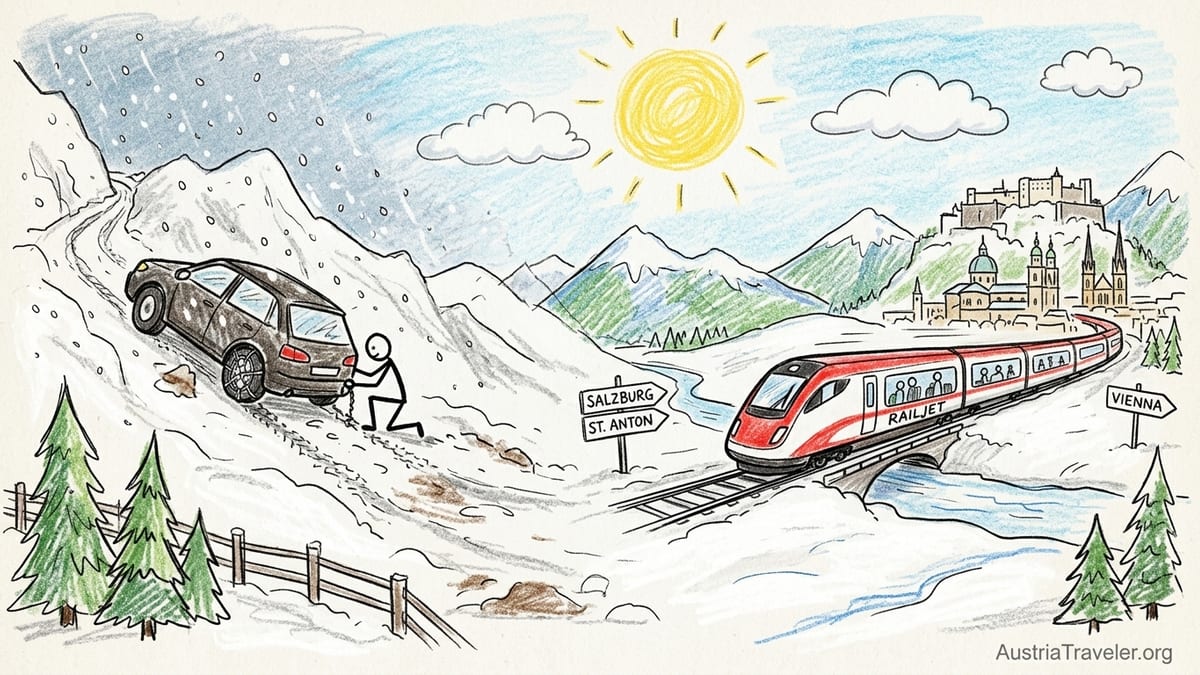
Why I Chose Trains Over a Winter Rental Car
My first serious test of winter rail in Austria was a Vienna to Salzburg trip in December, timed around the Christmas markets. Friends who drove warned me about mandatory winter tyres, potential snow chains in the mountains and slow holiday traffic around cities. I decided to skip the car desk and booked a Railjet instead, Austria’s high speed flagship train linking Vienna, Linz, Salzburg and Innsbruck. Railjet services run several times per hour on this corridor and take a little under 2 hours 30 minutes between Vienna and Salzburg, which already beats the driving time in bad weather.
On parallel trips that winter I also based myself in Innsbruck and used trains into the Alps, including St. Anton am Arlberg along the Arlberg line, one of the main gateways to big-name ski areas. Innsbruck to St. Anton takes a bit over an hour on direct long distance trains, with ticket search engines in autumn 2026 showing advance fares often starting under 30 US dollars equivalent for second class if booked early. Knowing I could sit with a coffee while someone else took responsibility for snowy mountain tracks was the main reason I committed to doing the entire itinerary without a car.
Another argument for the train was predictability. ÖBB, the national operator, treats the Vienna–Salzburg–Innsbruck line and the Arlberg route as core national arteries, and both are heavily used in winter. Timetables on these routes are currently valid through June 2026, and the pattern in winter is dense and consistent, even when individual trains are a few minutes late. Compared with watching the forecast for road closures and passes, building an itinerary around regular Railjets and intercity services felt like a national winter travel strategy, not a compromise.
Cost also played a role. A week-long rental with winter tyres, plus fuel, vignettes and parking in cities like Vienna or Salzburg, can easily climb into several hundred euros. By contrast, I combined advance-purchase tickets for the longer stretches with a discounted ÖBB benefit card, which reduced base fares by around a quarter, and used occasional local buses and taxis for the final kilometres to hotels. There were no unexpected parking garage fees, and when snow started falling heavily, I was not the one paying to put chains on.
Vienna to Salzburg in Winter: Inside a Railjet
The backbone of my city-to-city winter travel was the Railjet, ÖBB’s red high speed train capable of up to 230 km/h. On my December Railjet from Wien Hauptbahnhof to Salzburg, the platform departure board already showed the coach sequence so I could stand near the right section before the train arrived, something I came to appreciate on cold mornings when loitering in the wind is not appealing. These trains have low-floor entrances at several doors, which meant I could roll my suitcase directly from the platform into the carriage without wrestling with high steps.
Once on board, the setup is designed for luggage-heavy travel. Every Railjet I took had generous overhead shelves and large luggage racks near the doors and at mid-car points. On a later trip between Salzburg and Innsbruck I also carried a full-length ski bag. I could slide it into a vertical space beside the luggage rack and still keep sight of it from my seat. Newer Railjet generations additionally include lockable luggage racks and raised seats that improve visibility of bags, and power sockets and Wi-Fi throughout are standard. The fact that these features are part of Austria’s default long distance rolling stock, not an exotic premium service, makes winter travel with big bags feel normal rather than awkward.
In second class, which I used most often, seats are arranged in a mix of airline rows and four-seat tables, with clear electronic displays giving upcoming stops and connection information in German and English. This became more important in winter, when minor delays can shuffle platform allocations. On one January ride between Vienna and Innsbruck via Salzburg, we ran about ten minutes late because of a slow section near Linz. During the journey, the onboard screens updated the connecting options at Salzburg and Innsbruck, including new platform numbers, which meant I did not need to hunt for station staff on arrival in swirling snow.
Booking the Railjet sectors was straightforward through the ÖBB website and app. For winter weekends around Christmas and February school holidays, I found that popular departures could sell out the cheapest ticket tiers a few weeks in advance. Seat reservations on Railjets are optional and cost a modest extra fee per direction, and in December I considered them essential. My reserved window seat meant I was not searching for space with a suitcase and ski helmet in crowded carriages. For midweek trains in January and March, I sometimes skipped reservations and still found seats easily, but for anyone hauling winter gear I would still recommend reserving on longer routes so you can position near luggage racks.
From City to Ski: Innsbruck to St. Anton am Arlberg
The most revealing winter journey was from Innsbruck Hbf to St. Anton am Arlberg, with skis and a heavy duffel. St. Anton’s station sits directly in the village on the Arlberg line, served in winter mainly by long-distance trains rather than stopping regional services. In practical terms, that means you are often boarding an intercity or Railjet-style train rather than a simple commuter unit, and you need to pay attention to coach numbers because the train may be continuing to Switzerland or eastern Austria beyond St. Anton.
On the morning I travelled, heavy snow had fallen across Tyrol and the local roads were coated in a mixture of slush and compacted ice. From my hotel in central Innsbruck I walked ten minutes to the main station on cleared sidewalks, pulling my wheeled duffel and carrying the ski bag over my shoulder. Inside the concourse it was brightly lit and warm, with several bakeries and a supermarket open before 8 a.m. I grabbed a coffee and used the live departure boards to check that my train towards Bludenz was on time and which “Gleis,” or track, it would depart from.
Boarding with skis was significantly easier than loading a car in those conditions. The long distance train stopped with its doors almost level to the platform, so I stepped across with minimal gap. Again I found combined vertical and horizontal luggage spaces near the vestibule where the ski bag could stand upright without blocking doors. Overhead racks took helmets, smaller bags and boots. The run up the Inn valley and then through the Arlberg tunnels took just over an hour. Outside, traffic crawled along the highway while our train mostly kept to the timetable, arriving in St. Anton less than five minutes behind schedule despite ongoing snow.
From the station at St. Anton, the final connection was on foot. The resort’s main pedestrian street begins almost at the forecourt, and even pulling a heavy duffel in fresh snow it took under ten minutes to reach my guesthouse. Other skiers were doing exactly the same thing, many coming off international direct services from Germany and the Netherlands that stop in St. Anton in winter. For accommodation further up the valley or on the opposite slope, short resort buses leave directly from outside the station, included with some ski passes, so taxis are not always necessary. Compared with negotiating hairpin bends or parking in snowbanks at the edge of town, stepping off a long-distance train in the centre of a ski village felt like the most stress-free part of the week.
Handling Winter Luggage, Skis and Crowded Trains
Rail works in Austrian winter in large part because the trains are physically built to cope with people who bring more than a cabin bag. On Railjets and InterCity trains I used, there were always tall racks for suitcases and sports equipment near entrances, and in some cases additional bike and multi-purpose areas that, outside peak bike season, were informally used for bulky winter gear. Overhead shelves on long distance trains were deep enough for typical 70-litre duffel bags if packed sensibly, and under-seat space accommodated smaller daypacks and boot bags.
That said, travelling at busy times meant planning. On a Friday evening Salzburg to Vienna Railjet in February, the luggage areas filled quickly with skis and snowboards. In that situation, arriving at the platform ten to fifteen minutes before departure made a real difference. I could stand roughly where my reserved coach would stop, confirmed by the coach sequence boards, and board through a quieter door. When the racks were full, I slid my ski bag flat in the gap between the back-to-back seat blocks and checked several times during the journey, which felt more secure than leaving it unattended near the doors.
On regional trains within Tyrol and Salzburg state, the layout is simpler but still manageable. Some of these services use double-deck units, where I kept my luggage on the lower level near doors instead of dragging everything up the internal stairs. Others use single-deck multiple units with a clear multi-purpose area near the centre of the train. There were occasional moments of negotiation with parents and stroller users about who used which space, but in winter the shared understanding that everyone is juggling gear tended to make people cooperative rather than territorial.
Overall, carrying a large suitcase, daypack and full ski bag did not make rail travel impractical, but it did make a few habits necessary. Those included packing so I could briefly shoulder everything when boarding, avoiding tiny rolling suitcases that topple in snow, and using luggage tags with my local phone contact in case anything was left on board. Staff on ÖBB trains are trained to handle left-luggage reports and stations maintain lost property procedures, which added a layer of reassurance when I temporarily stashed my bag in a rack a few rows away.
Dealing With Snow, Delays and Platform Changes
Winter travel in Austria is not immune to disruption, even on a robust network. Over several seasons I encountered a mix of minor delays and one more serious disruption when a section of track near the Arlberg route was briefly affected by avalanche risk. The important distinction compared with driving was that these issues were usually predictable a few hours ahead and communicated systematically. In stations, the electronic boards and recorded announcements highlighted late-running services and revised departure platforms, typically in German first and then in English on major routes.
On a January Vienna to Innsbruck journey, my Railjet left Vienna around five minutes late and gradually slipped to about fifteen minutes by the time we reached Salzburg. I had originally booked a connection in Innsbruck with less than ten minutes’ margin for a regional train into the Zillertal. Watching the onboard information screens, I saw that my planned regional departure time was likely to be missed. However, the system also showed an alternative connection twenty minutes later from the same station. Instead of racing through snow-covered platforms, I accepted the delay, picked up a hot drink in Innsbruck’s concourse and used the restrooms, arriving at my valley destination only half an hour later than planned.
In extreme snow, especially in January and February, certain mountain lines can see speed restrictions or temporary closures. During one stay in Tyrol, avalanche control work near the Arlberg line meant that some trains were cancelled or combined. I received push notifications via the ÖBB app a few hours beforehand, which allowed me to shift to an earlier service still expected to operate. Station staff at Innsbruck confirmed that long distance services would be prioritised over some local trains, so I chose the mainline option and then a bus transfer, rather than relying on a chain of small-station regional hops that could be more vulnerable.
Platform changes were more common than outright cancellations, particularly in busy hubs like Vienna and Salzburg when late inbound trains forced last-minute track swaps. In winter this matters, because you may be waiting in freezing temperatures. One practical lesson was to wait inside the heated concourse whenever possible and move to the platform only five to ten minutes before departure, keeping an eye on both overhead screens and the ÖBB app. When a Vienna to Villach train I was taking to connect towards Carinthia changed from track 8 to track 4 at short notice, the change was reflected almost instantly on the app and in noisy platform announcements, which meant everyone simply crossed the underpass rather than missing the service.
Station Facilities and Transfers in Cold Weather
I underestimated at first how important station design and local transfer options would be in winter. In Vienna, Salzburg and Innsbruck, the main stations are modern and fully enclosed, with supermarkets, bakeries, fast food outlets and seating areas that effectively act as waiting lounges. Heated indoor spaces, plentiful restrooms and clearly marked elevators make a real difference when you are arriving in sleet or late at night. In Vienna I often used the luggage lockers in the station concourse to stash my suitcase before walking to nearby Christmas markets, returning later for an evening Railjet west.
In snowy weather, the quality of the last kilometre between station and hotel also matters. Vienna and Salzburg both have dense tram and bus networks, and ticket machines are integrated with the national rail system. For example, after arriving in Salzburg from Vienna with light snow falling, I rolled my suitcase through a covered section of the station to the bus area and boarded a city bus to the old town. The ride took under fifteen minutes and involved walking only a few hundred metres in the open. Taxis lined up outside offered an even faster option, and the queue moved quickly because trains deliver passengers in waves rather than continuously as on a highway.
Smaller alpine towns can be more variable. In St. Anton, the station sits almost on the main street, so many hotels are within easy walking distance if sidewalks are cleared. Where properties are uphill or in side valleys, accommodation owners frequently coordinate pickups with minivans timed to rail arrivals, especially on main changeover days. In the Gastein valley, which I visited on a separate trip via the mainline into Bad Hofgastein, the station was more utilitarian, but the local ski bus stopped right outside, included with my thermal spa and lift pass package. Standing under a small shelter with other skiers, we watched the bus countdown on a digital display while snow drifted across the tracks behind us.
In these smaller stations, the absence of large enclosed halls means you feel the cold more immediately if trains are late. My coping strategy was to use heated waiting rooms where available, identify nearby cafés on my first pass through town, and keep gloves and a hat easily accessible rather than buried in the main suitcase. When night temperatures dropped well below freezing, I was glad to have footwear suitable for compacted snow on platforms, because de-icing on far tracks lags behind main entrances.
When Buses and Taxis Still Matter in a Rail-Based Itinerary
Even in a country with a dense rail network like Austria, there were several points where I still depended on buses or taxis for the final connection. Mountain resorts that sit directly on main railway lines, such as St. Anton am Arlberg or Bad Gastein, are relatively rare. Many other ski villages are perched above valley stations or lie a few kilometres away. On a winter visit to the Zillertal, for example, I rode a regional train from Innsbruck to Jenbach and then transferred to the narrow-gauge Zillertalbahn, which runs down the valley floor. From the destination station I needed a bus to reach my accommodation higher on the slope.
These resort buses are usually timed to meet trains and are used heavily by locals, so the system felt well integrated. They were, however, more sensitive to road conditions than the trains. After a heavy overnight snowfall, one bus up my valley was running late and struggled on a steep section, adding twenty minutes to what would normally be a short trip. If I had driven myself, I would have faced the same climb, potentially with chains, and possibly needed to dig out a parking spot at the top. Letting a professional driver handle it in a heated bus was still less stressful, even if the timetable was not perfect.
In cities, taxis filled the gap when I arrived late at night with heavy bags and did not want to decipher local tram routes in icy rain. In Vienna and Salzburg, regulated taxi ranks outside stations made this simple, and contactless card payments were standard. In smaller towns, pre-booking a transfer through my hotel or a local service was worthwhile for very early departures when public buses were sparse. Because my main transport spend was on rail rather than car rental, budgeting for a handful of taxi rides did not break the trip.
The key lesson was that a rail-based winter strategy does not mean refusing to set foot in a road vehicle. Instead, it means letting trains handle the long distances and mountain approaches while accepting that short connecting hops by bus or taxi are still part of the picture. Planning connections with at least one bus later in the day as a fallback, and storing the local taxi company number in my phone, gave me the same kind of backup I would look for in a road-only trip.
Who Winter Rail in Austria Works Best For
After multiple seasons of winter journeys without a car, I became convinced that Austrian rail is not just an alternative but often the best option for specific types of trips. For Christmas market city breaks, rail is almost ideal. Vienna, Salzburg, Graz and Innsbruck all have central stations within tram or walking distance of their main festive squares, and the busiest market season overlaps with some of the most frequent long distance services of the year. My Vienna to Salzburg and onward to Innsbruck itineraries let me visit several markets without once worrying about driving after a mug of punch or searching for parking near medieval old towns.
For dedicated ski trips, rail works extremely well if you choose rail-friendly resorts and are willing to embrace buses for the last stretch. St. Anton, Bad Gastein, Schladming and Zell am See all have stations close to lifts or linked by short shuttles. Trains from Vienna and western hubs deliver waves of skiers every weekend in winter, and services such as private operators’ winter trains and extra seasonal long distance runs from abroad underscore how normal it has become to arrive with skis by rail. For families or groups carrying a lot of equipment, booking seats together and targeting trains with generous multi-purpose areas is important, but the system is clearly used by many others doing exactly the same thing.
Spa trips fit rail even more naturally. Towns like Bad Gastein, Bad Hofgastein and Bad Ischl have historic traditions as rail-accessible resorts, and modern spa hotels often market their proximity to stations. On my own spa-focused detour to the Gastein valley, I stepped from a long distance train to a local bus and was in a steaming thermal pool less than an hour later. For travellers prioritising relaxation and wellness, not managing a car in winter conditions is part of the appeal.
The mixed itinerary is where planning matters most. Combining Vienna’s museums, Salzburg’s baroque streets, an alpine ski week and perhaps a spa stop in one loop is entirely workable by rail, but you need to balance ambitious connections with realistic winter margins. On my longest loop, I structured the trip so that high-risk mountain transfers came earlier in the day, with city-to-city Railjets later when snowstorms would be less likely to cause major issues. I allowed at least half an hour for any change involving a bus in a small town, and reserved key long distance legs to avoid standing with luggage. The result was a trip that felt slower and more reflective than zipping along motorways, yet also more resilient to bad weather.
The Takeaway
Traveling across Austria in winter without a car is not an experiment at the edges of the system. It is increasingly how the network is designed to be used, especially along the Vienna–Salzburg–Innsbruck corridor and the main alpine valleys. From my genuine journeys, several conclusions stand out. First, high quality long distance trains with serious luggage capacity make it entirely feasible to travel with skis and big bags, as long as you book strategically for busy days. Second, the combination of reliable timetables, station facilities and real-time information takes much of the stress out of snow and ice that would be nerve-racking behind the wheel.
Third, a pure rail mindset needs to be flexible enough to include local buses and taxis for the last kilometres, particularly in mountain resorts perched above the track. Those short road segments can still be affected by winter weather, but letting professionals handle chains and steep roads usually feels safer than doing it yourself. Finally, the character of a winter rail trip is different from a driving holiday. Instead of long hours staring at taillights through slush, you spend more time watching rivers and peaks from a warm seat, wandering station bakeries between trains, and arriving in old towns and ski villages on foot from central platforms.
For Christmas market lovers, city culture fans, spa seekers and many skiers, Austria’s winter rail network already offers a practical, often superior alternative to renting a car. The national strategy of investing in modern trains and main lines shows itself most clearly when temperatures drop and snow piles up on the verges. If you are willing to let your itinerary follow the rails, carry your luggage with intention and give yourself breathing space at connections, you can criss-cross the country in winter with more confidence and less stress than you might expect.
FAQ
Q1. Do I need to reserve a seat on Austrian winter trains?
Seat reservations on long distance trains such as Railjets are optional but strongly recommended around December holidays and February school breaks, especially if you are carrying skis or large suitcases.
Q2. How early should I arrive at the station in winter?
For major stations like Vienna, Salzburg and Innsbruck, arriving 15 to 20 minutes before departure allows time to find the right platform, position near your coach and board without rushing on snowy surfaces.
Q3. Is it easy to bring skis and snowboards on Austrian trains?
Yes. Long distance trains have large luggage racks and multi-purpose areas where skis and snowboards can be stowed upright or laid flat, though space can be tight at peak times.
Q4. What happens if my train is delayed by snow?
Minor delays are usually handled by maintaining connections where possible or offering later alternatives, communicated via station boards, announcements and the ÖBB app, so you rarely have to improvise from scratch.
Q5. Are station transfers manageable in heavy snow with luggage?
In big cities, enclosed concourses, elevators and frequent trams or buses keep exposure to the elements short, while in smaller alpine towns cleared sidewalks and short walks or shuttle vans link most hotels to the station.
Q6. Do winter rail tickets in Austria cost more than renting a car?
For solo travellers or couples booking advance fares, long distance train tickets plus a few local buses usually work out cheaper than a rental car with winter tyres, fuel and city parking.
Q7. Is winter rail travel in Austria suitable for families?
Yes. Families benefit from avoiding mountain driving, using spacious luggage areas for gear and taking advantage of family discounts, though reserving adjacent seats is important on busy departures.
Q8. Can I rely on trains for very early or very late flights?
Major airports like Vienna have direct rail links, but for very early or late departures it may be wise to stay near the airport or use an airport hotel shuttle or taxi for the final segment.
Q9. How much connection time should I plan in winter?
For big hub stations a 15 to 20 minute connection between long distance trains is usually fine, while transfers involving buses or small alpine stations are safer with 30 minutes or more.
Q10. Does traveling by train limit which ski resorts I can visit?
Rail works best for resorts on or near main lines such as St. Anton, Bad Gastein or Schladming; more remote areas may still be reachable, but require longer bus transfers and more careful planning.