


I have spent several winters in Austria, chasing snow, Christmas lights and hot pools of thermal water. Some things were magical even when the weather did not cooperate. Others felt like a waste of time and money without fresh snow or blue skies. This article focuses on what I would genuinely repeat, based on concrete trips between 2019 and 2025, plus a few carefully labeled, researched ideas for your own planning.
Christmas Markets: Atmosphere First, Snow Second
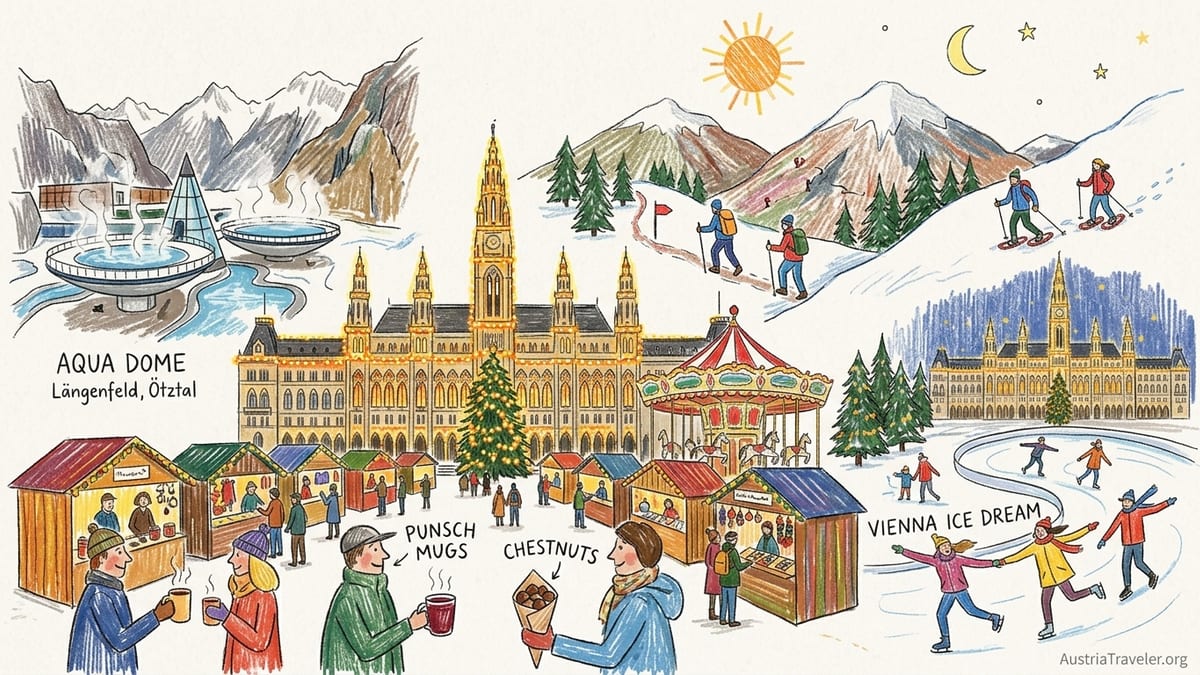
My most memorable Austrian winter moments did not happen on skis but under fairy lights. In late November 2023 I spent an evening at the Christkindlmarkt on Vienna’s Rathausplatz. It was around 3 degrees Celsius, damp and snowless, but the Gothic city hall facade, carousel, and smell of roasted chestnuts still made it feel like winter. I paid 5 euros as a refundable deposit for a decorated mug, then 5.50 euros for a hot mug of punsch, plus a paper cone of gebrannte Mandeln for about 4.50 euros. There was no entry fee, and I simply walked in from Ringstrasse after work. Even without a single snowflake, I would absolutely repeat that evening because the experience depended more on lights, music and food than on weather.
A year earlier, in early December 2022, I visited the smaller market at Spittelberg in Vienna’s 7th district. Narrow lanes between Biedermeier houses were packed by 7 p.m., and it took real effort to move from stall to stall. I bought a bowl of Käsekrainer with bread for around 7 euros and another mug of mulled wine for 5 euros plus deposit. The atmosphere was intimate and local, but the crowd level was high and slightly stressful. If you dislike being jostled, I would only repeat Spittelberg by going right at opening time on a weekday afternoon when light snow or drizzle does not matter as much.
In December 2019, I spent two evenings at Salzburg’s historic Christmas market on Domplatz and Residenzplatz. Light snow fell one night; the next evening it turned to sleet and puddles. Entry was free, but prices were slightly higher than in Vienna: around 6 euros for Glühwein and 6 to 8 euros for simple hot dishes like goulash soup. Even on the rainy night, the baroque facades, cathedral choir and smell of pine branches made it worth staying. This is an activity I would repeat regardless of snow conditions, although I would bring waterproof boots and a warm, hooded jacket to cope with slush.
I have also had less-than-perfect market experiences. On a drizzly evening in December 2021, I tried a smaller local market in a Tyrolean valley village where most stalls sold mass-produced trinkets and there was little music. It felt more like a parking lot fair than a Christmas village. I bought a mediocre sausage and left after half an hour. That is one experience I would not repeat at random. For my own trips now, I prioritize established city markets in Vienna, Salzburg or Innsbruck, where even rain or bare ground cannot completely ruin the mood.
Ice Skating: Vienna’s Rathausplatz and Classic City Rinks
One winter activity I happily repeat with or without snow is outdoor ice skating. In late January 2024, I skated at the large temporary rink on Vienna’s Rathausplatz, known locally as the Vienna Ice Dream. I bought an adult evening ticket at the onsite counter for around 10 euros, with skate rental for another 8 euros and a 3 euro deposit for the rental card, paid by card in just a few minutes. I skated for about two hours. It was a clear, cold evening at about minus 1 degree Celsius, with no natural snow in the city. The mix of winding ice paths through the park and the illuminated town hall made it feel magical anyway, and I would gladly repeat the experience at the same time of day.
On a different trip in early February 2020, I went to the traditional open-air rink operated by Wiener Eislaufverein near the Stadtpark area. Entry that afternoon cost just under 10 euros, skate rental was about 7 euros, and lockers for valuables required a coin deposit. The weather was grey and slightly windy; gusts occasionally pushed me across the ice. The surface was busier and less smooth than at Rathausplatz, and the overall feel more practical than romantic. I would repeat this rink only if I specifically wanted to practice for longer without the crowds of the big event rink. For a first-time visitor in winter, the more atmospheric Rathausplatz setting is the one I personally prioritize.
I have had at least one mixed skating day. In late January 2022, unseasonably warm weather softened the surface at Rathausplatz, leaving wet patches and slush by late afternoon. I had booked nothing in advance and simply bought a standard ticket at the booth. After only 45 minutes my socks were damp, and I gave up. That day reminded me that while ice skating does not require snow, it is sensitive to temperature and sunshine. Now I time my own visits for evenings or colder, overcast days, and I bring an extra pair of socks and lightweight waterproof trousers. Even when the snow refuses to fall, skating remains one of the most reliable winter feelings you can get in Vienna.
Outside the capital, I have skated on a small outdoor rink in Innsbruck during an early January 2023 stay. The setup was basic: a modest rectangular rink, local families, music from portable speakers and a simple ticket system at a small cabin. I paid roughly 7 euros for entry and 5 euros for basic rental skates and stayed for about an hour. It lacked the grand backdrop of Vienna but felt charming and low-key. I would repeat that experience on a city break, especially because it fits easily into a cloudy or snow-poor day when mountain visibility is limited.
Thermal Spas and Wellness: Reliable Rescue on Grey Days
When the Alps disappear into cloud or rain, I now default to Austria’s thermal spas. My most indulgent spa day so far was at Aqua Dome in Längenfeld, Tyrol, in mid-January 2023. I pre-booked a standard day ticket online for around 79 euros, which included access to indoor and outdoor thermal pools and saunas but no treatments. On arrival, I received a wristband to open my locker and charge food and drinks. I stayed for almost eight hours, arriving at 10 a.m. and leaving after dark. The weather was a mix of light snow and low, grey cloud shrouding the surrounding Ötztal mountains. While that would have ruined a day on the slopes, it made the steaming outdoor pools feel even better, and I would repeat this experience in a heartbeat.
For that Aqua Dome visit, I brought my own swimsuit, flip-flops and a quick-dry towel, plus a warm hat and down jacket for the short walk from the car park. Physical effort was minimal: gentle swimming and short walks between pools and saunas. The biggest logistical step was booking in advance. On a previous attempt in January 2022 I had driven there spontaneously on a Saturday afternoon and discovered the spa was fully booked with no day tickets left. After that, I learned to secure a ticket a few days ahead during peak winter weekends or school holidays. This is one activity that works in almost any weather, including pouring rain, and is largely independent of snow.
I have also tried a smaller, less famous spa complex attached to a mid-range hotel in the Zillertal region in February 2020. Day access for non-guests cost around 25 euros for three hours. Facilities included a small indoor pool, a whirlpool, and two saunas. I stayed for about two and a half hours. The experience was pleasant but not special, and the enclosed design meant I never really saw the mountains. On a short winter trip, I would not repeat that specific spa, and it taught me that the premium price of a flagship place like Aqua Dome or the Gastein valley spas is often justified by the view and variety of pools.
While I have not personally visited them in winter, I have researched other notable Austrian thermal options such as the spa complexes in Bad Gastein and Bad Hofgastein or Styria’s Rogner Bad Blumau, which combine pools, saunas and mountain or countryside views. For my next winter trip, I would be comfortable booking a half or full day at one of these based on their track record, design and facilities, but those remain researched rather than lived experiences for now. What I can say from my own trips is that at least one thermal day in a winter itinerary is almost never wasted, regardless of snowfall.
Skiing and Snowboarding: Fantastic When Snow Cooperates
Despite Austria’s marketing of non-ski activities, skiing still dominates many winter itineraries, including mine. My most reliable snow experience came on the Stubai Glacier, south of Innsbruck, during an early December 2021 trip. I bought a one-day Stubai Glacier skipass at the base station ticket office for around 64 euros and rented mid-range skis, boots, and poles from a shop next to the lift for another 35 euros plus a document as deposit. Conditions were excellent: packed powder, cold temperatures around minus 5 degrees Celsius and mostly clear skies. I skied from 9 a.m. until about 3 p.m. with a break for a simple mountain hut lunch of soup and bread for roughly 12 euros. With high-altitude snow reliability and wide glacier runs, I would gladly repeat that day, particularly in early season.
However, not every ski day has earned a repeat in my mind. In late December 2019, I tried a day trip from Innsbruck to the Nordkette area above the city using the Hungerburg funicular and Seegrube cable car. A combined return lift ticket cost around 45 euros at the time, and I rented snowboard gear at a shop in the old town for about 40 euros. Recent warm weather had thin snow cover, and several pistes were closed. The few open runs were hard, icy and heavily trafficked by mid-morning. Views over Innsbruck and the Inn valley were spectacular, but as a skiing experience it felt stressful and limited. If I find myself in the same conditions again, I would ride up for the view and a coffee but skip paying extra to ski.
Another mixed experience came in February 2020, when I booked three consecutive ski days in a lower-altitude Tyrolean resort expecting deep snow and sunshine. A warm, rainy front turned many slopes into heavy slush by early afternoon. My three-day pass cost roughly 170 euros, and equipment rental about 90 euros for the period. I carried on skiing because I had already paid, but visibility was poor and my legs were exhausted from pushing heavy wet snow. Looking back, I would now commit fewer consecutive days and keep plans more flexible, saving one or two days for non-ski activities such as winter hiking or a spa visit if the snow is not cooperating.
For clothing on all my ski days, I used a standard layered setup: moisture-wicking base layer, mid-layer fleece, insulated waterproof jacket and pants, ski socks, gloves, helmet and goggles. I either packed a small backpack with water and snacks or stopped regularly at on-mountain huts. Physical effort is high compared with most other winter activities in this article, and crowd levels can be intense during school holiday weeks. When the snow is good, however, I still find at least one or two ski days in Austria absolutely worth the cost and effort.
Winter Hiking and Snowshoeing: Quiet, Scenic and Surprisingly Weather-Resilient
I have learned to appreciate winter hiking and snowshoeing as flexible, lower-pressure ways to be in the mountains. In early January 2022 I tried a marked winter hiking trail near Neustift in the Stubai Valley. I picked up a free local map from the tourist office and chose a route from the village center gently ascending through meadows and forest to a small mountain inn. There was around 20 centimeters of compacted snow on the path. I wore waterproof hiking boots, thick wool socks, a base layer, fleece, waterproof shell and a wool hat, but no snowshoes or special equipment. The hike took about three hours round-trip including a stop for coffee and apple strudel that cost around 9 euros. Physical effort felt moderate, and I met only a handful of other walkers. I would definitely repeat this sort of outing, even with patchy snow, because the charm lies in quiet scenery and fresh air more than perfect white coverage.
In February 2023, during a stay in the same valley, I booked a half-day guided snowshoe tour through the local tourist office. The tour cost about 40 euros per person, including snowshoe and pole rental but excluding transport to the trailhead, reached on a short public bus ride. Over roughly three and a half hours we followed a forest track and then open slopes with views of the surrounding peaks. Snow depth was marginal at lower levels, and in some sections we walked on a thin layer of snow over grass, which the guide openly acknowledged as below ideal. Even so, the novelty of moving through silent forests on broad snowshoes still felt special. I would repeat a snowshoe tour, but now I would check snow reports carefully and aim for slightly higher starting altitudes.
I have also had a lackluster winter hike. In late February 2020, I set off on a recommended low valley trail after several days of warm rain. The path was mostly bare gravel and mud with only occasional icy patches. I wore regular hiking boots and a rain jacket, and after an hour of walking under dripping trees with minimal views I turned back. It felt like an autumn walk without the colors. That is a type of excursion I would not repeat in similar conditions. For my own trips now, I use winter hiking as a plan B when higher slopes have snow but lifts are closed or too windy for comfortable skiing, rather than as a default on rainy valley days.
Snowshoeing in particular depends on at least moderate snow, but basic winter hiking on prepared paths is relatively weather-resilient. As long as I have waterproof footwear, warm layers and ice grips or poles for steeper sections, I find that even a thin snow cover and grey skies can still make for a satisfying few hours outdoors. The key lesson from my own trips is to keep distances realistic, carry a thermos or budget for a warm drink stop, and know when to turn a dreary path into an early return to a cafe or spa.
Tobogganing and Sledding: Fun but Very Snow-Dependent
Of all the Austrian winter activities I have tried, tobogganing has been the most weather-sensitive. In mid-January 2020 I rented a classic wooden sled at a rental shop in a Tyrolean valley village for about 9 euros for the day, leaving a small cash deposit. My plan was to ride a gondola, pay a pedestrian ticket of roughly 18 euros, and then descend on a dedicated sled run. At the top station, staff warned of thin snow and icy patches, but the run remained officially open. I decided to try it anyway. The first section, shaded by forest, was enjoyable, with packed snow and good control. Lower down, the track alternated between ice and exposed gravel. Braking with my feet sent sharp stones flying and felt unsafe. After one descent I returned the sled early. In similar marginal conditions, I would not repeat this activity.
A far better experience came two years later, in late January 2022, when fresh snow had recently fallen. I again rented a sled for around 10 euros, this time with the option to keep it into the evening for a floodlit session. The gondola ride up and pedestrian track ticket cost just over 20 euros. The run was smooth, well-groomed and busy but not chaotic. Physical effort was moderate: walking short sections, steering and braking with legs and leaning into turns. I wore waterproof snow pants, insulated boots and ski gloves, and I strongly recommend a helmet, which I brought from my ski gear. That evening was filled with laughter, and I would repeat it whenever the snow report and local advice indicate good coverage.
One surprise for me was the crowd dynamic. During school holidays, families and groups can fill popular runs, leading to occasional collisions or near misses. On my 2022 outing, I felt comfortable but noticed several inexperienced riders struggling with speed control. If you prefer a calmer atmosphere, I would avoid peak holiday weeks and aim for midweek evenings. Tobogganing is also one of the few activities in this list that I now consider almost completely snow-dependent. While technically possible on thin or icy cover, my own 2020 experience convinced me that it is not worth the risk or the lift ticket cost in poor conditions.
I have looked into other sledding options across Austria, including well-known runs in the Tiroler Zugspitz Arena and Salzburg regions, but those are researched only at this stage. Based on my lived days on the tracks, I now treat tobogganing as a bonus activity when conditions are clearly good, rather than as a locked-in highlight that must happen regardless of weather.
Traditional Winter Food Experiences: Warming Up From the Inside
Austrian winter food rituals have rescued several of my cold and disappointing days in the mountains. After a wet, heavy-snow morning of skiing in February 2020, I abandoned the slopes at midday and ducked into a rustic mountain hut directly beside the gondola mid-station. For around 13 euros I ordered a large plate of Käsespätzle, cheesy egg noodles topped with crispy onions, and a small beer for another 4 euros. My outer layers steamed gently as they dried by the stove, and I sat for nearly an hour watching fog swirl outside. That meal turned a frustrating weather day into a cozy memory I would instantly repeat, and I now budget one or two such long hut lunches per ski trip.
In Vienna, I have made a habit of visiting a traditional coffee house after cold evenings at the Christmas markets or skating rinks. On a December 2023 night, after two hours outdoors at Rathausplatz, I stepped into a historic cafe near the Ringstrasse. I ordered a Wiener Melange for about 5 euros and a slice of Sachertorte for roughly 7 euros. The ritual of hanging up my coat, warming my hands around the cup and listening to quiet conversation was as much a part of the experience as the drink itself. Even if the city streets are snowless and damp, I would repeat this pattern every winter.
Street food at markets and in ski villages has been more hit-and-miss. I have had excellent bowls of goulash soup for around 6 euros from small stands near lifts, but I have also eaten lukewarm pre-grilled sausages that felt overpriced at 5 euros. On crowded evenings in Salzburg and Vienna, queues at the most popular stands can reach 15 or 20 minutes. After one too many disappointing quick snacks, I now time my main meal earlier in the evening at a simple sit-down Gasthaus, where a hearty main dish like Tafelspitz or roast pork runs 15 to 20 euros, and treat market food as a small extra rather than dinner. Repeating that approach has consistently improved my winter days.
For travelers with dietary restrictions, I have observed that vegetarian options are gradually improving but still limited compared with meat-focused classics. At Christmas markets I have found reliable meat-free choices such as cheese-filled pastries, pretzels, sweet crepes and potato dishes, but vegan options can be sparse. While this is based on my own limited sampling between 2019 and 2024, it is something I would plan around if I returned with plant-based friends, searching out specific restaurants rather than relying solely on spontaneous stands.
The Takeaway
Across several winters in Austria, I have learned that the most rewarding experiences are not always the ones printed on the ski pass. Christmas markets in big cities, outdoor ice rinks, and thermal spas have all delivered memorable days and evenings even when the snowline sat stubbornly high above the valleys. Winter hiking and carefully chosen snowshoe tours have added quiet, flexible ways to be in the landscape without depending entirely on fresh powder.
At the same time, my mixed and negative experiences have taught me to be honest about how weather-dependent some activities are. I now treat glacier skiing and high-altitude areas as my first choice when I care most about snow, and I consider tobogganing only when coverage is clearly good. I am quicker to pivot a rainy or slushy forecast into a spa day, a food-focused city walk or a long coffee house visit, instead of stubbornly forcing one more run on icy slopes.
If there is one guiding principle I would share from my own trips, it is to build a winter itinerary in Austria around experiences that still feel worthwhile in less-than-perfect conditions, then plug skiing or tobogganing into the gaps when the weather aligns. With that mindset, you are far more likely to fly home remembering glowing pools, twinkling lights and steaming bowls of Käsespätzle, rather than only the color of the piste map.
FAQ
Q1. Do I need perfect snow to enjoy a winter trip to Austria?
Based on my own trips, no. City Christmas markets, outdoor ice skating and thermal spas have all been enjoyable even when there was little or no natural snow in the valleys, as long as temperatures were cool enough for ice rinks and you packed warm, waterproof clothing.
Q2. How far in advance should I book popular Austrian thermal spas in winter?
When I visited Aqua Dome in January, I found that weekends and school holiday periods could sell out entirely for day visitors. I now book at least several days ahead for Saturdays or peak times, and I am more relaxed about midweek days outside of holidays, when same-day booking has worked.
Q3. Is it worth skiing near Innsbruck if snow conditions are poor?
From my own mixed day at Nordkette in thin, icy conditions, I would say that paying full price for limited, hard slopes is rarely satisfying. In that situation I would ride the lifts just for the view or choose a non-ski activity and save serious skiing for better snow or higher-altitude areas like the Stubai Glacier.
Q4. What clothing do you actually wear for winter hiking in Austria?
On my winter hikes I use waterproof hiking boots, warm socks, a moisture-wicking base layer, fleece mid-layer, waterproof shell, hat and gloves, plus optional light crampons or poles if the trail is steeper. That setup has kept me comfortable on compacted snow at a few degrees below freezing for several hours.
Q5. Are Austrian Christmas markets too crowded to enjoy?
They can feel crowded, especially in the early evening on Fridays and Saturdays. I have still enjoyed major markets like Vienna’s Rathausplatz by going on weekday afternoons or later in the evening. Smaller neighborhood markets can feel more intimate but sometimes offer less atmosphere or quality.
Q6. How expensive is ice skating at Vienna’s Rathausplatz compared to other activities?
On my last visit, an adult ticket plus skate rental cost a bit under 20 euros in total, which was cheaper than a ski day or spa visit but more than a simple museum ticket. For two or three hours of activity in a spectacular setting, I found the value good and would repeat it.
Q7. Is tobogganing safe for beginners in Austria?
In good snow conditions on groomed runs, I have found tobogganing manageable with basic instruction and a helmet, though speeds can feel high. On thin, icy cover, my own experience felt unsafe, and I would now skip it entirely if staff warn about exposed stones or very hard surfaces.
Q8. What are good backup plans if the weather ruins ski days?
My own favorite backups are a full or half-day at a thermal spa, city sightseeing combined with coffee houses, or a gentle winter hike on prepared paths. All of these have rescued trips when rain, wind or fog made skiing unappealing or lifts were restricted.
Q9. Do Austrian winter activities require cash, or can I pay by card?
In my experience, larger operators such as ski lifts, major Christmas markets, ice rinks and spas all accepted cards, while small food stalls and rural huts sometimes preferred cash. I carry a small amount of euros plus a debit or credit card, which has covered everything I needed so far.
Q10. Is Austria a good choice for non-skiers in winter?
Based on my own itineraries that mixed only one or two ski days with markets, skating, spas and hiking, I believe Austria works very well for non-skiers. As long as you choose bases with both city culture and nearby mountains, you can fill a week without ever clipping into skis.