


On my last two trips into the Austrian Alps I made a deliberate choice: no rental car, even with ski bag, hiking pack and a child in tow. Instead I stitched together EuroCity, Railjet and regional trains, plus the inevitable buses for the last few kilometres. What I discovered is that modern ÖBB services have quietly turned the Alps into a viable, even comfortable, car-free playground for parents, skiers and hikers, as long as you understand how the network really works on the ground.
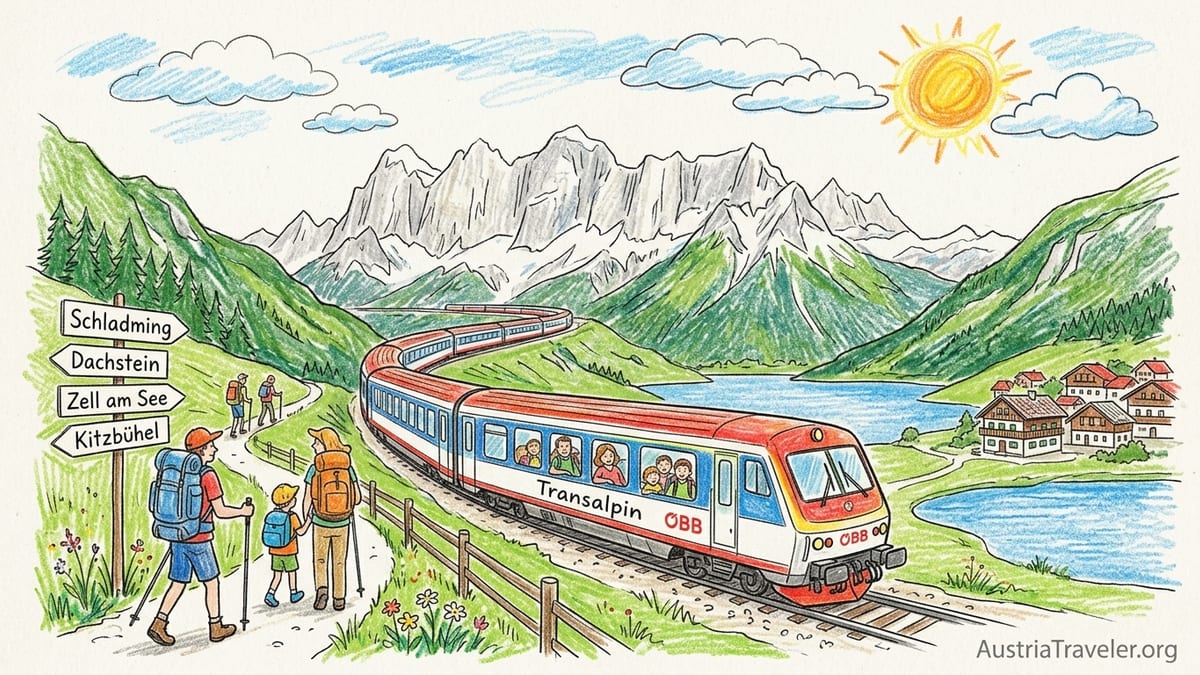
Riding the Transalpin Across the Heart of the Alps
My first serious test of car-free travel in the Austrian Alps was the EuroCity Transalpin between Graz and Zurich, which I boarded on a cool June morning in Graz. Branded EC 163 in the current timetable, it runs once daily and links eastern Austria with Switzerland via some of the most storied valleys in the country. The train itself is a conventional EuroCity consist, usually with an ÖBB locomotive, a mix of second and first class coaches and a designated restaurant or bistro car. When available, a Swiss panoramic coach is added on the western part of the route, which is worth seeking out if you care about scenery as much as schedules.
From Graz the line climbs gently through the Mur valley before swinging north into the Enns valley. After Bruck an der Mur and Leoben, the landscape starts to tighten. South of Schladming the train begins threading between the Schladminger Tauern on one side and the Dachstein massif on the other. On a clear day you see the Dachstein’s limestone walls hanging above the tree line, while the Enns River flashes between the trees beside the tracks. The scenery here is not a single postcard moment but a continuous backdrop that rewards sitting on the river side of the train and keeping your camera handy.
As the Transalpin continues past Schladming toward Stainach-Irdning and Selzthal, the valley widens again before the route eventually joins the west–east axis toward Innsbruck and Zurich. Between Wörgl and Kitzbühel the train enters the Kitzbüheler Alpen, a patchwork of steep meadows, farmhouses and the jagged skyline around the Hahnenkamm. If you book a seat in advance, choose the window on the valley side for unfolding views of the Wilder Kaiser range and the ski slopes that drop almost into Kitzbühel’s back yards.
Compared with driving, the biggest difference here is attention. On the train I watched cloud shadows drift along the Dachstein while my daughter played with sticker books at the table. On the A10 motorway, that same stretch would have demanded total focus on tunnels, gradients and trucks, with only fleeting glimpses of the same peaks. For a first encounter with the Austrian Alps, the Transalpin feels more like being in the mountains than merely behind the wheel somewhere below them.
Schladming-Dachstein: A Hiking Hub You Can Reach on Rails Alone
Schladming is one of those towns that looks as if it should require a car. In practice, it is one of the easiest Alpine bases to reach entirely by train. The EuroCity Transalpin stops here, as do regular Railjet and InterCity services between Graz, Salzburg and Innsbruck, plus regional trains that feed in from Bischofshofen and Stainach-Irdning. On my summer hiking trip I arrived on an evening InterCity from Vienna with a large backpack, trekking poles and a small child’s rucksack clipped to the front. We stepped off the train and in less than ten minutes were in a guesthouse on a residential street behind the station.
Buying the ticket was straightforward online through ÖBB: I chose a Sparschiene (saver) fare from Vienna to Schladming a few weeks in advance for under 40 euros in second class, including a seat reservation. The reservation was worth the extra couple of euros, because once the train passed Linz the coaches filled with families heading for the mountains. With the reservation we had a bay of four seats and a table, which made juggling snacks, colouring books and a shared laptop far easier than it would have been in a car with everything scattered underfoot.
From Schladming station, hikers fan out into the Schladming-Dachstein region using a web of buses that connect to trailheads, cable cars and villages like Rohrmoos and Ramsau am Dachstein. Local tourism information points out at least seven day hikes that start and finish at bus stops or cable car stations served by public transport, which means you can leave the car keys at home and still reach lakes such as Riesachsee or ridges above Planai. In my case we walked from our guesthouse to the Planai cable car, rode up, and spent the day on a family-friendly ridge walk that ended at another lift back down into town.
Carrying hiking gear on the trains into Schladming was more practical than I expected. ÖBB allows standard luggage that you can lift yourself, and my 60-litre pack plus a folded child carrier fitted easily into the overhead racks or the luggage shelves at the coach ends. Trekking poles travel best collapsed and strapped to the outside of the pack so they do not roll around on the floor. I did not need any special sports luggage service, though ÖBB does offer registered luggage and separate door-to-door transport for bulkier items if you prefer to travel light on the day of departure.
Zell am See-Kaprun: When the Station Sits Beside the Lake
If Schladming disproves the idea that you need a car to reach a small Alpine town, Zell am See goes further and puts the station almost on the waterfront. The tracks end within a few minutes’ walk of the old town and lake promenade, which changes the feel of arrival completely. On my autumn trip from Salzburg, I took a regional express that covered the journey in about one hour and forty minutes. I bought the ticket on the ÖBB app on the platform in Salzburg and skipped seat reservations, since these regional trains work on a turn-up-and-go basis and do not offer reserved places.
When I stepped out in Zell am See the first thing I noticed was how many people had wheeled ski bags or large duffels instead of car keys. The station frontage is small but functional, with a supermarket, bakery and a couple of cafés nearby. My hotel was three blocks away, so I walked the entire way with a suitcase in one hand and a boot bag over my shoulder. For winter visitors, that proximity is the key advantage of Zell am See: if you pick accommodation within ten minutes’ walk of the station you remove a whole layer of transfers, shuttles and parking decisions from your trip.
Reaching Kaprun and the Kitzsteinhorn glacier from Zell am See is where the last-mile reality appears. There is no railway into Kaprun itself, so you rely on the regional bus network and dedicated ski buses. Bus line 660 runs frequently between Zell am See and Kaprun, continuing on to the Kitzsteinhorn and Maiskogel valley stations in winter, and takes roughly twenty to thirty minutes depending on traffic and exact stop. In practice, that means skiers arriving by train roll their bags a short distance to the bus stop outside the station, load everything into the underfloor luggage hold and ride one more stage up the valley.
On the day I tested that connection, the bus pulled in busy but orderly. Drivers are used to winter gear, and passengers self-sort quickly into those hopping off in the town centre and those staying on for the glacier lifts. With a child and two pieces of luggage, the only awkward moment was stepping down from the bus with the ski bag in one hand and making sure my daughter did not disappear into the crowd. Compared with driving, however, it still felt calmer than fighting for space in a weekend car park under the lifts.
Kitzbühel and the Kitzbüheler Alpen: Direct Access, Subtle Trade-Offs
Where Zell am See hides its station almost in the old town, Kitzbühel pushes its Hauptbahnhof to the edge of the resort. The town actually has several stops, including Kitzbühel Hahnenkamm, which sits below the main gondola, but many long-distance trains call at the main station just outside the centre. The Transalpin and numerous Railjet and InterCity services between Salzburg, Innsbruck and beyond pass through here, which means you can board a direct train in cities like Vienna or Zurich and step off within a short taxi or bus ride of the famous Hahnenkamm downhill course.
On my winter visit I arrived from Innsbruck on a Railjet that continued toward Salzburg. I had reserved seats in economy class for peace of mind, paying a modest supplement on top of the base fare. The Railjet setup caters reasonably well for skiers: there are luggage stacks near the doors and some space at the carriage ends where people stand skis upright, bindings turned inward to avoid snagging other passengers. I kept my ski boots in a separate backpack that slid easily under the seat, avoiding the usual car-boot excavation every time I wanted to change footwear.
Once in Kitzbühel, the transfer decision becomes nuanced. Staying near Kitzbühel Hahnenkamm station or the main gondola lets you walk to the lifts in ten minutes or less, but you may find yourself farther from some family-friendly slopes or quieter neighbourhoods. Choosing accommodation in outlying hamlets such as Kirchberg can offer more space and lower prices but adds a train or bus commute every morning. With a child in ski school, I valued walking distance over extra square meters in the apartment. The payoff came on stormy afternoons when we could be back in our room, wet gloves hung over radiators, ten minutes after last run.
If I had been driving, I might have stayed in a larger chalet outside town and used the car to shuttle everyone to the lifts. That would have looked efficient on paper and offered more flexibility for side trips. Yet watching drivers inch their way into busy car parks while I rolled my ski bag along cleared pavements to the Hahnenkamm base convinced me that, at least in peak weeks, the train-and-walk model removes an entire layer of stress.
Tickets, Seat Reservations and Managing Luggage on ÖBB Trains
Across these journeys I experimented with both advance-purchase and flexible tickets. ÖBB’s Sparschiene fares from Vienna or Graz into the Alps can be very attractive when booked weeks ahead, often under 30 or 40 euros for a long stretch if you commit to a specific train. For family trips or fixed ski holidays that is usually a good trade-off. For hiking trips where weather may push you a day forward or back, I preferred standard tickets at a higher price, which allowed changes and cancellations with fewer penalties.
Seat reservations emerged as a small cost that made a big difference, especially on long runs such as Graz to Innsbruck, or Vienna to Zell am See with a change in Salzburg. On the Transalpin I paid a modest fee per person to reserve a window pair and ensured we were seated on the scenic side of the coach. Without that, boarding with luggage and a child would have been more stressful, since popular trains through Salzburg and Innsbruck corridors can fill quickly in holiday periods and at weekends.
Luggage management is less glamorous than mountain panoramas, but it can make or break a car-free Alpine trip. Standard suitcases and duffels work fine as long as you can carry them yourself along platforms and into buses. Long ski bags belong either in the train’s designated luggage areas or across empty seats in off-peak times, though that courtesy vanishes once coaches fill. On regional trains into side valleys like the Enns or Pinzgau, I found that locals and seasonal workers were surprisingly tolerant of bulky gear, provided it did not block doors or corridors.
For parents, the combination that worked best for me was one medium suitcase with shared clothing, one ski bag, one day pack for snacks and documents, and a small child’s backpack. Everything had wheels or could be slung over a shoulder. If I were traveling for a hut-to-hut hike instead of a resort stay, I would seriously consider ÖBB’s luggage forwarding service, which picks up bags in major cities and delivers them to designated stations or addresses, allowing you to move between valleys with only a hut pack on your back.
How Easy Is It, Really, to Reach Alpine Valleys Without a Car?
Looking back across multiple trips, a pattern emerges about which valleys and resorts feel naturally rail-focused and which still depend on road transfers. Towns like Schladming and Zell am See are the current sweet spots. Their stations sit close to compact centres, they have all-season bus networks, and major lifts or hiking routes start within walking distance or a short ride. These places treat rail as a main artery rather than a niche option, and local tourism offices actively promote arrivals by train with guest cards that include public transport.
Destinations tucked at the far end of side valleys often require more patience. Kaprun, despite its excellent bus links, still demands that final 20 to 30 minute ride from Zell am See, and accommodations scattered up the valley may add another ten minutes on a hotel shuttle or local line. Similar patterns appear in the Stubai or Ötztal valleys near Innsbruck, where glacier resorts sit a long way beyond the last station. You can absolutely reach them by public transport, but you need to factor in early departures and generous connection times, especially with children.
One of the biggest surprises was how often staying near the station improved the entire trip. In Schladming we could arrive on a late evening train, walk five minutes to the guesthouse, and be eating soup an hour later, with no need to navigate after-dark driving or find parking. In Zell am See I set an alarm for an early regional train back to Salzburg, rolled out of bed, walked down the hill and was on the platform within ten minutes, coffee still warm in hand. That would have felt far more complicated if I had parked a rental car at the edge of town and needed to return it in Salzburg by a specific time.
The trade-off comes when you crave complete freedom to chase a weather window to a distant valley, or to stop at every roadside viewpoint. On those days a car still outperforms the timetable. But for trips built around one or two main bases, with well-defined hiking or ski goals, the rail and bus network already covers most of what you need, especially in the central and northern Austrian Alps.
What Driving Would Have Changed
People often ask whether I regretted not having a car at any point on these journeys. The answer is complicated. On the long intercity stretches, such as Graz to Innsbruck or Vienna to Zell am See, I did not miss driving at all. The motorways parallel to the railway lines cut through the same valleys but usually stay lower, behind noise barriers or in tunnels. From the train I saw peaks like the Dachstein and Kitzsteinhorn for much longer, and I never had to think about fuel levels, vignette validity, or service station food.
Where a car would have helped most was with very early starts and late returns in shoulder seasons. When bus timetables shift between summer and winter patterns, first departures into side valleys may be later than ideal for long hikes, and the last return can feel uncomfortably early. I remember finishing a long loop above Schladming and jogging the last few hundred metres to catch a late-afternoon bus back down to town. With a car waiting at the trailhead I would simply have lingered at the hut for another coffee and descended at my own pace.
Parking, though, is the hidden cost of Alpine driving that itineraries often gloss over. In resorts like Kitzbühel and Zell am See, central parking garages charge daily fees that add up quickly over a week-long stay, especially for covered spaces near the lifts. Free lots further away mean morning shuttles or long walks in ski boots. On my train-based trips the money that might have gone to parking meters instead covered reserved seats, occasional taxi rides, and the occasional hot chocolate that kept a tired child cheerful during a delayed connection.
Delays themselves are worth mentioning. Across several weeks of travel, I experienced a handful of minor late arrivals, usually ten to fifteen minutes, caused by congestion around Salzburg or engineering work in narrower valleys. In all but one case, ÖBB staff either held the connecting regional train for transferring passengers or provided clear guidance on the next departure. A car does not eliminate delays; it simply swaps them for roadworks and traffic jams. At least on the train, delays come with legroom and a view.
The Takeaway
Traveling the Austrian Alps by train is no longer a quirky, backpacker-only choice. With services like the EuroCity Transalpin linking Graz with western Austria, and dense Railjet and regional networks feeding towns such as Schladming, Zell am See and Kitzbühel, you can plan serious hiking and ski trips without ever touching a steering wheel. The learning curve lies in last-mile logistics and realistic expectations about how far public transport will take you in a given day.
For me as a parent and mountain lover, the strongest argument for rail came from the quieter, more human moments: watching my child count tunnels in the Enns valley, drinking coffee in a sunlit carriage instead of a motorway rest stop, and stepping off trains directly into compact Alpine towns where the mountains feel close enough to touch. A car would have expanded our radius but also added a layer of stress that, at least for these journeys, I was happy to leave behind.
FAQ
Q1. Can I really plan a full hiking holiday in the Austrian Alps without renting a car?
Yes, as long as you choose rail-friendly bases such as Schladming, Zell am See or Innsbruck, you can combine long-distance trains with local buses and cable cars to reach a wide range of day hikes and multi-day routes.
Q2. How far in advance should I book ÖBB tickets for Alpine routes like the Transalpin?
For the best Sparschiene saver fares on trains such as the Transalpin or long-distance Railjets, aim to book several weeks ahead, especially for school holidays and weekends, while being aware that these discounted tickets are tied to specific departures.
Q3. Do I need seat reservations on Austrian trains when traveling with ski or hiking gear?
Reservations are optional on many ÖBB long-distance services but are a practical investment if you have bulky luggage or children, since a reserved window pair gives you space to organize gear and reduces stress on busy holiday trains.
Q4. How easy is it to get from Zell am See station to Kaprun and the Kitzsteinhorn glacier?
From Zell am See’s central station you can walk a short distance to the bus stop and take regular regional and ski buses up the valley to Kaprun and onward to the glacier and Maiskogel lift stations, with journey times typically around twenty to thirty minutes.
Q5. Is Schladming a good base for car-free hiking with a family?
Yes, Schladming works well because frequent trains connect it to major cities and a network of local buses and cable cars leads to family-friendly walks on Planai, Hochwurzen and nearby valleys, all reachable without driving.
Q6. What is the best way to handle long ski bags and large suitcases on ÖBB trains?
Use the luggage shelves near carriage doors or designated storage areas, keep bags out of aisles and doorways, and consider packing boots and essentials in a backpack that fits under the seat so you can move independently of the larger items.
Q7. Are there significant drawbacks to not having a car for an Alpine ski holiday?
The main drawbacks are less flexibility for very early or late lift access in side valleys and more reliance on bus timetables, but if you stay near stations and main lifts in towns like Zell am See or Kitzbühel, the trade-offs are often outweighed by not needing to park or drive in winter conditions.
Q8. How reliable are train connections in winter when snow is heavy?
Services can experience delays during heavy snowfall or engineering work, especially in narrow valleys, but mainline routes are treated as priorities and operators usually communicate connection options clearly, so building in a bit of buffer time is usually sufficient.
Q9. Does staying near the station really make a difference on a car-free trip?
Yes, being within a ten-minute walk of the station simplifies early departures and late arrivals, reduces the need for taxis, and makes it easier to manage luggage and children, particularly at the start and end of your holiday.
Q10. Who benefits most from choosing trains over a rental car in the Austrian Alps?
Rail travel works especially well for hikers focused on one or two regions, skiers heading to a single resort with strong bus links, families who value stress-free travel days, and anyone carrying significant luggage who prefers walking and public transport over driving and parking.