


I have lost count of how many times I have crossed Austria from west to east with skis or hiking boots in my luggage. What I do remember, very clearly, is where I was happy to linger once the climbing was done and the boots came off. The Austrian Alps are officially one long mountain system, but on the ground they feel like several different countries stitched together: wild western valleys near the Swiss border, gentler lake districts in the center, and quieter, more remote corners as you move toward Styria and Carinthia. This is not a list of famous resorts. It is a personal map of places where I actually stayed, counted the nights, and decided whether I would spend my own money there again.
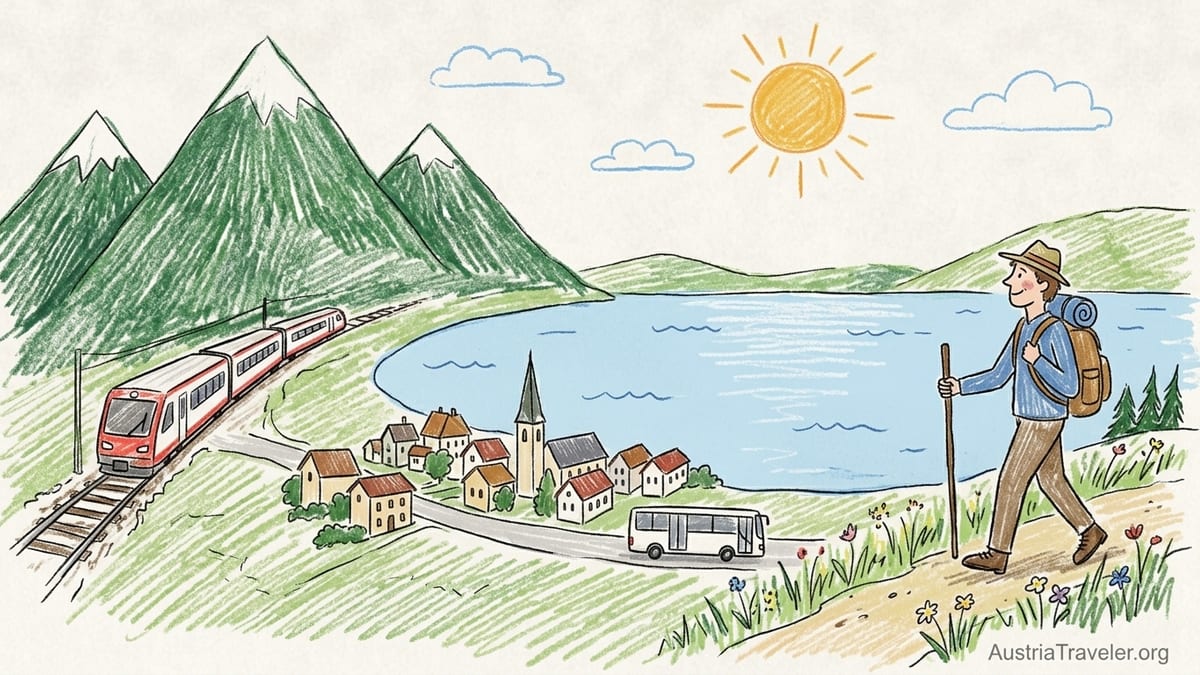
How I Travel the Austrian Alps After the Summit Days
Over the last decade, I have spent a combined three months in the Austrian Alps, spread over many shorter trips. My pattern is usually the same: two or three intense days at altitude, then a deliberate move to somewhere softer for lakes, village walks and slower evenings. I travel almost entirely by train and regional bus inside Austria, renting a car only when I know I will be staying in a side valley with poor connections or moving between several small villages in a short period of time.
Because of that, I judge every Alpine base on a handful of very practical questions. How many nights did I stay and would I add or subtract one next time? Could I arrive by train, or did I need a car to feel free? Was it somewhere I wanted to stroll after dinner, or did the place go dead once the last gondola shut down? And perhaps most honestly of all: when I left, did I feel regret or relief?
The regions below are the ones that stayed with me after the snow melted from my boots. I have also included a few disappointments, because the prettiest valleys are not always the places I would choose to sleep again. The result is a kind of east–west conversation across Austria, from Vorarlberg near the Swiss border to the lake country and out toward the less talked about mountains of the east.
What you will not find here is a resort-by-resort comparison of St. Anton, Kitzbühel, Zell am See or Innsbruck. I have visited all of them, in some cases more than once, but I do not let them dominate how I think about the Austrian Alps. The mountains are bigger and more various than their most famous postcodes.
Montafon and Vorarlberg: Western Valleys I Would Happily Repeat
My most satisfying "after the mountains" base in far western Austria has been the Montafon valley in Vorarlberg, particularly staying in Schruns. I have spent a total of six nights there over two separate trips, both times in small, family-run guesthouses within walking distance of the railway station. For me, Montafon delivers classic Alpine scenery high above and a genuinely lived-in valley floor below: dairy farms, local commuters on the train, and restaurants that are still busy on a rainy Tuesday outside school holidays.
In summer, Montafon gave me dramatic high peaks without feeling brittle or extreme. One July, I used Schruns as a base for three days of hiking up toward the Silvretta range, taking cable cars from the valley and then following red-white-red waymarked trails along ridges and past reservoirs. The lifts and mountain huts were easy to reach by bus and on foot, which meant I never felt I needed a car. In the evenings, I could walk the river promenade, pick up groceries at a normal-priced supermarket and have a plate of käsespätzle at a local Gasthaus without opening my phone to check which places were "top rated." It worked as a true base, not just a bed between excursions.
Winter was different but equally workable. On a February visit, I stayed three nights and skied at Silvretta Montafon using the valley ski bus. A three-day lift pass cost noticeably less than in the Arlberg or Ischgl at the same time of year, and restaurant prices on the mountain were moderate by Alpine standards. A basic plate of Tiroler Gröstl came in at a price that would barely buy a coffee and cake in some Swiss resorts I know. I did notice that weekend crowds built up on the main gondolas, and there were some lift lines mid-morning, but the valley never felt overwhelmed the way St. Anton can on a blue-sky Saturday in peak season.
If there was a limitation, it is that Schruns itself goes quiet after about 10 p.m. on non-holiday weeks. I enjoyed that, because it meant early starts and good sleep, but travelers who want nightlife might find the evenings too subdued. For me, three or four nights here feels exactly right: long enough to explore one or two ski areas or hike a couple of high routes, but not so long that you begin to repeat yourself.
Serfaus–Fiss–Ladis: High Plateau Comfort With Hidden Caveats
Further east but still in western Austria, I spent five winter nights in the Serfaus–Fiss–Ladis region, staying in a guesthouse above the village of Fiss. On paper, this is almost a dream Alpine base: a broad, sunny plateau, an interconnected ski area with modern lifts, and villages that are big enough to have bakeries and gear shops but small enough that you can walk across them in 10 or 15 minutes. The skiing leans toward intermediate cruising, which suited my legs after a week of steeper terrain in Switzerland.
Serfaus itself has a pedestrian underground "village metro" that carries skiers from the car park and edge-of-village accommodation to the main lifts. I found it genuinely useful. On one busy January morning, instead of trudging uphill in ski boots with children and gear, I stepped onto the small subway-style train and was dropped near the gondola a few minutes later. This detail sounds trivial but it is the kind of daily convenience that makes a place work as a base for a family or mixed-ability group.
Yet my stay here was not without disappointments. For a start, I found accommodation prices distinctly higher than in Montafon and even than in parts of the Zillertal, particularly for anything close to the lifts. I also felt the resort marketing very strongly. There is a children’s adventure zone, themed runs, and slick branding on everything from piste maps to napkins. For families with younger skiers, that can be a plus, but I sometimes missed the feeling of being in a real valley where farming and local life have as much presence as tourism.
As a car-free traveler, I also found Serfaus–Fiss–Ladis slightly less convenient than it appears on a map. The valley access road climbs steeply from Landeck, and while regional buses do run, I felt hemmed in once I arrived. This region works beautifully as a one-resort stay, especially with children, but it does not lend itself to spontaneous side trips by train in the way that bases like Kufstein or Zell am See do. Looking back, five nights was on the long side for me; three or four would have been enough to enjoy the pistes, try a torchlit evening walk and move on.
Stubai Valley: Glaciers by Day, Quiet Villages by Night
South of Innsbruck, the Stubai Valley has become one of my favorite compromises between access to serious high mountain terrain and the possibility of a low-key, relatively affordable stay. I have spent a total of seven nights here, split between two different villages: Milders, a little up-valley from Neustift, and Fulpmes, closer to Innsbruck. Both times I arrived entirely by public transport, taking a train to Innsbruck and then the Stubai bus up the valley, which is included in the local ski passes during winter seasons according to current price sheets.
In autumn and early winter, the Stubai Glacier is one of the first areas in Austria to offer reliable skiing, and in late spring it is often the last to close. On one November trip, I paid for a multi-day Stubai Glacier pass that included the valley bus. The price was still significant for my budget, but lower than the big linked areas in western Tyrol for similar dates. The glacier itself delivered what I wanted: high-altitude skiing, wide pistes and a sense of real mountains without needing crampons or a guide. Then, by late afternoon, I could be back down in a valley village where a plate of pasta or a simple schnitzel dinner felt reasonably priced compared with what I have seen in Swiss glacier resorts.
Evenings in Neustift and Fulpmes were sociable without being wild. There are enough restaurants and cafes to give you a choice, and I often ended the day in a small local bar with both helmeted skiers and people who clearly just lived there year-round. What there is not, in my experience, is much in the way of late-night life outside peak holiday weeks. After nine or ten in the evening, main streets are quiet and the mountains feel very close. I found that comforting. Friends who crave nightlife might be better off staying in Innsbruck and using Stubai for day trips.
As for whether the Stubai Valley works as a base or simply a short stop, I would say it rewards at least four or five nights. The bus ride to the glacier is not short, and on stormy days it can feel like a long commute, but having time means you can mix glacier days with lower-altitude hikes, visits to the small local lifts at Schlick 2000, and even a city day in Innsbruck if weather closes in. I never felt I needed a car here; the bus and the regular trains in and out of Innsbruck were enough.
Salzkammergut and Hallstatt: Lake Scenery With Mixed Feelings
Moving toward the center of Austria, the Salzkammergut lake district is where my Alpine trips start to feel more like a central European holiday and less like a pure mountain expedition. I have stayed nine nights in this region over several trips, divided between Bad Ischl, the smaller village of Gosau, and the much-photographed Hallstatt itself. The landscapes here are lake-and-mountain rather than high alpine glaciers, and most of my days were spent on moderate hiking paths, ferry rides and swims instead of summit pushes.
As a base, Bad Ischl surprised me in the best way. I have spent five nights there, arriving by direct train from both Salzburg and Vienna. The town is large enough to have supermarkets, bakeries, an elegant spa and a real evening promenade along the river. Rental prices for simple guesthouse rooms were lower than in Hallstatt for comparable quality, and I never once felt trapped by tourism. From Bad Ischl I could reach lakes like Wolfgangsee and Gosausee by bus or regional train, returning each evening to restaurants that served a steady mixture of locals and visitors. The evenings had a genuinely Austrian feel, with older couples eating cake at the traditional Konditoreien and younger people mixing beers with mineral water at open-air cafe tables.
Hallstatt itself was more complicated. I stayed two nights, which felt like the maximum I needed. The village is almost unimaginably pretty, squeezed between a lake and steep slopes, but in high season the narrow lanes fill quickly with day-trippers. I arrived by train from Bad Ischl, took the short ferry across the lake, and watched as each arriving boat poured another wave of visitors into the main square. By late afternoon and after the last tour buses departed, the atmosphere softened and I did experience an almost unreal calm walking along the lakefront with the church tower reflected in the water.
However, prices for accommodation and food were noticeably higher than in Bad Ischl or Gosau. Simple guesthouse rooms that would cost one amount in neighboring villages were significantly more here during the same week. I also found that for hiking and exploration, Hallstatt itself is not the most convenient base. Bus and train connections are limited in the evenings, and many of the classic walks in the region, such as those above Gosausee with views to the Dachstein, require backtracking or careful timetable planning. For that reason, I now consider Hallstatt an unforgettable short stop rather than a place I would anchor a whole week.
Gosau, where I stayed two nights, offered what Hallstatt could not: direct access to the Dachstein mountains, quiet evenings and prices that felt in line with rural Austria. Reaching it without a car took a little more patience, involving a train to a nearby station and a connecting bus, but once there I appreciated being able to walk from my guesthouse to trailheads around the Gosausee in under half an hour. For hikers who want lake views framed by serious limestone peaks, a base of three or four nights here would be close to ideal.
Gastein Valley and Hohe Tauern: Traditional Spa Culture Meets High Terrain
South of Salzburg, the Gastein Valley threads into the Hohe Tauern, the high central spine of the Austrian Alps. Over the years I have spent a total of eight nights here, split between Bad Hofgastein and Bad Gastein. This valley delivered one of the richest combinations of trip types I have found anywhere in Austria: serious mountaineering terrain on the skyline, comfortable spa town life in the valley, and lift-served skiing in winter that ranges from gentle family slopes to more challenging descents.
Bad Hofgastein worked beautifully as a base. Over five nights one September, I used it for day hikes up toward the Schlossalm area and along panoramic balcony paths that look out over the valley. A summer lift ticket here also included access to the local thermal spa complex for a fixed number of hours, which made it easy to step from a gondola into a warm pool without thinking about extra logistics. I arrived by direct train from Salzburg, walked to my guesthouse in ten minutes, and never felt the need for a car. Evenings had a quietly sociable feel. The spa brought a steady flow of visitors of all ages, and restaurants around the central square stayed open later than in comparable purely rural villages.
Bad Gastein, where I stayed three winter nights, struck me quite differently. The setting and architecture are astonishing: grand hotels stacked up a steep hillside around a waterfall, with distant peaks visible down the valley in clear weather. It is the very opposite of a modest farming village. For a day or two, wandering through grand but slightly faded Belle Époque buildings, I felt I had stepped into a lost world. Once I clipped into skis and took the lifts higher, the skiing itself was enjoyable and varied, with long red runs that suited intermediate legs at the end of a longer Alpine trip.
Yet as a night-time base, Bad Gastein left me conflicted. I found some pockets of excellent food and a few contemporary bars, but other streets felt strangely quiet or in mid-renovation. Accommodation in well-located, renovated buildings was at a premium compared with the rest of the valley. If you choose carefully, two or three nights here can be a highlight. If you end up in a tired property up a steep side street, lugging ski gear back and forth, the glamour fades quickly. For most travelers interested in the Hohe Tauern, I would recommend focusing more nights on Bad Hofgastein or even on smaller villages lower in the valley, and treating Bad Gastein as a striking but concentrated experience.
One consistent positive across the Gastein Valley was public transport. Trains from Salzburg and other cities stop at multiple stations in the valley, and local buses mesh reasonably well with hiking and lift timetables. I never felt stranded without a car, even in shoulder seasons when some lifts and mountain huts were closed for maintenance.
Eastern Edges: Schladming, Ramsau and the Quieter Side of the Alps
Farther east, approaching Styria, the character of the mountains shifts again. The peaks are still imposing, especially around the Dachstein, but tourism feels more diffuse and prices nudge down compared with western Tyrol. I have spent six nights around Schladming and Ramsau am Dachstein, mostly in shoulder seasons when both hikers and skiers were thin on the ground.
Schladming is very clearly a resort town, with a central street full of sports shops, cafes and hotels, and a ski area that has hosted major international races. As a base it delivered efficient lifts, long intermediate runs in winter and a well-marked network of hiking trails in summer. I stayed three nights in a small hotel five minutes’ walk from the main Planai lift. The town was easy to reach by train, and a short walk or local bus ride took me from the station to my accommodation. In the evenings there was just enough atmosphere: a mix of local families getting ice cream, visiting ski teams eating in groups, and older couples taking slow strolls. It did not feel empty, but it also did not have the boisterous apres-ski energy that defines places like Ischgl or Sölden.
Ramsau, on a plateau above Schladming, felt like a different world. I spent three nights there in early autumn, staying at a farmhouse-style guesthouse overlooking fields and the sheer north walls of the Dachstein. The village and its surroundings are famous for cross-country skiing in winter and easy family hiking in summer, and that is exactly the kind of trip it supports. Trails roll through meadows and forest, with the high rock faces always in view but rarely demanding technical skills. I saw more strollers and child carriers than mountaineering harnesses, and most cafes along the paths offered playgrounds along with coffee and cake.
The trade-off in Ramsau is clear: you gain peace and soft-edged mountain days, but you give up easy public transport. I managed with buses and a combination of walking and patience, but timetables were infrequent outside peak periods, and I sometimes adjusted my hiking routes to make sure I did not miss the last bus back. With a car, this would be one of my top recommendations for families or anyone wanting to decompress after more intense alpine days. Without one, I would keep a stay to three or four nights and be ready for early evenings.
Compared with western Austria, prices in and around Schladming felt slightly kinder. Lift tickets, meals and guesthouse rooms were all a shade less expensive than in the Arlberg or Kitzbühel, especially once you moved even a little away from the main lifts. For travelers looking to stretch a longer alpine trip budget, this eastern region offers very real value without any sense of compromise on scenery.
The Takeaway: How I Would Divide a Future Austrian Alps Trip
Looking back across my nights in the Austrian Alps, the west, center and east feel like three chapters of one long book. If I were planning a three-week trip tomorrow, using only the places I have actually slept and walked after dark, I would not simply hop between famous names. I would build the itinerary around how each region feels on a Tuesday evening in the shoulder season, when the postcards have been bought and the last gondola has already shut.
In western Austria, I would anchor about a week. Three or four nights would go to Montafon, where I know I can combine serious mountain days with normal valley life, and another three or four to the Stubai Valley. Those two bases together give access to glaciers, high peaks and quieter villages without forcing me to own a car or spend every evening in pure resort environments. I might pass through places like St. Anton or Ischgl for a day on the slopes, but I would be content to sleep elsewhere.
In central Austria, I would spend another week divided between the Salzkammergut and the Gastein Valley. Bad Ischl and Gosau between them would get four or five nights for lakes, moderate hiking and slower days, with Hallstatt as a beautiful but brief detour rather than the center of the trip. Then I would allocate three or four nights to Bad Hofgastein, using its lifts and spas as a way to recover from more demanding hikes while still feeling close to serious alpine terrain in the Hohe Tauern.
The final five or six nights would be reserved for the eastern mountains around Schladming and Ramsau. I would probably start with three nights in Schladming for straightforward train access, variety of trails and a modest but real evening atmosphere. Then, if I had a car or was willing to work with bus timetables, I would finish with two or three nights in Ramsau, letting the plateau’s soft meadows and wide views act as a landing strip for the whole journey. By the time I boarded a train back toward Vienna, I would have moved from the steepest western valleys through lakes and spas to quieter, less internationally known mountains, mirroring the way the Austrian Alps themselves stretch from one edge of the country to the other.
This distribution is not based on popularity rankings or resort marketing. It is rooted in the very simple travel test I use on every trip: how many nights did I willingly stay, and when I left, did I feel an urge to turn around and book another?
FAQ
Q1. Do I need a car to follow an itinerary like yours in the Austrian Alps?
For the places I describe, you can travel almost entirely by train and regional bus. Montafon, the Stubai Valley, Bad Ischl, the Gastein Valley and Schladming are all directly reachable by rail or with a single bus connection from a main station. The only area where I strongly felt a car would improve things is Ramsau, where bus timetables are less frequent and some trailheads are a long walk from stops, especially outside peak seasons.
Q2. How many nights should I plan in one base before moving on?
From my own stays, three nights is the minimum that feels worthwhile almost anywhere in the Austrian Alps. That gives you two full days to explore without spending the whole time packing and unpacking. In places that work well as hubs, like Bad Ischl, Bad Hofgastein or Schladming, four or five nights let you mix local hikes with day trips to neighboring valleys or lakes without feeling rushed.
Q3. When is the best time to avoid crowds in these regions?
Outside of specific holiday weeks, I have found late June, September and early October to be good compromises in summer and autumn, with most lifts and huts still open but noticeably thinner crowds than in high season. In winter, avoiding the Christmas and New Year period, local school holidays and peak Carnival weeks makes a big difference. Even famous regions feel more manageable midweek in January or March compared with Saturdays in high season.
Q4. Are the Austrian Alps much cheaper than the Swiss Alps?
On my own trips, accommodation and food in Austria have usually been more affordable than in comparable Swiss mountain areas, especially outside the most famous Austrian resort towns. A basic plate of hot food on the mountain and a simple guesthouse room typically cost less than I pay in Swiss resorts with similar terrain. That said, especially scenic or hyped villages such as Hallstatt or the priciest corners of certain ski regions can still feel expensive relative to the Austrian average.
Q5. Which of these areas is best for families with young children?
For easy family hiking and winter activities, Ramsau am Dachstein and the Salzkammergut around Gosau stand out, thanks to gentle terrain, lakes, and plenty of short trails. In winter, Serfaus–Fiss–Ladis is heavily geared to families, with child-focused areas and efficient lift access, although it can be more expensive and feel more like a purpose-built resort than a traditional valley community.
Q6. Where would you go for more serious mountaineering or high-altitude skiing?
If your trip tilts toward glaciers and higher summits, the Stubai Valley and the Hohe Tauern above the Gastein Valley are strong choices among the places I have stayed. From the Stubai Valley I accessed glacier skiing and felt close to guided mountaineering terrain, while the Hohe Tauern region around Bad Gastein and Bad Hofgastein opens up more demanding hiking and ski touring options. In all such cases, if you are moving onto glaciers or technical routes, hiring a certified local guide is important.
Q7. Are any of these destinations suitable for travelers who dislike party scenes?
Yes. Montafon, Bad Ischl, the Gastein Valley outside peak weeks, Ramsau and the Stubai Valley all offered me quiet evenings focused on food and conversation rather than loud apres-ski. Even in more resort-oriented spots like Serfaus–Fiss–Ladis or Schladming, it was easy enough to sleep in quieter guesthouses slightly away from the main bars and still walk into town for dinner.
Q8. How should I budget for mountain lifts and passes?
Costs for cable cars and ski passes add up quickly, so I try to group lift-intensive days in one region to make multi-day passes worthwhile and spend other days on lower, free-to-access trails. In places like Gastein and the Salzkammergut, I have also made good use of regional guest cards or combined lift-and-spa tickets that add value if you plan ahead. Checking current prices on local tourism or lift company sites just before you travel helps avoid surprises.
Q9. What kind of evening atmosphere can I expect in smaller villages?
In most of the smaller places where I stayed, evenings were low-key. You can usually count on at least one or two restaurants, a bar or cafe and perhaps a hotel lounge that welcomes outside guests. The pattern is often early dinners, a short stroll or drink afterward, and quiet streets by ten or eleven. If you want more going on after that, basing in a larger town like Innsbruck, Salzburg, Bad Ischl or Schladming and doing day trips into the surrounding mountains may be a better fit.
Q10. Is it realistic to combine western, central and eastern Austrian Alps in one trip?
Yes, as long as you give yourself enough time and think in terms of weeks rather than days. A three-week route that links a western base such as Montafon or the Stubai Valley with central stops in the Salzkammergut and Gastein, then finishes in the Schladming and Ramsau area, feels natural by train. Trying to fit all three regions into a single seven-day trip, however, would mean spending more time on platforms and highways than on trails or by the lakes.