

I thought I knew the Arlberg. I first met it the way most people do, on a mid‑January ski trip to St. Anton and Lech, wrapped in down jackets and chasing the last chair of the day. Years later I went back in late July, staying in the same kind of guesthouse, walking past the same lift stations, only this time with hiking poles instead of skis. What surprised me most was not simply the swap from white to green, but how almost every part of the trip changed: prices, pace, light, noise, and even how long I wanted to stay outside. The same mountains delivered two completely different holidays.
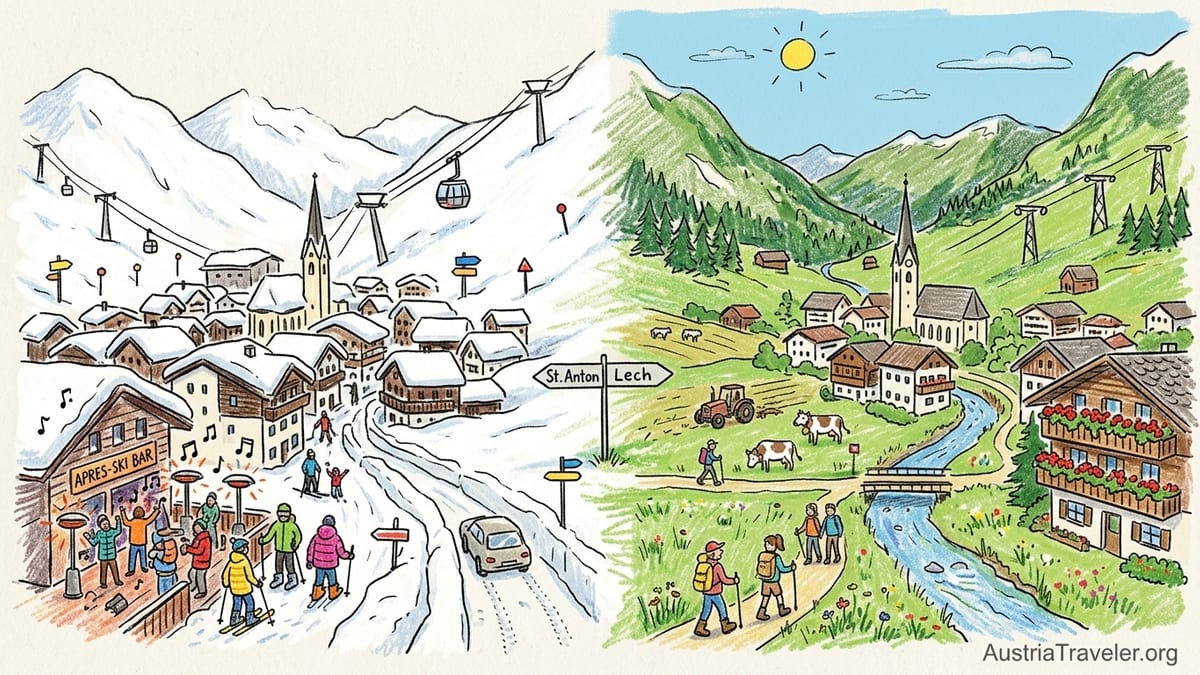
The Same Villages, Two Different Worlds
My first Arlberg visit was in deep winter in St. Anton am Arlberg, when the resort connects into the wider Ski Arlberg area with more than 300 kilometres of groomed runs and 85 lifts. In January the village felt tightly packed, with ski boots clattering on every street and music spilling out of apres‑ski bars from mid‑afternoon. I remember timing my walk from the Galzigbahn base station to my guesthouse in Nasserein by the last lift back from Lech, because once the lifts closed the entire rhythm of the village shifted indoors to saunas, fondue rooms and hotel bars.
In summer I returned to the same region on the Vorarlberg side, basing myself in Lech with day trips over the Flexen Pass to St. Anton. The physical layout was identical: the same church spires, the same lift pylons, the same hotels I had seen buried in snowbanks. Yet the atmosphere was almost alpine‑rural. Tractors hummed where ski buses had queued, and balconies that in winter glowed with heat lamps overflowed with geraniums instead. The soundscape changed from thumping apres playlists to cowbells and river noise. It felt more like staying in a high‑altitude village that happens to have lifts than in a ski factory.
What struck me was how the sense of crowding disappeared. In January St. Anton’s main street can feel like a moving carpet of jackets at 4 pm. In July I could walk the same stretch after dinner and hear my own footsteps. The same hotels that had week‑minimum stays and fully booked half‑board packages in winter were marketing themselves as quiet hiking bases, with empty loungers by the spa pools and reception staff who suddenly had time to chat about trail conditions.
This shift also changed how I related to the landscape. In winter I mostly saw the Arlberg framed by piste markers and wayfinding signs. In summer, standing by Formarinsee above Lech or looking down toward the Rosanna valley from a St. Anton ridge, the mountains felt larger and less structured. There were still marked paths, but fewer boundaries between the “destination” and the wild ground in between.
Accommodation and Budget: When the Alps Are Cheaper
The price gap between my winter and summer stays was the first objective difference I felt. In high winter season, especially around late January and February, St. Anton rooms near the lifts regularly quoted several hundred euros per night for standard doubles, and it was normal to see discussions of budget options still running close to 1,000 US dollars per night in peak weeks for central hotels with breakfast. By contrast, when I searched and then stayed in Lech and St. Anton in late July, similar mid‑range guesthouses were often half or even a third of their February rates, and availability was far wider for short stays.
Booking patterns shifted too. In winter many Arlberg properties strongly prefer Saturday‑to‑Saturday bookings, which I ran into when trying to do a four‑night ski break. Several guesthouses told me they would only release short‑stay slots at the last minute if full weeks did not sell. In summer my three‑night stays were welcomed, and owners were flexible about arrival days. This is a subtle difference, but it can make or break a trip if you are trying to squeeze skiing into fixed vacation dates.
What I saved on accommodation in summer, I reallocated to experiences. In Lech I bought the regional Lech Card, a summer guest card that bundled local buses, entry to selected attractions and unlimited use of several cable cars over the season from late June to early October. That meant that for a fixed fee I could ride the Rüfikopfbahn or Zugerbergbahn up to the high trails and lakes as often as I liked during my stay, something that would be unthinkably expensive with individual winter lift passes aimed at skiers.
In winter, lift access is the major budget line. The Ski Arlberg day pass has edged above 80 euros in recent seasons and multi‑day passes, while better value per day, quickly add up for a family. When I added four days of skiing, equipment rental and avalanche gear, my winter cost per person was several times higher than my summer cost for lifts and activities. The winter trade‑off is that you spend long, continuous days on the mountain. In summer I did more but shorter excursions, coming back to the village for a mid‑afternoon coffee or a nap when storms built up.
Lift Operation and Mountain Access
In January the Arlberg lift system runs like a circulatory system. From around early December into mid‑April, depending on snow, the goal is to connect everything: Galzig, Valluga and Kapall above St. Anton, over Flexenbahn and Valfagehr to Stuben and then on toward Lech, Zürs and Warth. The chairlifts and gondolas open early, typically around 8.30 or 9 am, and queues move fast because most riders are going up once and then flowing downhill all day. I spent entire winter days without coming back down to village level until last lift.
Summer lift operation feels more selective. In Lech, for example, a handful of cable cars and chairlifts run between roughly late June and early October, including the Rüfikopf cable car, the Bergbahn Oberlech, the Petersboden chairlift and the Zugerbergbahn, with typical operating hours from about 8.30 or 9 am until late afternoon. Rather than forming a fully connected ski carousel, they act as access points to specific hiking areas, lakes such as Formarinsee and Spullersee, and panoramic platforms. I learned to plan hikes around the last cable car down at 5 pm instead of the 4 pm “last run” of winter skiing.
Because fewer summer lifts operate and their capacity is aimed at hikers, the experience is calmer. In winter I joined early‑morning scrums at the Galzigbahn gondola on fresh‑snow days and watched ski schools fan out across blue runs by 10 am. In July my gondola cabin up to Rüfikopf might hold eight people and a dog, with no sense of urgency. The staff were more likely to give trail advice than to herd crowds. The trade‑off is that, if you are used to reaching every ridge by lift, some high points become full‑day hikes rather than quick gondola rides.
Access to the highest peaks also changes. In winter I took the Vallugabahn from Galzig up above 2,800 metres into a world of snowfields and off‑piste routes, with strict rules about where you could ski without a guide. In summer that same landscape is rock and scree, and certain sections may be closed or classed as alpine routes only for experienced climbers. So even though the gondola infrastructure stands year‑round, what “access” means changes completely with the seasons.
Roads, Daylight and Time Spent Outdoors
My winter trip began with the classic arrival over the Arlberg region from Innsbruck. The motorway and Arlberg road tunnel make access straightforward, but once you leave major roads the last kilometres into St. Anton or over toward Lech depend on snow management. In January chains were recommended on side roads after heavy storms, and on my first visit the approach to the Flexen Pass was lined with snow walls higher than the car. Driving demanded concentration, and after skiing I often chose to stay within walking distance of my accommodation rather than venturing out again at night.
In summer the Flexen Pass road turned into a highlight in itself. With dry tarmac and clear visibility, the drive between St. Anton, Stuben, Zürs and Lech became a scenic excursion instead of a logistical hurdle. Buses that in winter ferried skiers in ski boots now carried hikers, mountain bikers and families with strollers. Several locals told me that long closures due to avalanche risk, which can occasionally affect the road in deep winter, are almost unheard of in July and August. That security changed how I planned day trips. A dinner in Lech after a hike felt realistic instead of risky.
Daylight altered the shape of each trip even more. In mid‑January, the sun crept over the peaks late and vanished from the valleys early, leaving some pistes in shade by mid‑afternoon. I was usually off the mountain by 4 pm whether I wanted to be or not. The flip side was cozy evenings that began early, with long stretches indoors in hotel saunas, reading rooms or crowded bars while outside temperatures regularly fell well below freezing.
In July around the same latitude, light lingered into late evening. I remember finishing a hike from Oberlech after 7 pm with enough time to shower and still eat dinner in daylight. Average valley temperatures sat comfortably in the 20s Celsius during the day, cooling to fresh but rarely cold nights. As a result, I spent noticeably more hours outside in summer, but in shorter bursts: morning hikes, late‑afternoon swims in cold mountain lakes, an after‑dinner stroll along the Lech river. Winter delivered concentrated outdoor time in one block, followed by long indoor recovery. Summer stretched outdoor life across the entire waking day.
Clothing, Equipment and Activity Costs
Winter in the Arlberg demanded both gear and systems. For a week in January I checked in luggage dominated by a hard ski bag, boots, helmet, avalanche pack, transceiver, shovel and probe, plus insulated clothing. Even renting skis and boots locally still left me packing bulky outerwear and accessories. On the ground I paid around 30 to 40 euros per day for decent ski rental from shops close to the Galzigbahn, with extra charges for premium models and boots. Hiring a mountain guide for an off‑piste day added several hundred euros for the group.
Summer was refreshingly light. My hiking kit was essentially sturdy boots, trekking poles, a light shell, and layers. I carried a small daypack rather than a technical avalanche bag. I did not need to rent anything beyond the occasional e‑bike in St. Anton’s Moostal, which cost significantly less than a day of ski equipment. That saving showed up both in my luggage weight and in my budget. The only “lift” expenses were my Lech Card and a couple of individual rides where the card was not included, such as a specific cable car to a lake.
The cost structure of activities also changed. In winter almost every outdoor hour had an implicit meter running through lift passes and equipment. Even on a so‑called rest day, if I wanted to take the cable car up just for a mountain lunch, I was still buying at least a partial day ticket. In summer I could walk straight onto well‑marked hiking paths from the village without paying anything, only choosing to add lift rides when I wanted to save vertical metres. On one day in Lech I spent under ten euros after breakfast, hiking to a lake, picnicking and riding a bus back on my already‑paid guest card.
There is, however, a hidden equipment demand in summer: sun and storm protection. On a bluebird January ski day the cold and reflection off the snow are obvious, and everyone wears goggles and high‑factor sunscreen. In July the strength of the sun above 1,500 metres can catch hikers by surprise. I learned quickly to carry a hat and more water than I thought necessary, and to respect afternoon thunderstorms which roll in fast over the peaks. That added a different kind of vigilance to my supposedly slower‑paced summer days.
Restaurants, Reservations and Crowd Patterns
The restaurant scene in winter Arlberg is shaped by the ski day. On my January trip, mountain huts such as those on Galzig and Gampen filled sharply from noon to 1.30 pm, with shared tables, clattering plates of gulaschsuppe and servers moving at speed. In the evenings, especially Thursday through Saturday in high season, securing a table at popular places in St. Anton or Lech required advance reservations. Some hotels served only in‑house half‑board guests and turned away walk‑ins. The overall mood was efficient and energetic, with quick table turnovers so guests could still make last orders at the bar.
Summer dining felt more spread out. Lunchtime on the mountain was quieter, with hikers trickling into huts across a broader window. Terraces that I knew from winter as noisy self‑service decks became almost tranquil, with fewer people lingering over beer and more over coffee and cake. In Lech village I could usually walk into restaurants on weeknights without a reservation, and only the most in‑demand addresses filled up on weekends or during special events. Staff had more time to talk about local cheese or explain which dishes used herbs from their own gardens.
The most striking crowd pattern shift was apres‑ski. In winter, slopeside bars just above St. Anton like those in the Steissbachtal funnel hundreds of skiers into a narrow valley as lifts close, creating a daily river of people in ski boots. Walking or skiing through that flow is a specific kind of social experience, with loud music, dancing on benches and a feeling that the resort’s energy is peaking precisely as the natural light fades. In summer that entire ritual disappears. Those same venues might be closed or reconfigured as quiet terraces, and evenings centre on slow drinks on balconies, not mass parties by the piste.
If you are sensitive to crowds, this difference matters. In winter I accepted queues and noise as part of the price of skiing in a world‑class area. In summer I realised how relaxing the Arlberg can be once the high‑season intensity has gone. Even well‑known photo spots, like the viewing platform at Rüfikopf, had moments when only a few other walkers shared the view.
How Famous Ski Mountains Feel in Summer, and Hiking Villages in Winter
Seeing winter‑famous ski areas in full summer colour was the deepest mental reset of my second trip. St. Anton’s home run, which I had only known as a sometimes‑icy ski route lined with snow cannons, turned into a grassy slope dotted with wildflowers, with a clear stream audible where snowcats once parked at night. The huge piste‑side banners advertising ski schools were gone, replaced by smaller signs for hiking routes and bike trails. Standing on Galzig without skis, I noticed the shapes of ridges and rock bands that winter covers in a smooth white canvas.
Lech and Zürs surprised me even more. In winter I associated them with polished hotels, fur‑trimmed jackets and the famous White Ring ski circuit. In July the same streets were crossed by locals in work clothes and hikers in worn boots. Luxury remained, but it felt lower‑key. The lift pylons were still there, yet cable cars moved slowly over cows instead of skiers. The high‑alpine turquoise of Formarinsee and Spullersee, reached via summer buses and cable cars, changed my mental map of the Arlberg from exclusively vertical skiing to include horizontal journeys along valleys and around lakes.
The reverse was true when I visited areas I had first known as hiking terrain in winter. Above Lech, trails that in summer wander past grazing meadows become long, rolling red pistes. Approaching on skis, you see the same barns and chapels from above and at speed. Places that had felt like remote corners on a summer hike suddenly sat beside busy ski intersections. It was slightly disorienting to realise that my peaceful picnic meadow had been a junction of three ski runs all along.
This seasonal inversion extended to the social fabric. Hiking in summer I met local farmers repairing fences or moving cattle, and hotel owners who said they preferred the calmer pace of July and August, even if it brought less revenue than the high winter weeks. In January many of those same people were too busy running restaurants, ski shops or lift stations to chat. Experiencing both seasons gave me a fuller sense of the Arlberg as a lived‑in region, not just a ski product.
Choosing Your Season by the Experience You Want
After living both trips, I stopped thinking of “summer versus winter” as a simple climate choice. The better question is what kind of experience you want from the mountains. If your priority is skiing vast, linked terrain with a lively nightlife scene, then the Arlberg in winter delivers. You will pay more for lodging and lift passes, carry more gear and share pistes and restaurants with many others, but in return you gain hundreds of kilometres of snow‑sure slopes, professional guiding, and the thrill of big‑mountain descents right from your door.
If you are more drawn to long quiet hours outdoors, flexible days and a softer budget, the same region in summer feels almost like a different country. Accommodation is noticeably cheaper, booking rules are looser, and you can walk, bike and swim in mountain lakes without an invisible meter running every minute. Instead of chasing first chair, you might linger over breakfast, head up on a late‑morning cable car included in a guest card, and end the day with your feet in a stream rather than your boots clipped to a ski rack.
Families might think of it in terms of structure. Winter days come pre‑shaped: ski school in the morning, shared lunch on the mountain, afternoon runs, then apres‑ski and dinner. Summer days are more open‑ended, which some children love and others find less exciting than skiing. Travellers who feel energized by crowds, music and buzzing bars will find winter more stimulating. Those who recharge through quiet trails and early nights with the windows open to river sounds will probably prefer summer.
For my own planning, the biggest surprise was realising that I did not have to choose forever. Returning to the same mountains in another season doubled their value. The Arlberg stopped being a once‑in‑a‑lifetime ski trip and became a place I could get to know differently over years. If skiing draws you, start with winter, but consider coming back in July to see where the pistes lead when the snow has melted. If hiking and lake swims are your thing, start in summer and then decide whether you want to meet those same ridges under several metres of snow.
FAQ
Q1: Is the Arlberg region significantly cheaper in summer than in winter?
Yes. In my experience and research, mid‑range hotels and guesthouses in places like St. Anton and Lech were roughly half or less of their peak winter prices in July, and it was easier to find short stays without Saturday‑to‑Saturday rules. Lift access is also cheaper in summer because you typically buy a regional guest card or a few individual cable car tickets instead of full multi‑day ski passes.
Q2: How different are the crowds between winter and summer in the Austrian Alps?
In winter, especially from late January through early March, the Arlberg can feel very busy, with queues at main lifts, crowded mountain restaurants at lunchtime and lively apres‑ski scenes. In summer I found the same villages noticeably quieter, with only modest queues at cable cars and many empty tables at huts outside of peak lunch hours, even though popular trails still see a steady flow of hikers on sunny days.
Q3: Do I need a car to enjoy both seasons in the Arlberg?
No. The region is well connected by train and bus year‑round, and in winter ski buses and lifts link the main villages efficiently. I have visited without a car in both seasons. That said, in summer having a car can make it easier to reach trailheads, lakes such as Formarinsee and Spullersee, or to combine the Arlberg with nearby valleys, since roads are clear of snow and driving becomes part of the scenic experience.
Q4: How does daylight affect the daily rhythm in winter versus summer?
In mid‑winter daylight is short, and north‑facing slopes drop into shade early, which naturally limits outdoor time to a concentrated ski day and encourages long evenings indoors. In summer daylight stretches well into the evening, so I often hiked or walked after dinner. That extra light changes the feel of the trip from regimented ski days to more fluid, multi‑activity days with breaks and late strolls.
Q5: Are mountain restaurants and huts open in summer as well as winter?
Many, but not all, mountain restaurants operate in both seasons. In winter the focus is on fast service for skiers at peak lunch hours, while in summer the same huts tend to be quieter, with more space on terraces and a slower pace. Some venues that exist mainly for apres‑ski close or change character in summer, so it is worth checking locally which huts and bars are open for the time of your visit.
Q6: What kind of clothing and equipment do I really need in each season?
For winter skiing you need full snow sports gear, including insulated jacket and pants, gloves, goggles and either your own or rented skis, boots and helmet, plus avalanche gear if you plan to leave groomed runs. In summer I was comfortable with sturdy hiking boots, a light waterproof shell, layered clothing, sun protection and a small daypack. Renting is usually only necessary for bikes or via ferrata gear, which keeps both luggage and costs down compared with a ski trip.
Q7: Is it easier to get last‑minute accommodation in summer?
In my experience, yes. Winter high season weeks in the Arlberg can book out months ahead, and some properties insist on full‑week stays. In summer there was more last‑minute availability and more willingness to accept short stays of two or three nights. However, during specific summer events or school holidays, the most popular hotels can still fill quickly, so booking ahead is still sensible if you have fixed dates.
Q8: Can I combine skiing and hiking in a single shoulder‑season trip?
It is difficult in the Arlberg because ski lifts and pistes require consistent snow cover, while higher hiking trails need to be snow‑free. Late spring and late autumn are transitional, with limited lift operations and potentially unstable conditions for both sports. If you want to do both in one broader vacation, a better strategy is to ski in the Arlberg in winter and then hike in a different region at lower altitude later in the same year.
Q9: How child‑friendly are the Arlberg villages in summer compared with winter?
In winter, the Arlberg is very set up for families who ski, with ski schools, beginner areas and family‑friendly pistes. In summer I found it equally suitable but in a different way, with easy walking paths, playgrounds, lifts open to non‑skiers and family‑oriented activities around lakes and rivers. The atmosphere is calmer in summer, which can be ideal for younger children or those not yet interested in skiing all day.
Q10: If I can visit only once, should I choose summer or winter?
It depends on what you value more. Choose winter if you are passionate about skiing or snowboarding and want to experience one of Europe’s largest connected ski areas with a lively social scene. Choose summer if you prefer quieter villages, flexible days of hiking and lake visits, and a lower overall budget. Having done both, I would say that neither season is objectively better; they simply offer two distinct ways to experience the same mountains.