


I thought I was planning an easy lakes-and-mountains escape. Austria’s lake districts look compact on the map, and the photos of wooden jetties and pastel boathouses made it all seem straightforward. In reality, my Austrian lakes road trip was shaped as much by traffic, parking lots and tunnel choices as by turquoise water. This is what I actually drove, what went wrong, and how I would structure the route next time so it feels like a journey instead of a frantic checklist of viewpoints.
Where The Trip Really Started And How We Set Up The Car
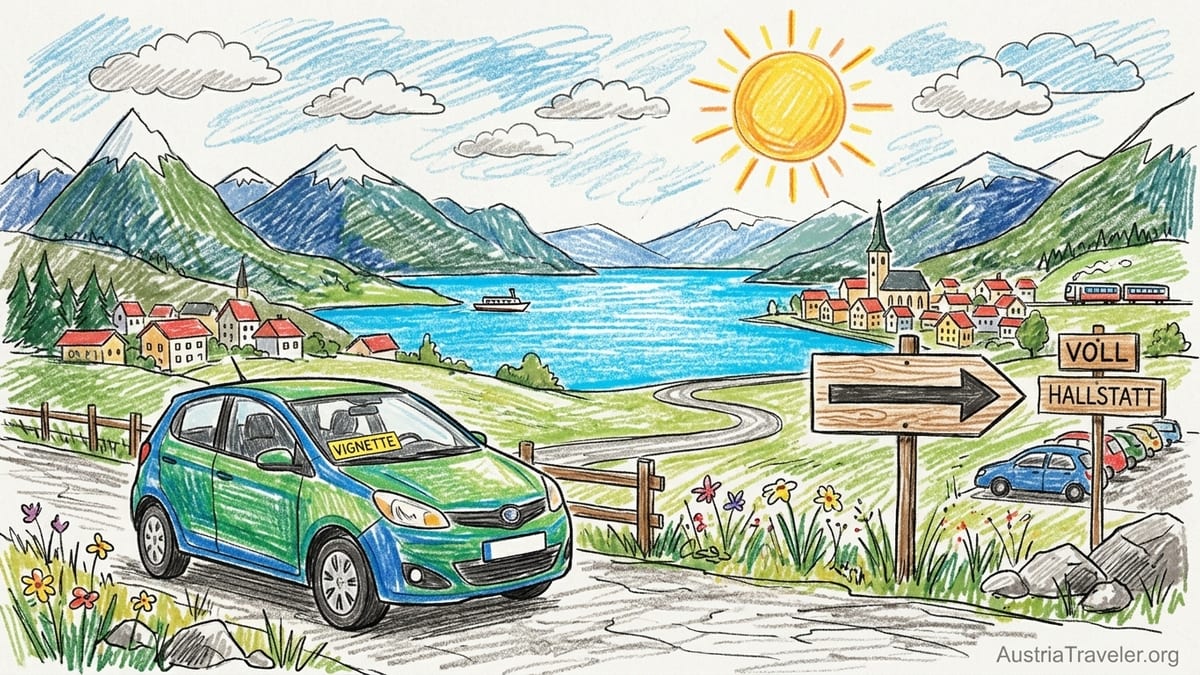
My road trip began in Salzburg, not Vienna, for one simple reason. I wanted to spend more time in the lakes than on the Autobahn. I picked up a compact rental car from Salzburg Airport, which sits right next to the A1 motorway and makes it easy to reach the Salzkammergut lakes without navigating the tight streets of the old town first. The rental counter staff immediately asked whether I wanted the Austrian motorway vignette. In Austria most major motorways require this small toll sticker, and rental cars based in Austria are usually supplied with a valid vignette already stuck to the windshield. The clerk pointed it out, explained it was valid for the duration of my rental, and warned that fines for using motorways without one can run into triple digits if you are stopped or scanned by cameras.
Fuel costs set the tone early. At a petrol station just outside Salzburg, regular unleaded was priced around 1.70 to 1.90 euros per litre, so a full tank on the modest hatchback cost roughly 75 to 85 euros. Over the course of a week in the lake regions I refuelled twice more, spending a little under 200 euros in total. Those numbers matter when you are deciding whether to hop between many small lakes or settle in one region and drive shorter scenic loops.
I made a conscious decision to use only two accommodation bases instead of booking a new hotel every night. The first base was in St Gilgen on Wolfgangsee, about 35 minutes from Salzburg on a mix of A1 motorway and the B158 lakeside road. The second was in Gmunden on Traunsee, just under an hour from St Gilgen if you stay on secondary roads via Bad Ischl and Ebensee. On paper this looked efficient. In practice my combination of motorway shortcuts and lakeside detours created more backtracking than I expected.
The car itself was essential for part of what I planned. Certain bathing spots, like quieter stretches of eastern Wolfgangsee or the small public jetties on the west shore of Traunsee near Traunkirchen, sit well away from railway stations. Some trailheads, including forest walks above Fuschlsee and minor paths overlooking Attersee, begin from lay-bys that are only realistically reached by car. I quickly discovered, however, that many of the classic postcard views of Hallstatt and the villages of Wolfgangsee are easier to approach by train or boat than by trying to wedge a car into overflowing lakeside car parks.
From Salzburg To Wolfgangsee: Scenic Road Versus Motorway And First Parking Lessons
Leaving Salzburg, I had two choices. The fastest route to Wolfgangsee is a short hop on the A1 motorway followed by the B158 towards St Gilgen and Bad Ischl. This takes around 35 to 40 minutes in light traffic. The slower but more panoramic option is to avoid the motorway almost entirely and follow local roads that swing via Fuschlsee, threading through forest before emerging suddenly beside jade water. I naively tried to combine the two, using the motorway for speed, then dropping onto slower roads to “collect” lakes.
The first miscalculation arrived at Fuschlsee. It looks so close on the map that I assumed I could simply nudge the car off the road, dash to the shore for a quick swim, then continue to Wolfgangsee. In reality the main stretch of lakeside access sits near the village of Fuschl am See where there is a proper public lido and paid parking. By the time I arrived in late morning in July, every marked space in the central car park was taken. Cars were circling slowly, and police were moving along the road asking people not to park on verges. I ended up driving straight through the village without stopping because I did not want to add a half-hour parking hunt to the day.
This set a theme. On a lakes road trip in peak season, arriving mid-morning means joining a parking queue. At Fuschlsee and later at Wolfgangsee, the easiest spots near the water were full by around 10:30. The more relaxed way to see both lakes would have been to stay in Salzburg and take an early bus to Fuschl am See or St Gilgen, then use local boats to reach trailheads and bathing jetties. Instead, I spent too much time scanning for green parking signs from behind the wheel.
The final approach to St Gilgen on Wolfgangsee, however, reminded me why I had chosen to drive. The B158 wraps along the northern edge of the lake with frequent lay-bys where you can pull over briefly and absorb the view. The trade-off is speed. Once you leave the A1, the road is single carriageway with frequent lower limits through villages and occasional roadworks. On my first afternoon a temporary traffic-light system for resurfacing work held me for nearly 15 minutes above Strobl. Those small holdups slowly eat into the day if you are trying to tag multiple lakes in one run.
Wolfgangsee, Hallstättersee And The Trap Of Too Many Lakes
From St Gilgen my plan was ambitious. I wanted to explore the villages around Wolfgangsee, then drive to Hallstatt in the afternoon, loop around Hallstättersee, and be back at my accommodation by evening. Driving times on route planners made this seem simple: around 25 minutes from St Gilgen to Bad Ischl, then roughly 35 to 40 minutes to Hallstatt either via the B145 to Bad Goisern and the eastern lakeshore road, or on the more direct B166. The reality of summer traffic and narrow lakeside roads turned it into a full day of tarmac.
Wolfgangsee itself is deceptively spread out. St Gilgen, Strobl and St Wolfgang each sit on different corners of the water, and they are linked by both the B158 and smaller local roads that twist up and down the hills. I spent nearly an hour driving the short stretch between St Gilgen and Strobl, stopping at several public bathing areas and a lakeside path, then changing my mind about which village to lunch in. Each small hop meant finding parking all over again. The pay-and-display machines are simple enough, but the cumulative cost adds up when you spend 3 or 4 euros here, 5 euros there, multiple times each day.
By the time I left Strobl for Hallstatt, it was already early afternoon. Instead of continuing the direct B158 route to Bad Ischl and then down to Hallstättersee, I detoured via the Postalm toll road above Wolfgangsee, having read that it was one of the most scenic drives in the region. The alpine meadows and sweeping hairpins are indeed beautiful and the toll, around 15 to 20 euros for a car depending on season, supports maintenance of the pasture road. The cost, however, is time. The Postalm loop added almost two hours to the day. By the time I descended again towards the Gosau valley and then cut across to Hallstatt, I was joining an afternoon line of cars all heading for the same few village parking areas.
Here the difference between viewing lakes and travelling through them became stark. The road along the western shore of Hallstättersee does not run as a neat continuous circuit. Near the village, traffic is channelled into signposted lots outside the pedestrian zone. Several of these were showing full signs when I arrived around 4 pm. Further along the lake, where I had imagined a relaxed drive directly beside the water, the road narrowed and alternated between tunnels and stretches set back from the shore. I found myself pulled into a lay-by high above the lake, looking down at the famous church spire view that most visitors know from boat photos, but separated from it by rock, water and the clock. I had neither the time nor the energy to repark, walk down, and then fight my way back out. The combination of one too many lakes and a mid-afternoon arrival had turned Hallstatt into something glimpsed through a windscreen instead of experienced on foot or by boat.
In hindsight, the better structure would have been to dedicate one full day to Wolfgangsee alone, moving entirely by boat between St Gilgen, St Wolfgang and Strobl after parking once in the morning. Hallstatt deserves its own separate day, approached either by train and ferry or by car very early in the morning with a single parking decision. Cramming both lakes into one driving day reduced them to a checklist of viewpoints and left me too tired to linger anywhere properly.
Shifting Base To Traunsee And The Hidden Costs Of Backtracking
After three nights on Wolfgangsee I moved my base to Gmunden on Traunsee, in the northern part of the Salzkammergut. On the map this looked logical. Traunsee, Attersee and Mondsee cluster relatively close together between Salzburg and Linz, and I pictured myself making short loops from a central lakeside town. The drive from St Gilgen to Gmunden via Bad Ischl and Ebensee is around 75 to 90 minutes on ordinary roads, longer if you divert into lake villages along the way. I underestimated just how much that transfer day would carve out of my itinerary.
The most direct route would have been to take the B158 back to Bad Ischl, then the B145 along the Traun valley past Ebensee into Gmunden, without stopping. Instead I tried to fold in quick visits to Bad Goisern and a roadside viewpoint of Hallstättersee from the opposite shore, hoping to “redeem” my rushed visit two days before. Once again I discovered that lakeside viewing points are not always slipped just off the road. The main highway section near Bad Goisern runs in part through short tunnels and elevated sections where it is impossible to stop. The accessible lay-bys cluster in specific pockets, and if you miss the sign you may not see another safe stop for several kilometres. By the time I reached Gmunden, a supposed hour-and-a-bit transfer had taken nearly three hours including detours and a supermarket stop.
Gmunden itself is a pleasant base. It has a compact old town, a lakeside promenade, the photogenic Seeschloss Ort on a small island, and a mix of paid parking garages and surface lots. Compared with Hallstatt and central St Wolfgang, I found parking less pressured here, especially in the evenings. The issue was geography. Traunsee is long and narrow, hemmed by steep slopes on its western side. The B145 and B120 cling to the lake, negotiating tunnels and rock cuttings before climbing away towards the Autobahn. Every exploration of Attersee or Mondsee required me to backtrack up the same valley.
The most obvious example came on the day I tried to combine Traunsee and Attersee. I drove south along Traunsee to Traunkirchen, paused for a short walk, then returned to Gmunden to take the B120 and local roads west towards Attersee. Each leg took around 30 to 40 minutes. Parking near Unterach on Attersee was once again tight after late morning, with local swimming areas beside the main road drawing in day trippers. I ended up driving further along the southern shore to find a less crowded lay-by and staircase to the water. The swimming was wonderful, but I paid for it with another full hour of driving back around the lake edge to rejoin the road towards Gmunden in the late afternoon.
Switching hotels had given me lake variety, but it also locked me into repeated transits on the same roads. If I had retained the Wolfgangsee base and accepted slightly longer single-day excursions to Traunsee and Attersee, I could have structured my days with clearer themes rather than constantly packing and unpacking. Every hotel change on a lakes road trip is more than a line on the map. It is an entire morning or afternoon of loading the car, wrestling luggage into small garages, and working around fixed check-in and check-out times.
Lakeside Roads, Tunnels And When Trains Or Boats Win
One of the biggest misconceptions I carried into this trip was that lake roads in Austria always hug the shoreline. On postcards, roads and jetties seem to sit side by side. In reality some of the most scenic stretches are accessible only on foot or by boat, with main traffic diverted through tunnels or pushed back against the valley sides. This matters when you are trying to decide whether a car is an asset or a liability.
A clear example lies along the western shore of Wolfgangsee between St Gilgen and Strobl. Parts of the road run close to the water with fine views. Other sections are set higher, and much of the intimate lake experience comes from local boat services linking St Gilgen, St Wolfgang and Strobl. I parked in St Gilgen one morning and boarded a scheduled lake steamer to St Wolfgang instead of driving. Within 40 minutes on the water, I glided past bays and boathouses that have no roadside equivalent. The car would have delivered me to the same village, but not the same journey.
Hallstättersee offers an even starker contrast. The railway line runs along the eastern shore while the main road uses a mix of tunnels and cliff-hugging terraces on the west. The village of Hallstatt itself is largely car-free, with visitors directed to peripheral parking areas and buses. Had I taken the train from either Salzburg or Bad Ischl and used the little ferry that crosses from the Hallstatt railway halt to the village, I would have arrived in the classic way, with the church tower and waterfront unfolding ahead. Instead I spent my energy watching brake lights in a line of cars competing for turnaround space.
By contrast, the car proved invaluable for more low-key corners of the lake districts. Around the fringes of Attersee there are modest public swimming spots and grass banks that are difficult to reach without a vehicle. Around Traunsee, small chapels, trailheads for forest walks and the starting points of side valleys often sit several kilometres from the nearest station or regular bus stop. On these days the freedom to pull into a lay-by, walk for an hour, then move on felt exactly like what a road trip should be.
The pattern that emerged was simple. Use the car for access and for quieter bodies of water where public transport is sparse. Surrender it near the busiest lakes and let the trains and boats do the hard work. On my first attempt I tried to drive everything. Next time I would deliberately park outside Salzburg or Bad Ischl on certain days and combine rail, boat and walking, treating the car more as a bridge between regions than as the default way to experience the lakes themselves.
Mistakes That Turned A Lakes Journey Into A Viewpoint Checklist
When I look back at my Austrian lakes road trip notes, the biggest mistake was not a particular road or car park. It was the underlying mindset that more lakes automatically meant a richer experience. I created a mental list of names I “had” to see. Fuschlsee, Wolfgangsee, Hallstättersee, Gosauseen, Traunsee, Attersee, Mondsee and several smaller waters all appeared on my planning sheet. With only a week at my disposal, this pushed me into a pattern of short, shallow stops.
Arriving after popular parking areas had filled compounded the problem. At both Fuschlsee and the most convenient parts of Wolfgangsee, I rolled up around mid-morning. By then, families and local day trippers had already taken the flat, easy spaces closest to lidos and beaches. I could have parked higher on backstreets and walked down, but each time I caught myself evaluating the day in minutes and metres. If I spent 20 minutes walking from the car now, would that delay my arrival in Hallstatt or Attersee later. That is how a route built around enjoyment subtly shifts into a timetable of obligations.
Another recurring error was trusting that lake roads form neat loops. Around Attersee in particular I assumed I could simply drive all the way around the water and exit where convenient. In reality some stretches of road climb away from the shore through villages and farmland, then drop back again. Signage can be modest and it is easy to miss narrow local roads that would cut out detours across hillsides. On one afternoon I found myself almost back where I started near Unterach after failing to spot an unsigned turning to the inland route. The result was half an hour of climbing and descending that added nothing except fuel consumption.
Choosing Gmunden as a base had another unintended consequence. I imagined I would wake up on Traunsee and simply potter along the waterfront. Instead, I used it as a launchpad to chase other lakes further west. That meant multiple days of backtracking to the same motorway junctions and valley floors, always in the car, and rarely on foot or by bike. Had I stayed loyal to Traunsee for two full days and resisted the urge to chase Attersee and Mondsee as well, I would probably remember specific swims and walks instead of specific bends and petrol receipts.
All of these missteps share one theme. I treated the lakes like items to be collected instead of landscapes to inhabit. Once you do that, every extra kilometre driven or car park joined erodes the very sense of calm that draws people to Austria’s lakes in the first place.
How I Would Structure The Route Next Time: 5, 7 And 10 Days
With the benefit of hindsight, I would rebuild my Austrian lakes road trip around fewer bases, fewer lakes and more time on each stretch of shore. The car would still play a central role in reaching trailheads, smaller bathing coves and less connected valleys, but I would be far more selective about when I drove and when I handed the journey to trains or boats.
With 5 days, I would choose a single base in the central Salzkammergut, most likely St Gilgen on Wolfgangsee or Bad Ischl. From there I would plan two full days focused just on Wolfgangsee and Fuschlsee, parking once each morning and then using boats and lakeside paths rather than moving the car. One dedicated day would go to Hallstatt and Hallstättersee, approached either by very early car departure to secure parking or by train and ferry from Bad Ischl. The remaining days would be kept flexible for short hikes above the lakes or a single excursion to either Traunsee or Attersee, but not both. In driving terms this would mean no more than around 1.5 to 2 hours behind the wheel on any given day.
A 7 day trip allows a little more reach, but I would still resist adding too many new names. I would keep a first base of four nights around Wolfgangsee or Bad Ischl, then shift to a second base for three nights either on Traunsee or Attersee. The transfer between bases would be a day in itself, with only one major stop en route. From a Traunsee base in Gmunden or Traunkirchen, I would plan one day entirely on the water and the lakeside promenades, and one day driving a simple out-and-back route to Attersee or Mondsee. The final spare day could be used for an alpine toll road like the Postalm or a half-day hike, but I would only add this if the previous days felt genuinely relaxed.
With 10 days you can think in terms of regions rather than individual lakes. I would cluster the trip into three blocks. The first four days in the central Salzkammergut would orbit Wolfgangsee, Fuschlsee and Hallstättersee, with at least one car-free day using boats and trains. The next three days would focus on the northern lakes, picking either Traunsee plus Attersee or Attersee plus Mondsee, but not all three. The final three days could then be spent in a different lake region altogether, such as the Ausseerland around Grundlsee and Altausseer See, reached via Bad Ischl and Bad Aussee. Here again, I would aim for one day of settled lakeside walking for every day that required more substantial driving. The lesson is simple. In Austria you do not need to chase lakes. If you give each region time, the combinations of water, meadow, forest and rock begin to reveal themselves without you needing to zigzag across every valley in the guidebook.
Structuring the trip this way turns the car into a quiet enabling tool rather than the main stage. You still need to think about vignettes on the motorways, fuel costs and the occasional tunnel closure or roadworks schedule. Yet the story of the journey shifts from managing parking meters to remembering particular swims, evening reflections on still water and the feeling of waking up beside one lake for several days in a row.
The Takeaway
Driving through Austria’s lake regions taught me that an “Austrian lakes road trip” is less about how many bodies of water you can see and more about how you move between them. Starting in Salzburg with a modest rental car and a valid motorway vignette gave me freedom. Overloading my days with lake names and underestimating how much time vanishes into tunnels, parking hunts and roadworks quietly stole that freedom back.
The roads I actually drove between Fuschlsee, Wolfgangsee, Hallstättersee, Traunsee, Attersee and Mondsee showed me where a car is indispensable. It opened up quiet trailheads above the lakes, smaller swimming spots, and evening drives along nearly empty shorelines once day trippers had gone. It also revealed where rail lines, ferries and lake steamers hold the real keys to the classic views. No amount of circling for a parking space in Hallstatt can replicate arriving by boat with the church tower rising ahead.
If you treat your Austrian lakes trip as a sequence of view stops to be captured through the windscreen, you will end up remembering fuel receipts and traffic lights. If you choose two or three regions, limit bases, and let the car work mostly in the background, you give yourself time to feel each lake at different hours of the day. My mistakes came from thinking in terms of “how much can I add.” My best moments came when I finally asked “what can I leave out” and let the lakes I had already reached do the talking.
FAQ
Q1. Do I really need a car for an Austrian lakes trip?
For quieter lakes and reaching trailheads, a car is extremely useful, but for places like Hallstatt and the main Wolfgangsee villages, trains and boats often provide an easier and less stressful experience than driving directly into the busiest areas.
Q2. How much driving time per day should I plan between the lakes?
Allow around 1.5 to 2 hours of total driving on most days, even if online maps suggest less, because summer traffic, roadworks, tunnels and parking searches around popular lakes can easily add unexpected delays.
Q3. Is parking difficult around Austrian lakes in summer?
Yes, around popular spots such as Fuschlsee, Wolfgangsee and Hallstättersee, the most convenient lakeside car parks often fill by mid-morning in July and August, so arriving early or using alternative transport helps avoid frustration.
Q4. How many lakes can I realistically see in 5 days without rushing?
In five days it is realistic to choose one central base and focus on two or three main lakes, such as Wolfgangsee, Fuschlsee and Hallstättersee, instead of trying to drive to every named lake in the region.
Q5. Are Austrian lake roads continuous loops around the shore?
Not always, because many lakeside roads are broken up by tunnels, cliffs or sections that climb away from the water, so you should not assume you can simply drive in a full circle hugging the shore at every lake.
Q6. What is the benefit of staying in one base versus changing hotels?
Using one or two bases reduces packing time and repeated check-in routines, and it prevents unnecessary backtracking on the same roads, which makes the overall trip feel calmer and more focused on the lakes rather than logistics.
Q7. When do boats and trains work better than driving?
Boats and trains are usually better for reaching compact, busy lakeside villages such as Hallstatt or moving between hubs on Wolfgangsee, where arriving by water or rail avoids congestion and limited parking spaces.
Q8. How expensive is fuel for an Austrian lakes road trip?
Fuel prices fluctuate, but filling a compact rental car can easily cost around 75 to 85 euros per tank, so multiple long driving days and detours between lakes can add up quickly over a week.
Q9. Do I need a motorway vignette for this kind of trip?
If you plan to use Austria’s motorways, you need a valid vignette, which rental cars in Austria normally include, and driving without it on toll sections can lead to significant on-the-spot fines from enforcement checks.
Q10. How many bases and lakes would you choose for a 10 day trip?
For ten days I would pick two or three bases and focus on perhaps six main lakes spread across two or three regions, which leaves space for full days beside the water rather than turning the entire holiday into a driving circuit.