


I planned my most recent Austrian lakes trip the way many people secretly do: with more enthusiasm than certainty. I knew the photos of mirror-still water and jagged peaks could not tell me where I should actually sleep, whether the lakeside price premium was worth it, or how annoying it might be to find dinner or parking after dark. So I designed the itinerary as an experiment in bases. Over ten nights I stayed beside three very different lakes and tried four distinct styles of accommodation: a lakeside village on Wolfgangsee, a slightly inland guesthouse near Attersee, a mountain-and-lake base on Achensee, and a larger town with lake access at Wörthersee. I changed properties twice, slept directly on the shore for six nights and a short walk or drive from the water for four. The short version: paying for the absolute waterfront was fantastic in two places and mostly just an expensive window in one. Picking the right region and style of base mattered far more than the specific hotel logo on the door.
How I Actually Structured My Austrian Lakes Trip
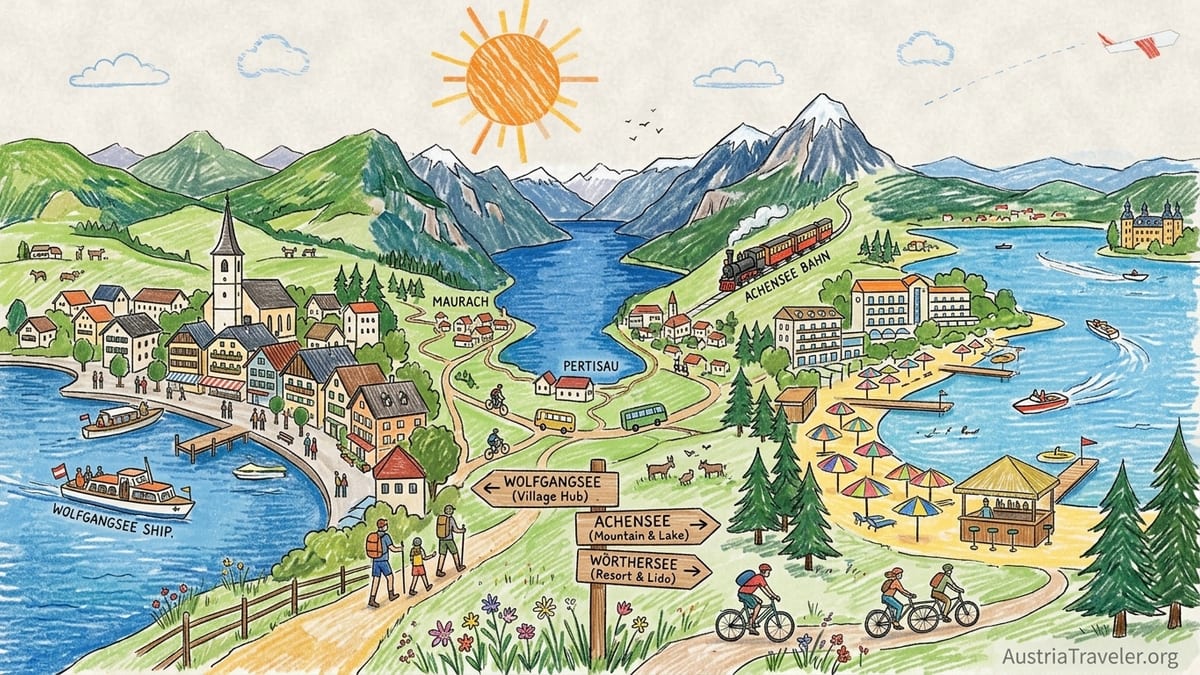
To make this guide genuinely useful, it helps to be clear about what I really did instead of pretending there is a single perfect blueprint. I began in the Salzkammergut, the classic Austrian lake district east of Salzburg, which concentrates dozens of lakes and well-organised transport in a compact area. I spent four nights at Wolfgangsee in a lakeside village base, three nights in the wider Salzkammergut near Attersee in a countryside guesthouse, three nights at Tyrol’s Achensee in a mountain-and-lake resort base, and then added a two-night stop at Wörthersee to see how a larger resort lake with stronger nightlife and rail links would feel.
At Wolfgangsee I stayed directly on the shore in St Gilgen, with a room that opened almost onto the promenade. Walking access to the water was effortless: thirty seconds from the front door to the public lakeside, and less than five minutes to the main boat pier and a small free swimming area. Parking was the main constraint. St Gilgen, like most Salzkammergut villages, has several paid public car parks near the lake and limited free street spaces further uphill, so a hotel with included or reserved parking saved both time and tickets.
For my Salzkammergut “hub” days around Attersee and Mondsee I deliberately chose a slightly inland farmhouse-style guesthouse above the lake rather than a waterfront hotel. From the property it was a five to ten minute drive to several free or low-cost swimming spots and the main Attersee boat piers, which connect lakeshore villages and make it easy to visit without constantly re-parking in busy bays. Regional information from the Attersee-Attergau tourism office confirms that the northern end of Attersee has a small railway line and coordinated boat services, so basing a little back from the shoreline and using a mix of car, train and boat is realistic for many visitors.
Achensee, by contrast, is a long, deep alpine lake framed by steep mountains, with villages like Maurach and Pertisau right on the shore. I split my time between a hotel directly on the lake promenade in Pertisau and a slightly cheaper place a short walk up the hill. Achensee’s shore is largely freely accessible and the three main villages are linked by regular buses from the valley railway station at Jenbach, a historic cog railway in summer and a straightforward lakeship network. This combination made it one of the easiest places to enjoy a “lake and mountain” base without constantly using the car.
My final stop was Wörthersee, in Carinthia, where I stayed in Velden and later inspected properties along the shore towards Pörtschach and Klagenfurt. This confirmed the other side of the equation: Austria’s warmer southern lakes can feel closer to a riviera resort, with private hotel beaches, stylish lidos, lively bars and limited stretches of truly free shoreline. Klagenfurt alone has several public lidos on the lake, and there are signposted free access points scattered along the north shore, but many prime pieces of waterfront are gated by hotels or beach clubs. That matters a great deal when you are deciding how much to pay for a lakefront room versus staying back from the water and paying for lido admission.
First Decision: Which Lake Region Fits Your Trip Style
Before thinking about villages or hotels, it helps to decide which lake region actually suits how you like to travel. The Salzkammergut is the densest, with famous names like Wolfgangsee, Hallstätter See, Attersee, Traunsee and Mondsee all within a broad hour of each other. Official regional information describes the area as a network of lakes, cable cars and boat lines spread across 58 municipalities in Upper Austria, Salzburg and Styria, which makes it ideal if you want to sample several lakes from one or two bases. Trains link Salzburg with towns like Gmunden, Bad Ischl and Hallstatt, and local buses and boat lines bridge the gaps.
Achensee in Tyrol feels more like a self-contained mountain-and-lake resort. The lake has three main villages right on the shore, and the local tourism board emphasises that most of the shoreline is publicly accessible, which is not a given at every Austrian lake. Because buses run regularly from the valley railway station at Jenbach to Maurach, Pertisau and Achenkirch, you can arrive by train and move around the lake car-free while still reaching trailheads and boat piers.
Wörthersee, stretching between Klagenfurt and Velden in Carinthia, is a warmer, lower-altitude lake with a long season for swimming and sunbathing. It has frequent regional trains and buses along the north shore, three major towns with proper nightlife and shopping, and a mix of public lidos and fenced-off hotel beaches. Local materials often call it “Austria’s Monte Carlo,” which captures both its appeal and its trade-offs: easy rail access, buzzing evenings, and a premium on the best lakefront addresses.
Other lakes like Grundlsee or smaller Salzkammergut lakes offer more seclusion. Grundlsee, for instance, lies in a basin accessed primarily from the west and forms part of the quieter Ausseerland cluster together with Altaussee and Bad Aussee. These places suit travellers who want relatively untouched landscapes, boat trips and hiking more than nightlife or multi-lake day-hopping.
Types of Bases I Tried: What Worked and What Did Not
Across these regions I intentionally booked different types of bases so I could compare how they changed the feel of the trip. The lakeside village base in St Gilgen on Wolfgangsee offered direct contact with the water and an immediate holiday atmosphere. The lake promenade doubled as a front yard. I could step out for a sunrise walk along the shore, reach the boat pier in minutes, and still have a couple of supermarkets and evening restaurants within five to eight minutes on foot. The compromise was parking: the closer you are to the lake, the more likely it is that you deal with paid public car parks and narrow streets, which can be stressful with a larger vehicle or late arrival.
The countryside guesthouse above Attersee was almost the opposite. My view was wide open over fields and distant water, and the property had its own large parking area. Nights were quiet, and I could drive to different lakes, trailheads and discount supermarkets without fighting village congestion. The trade-off was spontaneity at the water. A sunset swim required a short drive, and if I wanted a glass of wine with dinner at a lakeside restaurant, I had to think about who would drive back or rely on sparse evening buses.
On Achensee, a resort-style base in Pertisau facing the lake promenade came with in-house spa facilities, a private or semi-private stretch of lakeshore and easy access to both the boat pier and the cable car into the surrounding mountains. The local ship company highlights main landing stages in Pertisau, Seespitz and Achenkirch, and tourist information notes that hikers can combine boat trips with walks along the shore and into side valleys. From this kind of base I could walk directly to the boat, start hikes from the village, or use frequent buses to reach other trailheads without moving the car.
At Wörthersee, I tested both a central property a few minutes from Velden’s lakefront and an inland guesthouse reachable by a short drive or a 20-minute uphill walk. Being in town meant faster access to the casino, restaurants and boat pier, but also traffic and higher prices. The inland option made parking and price more manageable and gave me a quieter environment, at the cost of planning my swims around lido opening hours and admission fees. This mix repeated the pattern I had seen elsewhere: lakeside delivers immediacy and atmosphere, while slightly-away offers control over budget and logistics.
Lakeside Village vs Larger Town vs Countryside Guesthouse
In practice, most travellers end up choosing between three main styles of base. A lakeside village like St Gilgen or St Wolfgang on Wolfgangsee, Maurach on Achensee, or one of the smaller places on Attersee gives you a compact, walkable environment with the lake at the centre of daily life. These bases usually have a promenade or at least a public path at the water’s edge, some form of lido or designated swimming area, a cluster of restaurants, a bakery or small supermarket, and a boat pier. Evening life is gentle rather than wild. From my lakeside stays, I rarely needed the car once I had arrived, except for specific hikes or day trips to other lakes.
Larger towns with lake access, such as Gmunden on Traunsee, Bad Ischl near several Salzkammergut lakes, or Klagenfurt on Wörthersee, offer more amenities and better public transport connections. In Bad Ischl you can walk to a proper supermarket, pick up supplies for hikes and still be a short bus ride or local train from lakes like Wolfgangsee or Hallstätter See. In Klagenfurt you have city-scale infrastructure plus dedicated lido complexes on the lake. This style of base suited my days when I wanted reliable evening restaurant options, easy shopping and the ability to take trains instead of driving after a long hike.
The countryside guesthouse option, which I tried above Attersee and have also seen replicated around smaller lakes like Fuschlsee and the Ausseerland, trades away immediate water access for space, views and price. Properties often have generous free parking, larger rooms or apartments and sometimes on-site playgrounds or animals, which can be ideal for families. I typically had to drive five to fifteen minutes to access the lake, where parking was more limited. In high summer, arriving at popular bathing places or boat piers before late morning avoided full car parks.
From a practical perspective, the main differences played out after dark and at swim time. Lakeside village bases made it possible to stroll to dinner, linger on the promenade and not worry about the car keys. Larger towns meant more nightlife and choice but often required a bus, tram or drive to reach the most scenic parts of the lake. Countryside bases gave me quiet nights and morning birdsong, but every dip in the water involved packing a bag, choosing a lido or free access point and watching the time on the parking ticket.
How Close to the Water Do You Really Need to Be?
One of the most expensive decisions in any Austrian lakes trip is whether to pay for an absolute lakefront property or settle for a place a few minutes back from the shore. In my ten-night trip, staying directly by the water clearly improved the experience at Wolfgangsee and Achensee, and mattered less at Wörthersee where lake access is often mediated by lidos and private beaches regardless of where you sleep.
At Wolfgangsee, my room in St Gilgen looked straight across the lake toward the Zwölferhorn mountain. The town’s main boat pier and a small free swimming area were an easy stroll along the waterfront, and I could reach the cable car to the Zwölferhorn with a walk from the hotel. Being able to step out at sunset, sit almost at the water’s edge and then wander back without thinking about closing times or bus schedules was worth the premium. These intangibles mattered more than the view through the window itself.
On Achensee, the lakefront hotel in Pertisau gave me not only a view but also direct access to a semi-private lakeshore and promenade. Because Achensee’s shoreline is largely open to the public, I could still walk or cycle along the water if I had been staying further back, but having the boat pier and main paths outside the door meant every activity started with a short walk rather than a transfer. With the cog railway and ships meeting at Seespitz and regular buses linking villages to the valley station at Jenbach, I could realistically leave the car parked for days.
Wörthersee was different. Even when I stayed close to the lake in Velden, access to the actual water often ran through gates: hotel beaches, lidos with admission, or managed free access points. Klagenfurt has three main lidos, and while there are free access spots around the lake, they can be smaller and fill up quickly on hot days. In this context, a lakeview balcony was pleasant but did not change the logistics of swimming or boating as much as at Achensee or Wolfgangsee. What mattered more was choosing a property that included its own beach or lido entry, or staying a little back and simply budgeting for daily lido fees.
In terms of distance, I found that being within a five to ten minute flat walk of the water was usually enough to feel “on the lake,” especially where the shoreline is publicly accessible. In places where hotels or private clubs control the best stretches of shore, it became more important either to pay for a property with its own lakeside facilities or to embrace a short drive and the routine of buying lido tickets.
Access: Walking, Parking, Boats and Trailheads
Whichever style of base you choose, you will spend a surprising amount of time dealing with mundane questions: can I walk to the water without crossing a main road, where do I park, how do I get to the boat or the start of a hike. Accounting for these in advance made my trip feel smoother than my earlier, more improvised visits to the region.
In lakeside villages like St Gilgen or St Wolfgang, the lakefront is usually traffic-calmed or partly pedestrianised, which makes walks to the water pleasant but can push general parking to the edges of the village. In St Gilgen, for example, official local information lists several paid public car parks near the centre and encourages overnight guests to use hotel parking or designated long-stay lots. Once parked, I could walk almost everywhere, but moving the car mid-day for hikes around other lakes meant dealing with a second round of parking in the new village.
Around Attersee and other Salzkammergut lakes, the interplay between lake, boats and road network creates useful options. Regional transport information for the Attersee-Attergau area highlights train stations at the northern end of the lake, coordinated bus services and several boat routes that let you travel along the shore. By basing on a hillside above the lake, I could drive to the railway or pier, leave the car and then rely on the boat to hop between lakeside settlements, which simplified parking in small bays where day-trippers compete for limited spaces.
For hiking, Achensee stood out. The Tyrol tourism board emphasises the variety of trails starting directly from villages like Pertisau, including paths along the shore and routes into side valleys, plus access to high-alpine terrain via cable cars and mountain huts. Trailheads are often reachable on foot or by short bus rides from the village, and day parking at popular starting points is signposted. This meant I could choose between a car-free hiking day, using buses and boats, or driving to a more remote valley without logistical drama.
Public lidos and designated bathing areas are another practical piece of the puzzle. On Achensee, the mostly free shoreline meant I could simply walk down and swim where the access was signposted. Around Wörthersee, by contrast, towns like Klagenfurt and Velden lean on structured lidos with changing rooms and lawns, while certain stretches of shore remain private or semi-private. Around Salzburg’s lakes there is a mix: some villages maintain free public bathing places, while others rely more heavily on paid facilities. Checking in advance whether your base has free lake access within walking distance prevented unpleasant surprises.
Who You Are Matters: Couples, Families, Hikers and Car-Free Travelers
My impressions of each base type changed depending on which “hat” I imagined wearing. As a couple on a romantic break, the lakeside village base on Wolfgangsee felt almost ideal. We could walk hand-in-hand along the promenade after dinner, listen to live music drifting from hotel terraces and retreat to a balcony with a view. The small scale of the village made evenings feel intimate rather than crowded, even in high season.
For families, the calculus shifts. Many farmhouse-style guesthouses around Attersee, Mondsee or smaller lakes have family rooms or apartments, play areas and safe outdoor space, plus easy parking and the ability to self-cater from nearby supermarkets. From these bases, parents can drive to a different lido each day, choosing between shallow beach zones, playgrounds and boat rentals. Staying directly on busy promenades, while beautiful, can feel more stressful with young children, especially where the lakefront path is close to the water without fencing.
Dedicated hikers and trail collectors may find that mountain-and-lake bases like Achensee, or a town like Bad Ischl connected to several valleys, offer the best balance. At Achensee I could start low-level walks along the shore, take boats to different trailheads or ride cable cars into the high mountains, all without long transfers. In the Salzkammergut, the rail line through towns such as Ebensee, Gmunden and Bad Goisern provides a backbone for car-free hiking, since you can start in one place and finish in another, then return by train or boat.
Car-free travellers have the most to gain from choosing their base carefully. The Salzkammergut tourism board provides detailed information on reaching the region by train and bus, and routes like the line between Salzburg and Bad Ischl, plus bus services to Wolfgangsee and Hallstätter See, allow visitors to see classic lakes without renting a car. In such cases, basing in a town like Bad Ischl or Gmunden, or in a well-served lakeside village on bus route 150 from Salzburg, can be more practical than a secluded guesthouse. At Achensee, the combination of train to Jenbach, bus to the lake villages and the historic cog railway and boat services makes a car-free stay realistic for several days.
One Base or Several? What My Trip Proved
Before this trip, I suspected that constantly changing lake bases would be tiring and that one central hub might be enough. After living the experiment, my conclusion is more nuanced. For a week or less, one well-chosen base in the right region is usually sufficient, provided you match it to your priorities. For ten days or more, splitting your time between two contrasting lakes or base types can make the itinerary feel richer without turning into a hotel-hopping contest.
Using the Salzkammergut as a base region for the first week worked very well. From a single base near Wolfgangsee or Bad Ischl, I could reach lakes like Gosausee, Fuschlsee, Hallstätter See, Attersee and Traunsee in a series of day trips. Moving only once, from a lakeside village to a countryside guesthouse, gave me a fresh perspective on the region while limiting packing and check-in time. If I had tried to sleep at a different lake every night, I would have spent too much of the holiday comparing check-out times rather than mountain views.
Adding Achensee as a second region brought a distinct change of character: steeper mountains, clearer water with many free access points and a slightly different cultural flavour in Tyrol. Because Achensee is around an hour and a half by car from the Salzkammergut core, it felt like a genuine new chapter rather than just another village around the corner. Here it was worth moving base, especially since the combination of buses, trains, boats and trailheads allowed me to stay three nights without repetitive drives.
The short Wörthersee add-on at the end of the trip underlined the downside of too many short stops. Two nights were barely enough to orient myself, explore both the lakefront and the hinterland and understand how lidos, private beaches and public transport interacted. If I had more time, I would either give Wörthersee at least four nights as a standalone base or save it for a separate trip entirely.
In practical terms, my answer to the “one base or several” question is this. For five to seven nights focused on classic lake scenery, pick one strategic base in the Salzkammergut or at Achensee and stay put. For ten to fourteen nights, consider two bases: one multi-lake hub such as a Salzkammergut town or Wolfgangsee village, and one contrasting lake like Achensee or Wörthersee to change the mood. Only travellers with very specific reasons, such as long-distance hikers linking trails or photographers chasing particular dawn viewpoints, benefit from more frequent moves.
The Takeaway
Looking back on this itinerary, the most useful decisions were not about specific hotels but about regions and base types. Sleeping directly on the shore at Wolfgangsee and Achensee genuinely improved the trip because it changed how easily I could touch the water, catch boats and start hikes. In those places, the lakeside premium bought me time and spontaneity rather than just a postcard view framed by glass. Around Wörthersee, where lidos and private beaches shape access, being absolutely on the water mattered less than having clear arrangements for lake entry, parking and evening dining.
Choosing between a lakeside village, a larger town and a countryside guesthouse is ultimately an exercise in matching your habits to the landscape. If you drink in the atmosphere of promenades and boat horns, a village like St Gilgen, St Wolfgang or Maurach will make every morning feel like the start of a holiday. If you want guaranteed supermarkets, varied restaurants and robust train links, a hub like Bad Ischl, Gmunden or Klagenfurt will serve you better. If you prize space, quiet and value, a hillside guesthouse above Attersee or in the Ausseerland might be the right call, as long as you are comfortable driving to the lake.
For car-free travellers, the Salzkammergut and Achensee stand out thanks to their combination of rail links, buses, boat services and walkable villages. Families may prefer a mix of one lakefront property with easy child-friendly swimming and one countryside base with room to spread out. Couples can safely lean into lakeside romance at one or two key stops without feeling that every night has to come with a balcony over the water.
Most importantly, an Austrian lakes trip does not need a dozen hotel changes to feel rich. One smartly chosen base in the right lake region can deliver mountains, boats, swims and villages for a week, especially in the Salzkammergut. Add a second base at a contrasting lake if you have the time and curiosity, and be honest about how much you actually enjoy packing. With that structure in place, the name on the hotel sign matters far less than the path you will walk each morning from your pillow to the water’s edge.
FAQ
Q1. Is it better to stay in the Salzkammergut or at Achensee for a first Austrian lakes trip?
For a first trip, the Salzkammergut usually offers more variety in a compact area, with several famous lakes, frequent public transport and many classic villages. Achensee is excellent if you prefer a single, dramatic alpine lake with strong hiking and largely free shoreline access.
Q2. Do I need to stay right on the lake to enjoy swimming and boat trips?
No. Being within a five to ten minute walk of the water is usually enough, especially at lakes with public promenades and bathing areas. However, at lakes where hotels and lidos control most shoreline, it helps either to stay in a property with its own access or to plan for daily lido visits.
Q3. Which base works best if I will not have a car?
Car-free travellers are usually best off in a town or well-connected village. In the Salzkammergut, towns on the main rail line such as Bad Ischl or Gmunden, or a lakeside village on a frequent bus route, make day trips easy. At Achensee, combining the train to Jenbach with buses, the historic cog railway and boats lets you get around without driving.
Q4. Are countryside guesthouses far from restaurants and supermarkets?
They are often a short drive from both. In my experience, hillside guesthouses above Attersee and other lakes were five to fifteen minutes by car from supermarkets, bakeries and lakeside restaurants. This setup works well if you are comfortable driving to dinner or self-catering some evenings.
Q5. How difficult is parking around popular Austrian lakes in summer?
Parking is straightforward if you arrive early at popular lidos and trailheads, but spaces around small bays and village centres can fill by late morning. Many lakeside villages rely on paid public car parks and limit long-term street parking, so choosing accommodation with its own spaces can save time and stress.
Q6. Is paying extra for a lake-view room always worth it?
Not always. It added real value where I could step straight from the hotel into the lake environment, such as on Wolfgangsee or Achensee. At lakes where access runs mainly through lidos or private beaches, the view from the window matters less than the property’s arrangements for actually reaching the water.
Q7. How many bases should I plan for a 10-day lakes itinerary?
For around ten days, two bases are usually ideal: one multi-lake hub in the Salzkammergut or a similar region, and one contrasting lake such as Achensee or Wörthersee. This keeps packing manageable while still giving you different landscapes and atmospheres.
Q8. Are Austrian lakes suitable for families with young children?
Yes. Many lakes offer shallow, managed bathing areas, playgrounds and gentle walks. Family-friendly bases include countryside guesthouses with outdoor space and lakeside properties near lidos with lawns and facilities. Checking for shade, shallow entry and nearby toilets is more important than chasing the very closest shoreline.
Q9. Can I visit several lakes as day trips from one base?
In regions like the Salzkammergut, yes. From bases near Wolfgangsee or Bad Ischl you can reach lakes such as Hallstätter See, Attersee, Traunsee, Fuschlsee and others in individual day trips by car or a mix of train, bus and boat.
Q10. When is the best time to stay at the Austrian lakes?
Late spring through early autumn is most popular. June and September often combine warm enough water for swimming with slightly quieter villages than peak school holiday weeks in July and August, though exact conditions vary from year to year.