


I learned how not to plan an Austrian lakes trip by doing almost everything wrong the first time. I tried to see Hallstatt, the classic Salzkammergut lakes, a slice of Salzburger Seenland and even Carinthia’s Weissensee in a single ten day loop. On paper it looked efficient. In reality it meant packing every second morning, racing to beat boat timetables and watching thunderstorms roll in on the very days I had optimistically earmarked for long swims. That messy trip is what finally taught me how many lake regions, hotel bases and actual swimming days really fit into 5, 7 or 10 days in Austria.
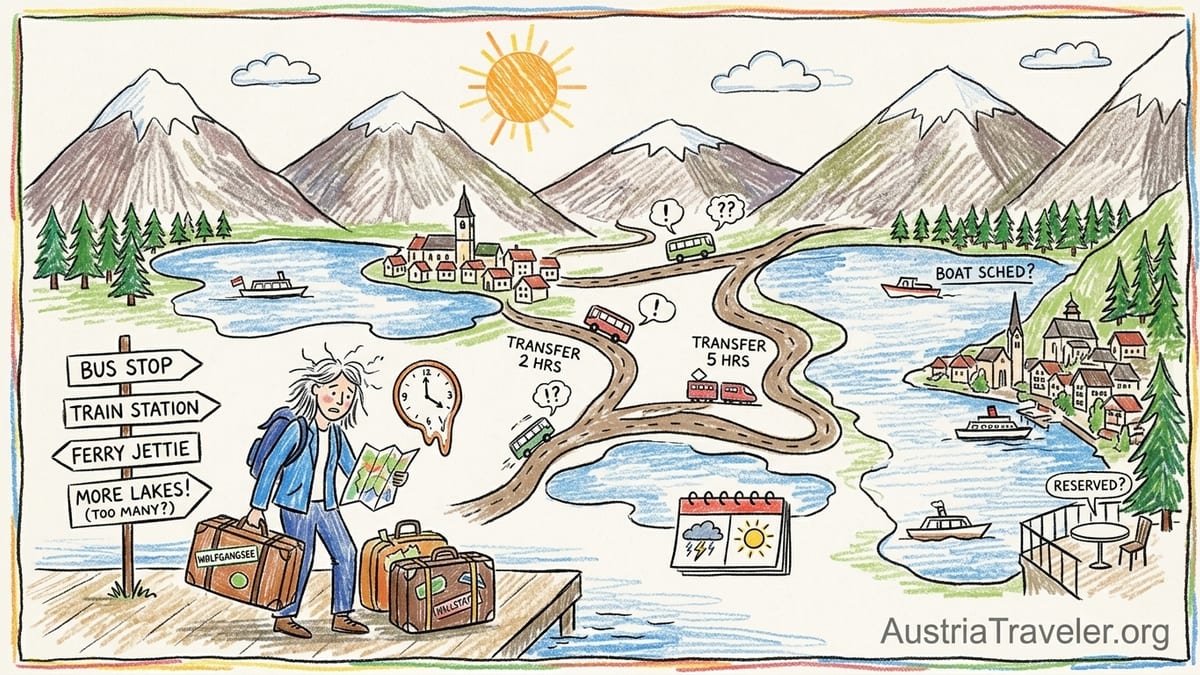
What I Did Wrong On My First Austrian Lakes Trip
My first serious lakes itinerary in Austria stretched to ten days in late June. I started in Salzburg, then tried to “connect the dots” across as many famous lakes as possible. I booked three nights near Wolfgangsee, two near Hallstättersee, two near Attersee, one at Mondsee and two nights on Weissensee in Carinthia. That meant five hotel bases in ten nights, plus several day trips to Gosausee and smaller bathing lakes along the way.
On the map, the distances looked harmless. Salzburg to St Wolfgang is around 50 minutes by bus or car. Wolfgangsee to Hallstatt via Bad Ischl is about 90 minutes on the 150 bus and a local train. From the Salzkammergut down to Carinthia’s Weissensee, the official tourism board recommends travelling via Villach or Spittal an der Drau, with trains to Greifenburg–Weissensee station and a shuttle to the lake. In practice, every transfer ate half a day. By the time I checked out, drove or bussed to the next base, found parking or my guesthouse, and settled in, swimming time kept shrinking.
I also underestimated just how many lakes there are in even one region. The Salzkammergut tourism boards count more than 60 lakes suitable for recreation, with some official documents referencing more than 70 bodies of water spread across Upper Austria, Salzburg and Styria. That sheer choice fed the temptation to keep stopping. Driving from Mondsee to Attersee, I pulled into a viewpoint at Irrsee, then another at a tiny Moorsee, then lost 45 minutes at a bathing beach I had not planned on at all. Each impulsive stop was beautiful. Together, they turned a 40 minute transfer into a two hour crawl.
The result was a trip heavy on logistics and light on what I had actually come for: slow swims, boat rides and unhurried evenings by the water. That experience, plus watching less rushed travellers around me, is what underpins the rules of thumb that follow.
Lessons From The Road: Weather, Swimming Days And Over-Planning
The first hard lesson was that you cannot “schedule” swimming in the Alps with the same certainty as a museum visit. In early summer, water temperatures vary a lot between lakes. Mondsee is one of the warmer Salzkammergut lakes, with local tourism information quoting summer surface temperatures that can reach the mid-20s Celsius. High alpine lakes like Gosausee or Vordere Langbathsee remain much colder. On my trip, the three days I had mentally assigned to long swims on Wolfgangsee turned stormy, while my quick transit day past Attersee brought blue skies and 28 degrees Celsius.
Because I had packed the itinerary so tightly, I had almost no flexibility. If the only full day on Attersee is locked to a pre-booked boat loop, or your single Hallstatt day is the one when heavy rain closes mountain viewpoints, there is no buffer. I now plan at least one “weather flex” day for every three or four days in a lake region. That means a day with no essential reservations, where I can flip a planned hike with a swim depending on the morning forecast.
The second big lesson was about boat schedules. On Hallstättersee, the ferry between the railway station and Hallstatt village runs year-round as a public transport link, but other round-the-lake services and the historic barge only run seasonally and on specific timetables. On Attersee, the large lake tour run by the Attersee shipping company typically leaves the village of Attersee around mid-morning and returns early afternoon on a fixed circuit. On Mondsee and Wolfgangsee, the classic round-trip cruises also cluster around midday and early afternoon. I repeatedly found myself sprinting from parking areas or bus stops to jetties because I had underestimated the time needed to decode a timetable in German and buy tickets.
A third lesson involved restaurant reservations. In villages like St Wolfgang or St Gilgen on Wolfgangsee, and in the old center of Hallstatt, lakeside terraces book out quickly on sunny summer evenings. Walking up at 7:30 p.m. and hoping for a front-row table by the water often meant a long wait or a back room. After a couple of nights standing in line while the light faded over the lake, I started booking dinner the evening before, especially on Fridays and Saturdays.
How Often To Move: The Real Cost Of Packing vs Variety
My five-base experiment taught me that every accommodation change costs more time than you expect. Even with a car, you lose at least two to three hours to packing, check-out, the drive, finding parking or the right bus stop, and then check-in. With trains and buses, there is often a forced layover in hubs like Bad Ischl, Villach or Salzburg. On my transfer from the Attersee area to Weissensee, for example, the combination of regional train, mainline train and station shuttle added up to almost five hours door to door, including waiting time.
Over ten days, those lost hours added up to the equivalent of almost two full days that could have been spent on the water. I watched couples who had chosen just two bases do far more with their time. One pair in my Mondsee guesthouse spent four nights there and simply did day trips to Wolfgangsee and Fuschlsee on clear days, then stayed close to Mondsee promenade when storms moved through.
There is also an emotional cost. Constantly moving reduces the sense of being “on holiday by a lake” and replaces it with the feeling of being on a permanent transit. I noticed I only really relaxed on my second evening in each place. The first afternoon was always for finding the bathing beach, the supermarket, working out where boats left from and figuring out local parking rules. By the time I had that mental map, it was already time to leave.
Today, I set a maximum number of lake bases for any given length of trip, and I treat each base as a hub for day trips. That change alone has made later itineraries both calmer and, paradoxically, more varied, because I actually have time to explore side valleys and less famous lakes that were just names on a map before.
Five Days: Focus On One Lake Region And Two Bases At Most
With five days, the most common mistake is trying to see “all of the Salzkammergut” plus Hallstatt and perhaps even a taste of Carinthia. Salzkammergut on its own includes major lake clusters around Wolfgangsee, Mondsee and Attersee in the west, Hallstättersee and Gosausee in the Dachstein area, and more tranquil lakes like Altaussee and Grundlsee further east. Trying to cross the entire region in five days means you are essentially on a scenic road trip, not a lakes holiday.
If I had five days again, I would pick one subregion and one primary base, with the option of a second base if there is a clear reason. One smart five day plan is to sleep all five nights around Wolfgangsee or nearby St Gilgen. From there, you can spend two full days on the lake itself, taking the Schafbergbahn cog railway up for the panoramic view if you book in advance during high season, and renting a small electric boat or using the scheduled lake ships between St Gilgen, Strobl and St Wolfgang for a swimming and café-hopping day.
On the remaining days, you can day-trip by bus to Fuschlsee for a quieter swimming day, or continue to Bad Ischl for a half day in town and onward connection to Hallstatt if you are determined to see it. That Hallstatt day will inevitably be long: bus to Bad Ischl, train to the Hallstatt station, boat across the lake, then the same in reverse. Expect a 12-hour day with several timetable dependencies. For many first-timers, Hallstatt is worth that effort once. I would not use one of only five nights to actually move hotels to Hallstatt, because the village is small, busy in the middle of the day and heavily restricted for traffic and parking.
In a five day framework, lakes that deserve several nights include Wolfgangsee and, if you want a quieter alternative, the Mondsee and Irrsee area. Mondsee is close to Salzburg via the A1 motorway, with clearly signed parking zones in and around the village, from short-stay bays to longer-term paid car parks behind the lakeside promenade. Both lakes have designated bathing areas, boat rental and restaurants within an easy evening stroll. Hallstatt, Gosausee and the smaller Ausseerland lakes like Altaussee make much more sense as single long day trips in this short time window.
Seven Days: Adding Variety Without Constant Packing
Seven days gives you just enough space to add a second subregion or a genuine change of atmosphere, as long as you keep the number of hotel bases under control. I now treat seven days as a two base maximum, sometimes with a third one-night stop only if a train schedule forces it.
One pattern that has worked very well is four nights in the central Salzkammergut, followed by three nights in a quieter pocket. For example, you might spend your first four nights based in Bad Ischl. This small spa town sits at a rail and bus crossroads, with direct connections toward Salzburg, Hallstatt, Wolfgangsee and the eastern lakes. From here, you can reach Hallstatt and its ferry, Gosausee’s famous Dachstein reflection, and the villages around Wolfgangsee on separate days without moving hotels.
The second base could then be either the Mondsee area, which has warmer bathing and easy access back to Salzburg airport or station, or Altaussee / Grundlsee in the Styrian corner of the Salzkammergut. Grundlsee, a long, fjord-like lake at the foot of the Totes Gebirge, combines lake cruises with access to hiking trails that start almost at village level. Spending three nights here lets you choose between a boat trip, a lakeside walk or a high-level hike each morning, depending on the clouds over the limestone walls.
With seven days, you can also afford to write off one day to bad weather without feeling cheated. On my revised itinerary, if a cold front rolls in, I use that day for spa time in Bad Ischl, exploring cafés and museums in Gmunden on Traunsee, or taking a train into Salzburg city, which lies less than an hour from some of the western lakes. That way, I am not trying to force a chilly swim or fogged-in viewpoint just to “stay on schedule.”
In terms of what I would skip: I would remove any attempt to add Carinthia or Tyrol to a seven day lakes trip. Even the nearest Carinthian lakes like Wörthersee or Weissensee require at least several hours of inter-regional train travel from the Salzkammergut. You feel that transfer in your body, especially with luggage. Far better to lean into depth, perhaps visiting lesser-known spots like Traunsee’s ceramics town Gmunden or the marshes around Irrsee, than to chase an extra region.
Ten Days: When Combining Regions Finally Makes Sense
Ten days is the first length at which I think it is reasonable to combine two genuinely different lake regions, such as the Salzkammergut and Carinthia. Even then, the transfer time is real. From Bad Ischl or Attnang-Puchheim, reaching Carinthia’s Weissensee by public transport typically involves a mainline train toward Villach or Spittal an der Drau, then a regional train to Greifenburg–Weissensee station and a shuttle or bus to the lakeshore. In my case, the journey, including a planned break in Villach, consumed most of the middle day of my trip.
Looking back, I still think it was worth it. Weissensee, with its car-reduced north shore and strong focus on sustainable mobility, felt completely different from the more built-up promenades of Wolfgangsee or Mondsee. Wooden jetties and pastures reached right to the water in places, and the pace of life slowed noticeably. If your goal is to pair a more traditional Austrian lake district with somewhere that feels wilder and less commercial, ten days gives you the margin to do so.
The trick is to resist the urge to add even more. With ten days, I now recommend three lake bases at most. A balanced version might be four nights around Wolfgangsee or Mondsee, three nights in the Hallstatt or Bad Ischl area, and three nights in Carinthia, either on Weissensee or a better-connected lake like Wörthersee near Klagenfurt and Villach. Each move should be justified by a clear change in scenery or activities, not simply tick-box tourism.
Ten days also allow for more structured hiking. Around Hallstättersee and Gosausee, waymarked trails ranging from gentle lakeside walks to demanding alpine hikes start near the shore. On a shorter trip, it is painful to “lose” a swim day to a full-day hike. Over ten days, you can comfortably dedicate two or three days to the mountains without sacrificing your time in the water. Just remember that cable cars and mountain lifts have their own operating periods and weather closures, so the same rule applies: leave a flex day and avoid locking every activity to a non-refundable booking.
Parking, Trains, Boats And The Temptation Of Every Photogenic Lake
Logistics are the quiet forces that shape how pleasant or exhausting your lakes trip feels. In the busiest hotspots like Hallstatt, car access is restricted. Visitors park in structured car parks on the edge of the village and either walk or, in some cases, use shuttle options. Spaces can fill quickly in peak hours. Nearby villages such as Obertraun on the opposite shore of Hallstättersee often offer a calmer experience, with lakeside bathing areas and more straightforward parking, plus frequent boats or buses back to Hallstatt itself.
On lakes closer to Salzburg, such as Mondsee and Wolfgangsee, the spread of parking zones, free short-term areas and larger paid car parks can be confusing on arrival. The Mondsee tourism office describes a mix of short-stay curbside spaces in the center and larger lots like Parkplatz Süd and the Seepromenade area near the lido. Time limits and fees vary by zone. If you arrive in the late morning on a hot weekend, expect both some circling and a walk along the promenade. This is another reason why staying several nights in one place reduces stress. Once you have worked out where to leave the car, you keep using the same strategy.
Public transport, by contrast, is relatively straightforward but demands attention to timetables. The bus line from Salzburg to Bad Ischl and its connecting trains to Hallstatt and the eastern lakes run regularly, but evenings and Sundays may have reduced frequencies. In Carinthia, the Greifenburg–Weissensee train station is well integrated into national connections, but the final stretch to the lake usually involves a scheduled shuttle or pre-arranged transfer listed on Weissensee’s mobility pages. Missing one link can turn an easy journey into an unexpectedly long wait at a small station café.
The biggest psychological trap, though, is the urge to stop at every beautiful water surface you pass. Between Salzburg and the Salzkammergut alone, the Salzburger Seenland and smaller pre-alpine lakes glitter beside the road. On the way from Mondsee to Attersee or from Traunsee toward Altaussee, roadside viewpoints multiply. If you are trying to reach a booked boat departure on Attersee or Mondsee, where large round trips might leave just once or twice in the late morning, each unscheduled stop nudges you closer to missing it.
My compromise now is to pick one spontaneous stop per transfer at most, and to treat everything else as “for the next trip.” Knowing that Salzkammergut alone has several dozen named lakes, including small tarns and dammed reservoirs, helps you accept that you will never see them all in a single journey. It is better to truly know three or four than to photograph twenty from the roadside.
The Takeaway
After that first over-ambitious circuit and several calmer returns, I have ended up with some simple rules for matching trip length to lake regions and hotel bases. They are not hard laws, but they have kept me from repeating past mistakes.
For five days, I now cap myself at one lake region and one, maximum two, bases. That could mean five nights on Wolfgangsee, using buses and boats for day trips to Hallstatt and Fuschlsee, or a full five nights on Mondsee with quick hops to Salzburg city and the surrounding lakes. The goal is to unpack once, learn the rhythm of one stretch of shoreline, and accept that some famous spots will wait for another visit.
For seven days, I allow two lake regions or subregions, anchored by two bases. An example is a four and three night split between Bad Ischl and Grundlsee, or between Wolfgangsee and Mondsee. This gives enough variety in landscapes and activities without turning the week into a chain of check-out mornings. I deliberately avoid pushing south into Carinthia or west into Tyrol, knowing the time and energy that long transfers demand.
For ten days, I permit myself up to three bases and, if there is a strong reason, two distinct lake regions. A classic pattern is a six and four night split between Salzkammergut and Carinthia, or a four, three and three night trio across Wolfgangsee, Hallstatt / Bad Ischl and Weissensee. In every case, I budget one nearly empty day per region to play weather roulette, shuffle boat trips and hikes, and leave space for a long, lazy swim when the sun finally comes out.
My revised rule, learned late but firmly, is simple. In five days, one lake base and one lake region genuinely fit. In seven days, two bases and one or at most two closely connected subregions work well. In ten days, three bases across two contrasting lake regions is the natural upper limit before your holiday becomes a transport project. The Austrian lake districts reward depth and slowness. The fewer times you zip up your suitcase, the more often you will actually be in the water, looking back at those postcard villages from the middle of the lake instead of from yet another car park.
FAQ
Q1: Is a car essential for an Austrian lakes itinerary?
For many classic lakes like Wolfgangsee, Mondsee, Hallstättersee and Traunsee, public transport is good enough that you do not need a car. Buses connect Salzburg with Wolfgangsee and Bad Ischl, and trains run onward to Hallstatt and the eastern lakes. A car is most useful for reaching smaller bathing spots, trailheads and less served lakes such as some of those in the Ausseerland or on the fringes of Attersee.
Q2: How far in advance should I book lakeside accommodation in summer?
For July and August, and for lakes that are close to Salzburg or Vienna, it is wise to book at least two to three months ahead if you want a room directly on the water or with secure parking. Shoulder months like June and September have more flexibility, but weekends can still fill quickly in famous villages such as St Wolfgang or Hallstatt.
Q3: Do I need to reserve boat trips in advance?
Short, frequent ferry links, such as the boat between Hallstatt station and the village, usually do not require reservations. However, special panoramic cruises or longer round-the-lake circuits on Wolfgangsee, Attersee or Mondsee can sell out on sunny days, and some operators now suggest or require advance booking in high season. Check schedules a day or two ahead and buy tickets early if a specific departure is important to your plans.
Q4: Where should I stay if I want to visit Hallstatt but avoid the worst crowds?
Staying in nearby bases such as Bad Ischl, Obertraun or even on Wolfgangsee can be a good compromise. You can travel into Hallstatt early in the morning or later in the afternoon by train and boat or by bus, then retreat to a quieter lakeside for the night, with easier parking and more dining options.
Q5: Are the Austrian lakes warm enough for swimming without a wetsuit?
Many lowland lakes like Mondsee, Irrsee, Wörthersee and parts of Wolfgangsee reach comfortable swimming temperatures in summer, often over 20 degrees Celsius in July and August. Higher or deeper lakes near glaciers and high mountains, such as Gosausee or some Styrian lakes, can remain noticeably colder, so early and late season swims may feel brisk.
Q6: How many nights should I spend on Wolfgangsee?
Wolfgangsee rewards at least three nights, and four or five if you want to combine boat trips, a ride on the Schafbergbahn, lakeside walks and unhurried swimming days. From this base you can also do day trips to Fuschlsee or even all the way to Hallstatt, which makes a longer stay here more efficient than one or two rushed nights.
Q7: Is it realistic to combine Salzkammergut and Carinthia in one week?
Technically it is possible to visit both regions in seven days, but the train or car transfer between them will consume much of one day and risks making the trip feel rushed. For a single week, focusing on just one of these lake regions usually gives a better balance of relaxation and variety.
Q8: What is the biggest planning mistake visitors make with Austrian lakes?
The most common mistake is underestimating how much time is lost to packing, transfers and decoding timetables, and overestimating how many lakes and regions can fit into a short trip. This often leads to tired travellers who have impressive lists of places visited but few memories of actual time spent in the water or on the trails.
Q9: Are restaurant reservations really necessary in lake villages?
On clear summer evenings in popular villages like St Wolfgang, St Gilgen, Mondsee or Hallstatt, lakeside terraces often fill completely, especially on Fridays and Saturdays. Reserving a table earlier in the day or the evening before greatly increases your chances of dining right by the water at sunset instead of queuing or settling for an indoor table.
Q10: How many lake bases would you choose for a ten day trip today?
For ten days, I would choose three bases at most. A typical pattern would be splitting time between two Salzkammergut bases and one contrasting region such as Weissensee or Wörthersee in Carinthia. That balance offers variety without turning the itinerary into a constant sequence of check-outs and long transfer days.