


I went to Austria for the lakes the way many people go for the Alps and the cities: with a vague Instagram vision of wooden jetties, glassy turquoise water and a relaxed ritual of daily swims between café stops. Over ten summer days I travelled by a mix of train and rental car through three lake regions, stayed in four different bases, and dipped into eight individual lakes, from postcard-famous Hallstätter See and Wolfgangsee in the Salzkammergut to wide-open Attersee and warm, resorty Wörthersee in Carinthia. What I found was not one “Austrian lake holiday” but a set of very different personalities shaped by water temperature, shoreline access, boats, parking, and even how aggressively the shore has been carved up by private houses and hotels.
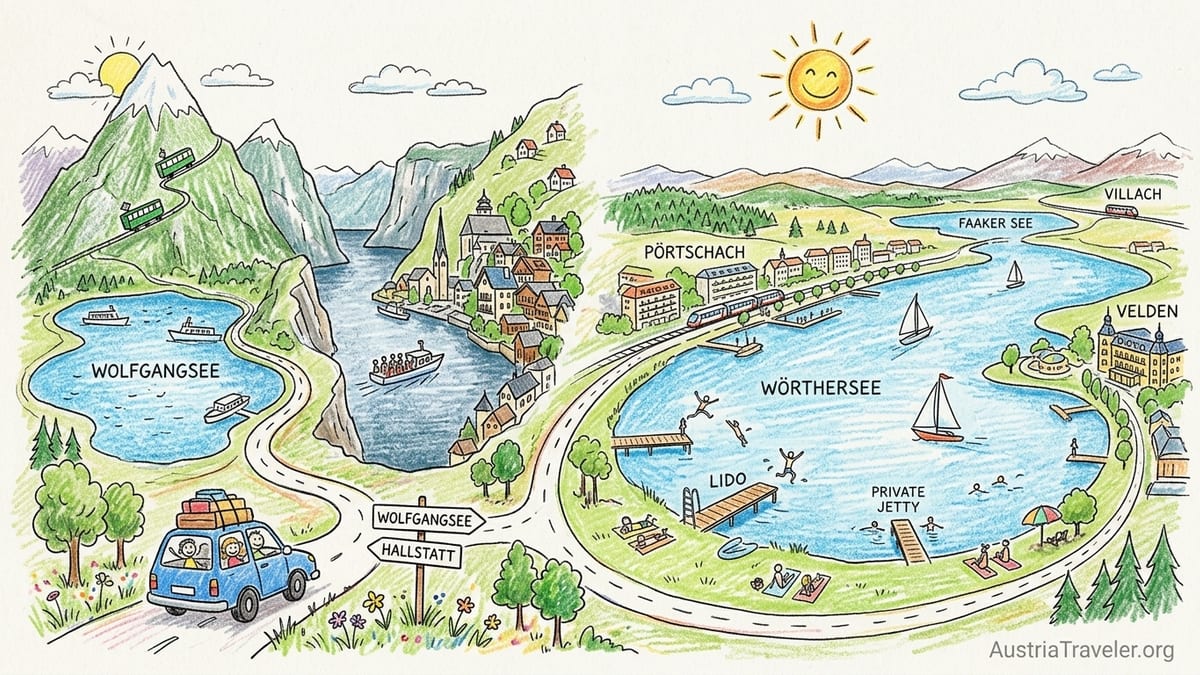
My Route: Ten Days, Eight Lakes, Four Bases
I started and finished the trip in Vienna, using the rail network to reach the first lake region before picking up a car. I began with three nights on Wolfgangsee, splitting time between St. Gilgen and St. Wolfgang, then moved one night to Hallstatt on Hallstätter See, two nights near Unterach am Attersee on the shores of Lake Attersee, and finally three nights in Pörtschach on Wörthersee in Carinthia. Trains linked the big jumps between Vienna, Salzburg and Villach. The car came into its own on the smaller hops and spontaneous detours to Mondsee and Fuschlsee.
Initially I had planned to rely entirely on trains and buses. Looking at the map from home, the Salzkammergut lakes seemed tightly clustered. In reality, the local buses were reliable but not frequent, and crossings that looked trivial on a map, such as Wolfgangsee to Mondsee, still ate up close to an hour each way once I factored in waiting and changes. After the first days, I accepted that if I wanted to chain together multiple lakes and still have time to swim, a rental car would be less romantic but far more efficient.
Those four bases were a conscious experiment. I wanted to know what it feels like to sleep right on the water versus a short walk or a few minutes’ drive away. On Wolfgangsee and Wörthersee I paid more to stay within a few steps of the shore. In Hallstatt I stayed up the hill from the lake, and at Attersee I misjudged the distance and ended up a brisk 15-minute walk away. By the end of the trip I had a very clear sense of how much staying off the water changes the character of a lake holiday.
Most of all, I arrived expecting all the lakes to behave similarly once summer had settled in: warm, inviting water, multiple public jetties and a mix of pretty towns with obvious places to jump in. Instead I met a cold, deep Hallstätter See that felt more like a fjord, a breezy, sailing-heavy Attersee with clear but surprisingly fresh water, and Wörthersee which, on a still August afternoon, really did live up to its reputation as one of Austria’s warmest large lakes, its surface close to 24–25 degrees Celsius in the shallows according to local information boards and tourism staff.
Wolfgangsee: Classic Postcards and Unexpectedly Brisk Water
Wolfgangsee was my first stop and, on paper, the ideal all-rounder. It sits within easy reach of Salzburg, is ringed by three characterful villages, and has its own fleet of boats plus the famous Schafberg cog railway climbing straight up from the lakeshore. Regular lake boats zigzag between St. Gilgen, Strobl and St. Wolfgang in season and published timetables for 2026 showed core services running at least hourly in the main summer months, with denser connections in peak periods. Combined tickets that bundle the SchafbergBahn railway and Wolfgangsee boat services are sold at station counters, which makes it easy to plan a car-free day on and above the water.
I based myself first in St. Gilgen, where the shoreline is a mixture of private hotels, a formal lido and sections of grass with informal lake access. In early July the water was crystal clear but sharper than I had imagined from all the romantic photos. Local boards and recent regional guidance for comparable lakes suggested surface temperatures around the high teens to low twenties Celsius in early summer. It matched what my skin told me when I stepped off the jetty. I could comfortably swim for several minutes, but if I floated still, a chill crept in from the deeper layers.
Public access around Wolfgangsee was better than I had feared but more fragmented than I had expected. St. Gilgen and St. Wolfgang both have paid lidos with changing rooms, lawns, slides and café terraces, plus small free sections of lakefront where people spread out towels and climb down ladders into the water. Outside the villages, stretches of the shore are taken up by private homes and hotel gardens. Walking the waterline is rarely a continuous experience. Parking near the shore was straightforward on the days I visited, with signed parking lots in each village and time-based fees that felt reasonable by central European standards, but I saw how on peak August weekends those lots could fill quickly, particularly in St. Wolfgang where the car parks also serve visitors heading up the Schafberg.
Wolfgangsee ended up being where I found the balance of classic Austrian lake scenery and practical swimming. Its steep surrounding hills and frequent boat services gave it drama and variety. Yet for me it was not a pure “swim all day” lake. The water stayed fresh enough that most people seemed to treat swimming as a refreshing interlude between walks, boat trips and café visits rather than an all-afternoon soak. I left seeing Wolfgangsee as the best base for a mixed holiday, with great scenery and day-trip options, but not the warm, languid swimming haven I had vaguely pictured from afar.
Hallstätter See: A Fjord-Like Beauty Better Suited to Sightseeing
Hallstätter See, framed by huge limestone walls and the UNESCO-recognised village of Hallstatt, was where my expectations misfired most. From photos I had imagined a lakeside town where you stroll a promenade and dip in whenever the mood takes you. The reality is that the village and the lake are squeezed onto a narrow ledge between cliff and water. Most of the shore near the historic centre is taken up by boat landings, houses and hotels. Public lake access within a short walk of the main square is limited to a few small steps and platforms where people sit with their feet in the water or swim a short distance in relatively deep, cold water.
The lake itself is large and deep. Official descriptions from Upper Austria describe it as around 8.5 square kilometres in area and up to roughly 125 metres deep. That depth, combined with the surrounding mountains and relatively limited shallow margins, keeps the water markedly colder than several other Austrian lowland lakes in early and even mid-summer. It felt invigorating to plunge in for a quick dip from a public platform but far from the sort of place where I would linger for a leisurely hour-long swim close to shore.
Arrival logistics also encouraged me to treat Hallstatt as a spectacular stop rather than a bathing base. Private cars are not allowed into the historic centre. Visitors must use designated parking areas on the edge of town and either walk or, in some cases, connect by local shuttle when available. Current local information for 2026 emphasises that day visitors cannot reserve parking in advance at the main P1 and P2 car parks and that there is no shuttle bus service from the more distant P3 and P4 lots into town. On my summer visit, I parked at one of the paid lots and walked about ten minutes into the centre. It worked smoothly enough, but I could see how arriving in the late morning on a peak day would involve circling for space.
My biggest mistake at Hallstätter See was booking a lovely guesthouse perched high above the village because of its view. The panorama really was superb, but it took me 15 to 20 minutes each way to get down to the lakeshore and back up again. That does not sound like much until you want to go for spontaneous evening or early-morning dips. With the water as cold as it was and shoreline access as bitty as it is near town, I found myself swimming far less here than I expected. In hindsight, I would treat Hallstatt as some travellers already do: a dramatic, must-see day trip or single-night stop to ride boats, walk the lanes and absorb the view, but not the place to book several days if swimming is your priority.
Attersee: Big Skies, Sailing Breezes and Serious Swimmers
Leaving Hallstatt, I drove over to Attersee, Austria’s largest inland lake by surface area. The mood changed immediately. The lake is wide and open with relatively gentle hills along much of its shore, and the scale feels more like a small inland sea than a mountain basin. That broader horizon goes hand in hand with steady winds, which make Attersee a magnet for sailors and windsurfers. On both afternoons I visited, dinghies dotted the water and the breeze raised a light chop even under blue skies.
Attersee’s water clarity is striking, and local tourism information highlights the lake’s reputation for excellent water quality. For swimmers, the crucial detail is that while the lake warms in sheltered bays, its exposed sections stay on the fresh side well into summer. Regional guidance and experience from frequent visitors suggest typical early-summer surface temperatures around 16 to 20 degrees Celsius, rising into the low twenties in the height of summer but rarely attaining the bathtub warmth of Carinthian lakes. When I swam at one of the public bathing areas near Unterach, the water felt bracing when I first entered and stayed cool even after a few minutes of steady strokes.
What impressed me most at Attersee was the way the region has structured lake access. There is a patchwork of public lidos and free bathing areas all around the shore, clearly listed in recent regional guides and on local boards. The public bathing spots vary from simple stretches of grass with a ladder into surprisingly deep water to better-equipped lidos with showers, toilets, snack kiosks and sometimes small playgrounds. Some charge a modest entrance fee for the facilities, especially in high summer, while others remain free, funded as a public service by the municipality. Parking is usually clustered just inland from the water. At the larger lidos I paid a small day fee to park in official lots only a few steps from the entrance.
My biggest planning mistake at Attersee was underestimating how much being away from the water would matter. I booked an attractive guesthouse a 15-minute walk uphill from the lakeshore. It kept costs down and gave me a quiet setting, but it also meant every swim required deliberate effort and time, especially in the heat. Unlike Wörthersee, where my accommodation had its own little stretch of lakefront, here I depended on public access points and their opening hours. On the afternoon when work commitments delayed me, I arrived at my chosen lido just as staff were starting to tidy up and gently pointing people toward the exit. I still managed a short dip, but the window for a long, lazy, end-of-day swim had closed.
Attersee ended up feeling like a lake that belongs to active people. I saw confident swimmers doing long crossings close to shore, scuba divers using marked entry points noted on regional dive maps, and clusters of people setting off for hikes in the low hills after a morning swim. The mountain silhouette is softer than around Hallstätter See, but the combination of open water and sporting life gave Attersee its own distinct personality. For an itinerary, it rewarded a slower, more settled stay of several days rather than my two hurried nights.
Wörthersee: Warm Water and Resort Energy
After several days of cooler dips, Wörthersee felt almost like another country. The lake sits in Carinthia, near the Slovenian and Italian borders, and has long marketed itself as a sunny, almost Mediterranean-feeling escape. Its shape is elongated, with resort towns such as Klagenfurt, Pörtschach and Velden spaced along the shore. The hills are lower than in the Salzkammergut, and the climate is milder, which helps to bring the water temperatures up. Regional information and long-term observations describe peak summer surface temperatures that often climb into the mid-twenties Celsius.
I stayed three nights in Pörtschach in a small, family-run hotel that owned a narrow private lakeside strip between two bigger properties. The difference that direct water access made was dramatic. For the first time on the trip I swam several times a day without thinking about lido opening hours or parking meters. The hotel had a simple wooden jetty and a ladder into water that stayed pleasantly warm close to shore. In the late afternoon, the surface felt more like a gentle river than a cold alpine lake. When I later visited the public lido in town, the shallow, gently shelving area for families was a degree or two warmer again, heated all day by the sun.
Public access at Wörthersee is mixed. Some shoreline sections are lined with villas, hotels and private jetties, especially around Velden. Yet every major resort town maintains at least one significant public lido, often with grassy areas, changing cabins, cafés and supervised swimming zones marked by buoys. Entry fees in high summer were higher than the basic municipal lidos at Attersee but still reasonable when viewed as all-day access to a lakeside park. I also found informal access points where locals slipped into the water from small steps near the promenade, especially in the early morning or late evening when the lidos were closed.
Wörthersee was the only lake on this trip that felt like a true “swimming holiday” destination. The combination of warm water, multiple access points, and long daylight hours made it natural to structure days around swims, with short train or boat hops as extra options rather than the main attraction. Regular local train services run along the north shore, linking Klagenfurt, Pörtschach and Velden, and small lake boats complement that rail spine in high season. I still used the car once or twice for evening trips, but I could easily imagine a fully car-free week here with swims in the morning, walks in the woods behind town at midday and sunset dips before dinner.
The trade-off is that Wörthersee lacks the dramatic, vertical mountain scenery of the Salzkammergut. At sunset, the colors over the water were beautiful, but the silhouettes were gentle rather than jagged. If your mental picture of Austria centers on high peaks reflecting in the water, Wörthersee may feel slightly tamer visually. For me, however, it was the perfect place to finish, a warm, easy lake that finally matched my initial idea of swimming first and everything else second.
Access, Parking and Shoreline Reality
One of the most useful lessons from this trip had nothing to do with water temperature and everything to do with land. On a map, many Austrian lakes look as if their shorelines are continuous public promenades. On the ground, the picture is more complicated. Legal frameworks treat lakes as public waters, but access along the banks can be heavily fragmented by private properties, hotels and infrastructure, particularly in popular tourism regions. The result is that your practical access to the water depends far more on specific local bathing areas, lidos and municipal policies than on any abstract right.
In practice, each lake I visited illustrated a different point on that spectrum. Attersee stood out for the sheer number of mapped and signposted public bathing areas, including several free spots with parking close by. Wolfgangsee offered plenty of lidos and some free sections but had long stretches of privately held shoreline between the villages, which made spontaneous shoreline walks more difficult. Hallstätter See combined a limited amount of flat lakefront with a tiny, globally famous village pressed between rock and water. There, even the parking lots felt like precious real estate. Wörthersee had the strongest resort flavor, with stretches of privatized shore balanced by well-developed, paid lidos in each main town.
Parking was a daily consideration. At Wolfgangsee I was usually able to find space in signed village car parks a short walk from the water, paying typical hourly or daily fees. At Attersee, some small public bathing grounds had such tiny lots that arriving before late morning became essential if I wanted to avoid a long roadside walk. Around Hallstätter See, the pattern was different again. The official car parks on the edge of Hallstatt function almost as gates, and local guidance makes clear that driving into the historic centre is not allowed for visitors. Information updated for 2026 states that spaces cannot be reserved in advance and that there is no shuttle from the most distant car parks, which effectively caps impromptu crowd growth but adds pressure to arrive early.
Train and boat services compensated for those constraints in some places. Wolfgangsee’s scheduled boats and the cog railway turned the lake into a joined-up experience even without a car. At Wörthersee, the combination of regular regional trains along the shore and lake boats in summer allowed me to leave the car parked for entire days. Yet at each lake I also saw how capacity limits in transport and parking worked as quiet crowd-management tools. On a hot Sunday, for example, the queue of cars inching toward lakeside parking at one Attersee bathing area made me appreciate the value of checking capacity and, if possible, arriving by mid-morning.
Water Temperature, Weather and Finding Your Ideal Lake
Going into the trip, I assumed that “summer in Austria” meant lakes that were all more or less warm enough for long swims by July. Reality was subtler and more interesting. The major differences I felt between lakes came down to altitude, depth, shape and how much shallow water each one had. Deep mountain lakes such as Hallstätter See, enclosed by steep slopes and with few shallow shelves, held onto cold longer. Mid-altitude lakes like Wolfgangsee and Attersee warmed up in sheltered bays but stayed fresh enough in exposed areas that long, leisurely floating never felt as relaxing as it does in southern Europe. Lowland Carinthian lakes such as Wörthersee collected and kept heat far better, especially in their shallow zones near the shore.
Weather played its part day to day. Two consecutive afternoons at Wolfgangsee under mixed cloud felt distinctly colder in the water than a fully sunny morning at roughly the same air temperature. At Attersee a strong breeze, so welcome for sailors, cooled the surface and my skin faster than still air would have done. On Wörthersee, by contrast, still air and long, sunny days combined to heat the top layer, creating a tangible warm band near the surface that made lake swimming feel almost like a protected bay in the Adriatic.
For planning, the most pragmatic takeaway is that you should choose lakes to match your tolerance for cooler water. If you want genuinely warm, easy swimming without wetsuits, especially in June or early July, prioritise lower, southern lakes such as Wörthersee or very shallow bathing lakes recommended by locals. If you love clear, fresh water for short, invigorating swims framed by rugged mountains, then Wolfgangsee, Attersee and Hallstätter See are rewarding even when they sit in the high teens or low twenties Celsius. It is also worth remembering that “bathing season” information in Austria usually covers June to September, and that early-season temperatures often lag behind air temperatures by several weeks.
I also learned that assumptions about uniform warmth can lead directly to small disappointments. One evening in the Salzkammergut I turned up at a lakeside lawn with a towel and a book expecting to spend hours swimming and reading. The air stayed balmy, but the water was cold enough that after ten minutes I was back on shore, wrapped in the towel and watching more thick-skinned locals continue their laps. Since then, I check regional tourism sites and actual water temperature boards wherever possible and, where in doubt, mentally frame swims in the northern and alpine lakes as refreshing dips rather than all-afternoon sessions.
How Much Travel Is Too Much Between Lakes
On my initial itinerary sketch, I tried to fit in almost every major lake cluster within about a week. It looked doable on screen: Hallstätter See, Wolfgangsee, Attersee, Mondsee, Fuschlsee, then south to Wörthersee, Faaker See and maybe even a Carinthian side-trip, all in ten days. Once I started plotting actual connections and considering check-in times, the plan dissolved. Even with a car, each move between bases took at least half a day once I factored in packing, driving, shopping for food and orienting myself to a new shoreline.
In practice, the hops within the Salzkammergut were short in distance but deceptively time-consuming. The roads thread through narrow valleys and along lake shores, where speed limits and summer traffic keep the pace moderate. A drive that online maps listed as 35 minutes commonly became closer to an hour in real life with photo stops and small jams. Public transport, while efficient on the main Salzburg to Bad Ischl axis, requires attention to timetables if you want to link several lakes in a day. I tried one ambitious day using only buses and trains to visit both Mondsee and Fuschlsee from Wolfgangsee. It worked, but I spent more time in transit and at stops than by the water itself.
By the time I reached Carinthia, I had slowed my rhythm intentionally. I limited myself to Wörthersee and one short side-trip to a nearby smaller lake. Staying three nights in one place allowed me to understand the pattern of the local lido, notice when it was crowded and when it was quiet, and build up a feeling for the place beyond a quick impression. It also meant that the fixed costs of travel to that region, whether train tickets or fuel and tolls, were spread over more days of actually being in the water.
If I were to redesign the trip for someone with similar interests, I would recommend choosing at most one primary lake base per region. For example, one base on Wolfgangsee or Attersee to explore the Salzkammergut with occasional day trips by car or bus, and one base on Wörthersee if warm water is a priority. From each base you can still sample neighbouring lakes without re-packing. The difference in day-to-day quality of life between three bases in ten days and four or five is significant, particularly when hot weather and midday traffic sap energy.
The Takeaway
Exploring Austria’s lakes beyond the famous city-and-Alps triangle revealed less a single “lake holiday” template than a series of distinct experiences shaped by geography, climate and public policy. Wolfgangsee gave me the archetypal images of emerald water, traditional boats and steep green slopes, yet reminded me that beautiful does not always mean warm or quiet. Hallstätter See delivered unforgettable views and made me glad I had not committed a full week to a place that functions better as a dramatic sightseeing stop than as an easy swimming base. Attersee, with its big skies, sailing fleets and well-mapped public bathing areas, showed how a lake can feel both sporty and accessible if you are prepared for fresher water. Wörthersee finally matched the idea of long, lazy swims, even if it traded away some dramatic alpine skyline in the process.
The practical lessons were simple and, for future travellers, useful. Book as close to the water as your budget allows or, at minimum, understand clearly how far you will have to walk or drive for each swim. Do not assume that all lakes are warm, even in high summer, and check regional information or on-the-ground temperature boards when planning. Pay close attention to bathing access, not just lake names, and look for mentions of free public bathing areas, municipal lidos and shoreline restrictions in up-to-date local sources. Finally, resist the temptation to string together too many different lakes in too few days. It is in the second or third unhurried swim from the same little jetty, when you start to recognise faces on the shore and understand how the light shifts over a particular bay, that an Austrian lake holiday really comes into focus.
FAQ
Q1. Which Austrian lake is best if I want genuinely warm water for swimming?
For consistently warm water without a wetsuit, lakes in Carinthia such as Wörthersee are a strong choice, especially from mid-July to late August when surface temperatures often reach the mid-twenties Celsius in shallow areas.
Q2. If I only have three or four days, should I split my time between several lakes?
With less than a week, it usually works better to choose one lake as a base and make short day trips to neighbouring lakes rather than changing accommodation every night, which consumes time in packing, driving and check-in.
Q3. Is Hallstatt a good place to spend a full week by the lake?
Hallstatt offers spectacular scenery and is excellent for a night or day trip, but shoreline access is limited and the deep lake stays relatively cold, so many travellers prefer to base themselves at another lake and visit Hallstatt as an excursion.
Q4. How easy is it to find free public bathing areas on Austrian lakes?
Availability varies by region. Some lakes, such as Attersee, have numerous signposted public bathing spots, including free areas, while others rely more on paid lidos and hotels, so it is worth checking local tourism information before you go.
Q5. Do I need a car to enjoy Austria’s lakes, or can I rely on trains and buses?
Main routes between cities and larger lakes are well served by trains and buses, and some lakes have good boat connections, but a car makes it easier to combine several lakes in one trip and reach smaller, less accessible bathing areas.
Q6. Are Austrian lakes suitable for children and less confident swimmers?
Many lidos provide shallow, roped-off areas with gentle entry, lifeguards and playgrounds, which are suitable for families, although deeper mountain lakes can get deep very quickly outside marked zones, so supervision remains important.
Q7. How crowded do the most popular lakes get in summer?
On hot weekends in July and August, famous spots like Hallstatt, Wolfgangsee and Wörthersee can feel busy, with parking lots filling by late morning, so arriving early or staying within walking distance of the shore makes a big difference.
Q8. What should I budget for entry to lakeside lidos in Austria?
Entry fees depend on the lake and facilities, but many municipal lakeside lidos charge a modest per-person day rate in summer, with discounts for children and, in some cases, evening tickets at reduced prices.
Q9. Can I walk all the way around the shore of most Austrian lakes?
In many cases you cannot walk a full lakeside circuit directly on the water because stretches of shore are private or steep; instead there are marked paths that occasionally move away from the lake before returning to accessible sections.
Q10. How far in advance should I book lakeside accommodation in summer?
For July and August, especially if you want a room or apartment directly on the water, booking several months ahead is wise, while shoulder seasons give you more flexibility but still reward early planning for the most popular spots.