

Austria is famous for lakes that look like screen savers, but after a few trips zigzagging between Carinthia, Tirol, the Salzkammergut and the Zell am See region, I learned that not every picture-perfect lake is actually fun to spend a full day at. Some were ice-cold even in August, others felt like seaside resorts with surprisingly warm water, and a few turned out to be better from a cable car viewpoint than from a crowded bathing lawn. This is a first-person account of the Austrian lakes I have genuinely visited, how long I stayed, what they were actually good for, and which types I would choose again for a future trip.
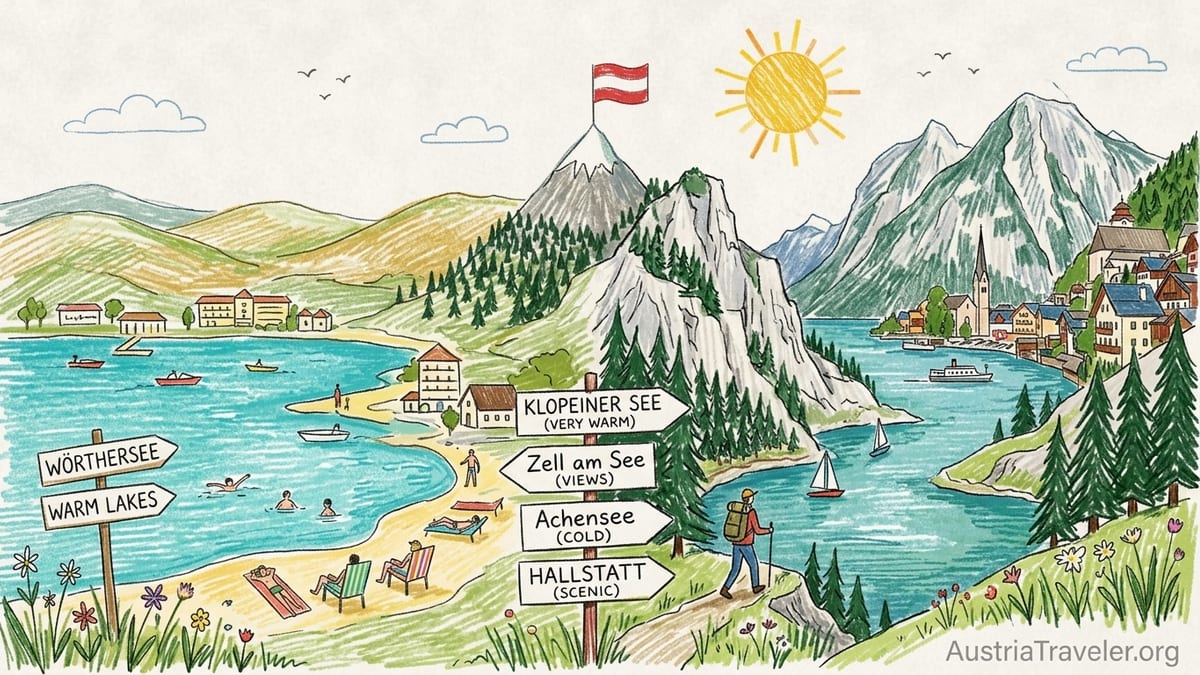
How I Chose These Austrian Lakes
Across three different summers, I spent roughly five weeks in Austria, usually in July and early September, with the same basic goal: combine proper swimming with mountain scenery and easy public transport. I moved by train and regional buses, rented a car for only one week in Carinthia, and always tried to mix at least one famous name like Zell am See with a quieter alternative nearby. That means every lake in this article is one I have genuinely swum in or at least waded into, not just admired from an Instagram viewpoint.
Because water conditions change through the season, I cross-checked my own impressions with current regional information. For example, Carinthia’s official tourism service publishes live lake temperatures, which in late September 2026 still showed around 20 degrees Celsius in places like Wörthersee and Millstätter See, while summer guides for Lake Klopein describe peak temperatures up to around 28 or 29 degrees. At higher altitude, Tirol’s Achensee is regularly described as refreshing, with local information talking about cool but swimmable summer water and fully public shorelines. I will reference these tendencies where they match what my skin felt when I jumped in.
The lakes below are not ranked from best to worst. Instead, I group them by the kind of experience they delivered: warm bathing lakes that feel almost Mediterranean in summer, deep turquoise Alpine lakes that look spectacular but stay cold, and mid-range options that quietly became my favorites for a full week of mixed hiking, swimming and village life.
Wörthersee: Austria’s Classic Warm-Water Resort Lake
I spent four nights on Wörthersee in July, staying in Pörtschach and Velden, and it was the closest thing to a seaside holiday I have ever had in the Alps. Carinthia promotes Wörthersee as one of the warmest large lakes in the region, and recent regional brochures still quote typical summer surface temperatures up to about 25 degrees Celsius. The live temperature service for Carinthian lakes backs up the idea that this is a genuinely warm bathing lake compared with mountain reservoirs. In practice that meant I could swim for 30 to 40 minutes without turning blue, which is not something I can say about the high Alpine lakes I visited.
For swimming, I mostly used the public lidos in Pörtschach and the free lakeside areas in Krumpendorf. Access is straightforward by train from Klagenfurt or Villach, with frequent local services running along the north shore. The downside is that much of the shoreline is built up with hotels, villas and private bathing platforms. You get manicured lawns and cafés right at the water, but less of a wild-lake feeling. Parking near the popular lidos was paid and sometimes tight after late morning on sunny weekends, although I usually arrived by train and walked.
Wörthersee worked exceptionally well for nightlife and people-watching. Velden has bars, a casino and late-opening restaurants, and the promenade felt more like a compact beach resort than a mountain village. The trade-off is crowd level. On hot days the main lidos were absolutely packed by early afternoon, and the view from the water is dominated by grand houses instead of raw mountain walls. From the Pyramidenkogel viewing tower above the lake, Wörthersee looks like a turquoise ribbon framed by low hills and development, and at water level that impression is fairly accurate. It is pretty, but not dramatic in the same way as the Salzkammergut or Zell am See.
Would I return? Yes, but specifically for warm, lazy swimming and café life. If my next trip was about quiet hikes and photography, I would choose a different lake. Wörthersee is ideal if you want reliably swimmable water, good public transport, and an evening scene that continues long after sunset, especially in July and August.
Faaker See and Ossiacher See: Family-Friendly Carinthian Bathing Lakes
On the same Carinthia trip I based myself in Villach for five nights and day-tripped to both Faaker See and Ossiacher See. These two lakes are smaller than Wörthersee, but for a relaxed family day they were actually more enjoyable. Carinthian lake overviews describe Ossiacher See as reaching surface temperatures up to the high twenties in good summers, and similar guides mention Faaker See as a warm bathing lake, if usually a little cooler than Lake Klopein. I did not measure the water, but both felt warm enough for prolonged swimming, certainly above 22 degrees during my mid-July visit.
Access from Villach was fairly easy. Local buses run to Annenheim and Sattendorf on Ossiacher See and to Drobollach or Egg on Faaker See, though they thin out in the evening, so I always checked the last departure. Parking near the lakeside lidos was paid and moderately busy, but not as overwhelming as on Wörthersee. Shoreline development is a compromise here: there are campsites, hotels and structured beaches, yet between them you still find pockets of reeds and less built-up views toward the surrounding hills.
In terms of atmosphere, Faaker See charmed me more. The lake has an intense turquoise color from mineral particles and feels compact, so when you swim out from Drobollach you have a strong sense of being in a bowl of forested hills and low peaks. It is still a valley lake, not a high Alpine one, but the color and relative quiet made it my favorite place in Carinthia for an afternoon dip. Ossiacher See, on the other hand, shines when you combine it with a trip up the Gerlitzen Alpe. From the cable car and even more from the hiking trails above, you get wide views over the lake and surrounding countryside, and here the lake definitely looks more impressive from above than from a crowded beach.
The main trade-off with both Faaker See and Ossiacher See is that they are great for families and relaxed swimmers, but less dramatic for photography compared with the high mountains around Zell am See or the jagged Dachstein range. If you want warm water, camping options, accessible lidos with slides and playgrounds, and reasonable public transport from Villach, they are strong choices. If you dream primarily of sharp peaks dropping straight into the water, you will be happier farther north.
Achensee in Tirol: Stunning Turquoise Giant That Stayed Cold
Achensee was the lake I had been dreaming of before my first Tirol trip, and visually it lived up to every expectation. I spent three days there in early September, staying in Pertisau on the western shore. Regional descriptions call Achensee the largest lake in Tirol, with clear turquoise water backed by the Karwendel and Rofan mountain ranges, and local tourism information emphasizes that the entire shoreline is publicly accessible. From the lake promenade in Pertisau you see steep limestone walls rising directly from the water, and from hiking paths like the Bärenkopf trail the lake looks like a Norwegian fjord.
The catch is water temperature. Achensee is deep and sits higher than Carinthian valley lakes, so even in midsummer regional data presented in lake guides describe only moderate surface temperatures, and that matched my experience. When I swam off the free grass beach near Pertisau, the first few strokes were refreshing, but within ten minutes I felt properly cold. Friends who visited in July reported similar impressions: gorgeous, but not a place to spend an hour floating unless you are very comfortable with cool water. In early September it was firmly in the “bracing” category.
Access to Achensee without a car is reasonable. I took a train to Jenbach and then the regional bus up the valley to Pertisau, which took under an hour including the change. Once at the lake, a network of paths allows you to walk along most of the western shore, and scheduled boats link Achenkirch, Pertisau and other landing points. Parking exists in all major villages, but lots closer to popular beaches tend to fill and may come with fees, so arriving by bus felt less stressful. The shoreline is only lightly built up outside the main settlements, which preserves a feeling of space and wildness compared with heavily developed Wörthersee.
The trade-off is that Achensee is absolutely better for hiking, sailing and photography than for leisurely bathing. Stand-up paddling and sailing schools operate in Achenkirch and Pertisau, and the lake is large enough that even on busy days you can paddle with a sense of openness. However, if I were planning a trip focused on warm-water swimming with children, Achensee would not be my first recommendation. I loved it for ridge walks, lakeside hikes and sunrise photography, but after three days I found myself craving one truly warm bathing day, which I later found in Carinthia.
Lake Zell: Big Mountain Views, Mixed Swimming Experience
I stayed in Zell am See itself for five nights in August, and Lake Zell might be the most complex lake in this article. On one hand, for the combination of a real town, a good rail connection and powerful mountain scenery, it is hard to beat. On the other hand, the swimming experience is uneven, and crowd levels can be high enough to change the feel of the place. Official descriptions highlight boating and water sports here, with electric boat rentals, ferries crossing the lake, and dedicated lidos, and they typically mention that combustion-engine boats are largely banned except for the ferries, which keeps the water quieter.
Water temperature in Lake Zell felt cooler than in Carinthia but warmer than Achensee. On sunny afternoons I could comfortably swim off the public lido near the Grand Hotel for 20 minutes or so before getting cold. Information from regional brochures describes summer temperatures warm enough for regular bathing, but the lake is fairly deep, and the southern end around Schüttdorf is noted as being shallower with more weed growth, which made that part of the shore less suitable for swimming and boating. I personally avoided the weedy sections and stuck to the better-maintained beaches on the western and northern shores.
Access is one of Lake Zell’s big strengths. International trains arrive straight into Zell am See, and from there you can walk to the lakeshore in minutes. The promenade around the north and west sides is mostly flat and family-friendly, and regular buses ring the lake, so it is easy to move between different bathing spots and villages like Thumersbach. Parking in the town itself is mostly paid and fills quickly, particularly on market days, so I preferred to stay in town and walk, only using a car to reach higher trailheads on the Schmittenhöhe or Kitzsteinhorn sides.
From viewpoints, Lake Zell is spectacular. The classic trip is to take the Schmittenhöhe cable car and look back down at the town and lake framed by higher peaks and nearby glaciers. The surprise for me was that water-level views in town can feel quite urban and busy, especially in high season. On grey or rainy days, which Zell am See is known for in summer according to many travelers, the lake loses some of its turquoise sparkle and looks more like a regular Alpine reservoir. I would return, but next time I would plan for shoulder season and treat it primarily as a base for hiking and excursions, using the lake for short, refreshing dips rather than full-on beach days.
Salzkammergut Choices: Fuschlsee for Swimming, Hallstätter See for Scenery
Over two different trips I spent about a week and a half in the Salzkammergut region, splitting my time between Fuschl am See and the Hallstatt area. The Salzkammergut contains more than 70 lakes, and Austrian tourism even breaks the area into distinct lake and mountain regions, from Attersee and Mondsee to the UNESCO-listed Hallstatt-Dachstein zone. Regional materials often distinguish relatively warm bathing lakes like Fuschlsee from deeper, cooler fjord-like lakes such as Hallstätter See and Gosausee. In practice, I found that distinction very helpful when deciding where to base myself.
Fuschlsee was my favorite pure swimming lake in this region. I stayed three nights in Fuschl am See in late August and swam every afternoon from the main public beach at the eastern bay, which local brochures describe as one of the better-equipped bathing areas in the Salzkammergut. There was a well-maintained grass shore, a supervised swimming zone, rental options for pedal boats and stand-up paddleboards, and even low-key yoga sessions on the dock some mornings according to the local timetable. The water felt comfortably cool rather than cold, certainly warmer than Achensee and similar to what I felt on Faaker See.
Access to Fuschlsee is bus-based if you do not drive. I came by bus from Salzburg in just under an hour, and the stop is an easy walk from both the village center and the public beach. Parking exists near the bathing area and along the main road, but fills on sunny days, which I experienced during a Saturday visit when cars were queuing for spaces by mid-morning. Shoreline development is relatively restrained: aside from the village, a few hotels and the lakeside trail, much of the shore feels green and low-key. From the water you see hills and forests rather than dense construction, and the lake looks almost as inviting at water level as it does from the hiking paths above, such as sections of the Fuschlsee Rundweg.
Hallstätter See, by contrast, delivered some of the best mountain-and-lake photos of my entire Austria trip, but offered a more mixed experience as a full-day swimming destination. I stayed two nights in Obertraun and visited Hallstatt multiple times by boat and bus. Regional brochures for the Dachstein Salzkammergut emphasize water sports and bathing opportunities on lakes like Hallstätter See and Gosausee, but they are also honest about the water being refreshing or cool. When I waded in at the bathing area near Obertraun, I only managed a short swim of five to ten minutes before the cold got to me, in sharp contrast to my lazy sessions at Fuschlsee.
Access around Hallstätter See is excellent by public transport, with trains stopping at the small Hallstatt station on the opposite shore of the village and regular boats shuttling passengers across the lake. Buses connect Obertraun, Hallstatt and other villages along the shore. However, the geography means that wide flat beaches are rare, and space can feel limited when day-trippers arrive. The view from the lake or from the eastern walking paths is extraordinary, with sheer rock walls and historic houses clinging to the shore, but at water level you do not have the same sense of wide lawns and open shoreline that you get around Fuschlsee or Carinthian lakes.
If my next trip was about dramatic scenery, moody weather and photography, I would absolutely base myself again near Hallstätter See. For multihour swimming and relaxed sunbathing, Fuschlsee or one of the warmer Salzkammergut bathing lakes would win easily. The official regional information reflects this split by highlighting specific lakes for bathing and others for panoramic viewpoints and combined hiking-and-sightseeing days.
Carinthia’s Super-Warm Specialists: Klopeiner See and Friends
On my most recent Austria trip I intentionally went back to Carinthia for one reason: to finally experience the smaller, very warm lakes southeast of Klagenfurt that locals kept recommending. I spent three nights near Lake Klopein, with day trips to nearby Turnersee. Regional descriptions consistently call Lake Klopein one of the warmest bathing lakes in Europe, and both official and independent sources mention peak summer water temperatures around 28 to 29 degrees Celsius in hot spells. Live lake temperature charts for Carinthia in late summer 2026 still showed high teens to low twenties in this cluster of lakes well into September, which matched the mild evening swims I enjoyed.
Lake Klopein itself is quite built up around the shore, with hotels, guesthouses, cafés and structured bathing areas. There is a promenade that loops around much of the lake, and several beaches are reserved for paying guests or hotel visitors. I swam from both a public section and a paid lido, and in each case the water felt more like a well-warmed outdoor pool than a mountain lake. For my personal tolerance, it was perfect for long, lazy sessions. Families with small children seemed to appreciate the shallow, warm zones and the abundance of pedal boats and slides.
The trade-off is that Klopeiner See can feel crowded and commercial. Shoreline nature is less prominent, and while there are nearby forests and walking trails, the immediate impression from the water is of hotels and lidos rather than wild hills. Parking was straightforward but mostly paid, and arriving after lunch on a hot day meant competing for the remaining spaces. Public transport exists via regional buses from Klagenfurt, but services thin out in the evening, so I was glad to have a car for this part of the trip.
Nearby Turnersee felt like a calmer version of the same warm-lake idea. I only spent an afternoon there, but the water was nearly as warm, the surroundings a little greener, and the bathing lawns more relaxed. Carinthian regional overviews list several of these smaller lakes with surface temperatures reaching the high twenties in good summers, and they are exactly the places I would pick next time if my main goal were guaranteed warm water without needing to think about wetsuits or quick dashes back to a towel.
The Takeaway: Which Lake Types I Would Choose Next Time
After all these visits, I have stopped asking which Austrian lake is the single best. Instead I think in terms of categories and choose a base that matches my priorities for that specific trip. Warm Carinthian bathing lakes like Wörthersee, Faaker See, Ossiacher See and Klopeiner See are ideal if I want to swim for a long time, travel with friends or family who like structured lidos, and still have easy evenings in towns like Villach, Velden or Klagenfurt. Their shorelines are more developed, but the trade-off is genuinely comfortable water temperatures and good infrastructure, which regional lake-temperature data and tourism materials consistently support.
For a trip centered on hiking and photography with some short, sharp swims, I would pick Achensee or the Salzkammergut’s cooler lakes like Hallstätter See again. Achensee in particular offers open public shores and wild-feeling views, while the Hallstatt-Dachstein area combines world-famous scenery with a dense network of hiking trails and cultural sights. I would go in knowing that my lake time would be refreshing rather than languid and plan my days accordingly, using the water more as a post-hike plunge than as an all-day focus.
If I wanted a balanced week with both decent swimming and postcard scenery plus a proper town, I would be tempted to return to Fuschlsee or Lake Zell in shoulder season. Fuschlsee gave me some of the nicest full-day lake experiences, with respectable water warmth, manageable crowds and views that felt Alpine without being harsh. Lake Zell, on the other hand, makes sense when I want trains at my doorstep, glacier excursions, and the option to finish a hike with a quick swim in front of a lively lakeside promenade.
Ultimately, Austria’s own tourism information hints at the same conclusion: Carinthia’s valley lakes, Achensee in Tirol, the Salzkammergut and Lake Zell are fundamentally different products rather than direct competitors. After visiting them in person, I would not crown a single universal winner. For my next trip, if I travel in high summer and crave long swims and warm evenings, I will book Carinthia again, probably near a smaller lake like Faaker See or Turnersee. If I go in June or September and care more about empty trails, misty mornings and photography, I will head back to Achensee or the Hallstatt area and happily accept colder water in exchange for quieter shores and bigger mountain drama.
FAQ
Q1. Which Austrian lake is best if I want the warmest possible swimming water?
In my experience and based on regional information, Lake Klopein and several nearby Carinthian lakes often reach some of the highest summer water temperatures in Austria, with reported peaks around the high twenties Celsius in hot spells, making them ideal if your top priority is long, warm swims.
Q2. Is Achensee too cold for an enjoyable swim in summer?
Achensee is certainly swimmable in summer, but it feels much cooler than Carinthian valley lakes because it is deep and sits at higher elevation. I enjoyed short, refreshing dips there, yet I would not choose it as my base if my main goal were multihour bathing days with children or reluctant cold-water swimmers.
Q3. Can I visit Wörthersee, Faaker See and Ossiacher See using only public transport?
Yes, all three are accessible without a car. Trains run along Wörthersee’s north shore between Klagenfurt and Villach, and regional buses from Villach reach Faaker See and Ossiacher See. You need to check timetables, particularly for evenings, but it is realistic to base yourself in Villach or Klagenfurt and visit the lakes by bus and train.
Q4. Which lake combines the best mountain scenery with a real town and train station?
For me, Lake Zell is the strongest all-rounder in that category. Zell am See has a proper town center with a rail hub, a lakeside promenade and quick access to mountain lifts. The scenery from viewpoints like Schmittenhöhe is outstanding, and although the lake is not as warm as Carinthian bathing lakes, it still offers comfortable summer swimming in dedicated lidos.
Q5. Are Austrian lakes generally safe and clean for swimming?
Austria regularly reports a very high percentage of its monitored bathing lakes as having excellent water quality, and the lakes in this article all had clear water and well-managed bathing areas. As always, it is wise to use designated beaches, respect local safety notices and avoid swimming during severe storms or strong inflows after heavy rain.
Q6. How crowded do the popular lakes get in peak season?
In July and August, lakes like Wörthersee, Lake Zell and Hallstätter See can become very busy, especially near famous villages and main lidos. I have seen car parks fill by late morning and bathing lawns covered in towels. Choosing shoulder season, arriving early in the day and using lesser-known access points can help if you prefer quieter experiences.
Q7. Do I need a car to enjoy the Salzkammergut lakes?
A car helps if you want to reach very small or remote lakes, but it is not essential. I visited both Fuschlsee and Hallstätter See by a combination of regional buses, trains and boats. Basing yourself in a hub like Salzburg, Bad Ischl or Hallstatt gives you multiple public transport options, though services are less frequent in the evening.
Q8. Which lakes would you avoid if traveling with young children who dislike cold water?
If warm water is crucial, I would avoid planning a full week around colder, deeper lakes like Achensee or the higher Salzkammergut lakes, and instead choose Carinthian bathing lakes or Fuschlsee. You can still visit dramatic places like Hallstätter See on day trips, but rely on warmer lakes for the main swimming days.
Q9. Are there quieter alternatives to the big-name lakes you mention?
Yes, in Carinthia smaller lakes such as Turnersee and some of the lesser-known warm lakes east of Wörthersee felt calmer than the main resort towns, while in the Salzkammergut the smaller lakes near Altaussee and Grundlsee offer a more subdued atmosphere than Hallstatt. I found that moving even a few kilometers away from the most photographed spots usually reduced crowd levels significantly.
Q10. How should I decide where to base myself for a first Austrian lake trip?
Start by choosing your priority: warm, easy swimming and nightlife, or cooler but dramatic mountain scenery and hiking. For warmth and social evenings, I would suggest Carinthia around Wörthersee, Faaker See or Lake Klopein. For scenery and trails with some swimming, I would look at Achensee, Lake Zell or the Salzkammergut around Fuschlsee and Hallstätter See, then use public transport or short drives to sample nearby lakes without changing base every night.