


On my first lake holiday in Austria without a car, I expected panoramic train rides and lazy swims. I did not expect to memorise bus timetables, drag a suitcase along village pavements or begin to see lake ferries as my local commuter line. Over several trips around Wolfgangsee, Achensee and the wider Salzkammergut, I relied entirely on trains, regional buses and scheduled boats. What follows is drawn from those journeys, checked against current timetables and fares as of October 2026, for travellers who want mountain water and village life without ever turning a key in an ignition.
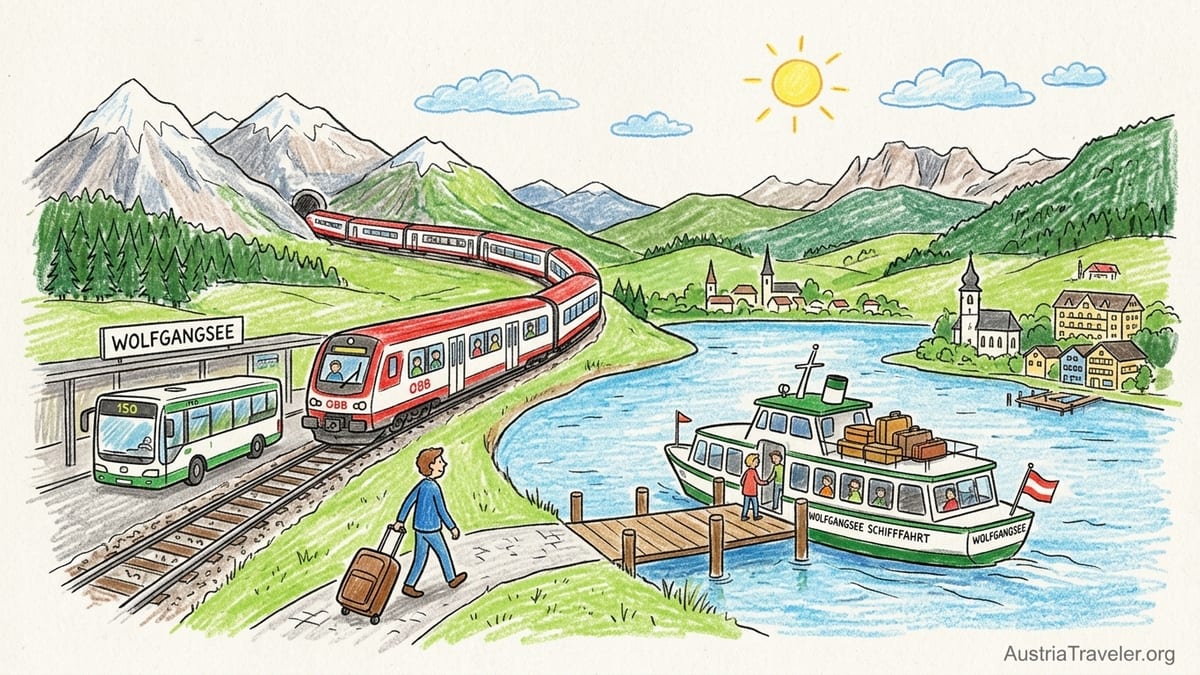
Arriving in the Lakes by Train: Western Railway and Salzkammergut Line
Like most visitors, I started at Salzburg Hauptbahnhof, the main rail gateway for Wolfgangsee and much of the Salzkammergut. Long‑distance ÖBB Railjet and Westbahn services feed into Salzburg from Vienna, Munich and beyond. From there you face an immediate choice if you are heading towards the lakes: stay on the main Westbahn line as far as Attnang‑Puchheim, then continue on the Salzkammergutbahn towards Gmunden, Bad Ischl and Hallstatt, or step off in Salzburg and transfer directly to a regional bus for Wolfgangsee. Both options work without a car, but they shape your holiday very differently.
On one trip I took the classic lake approach: a Railjet from Vienna to Attnang‑Puchheim, then a regional train along the Salzkammergutbahn towards Bad Ischl. This line is a genuine backbone for lake tourism, serving Traunsee, the imperial spa town of Bad Ischl and the branch towards Hallstatt. Car‑free, it was liberating to sit by the window rather than focus on mountain roads. Seats on these regional trains are unreserved, so I simply bought a standard ÖBB ticket in the app a few hours in advance and boarded any service that fit my plans.
Buying tickets entirely on my phone became a theme. The ÖBB app allowed me to check departures, platform changes and delays in real time. For flexible lake days I favoured normal second‑class tickets or, on busy weekends, regional day tickets sold by the local transport associations that cover both trains and buses within a state. For example, in Salzburg and Upper Austria there are day passes that work on regional trains and most buses across the Salzkammergut, useful if you expect to hop between several lakes in one long day.
The first trade‑off of going car‑free arrived with luggage. On long‑distance Railjet services luggage racks and overhead shelves are generous. On the smaller regional trains into the lake districts space is tighter and passengers often stack suitcases in the door areas. It was manageable with a medium suitcase and a daypack, but I was glad I had not packed a giant hard‑shell case. Rolling bags over station underpasses and village pavements is part of a car‑free lake holiday, and packing lighter makes every connection less stressful.
Bus 150 to Wolfgangsee and a Stay by the Pier
My most car‑free friendly lake base has been Wolfgangsee, where the combination of bus 150 and the Wolfgangsee ferry network makes a private car feel unnecessary. From Salzburg Hauptbahnhof I followed signs not for another train, but for the regional bus bays just outside the station. Bus line 150, operated within the Salzburg transport network, runs roughly every 30 minutes during the day between Salzburg and Bad Ischl, via St. Gilgen and Strobl on Wolfgangsee. I purchased a regional bus ticket from the machine next to the stop on my first visit, and later simply used the Salzburg transport app to show a QR code to the driver.
The bus journey to St. Gilgen took about an hour, climbing steadily out of Salzburg and winding through lake‑and‑meadow scenery. Without a car I could watch the landscape instead of the hairpin bends. The obvious downside was shared space: at peak times in July and August, the 150 can be standing‑room only between Salzburg and the lake corridor. One afternoon bus was so full at Salzburg that passengers with large suitcases were gently asked to wait for the next service. That is the kind of small delay you largely avoid with a rental car, but in my case the next bus was only 20 minutes later and my accommodation check‑in was flexible.
I chose to stay directly beside the boat pier in St. Gilgen. That decision narrowed hotel options, and the lakefront guesthouse I booked was slightly more expensive than places set back in the village. Yet it paid off every day. From my room I could see the classic white and green Wolfgangsee ships docking, and I reached the pier in less than two minutes on foot. There was no need to think about parking rules, no loading zone stress and no risk of a ticket if I returned late from a swim. Checking the current WolfgangseeSchifffahrt timetable confirmed that scheduled boats still link the three main lakeside communities of St. Gilgen, Strobl and St. Wolfgang across most of the main season, with year‑round but reduced services in shoulder periods.
Using the boat as real transport rather than a sightseeing novelty changed the feel of the holiday. I bought a standard point‑to‑point ticket on board for my first trip from St. Gilgen to St. Wolfgang and then tried a Wolfgangsee day ticket, which the operator currently prices so that adults pay roughly the cost of two normal single journeys and can ride as much as they wish for that day. Tickets are sold at the pier kiosks, online and on board, and staff scanned QR codes from my phone without issue. The crew also handled luggage without fuss. After arriving on bus 150 with a suitcase, I walked it to the pier and rolled it directly onto the boat for my onward journey to St. Wolfgang, treating the lake as a floating continuation of the bus route.
Boats as Daily Transport: From Pier to Swim and Supper
At Wolfgangsee, the scheduled boats made moving between accommodation, swimming spots and evening meals simple without a car. One morning I took an early boat from St. Gilgen to the pier at St. Wolfgang Markt, then walked five minutes along the waterfront to my lakeside guesthouse. The path was flat and fully paved, which matters with wheeled luggage. Had I arrived by car, I would have needed to navigate narrow streets, find short‑term parking to unload and then move the car to a paid car park on the edge of the village, something I have watched drivers wrestling with on busy Sundays.
Once settled, the lake boats effectively became my bus network. For swimming, I used the stops at Strobl and Gschwendt. From the Strobl pier, a well‑signed path leads to a grassy public lido in about ten minutes on foot. There I spread a towel on the grass, swam from the bathing jetty and grabbed snacks from a nearby kiosk. Returning in the afternoon, I simply consulted the live timetable on my phone and walked back to the pier. The only real inconvenience was timing: in shoulder season there can be gaps of over an hour between boats, so a spontaneous late‑evening dip may require a taxi or a long shoreline walk if you miss the last departure.
Luggage on boats was easier than I expected. The larger Wolfgangsee ships have level boarding and enough open deck space to park a suitcase beside a bench. On one transfer from St. Wolfgang to St. Gilgen I boarded with a suitcase and a small backpack, found a spot on the side deck and kept an eye on my bags while enjoying the view. Crew are used to guests changing hotels along the lake and did not treat luggage any differently from strollers or bikes. That convenience is one of the reasons I now consider Wolfgangsee one of the best Austrian lakes for a fully car‑free stay.
The only moment where I missed a car on Wolfgangsee was late at night. After a lakeside concert in St. Wolfgang, the last regular boat had already departed for St. Gilgen. My choices were a taxi, sharing a ride with other guests who had driven, or an hour‑long walk combined with a night bus that did not run conveniently for my direction. I chose a taxi, which cut into the day’s budget but still saved money compared with a multi‑day car rental once insurance and parking fees were factored in. For travellers who prioritise nightlife over quiet evenings, staying in the same village each night or accepting occasional taxis is part of a realistic car‑free strategy.
Achensee Without a Car: Rail, Cog Railway and Lake Boats
Achensee in Tyrol felt more remote yet still worked well without a car, thanks to the combination of mainline rail, the Achenseebahn and the Achensee boat services. I reached the lake via Jenbach, a busy Tyrolean railway junction served by long‑distance ÖBB trains from Vienna, Salzburg and Innsbruck. After stepping off my Railjet, I followed signs to the historic Achenseebahn, a rack‑and‑pinion line that climbs steeply from Jenbach to Seespitz at the southern tip of Achensee. The operator’s current information confirms that the cog railway again runs during the main summer season, usually from late spring to autumn, and connects at Seespitz with the lake boats.
On my last visit, I chose a combined ticket that included the cog railway from Jenbach to Seespitz and a hop‑on, hop‑off day pass on the Achensee boat network. Current pricing from the boat operator shows a separate ticket range that includes point‑to‑point fares and day passes, with the Achensee experience card and certain regional guest cards providing discounts within fixed dates. I purchased my combination ticket at the ticket office in Jenbach with a debit card, but it is now also possible to buy boat tickets online and present them digitally when boarding.
At Seespitz, the cog railway literally stops beside the pier. With a medium suitcase and daypack the transfer was easy: a short walk across the platform and onto the waiting lake boat. The scheduled Achensee boats connect Seespitz with Pertisau, Gaisalm, Buchau, Achenseehof and Scholastika along the lakeshore. The operator’s latest timetable confirms that in the main season these services run several times a day in each direction, with first and last departures varying by month. For me this meant I could choose accommodation in Pertisau, a popular lakeside village, walk from the pier to my guesthouse in around ten minutes and still use the boat to reach other villages for swims or walks without ever seeing a parking lot.
Swimming access around Achensee without a car depends more on your comfort with walking. From the Pertisau pier, I followed a lakeside promenade to several public bathing spots within fifteen to twenty minutes on foot. The Gaisalm stop is a particular highlight: the only alpine pasture on an Austrian lake that is accessible only by boat or on foot. I took a mid‑morning boat from Pertisau to Gaisalm, swam in the cold turquoise water and then hiked a lakeside trail back towards Pertisau, catching another boat for the final stretch when tired. Had I been driving, I would still have needed to park well short of these spots and walk, so in this case public transport did not reduce convenience.
When Public Transport Feels Relaxing and When It Does Not
Across several Austrian lake trips, there were days when public transport created a genuinely relaxing rhythm and others when it became a puzzle. The most relaxing days shared common traits. My accommodation was within an easy ten‑minute walk of a major pier or train station. I used day tickets so I did not need to think about individual fares. Departures were frequent enough that missing one connection did not disrupt the day. Above all, I accepted that travel time was also part of the holiday. Floating across Wolfgangsee or Achensee with a coffee on deck felt less like a transfer and more like a two‑hour cruise built into the itinerary.
The stressful moments came mostly from last‑mile gaps. On one Salzkammergut trip, I took the Salzkammergutbahn to Bad Ischl and a connecting regional train towards Hallstatt, then crossed to Hallstatt village by scheduled lake boat. That part worked beautifully without a car. The difficulty came when I tried to reach a small guesthouse above the village that claimed it was a twenty‑minute walk from the pier. With a suitcase in summer heat and partly on steep alleys, it took me closer to forty minutes. In a rental car, I could have parked higher up the slope and rolled my bag a much shorter distance, although parking spaces in Hallstatt are limited and expensive.
Timetables can also compress your day. Around Wolfgangsee in lower season, bus 150 shifts from a 30‑minute to an hourly pattern. On one November Sunday I misjudged the timetable leaving St. Gilgen and reached the stop just as the bus pulled away. With no other public transport for an hour, I spent the time in a café rather than on the lakeside, which was hardly a disaster but did feel dictated by the schedule. By contrast, a driver could simply depart whenever they wished. Travellers who value independence above cost may still prefer a car.
Ticket buying is another area where public transport can be both easy and confusing. For simple journeys, the ÖBB app and local transport apps work well. The challenge comes when you cross tariff boundaries. For example, one ticket might cover your Railjet journey to Salzburg, another your regional bus pass in the Salzburg region, and yet another a combination ticket for local boats. Staff at station ticket counters are used to these questions and helped me choose passes that avoided overpaying, but doing this research in advance would have saved time at the counter.
Would a Rental Car Have Changed These Lake Holidays?
To understand what a car would have changed, I compared one of my Wolfgangsee stays with a later trip where friends joined by rental car. On the car‑free trip, I stayed in St. Gilgen beside the pier and used boat 150 and the lake ferries for all movements. My daily routine was defined by departure boards. Morning swims had to fit around boat times. Dinner choices were mostly limited to restaurants in St. Gilgen or those easily reached on the last evening boat.
When my friends arrived with a rental car on a later trip, they stayed in a guesthouse on a hill above St. Gilgen that had abundant parking but no quick pier access. We could drive to more remote bathing spots on smaller lakes in the Salzkammergut, like Fuschlsee and Hintersee, that are served less frequently by buses. They also used the car to shop in larger supermarkets outside the lake villages, which lowered food costs for a family group. In heavy rain the car made it easier to get around without umbrellas and wet backpacks.
Yet the car introduced its own frictions. Parking in St. Wolfgang involved circling designated zones at the edge of the village and then walking ten to fifteen minutes to the centre. Returning late from a hike meant worrying about parking time limits. On busy weekends, signs on the access roads warned that central car parks were full, so we diverted plans to less popular spots. On my solo car‑free stays, none of these issues existed. Once the suitcase was in the room, my only timings were boats and buses, and I could enjoy wine with dinner knowing I would not be driving back along dark lakeside roads.
Cost comparisons are not straightforward because they depend on how many people share the car. By autumn 2026, compact rental cars in Salzburg typically cost a moderate daily rate plus insurance, fuel and parking. For a solo traveller or couple staying primarily on one or two well‑served lakes such as Wolfgangsee or Achensee, my experience suggests that public transport and boats are usually cheaper, especially when you make use of regional day passes or occasional combination tickets that bundle trains, cog railways and lake boats. For a family of four wanting to explore several out‑of‑the‑way swimming spots in a single week, the car can work out similar in price and more flexible, at the cost of driving and parking stress.
Does Staying Beside a Station or Pier Limit Your Trip?
Choosing accommodation directly beside a railway station or ferry landing is the most powerful way to simplify a car‑free lake holiday, but it shapes your experience. In St. Gilgen, St. Wolfgang and Pertisau I deliberately chose guesthouses within a five‑minute walk of piers. Room rates were sometimes higher and the buildings a little more traditional than the stylish lodges set back in the hills. Nighttime noise from boat announcements and waterfront promenades was also more noticeable on warm evenings when windows stayed open.
In return, I gained almost effortless logistics. Arriving with luggage meant one transfer at most between train, bus and boat, and then a short walk. If a thunderstorm broke while I was swimming, I could be back in my room after a single boat ride. Early departures for onward travel were less stressful because missing a boat by two minutes did not also mean missing a long‑distance train. I could see ferries arriving from my balcony on Wolfgangsee and time my departure to the minute, something drivers rarely enjoy when watching for parking inspectors.
On another Salzkammergut trip, I tried the opposite approach and booked a hillside apartment a twenty‑minute walk above Traunsee. The lake views were spectacular and the price lower, but every outing began and ended with a steep walk. When rain turned the path slippery, I envied those stepping directly off trains at lakeside hotels near Gmunden’s tram and boat connections. With a car, that hillside apartment would have been ideal, but without one it introduced a daily obstacle course that occasionally dissuaded me from evening swims or dinners in town.
The compromise I now recommend is to prioritise one base directly beside a station or pier for the first few nights of a trip, especially after a long journey, and only then consider moving to a more remote apartment for a second stage if you are comfortable with regular walks. This two‑base strategy works especially well in the Salzkammergut, where you might spend three nights beside the pier in St. Gilgen on Wolfgangsee and then shift to a quieter, slightly more remote village on a smaller lake once you have adjusted to the local transport rhythms.
The Takeaway
Traveling the Austrian lakes without a car is not a stunt. It is a viable and often delightful way to see some of Europe’s best mountain water landscapes, provided you accept that your timetable will occasionally be set by buses and boats rather than your own ignition key. On Wolfgangsee, the combination of bus 150 from Salzburg and the dense WolfgangseeSchifffahrt network turns the lake into a stitched‑together village, with real local traffic moving by boat rather than purely sightseeing cruises. Achensee offers a more alpine variation, where the Achenseebahn and boat services act as a backbone along the shore.
Where public transport shines is in removing driving and parking stress from tight lakeside villages. Staying beside a pier or rail stop may limit your accommodation to more traditional properties, but it gives you simple access to swims, meals and day trips without ever worrying about where to leave a car. You can read, nap or watch the water during transfers instead of focusing on traffic. Late evenings bring some compromises, and remote coves may remain out of reach unless you are willing to hike or pay for the occasional taxi, yet for many travellers these are acceptable trade‑offs.
The key lesson from my own trips is that the more you build your itinerary around real transport nodes, the more relaxing a car‑free lake holiday becomes. Think of buses like line 150, lake boats on Wolfgangsee and Achensee, the Salzkammergut railway and even small cog lines as part of an interconnected network. Once you start treating boats as buses on water and stations as your front door, the Austrian lakes open up in ways that are surprisingly compatible with slow, sustainable travel.
FAQ
Q1. Can I visit Wolfgangsee for several days without renting a car?
Yes. You can reach Wolfgangsee by train to Salzburg and then bus 150 to St. Gilgen, Strobl or on to Bad Ischl, and use the Wolfgangsee boats to move between lakeside villages for swimming, walks and meals.
Q2. How do I buy tickets for buses and lake boats in the Salzkammergut?
For trains and many regional buses you can use the ÖBB app or ticket machines at stations. Lake boat tickets on Wolfgangsee or Achensee can be bought at pier kiosks, online in advance or on board, often with options for day passes and discounts via regional guest cards.
Q3. Is traveling car free cheaper than renting a car for the Austrian lakes?
For solo travellers and couples staying mostly on lakes with good public transport such as Wolfgangsee and Achensee, public transport plus boats is usually cheaper than a rental car once fuel and parking are included. For families or groups who move every day to remote spots, the cost difference may narrow.
Q4. How easy is it to manage luggage on buses, trains and boats?
With a medium suitcase and daypack it is very manageable. Long‑distance trains have luggage racks, regional buses and boats have floor space, and pier‑side accommodation keeps walks short. Very large or multiple suitcases can make transfers and hillier walks more tiring.
Q5. What happens if I miss the last boat or bus at the lake?
If you miss the last scheduled service, options include walking if distances are safe and reasonable, calling a local taxi or asking your accommodation for assistance. In planning, always check the latest return departures, especially in shoulder seasons when frequencies drop.
Q6. Should I stay directly beside a pier or railway station?
Staying by a pier or station can limit hotel choice and slightly raise prices, but it simplifies a car‑free trip. Short walks with luggage, easy returns after swims and less stress for early departures often outweigh the downsides.
Q7. Can I reach remote swimming spots without a car?
You can reach many good swimming areas by combining buses, boats and walking, such as the Strobl lido on Wolfgangsee or lakeside spots near Pertisau on Achensee. Very remote coves may require longer hikes, occasional taxis or a car.
Q8. Do I need to book public transport tickets in advance for lake regions?
Long‑distance trains that offer discounts or reservations are best booked ahead, especially in summer. Regional trains, buses and most lake boats usually do not need reservations, and tickets can often be bought on the day, though checking for any special event days is wise.
Q9. Is it realistic to combine several lake regions in one car‑free trip?
Yes, if you link them along major rail and bus corridors. For example, you can stay on Wolfgangsee, then travel via Salzburg or Bad Ischl to the Salzkammergut railway and continue to Traunsee or Hallstatt, or reach Achensee via the rail junction at Jenbach and the Achenseebahn plus boats.
Q10. What type of traveller benefits most from a car‑free Austrian lake holiday?
Travellers who enjoy slower days, are comfortable planning around timetables and prefer reading on boats to driving mountain roads benefit most. Those who want to chase remote coves at short notice or carry extensive gear might still prefer a rental car.