


I arrived in Austria thinking most big-name resorts would feel more or less the same: modern lifts, perfect grooming, schnitzel at lunch and lively après-ski. Over four seasons and roughly 40 ski days, spread across St Anton am Arlberg, Saalbach Hinterglemm Leogang Fieberbrunn, Obergurgl-Hochgurgl and Zell am See – Schmittenhöhe, I learned how wrong that assumption was. I am an upper-intermediate to low-advanced skier, comfortable on European red runs and easy blacks but not a true off-piste expert. I usually travel with one similarly experienced friend and, on two of these trips, a partner who prefers cruisy blues and long lunches. We mixed rental cars with train-and-transfer days and skied everything from early December openings to late March slush. What follows is not a complete catalogue of Austrian skiing, but a practical comparison of four areas I actually skied, and the concrete decisions and mistakes that shaped each trip.
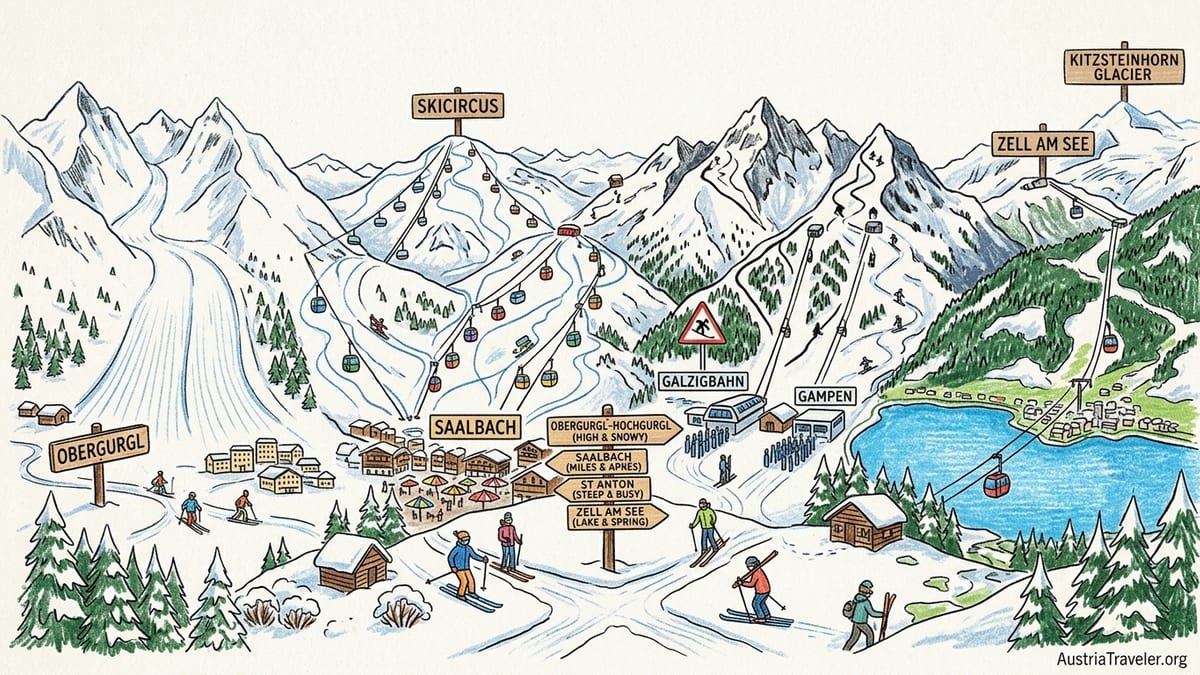
My Austrian Ski Background and How These Trips Came Together
By the time I first pointed my skis down an Austrian piste, I had logged perhaps 12 weeks of skiing in France, Italy and Switzerland, plus a few long weekends in the Rocky Mountains. On a typical day I am happy linking fast carving turns on reds, but I still slow down for steep, moguled blacks and I avoid no-fall couloirs. That level matters because Austria rewards confident intermediates with long, rolling pistes, yet some famous areas, especially St Anton, can feel overwhelming if you jump in at the deep end.
Over four winters I pieced together a patchwork of Austrian experiences. One early-December week in Obergurgl-Hochgurgl chased guaranteed snow at higher altitude, with most slopes between roughly 1,800 and just over 3,000 meters and extensive snowmaking covering the main pistes. Another trip was a mid-January circuit around Saalbach Hinterglemm Leogang Fieberbrunn, the Skicircus area that now markets around 270 kilometers of linked pistes on about 70 lifts, with its own early-bird lift openings at 8:00 am on key gondolas in high season. A later February visit to St Anton am Arlberg focused on the legendary steeps and après bars, while a March long weekend in Zell am See tested how a lower, lakeside resort copes when temperatures creep above freezing.
Logistics also varied. For Obergurgl we flew into Innsbruck and took a pre-booked shared transfer van up the Ötztal valley. For Saalbach we rented a small car in Munich, appreciating the flexibility to chase fresh snow within the wider Salzburger Land region. St Anton we reached by rail, taking a direct train to St. Anton am Arlberg station and walking to our guesthouse. Zell am See was another car-based trip, which made day trips to the glacier at Kitzsteinhorn possible. These choices changed how close we stayed to the lifts, how early we could catch first chair and how tired we felt at the end of big ski circuits.
Before all of this, my mental picture of Austrian skiing was of perfectly groomed motorways, compact village centers, brass bands, and affordable prices compared with Switzerland. What I actually found was far more nuanced. The width of pistes, the feel of the villages, the queuing etiquette and even the time it took to get from hotel to first lift varied so much between resorts that I stopped thinking of “Austrian skiing” as a single product at all.
Obergurgl-Hochgurgl: High, Quiet and Surprisingly Efficient
My first Austrian week was in Obergurgl-Hochgurgl, chosen for early-December reliability. Official information for the area highlights around 112 kilometers of slopes served by roughly 25 lifts, with snowmaking on the majority of marked runs and base villages already above 1,800 meters in Obergurgl and Hochgurgl. That combination translated directly into confidence when we booked for the first half of December, when many lower resorts were still waiting on natural snowfall.
We stayed in Obergurgl itself, in a small hotel about a five-minute walk from the Festkoglbahn gondola. On most days we were booted up and walking out by 8:25 am, in the gondola line at 8:35 and skiing our first proper top-to-bottom run by around 8:55. What struck me first was piste width. Many of the red runs off Festkogl and Hohe Mut felt like broad boulevards, two or three times wider than narrower, trench-like pistes I remembered from some older French resorts. With fewer skiers than mega-areas like St Anton, carving clean arcs was easy even mid-morning.
Lift speed and queues were also better than I expected for an early-season holiday week. The main connections between Obergurgl and Hochgurgl, including the modern Kirchenkarbahn gondolas and the Top Express link, moved quickly and did not generate long lines. We rarely waited more than three or four minutes, even at pinch points just after ski school set off. That efficiency meant we could ski from the Obergurgl side over to Hochgurgl and back before lunch without feeling rushed, a useful benchmark when you are still finding your bearings in a new area.
Snow quality in Obergurgl was the best of all four regions I tried, at least in early December. Upper slopes stayed chalky and cold-packed all day, and even the valley runs held their shape until late afternoon, with only small piles of pushed-up snow in busy sections. Grooming was meticulous, with clear overnight tilling visible most mornings. By 3:00 pm, my legs were more tired from mileage than from fighting chopped-up snow. The village itself, though, was calm to the point of sleepy. Après-ski options existed, but they leaned toward live music in hotel bars and quiet drinks rather than shoulder-to-shoulder dancing on tables.
Saalbach Hinterglemm Leogang Fieberbrunn: Big-Mountain Feel Without Exhausting Transfers
On paper, the Skicircus Saalbach Hinterglemm Leogang Fieberbrunn looks almost intimidating. Regional brochures for recent winters highlight about 270 kilometers of pistes on some 70 lifts, connected into circular routes around the Glemmtal valley and reaching over the ridge into Tyrol near Fieberbrunn. Press material for the 2025/26 and 2026/27 seasons also emphasizes extensive snowmaking, with hundreds of snow cannons supporting valley runs and key links, and a core season roughly from the end of November to early April, subject to snow conditions.
For a mid-January week here we based ourselves in Saalbach village, following the advice that Saalbach and Hinterglemm sit at the heart of the network. Our guesthouse was three minutes’ walk from the Schattberg X-press gondola, which in winter typically opens around 8:30 am, with several lifts moving to 8:00 am starts in mid-season as part of an “early bird” program. On our earliest morning we stood outside the base station at 8:15, loaded by 8:25 and were skiing high above the valley by 8:40. From there it took us about 40 minutes of steady skiing, including one chairlift from the Westgipfel side, to link into Hinterglemm and begin a clockwise loop toward Leogang.
What surprised me most was how efficiently the area skied compared with how chaotic the piste map looks. When you first unfold the map, especially the latest versions that include all four main villages and the Tyrol-side extension to Fieberbrunn, it can feel like staring at a piece of modern art. In reality, once you understand that most valley floors sit around 1,000 meters and most ridge tops between about 1,600 and 2,100 meters, the navigation starts to make sense. Color-coded zones and clearly numbered lifts, many of them fast chairlifts with weather bubbles, helped us move from Saalbach to Fieberbrunn and back in a single day without ever needing to sprint for the last lift.
Piste width was more varied than in Obergurgl. Some main arteries, such as the blue and red runs under the Schattberg and Kohlmais sides, were wide enough for comfortable carving and coped well with mid-morning crowds. Other connecting pistes, particularly on the Leogang side, narrowed into traverses that required more concentration, especially when littered with small piles of artificial snow. Grooming was generally strong, but the sheer volume of skiers meant that by 2:30 pm the lower sections into Saalbach and Hinterglemm developed soft moguls and patches of polished hard-pack. Snowmaking kept coverage consistent, yet in warmer spells the last few hundred vertical meters back to town felt heavier and more tiring than the cruisy upper sections.
Après-ski here was easily the liveliest of my Austrian trips. Saalbach and Hinterglemm both offered classic umbrella bars right at the bottom of the main pistes, with music starting in mid-afternoon and running until dinner time. Mountain restaurants mixed self-service canteens with more polished table-service huts. Prices for a main course tended to be a bit below what I had paid in French flagship resorts, though still very much alpine rather than budget. The main drawback of Saalbach for our group was fatigue. Big circuits like the clockwise “Skicircus round” demanded concentration all day. By late afternoon, valley runs were crowded and heavy, and our legs sometimes felt more beaten up than on even steeper but less crowded terrain in other countries.
St Anton am Arlberg: Legendary, Demanding and Sometimes the Wrong Choice
St Anton had been on my wish list for years. The wider Ski Arlberg region, which includes St Anton, St Christoph, Stuben, Zürs and Lech, is often sold as one of the largest interconnected ski domains in Austria, with a modern lift network and a reputation for serious off-piste terrain. Recent seasons have also brought attention to rising prices, with local skiers commenting that peak-day lift passes now cost in the mid-80 euro range and season passes over 1,000 euros, reflecting both the scale of the area and its international popularity.
We chose a late-February week and arrived by train directly into St. Anton am Arlberg station, an easy walk from our guesthouse. That part went perfectly. The mistake was more fundamental: for a mixed-ability group with one cautious intermediate, St Anton itself was simply too demanding as a base. On our first morning we caught the Galzigbahn around 8:35 am and were unloading around 10 minutes later into a sea of skiers queuing for the next-stage chairlifts and gondolas that spread across the main bowl. Even the marked blue runs off the Galzig and Gampen areas felt narrower and more crowded than equivalent “home runs” in Obergurgl or Saalbach, and by late morning they were already cut up with firm, irregular bumps.
Piste width and grooming were only part of the challenge. The character of the terrain itself is more serious. Many of the descents back to town are steeper than the average Austrian valley run, and the sheer amount of off-piste traffic means that chopped-up powder and heavy tracked snow sit right beside the groomed strip. For confident advanced skiers that is heaven. For a lower-intermediate partner, it created stress every afternoon. On one day we tried to reach Zürs via the Flexenbahn connection, which in theory is a quick gondola hop. In practice it involved a busy traverse and some narrower reds that wiped out the last of our friend’s confidence before lunch.
Queues also felt different here. While lift infrastructure is mostly modern, with large gondolas and high-speed chairs, key access points like Galzigbahn and Rendlbahn attracted concentrated crowds between 9:00 and 10:00 am. We regularly waited 10 minutes, sometimes closer to 15, even on weekdays outside the absolute peak of school holidays. Once higher on the mountain the pressure eased, but that initial crush colored our experience. Après-ski, not surprisingly, was powerful. Bars near the slopes and in town were packed by mid-afternoon, with international crowds and higher drink prices than we encountered elsewhere in Austria.
Looking back, St Anton was the one resort where I clearly chose wrong for our group level. An advanced skier would relish the challenging terrain and might barely notice the crowds if they were chasing steeper lines away from the main pistes. For a mixed group wanting relaxed, scenic mileage, the combination of steeper home runs, busy mornings and premium prices made the week more tiring than it needed to be. It taught me that not every big-name Austrian resort is automatically the right fit just because the infrastructure is impressive.
Zell am See – Schmittenhöhe: Lake Views, Lower Altitude and Spring Snow Reality
Zell am See was our wildcard, a three-day March trip that slotted neatly between other commitments. The appeal was obvious. The Schmittenhöhe ski area rises directly above a scenic lakeside town, with the base around 750 to 800 meters and lifts climbing to just under 2,000 meters. Official materials and local discussions point to extensive snowmaking on the main pistes, but also acknowledge that natural snow cover on the lowest sections varies a lot in warmer winters, with valley runs relying heavily on artificial snow and colder nights to stay open.
We booked a hotel close to the old town, thinking we would enjoy the lakeside atmosphere. That was our main logistical mistake. Each morning involved a 10-to-15-minute walk in ski boots through town to reach the main cityXpress gondola, or a short bus ride followed by a smaller walk to another base lift. On paper this sounded fine. In practice, carrying skis and wearing stiff boots through slushy side streets by 8:30 am was a noticeably worse start to the day than stepping out almost directly onto the snow, as we had in Obergurgl and Saalbach.
Once on the mountain, navigation was straightforward. The piste map is compact compared with Saalbach or Ski Arlberg, and even on our first full day we comfortably skied most of the main reds and blues between 9:00 am and 3:00 pm with time for a long lunch. Lift speed felt modern enough, with a mix of gondolas and detachable chairs, and queues rarely exceeded five minutes. Where Zell am See lagged behind the higher resorts was in afternoon snow quality. In mid-March, upper slopes above roughly 1,600 meters still skied nicely until late in the day. The lowest few hundred vertical meters toward the lake, however, had transformed into soft, heavy snow and occasional bare patches by 2:30 pm.
Snowmaking clearly worked hard to keep the main valley pistes intact, but compared with Obergurgl in early December or even Saalbach in mid-January, the difference in altitude and exposure was very noticeable. That does not make Zell a bad choice. For families or groups prioritizing scenery, non-ski activities and easier motorway-style pistes, it can be a great base, especially if combined with access to the nearby high-altitude glacier area at Kitzsteinhorn via the wider regional lift alliances. My lesson, though, was simple. For March trips in recent, warmer winters, I would now favor Austrian resorts with either higher top lifts, more north-facing terrain or both.
Comparing the Details: Grooming, Lifts, Queues and Day-to-Day Experience
Looking across these four areas, certain patterns emerged that shaped how each ski day actually felt. Grooming was consistently strong everywhere, but the effect of skier traffic differed. In Obergurgl, where total piste length is shorter and skier numbers felt lower, the corduroy lasted much longer into the day. Even popular reds off Hohe Mut remained smooth into mid-afternoon unless a storm had just passed. In Saalbach and St Anton, by contrast, the main arteries were scraped down by lunchtime on sunny high-season days, even though grooming overnight was probably just as thorough.
Lift speed and queuing showed a similar split. Obergurgl and Saalbach both featured many modern chairlifts and gondolas, and in mid-winter Saalbach’s early-bird program that opens certain lifts at 8:00 am gave us a quiet first hour when we took advantage of it. Zell am See was one notch behind in sheer capacity but still modern enough that we never felt stuck. St Anton had modern hardware too, yet high prices and global fame concentrated so many skiers into the main access lifts each morning that queues became a defining part of the experience.
Village atmosphere and après-ski were perhaps the most personal aspects. Obergurgl was controlled, comfortable and a bit sleepy after dinner. Saalbach and St Anton brought the classic image of Austrian après to life, with packed bars, loud music and a genuinely international mix of skiers. Zell am See offered a softer, more relaxed scene, blending ski bars with lakeside cafés and a more mixed winter-sport and sightseeing crowd. None of this is inherently better or worse. The lesson for me was to align the social energy of a resort with the group traveling. Bringing hard-partying friends to Obergurgl would probably disappoint them. Taking a young family right into the heart of St Anton’s nightlife might feel like the wrong kind of lively.
On the practical side, hotel access to lifts mattered far more than I had appreciated. In Obergurgl and Saalbach we stayed within a few minutes’ walk of a major gondola. That one factor probably added an extra run or two to each morning and kept everyone’s mood high. In Zell am See, staying closer to the lake and old town center sounded charming but translated into more time on buses or in boots, which felt disproportionately tiring by day three. Next time in any Austrian resort, I will prioritize being genuinely close to a main lift, even at the cost of a slightly plainer room.
Money, Lift Pass Choices and Overbuying Coverage
One of the more subtle mistakes I made on these trips was repeatedly buying more lift pass coverage than I actually used. In Saalbach, I chose a regional pass that included neighboring areas partly accessible by bus, imagining we would explore every corner of the network. In reality we never left the core Skicircus, since even that felt like more than enough terrain for a week. The premium paid for extra coverage, while not ruinous, could have funded a couple of long lunches or an extra night in a slightly more comfortable hotel.
In Zell am See I was tempted by combination passes that linked Schmittenhöhe with Kitzsteinhorn glacier and other nearby areas. Again, on a three-day visit with a mixed-ability group, we barely scratched the surface of the local hill itself, let alone needing efficient access to multiple distant lift systems. Looking back, a standard local pass would have been quite sufficient, saving both money and the subtle pressure I felt to “get value” by skiing every possible connection.
St Anton highlighted a different side of value. There, lift passes sat at the top end of Austrian pricing, and the surrounding bar and restaurant scene priced itself accordingly. For strong skiers who will log massive vertical and explore the full extent of the Arlberg domain, that cost can make sense. For a group struggling on steeper home runs and skipping large parts of the map, more moderately priced regions like Saalbach or Obergurgl deliver better value relative to how much terrain you will realistically ski.
Accommodation patterns followed the same logic. In Saalbach and Obergurgl, where we stayed almost ski-in or within a few minutes of a gondola, we felt no need for taxis or extra transport during the week. In Zell am See, the appealing lakeside address raised small daily costs in time and energy rather than cash, while in St Anton, central accommodation priced at a premium simply for proximity to lifts and nightlife. When budgeting for Austrian skiing now, I look beyond headline pass prices and consider how terrain scale, group ability and actual daily routines will affect whether that investment feels justified by the end of the week.
The Takeaway
After four seasons and around 40 ski days across Obergurgl-Hochgurgl, Saalbach Hinterglemm Leogang Fieberbrunn, St Anton am Arlberg and Zell am See – Schmittenhöhe, I stopped asking which Austrian resort is “best” and started asking which is best for a specific trip. For early-season snow and quiet slopes, Obergurgl remains my standout. Its high altitude, extensive snowmaking and calm village atmosphere delivered the most consistently good skiing per hour spent in lift queues or navigating crowds. For mid-winter miles with friends who enjoy both long circuits and lively après, Saalbach hits a sweet spot, provided everyone accepts that afternoon valley runs will feel heavy and that big days will leave legs tired.
St Anton taught me that fame and scale do not automatically mean a better week for a mixed-ability group. The challenging terrain, busy morning lift stations and higher prices made it a resort I would happily revisit with strong, keen skiers, but not one I would recommend as a first Austrian experience or for cautious intermediates. Zell am See gave me a clearer sense of how lower altitude and lakeside charm interact with warming late-winter temperatures. For a March or April holiday I would now tilt firmly toward higher, more north-facing areas or add planned days on nearby glaciers.
If I were booking my next Austrian ski trip tomorrow, for my own upper-intermediate legs and a partner who values scenery and relaxed lunches, I would choose either Obergurgl again in early December or Saalbach in mid-January, staying very close to a main gondola. I would buy a straightforward local pass rather than chasing every regional link, and I would pay more attention to piste orientation and altitude than to marketing slogans about total kilometers of pistes. Austria offers an impressive variety of ski experiences within relatively short distances. The key is to match the real character of each resort to your group’s ability, energy level, timing and budget, rather than assuming that all famous names deliver the same type of week.
FAQ
Q1. Which Austrian resort from your trips would you recommend for confident intermediates who like long, groomed runs?
For confident intermediates who enjoy covering distance on groomed pistes, Saalbach Hinterglemm Leogang Fieberbrunn is my top pick from these trips. The linked network of around 270 kilometers of runs offers long red and blue descents, modern lifts and the chance to ski big circuits without repeating the same slope all day, provided you are comfortable with variable afternoon snow on the valley runs.
Q2. Where did you find the most reliable early-season snow?
Of the resorts I skied, Obergurgl-Hochgurgl felt the most reliable for early-season conditions. With village bases already around 1,800 meters, top lifts above 3,000 meters and extensive snowmaking on the main pistes, we enjoyed good coverage and cold, chalky snow in early December when some lower areas were still waiting for consistent snowfall.
Q3. Is St Anton a good choice for mixed-ability groups including cautious intermediates?
In my experience, St Anton was not ideal for a mixed group with cautious intermediates. Many home runs are steeper and busier than in other Austrian resorts I skied, morning queues at key lifts were longer, and the overall feel of the terrain is more demanding. Strong advanced skiers may love it, but for mixed groups I would point first to Saalbach or Obergurgl.
Q4. How important is staying close to the lifts in these Austrian resorts?
Staying close to the lifts proved far more important than I expected. In Obergurgl and Saalbach, being a few minutes’ walk from major gondolas meant relaxed starts and extra skiing. In Zell am See, staying nearer the lake and old town made mornings feel longer and more tiring due to bus rides or 10-to-15-minute walks in ski boots. I would now prioritize genuine proximity to a main lift, even if that means a slightly simpler hotel.
Q5. Did you feel that big regional lift passes were worth the extra cost?
Often they were not. In both Saalbach and Zell am See I bought passes that included surrounding areas I never actually skied. For typical one-week trips with mixed-ability groups, we found more than enough terrain on the core local pass. Unless you are certain you will use the wider coverage, a standard local pass can offer better value and less pressure to chase distant connections.
Q6. How did afternoon snow conditions compare between the different resorts?
Afternoon snow held up best in Obergurgl, where altitude and aspect helped keep pistes firm and grippy into late day. Saalbach and St Anton both saw their busy lower runs chopped up and partly scraped by early afternoon on sunny days, while in Zell am See, the combination of lower altitude and March sun turned the bottom sections above the lake into heavy, slushy snow by mid-afternoon, even when the upper slopes still skied well.
Q7. Which resort felt least crowded overall during your visits?
Obergurgl-Hochgurgl felt the least crowded on the slopes and in lift lines. Even at popular times for ski school, we rarely waited more than a few minutes, and pistes offered plenty of space to carve without constantly navigating around other skiers. Zell am See also felt moderate in terms of crowds, while Saalbach and especially St Anton were noticeably busier at peak times.
Q8. How suitable is Zell am See for a spring ski trip?
Zell am See can work for a spring ski trip if your priorities include scenery, town atmosphere and relaxed skiing rather than chasing the best-quality snow. In my March visit, upper pistes held up acceptably, but lower sections became heavy and slushy by mid-afternoon. For snow-focused skiers in late season, I would lean toward higher resorts or pair Zell with planned days on a nearby glacier.
Q9. Did you find Austrian mountain restaurants and après-ski good value compared with other Alpine countries?
Prices varied by resort, but overall I found Austrian mountain restaurants and après-ski slightly better value than in major Swiss destinations, and comparable to or a bit below high-profile French resorts. Saalbach and St Anton were pricier than Zell am See or Obergurgl, especially for drinks, yet food quality was solid across the board and portion sizes were generous in most huts.
Q10. If you were planning a first-ever Austrian ski holiday, which of these resorts would you choose?
For a first Austrian ski trip, I would choose either Saalbach Hinterglemm Leogang Fieberbrunn in mid-winter for its extensive, well-linked groomed terrain and lively atmosphere, or Obergurgl-Hochgurgl for a quieter, high-altitude experience with excellent early or mid-season snow. I would avoid St Anton for absolute beginners or very cautious intermediates until they are comfortable on steeper, busier slopes.