


Planning a family ski trip to Austria sounds idyllic until you start mapping ski-school hours against nap times, working out who carries whose skis to the lift, and wondering whether you will actually ski those advertised 200-plus kilometres of pistes. After multiple trips to Austria with our children at different ages and ski levels, including Serfaus-Fiss-Ladis and SkiWelt Wilder Kaiser – Brixental, we learned that the success of a holiday depended less on the size of the ski area and more on everyday logistics like nursery drop-off, toilet access and how far it was from the breakfast table to the beginner slope.
How Our Kids’ Ages and Ski Levels Shaped Every Decision
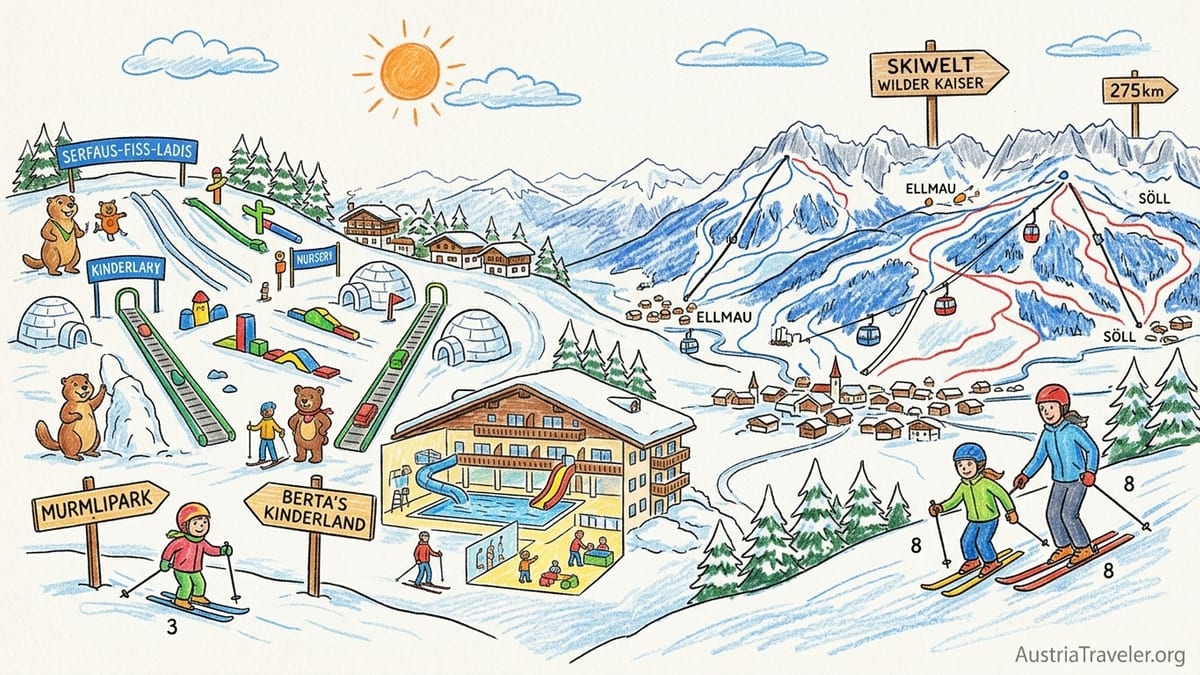
Across several winters in Austria, we travelled as a family of four with different combinations of ages and abilities: a pre-schooler aged 3 almost 4 on their first skis, an early primary school child aged 6 to 7 progressing from snowplough turns to confident blue runs, and later the same children as 8 to 10-year-olds starting to explore reds and small fun parks. Those stages changed what we actually used in each resort and how useful the huge ski areas really were.
In the Serfaus-Fiss-Ladis region in Tyrol, which markets itself clearly as a “family winter paradise”, our 3-year-old started in Murmlipark and Murmli’s beginner programs in Serfaus while the 6-year-old joined a children’s group lesson on the nearby Kinderschneealm plateau. The ski school offers dedicated beginner zones such as Berta’s Kinderland and Murmlis Kinderalm that combine ski teaching with play on around 45,000 square metres of children’s area, complete with conveyor belts, igloos and themed obstacles. That scale mattered because it meant our youngest never had to venture onto regular pistes in the first days, but from an adult’s perspective it is still essentially one big, well-organised nursery zone rather than “extra kilometres” of skiing.
By contrast, our first trip to the SkiWelt Wilder Kaiser – Brixental area in Tyrol, which promotes 275 kilometres of pistes and 22 ski schools, coincided with the children being slightly older: 5 and 8. The older child could already ski most blue runs and some gentle reds, while the younger one was strong enough after two days of lessons to link turns on easy blues near the village. That meant we could use more of what SkiWelt sells in its brochures: long family-friendly descents between villages, easy-access blue runs above Ellmau and Scheffau, and child-friendly chairlifts with safety bars on many main routes.
What we found again and again is that under about age 6, even with excellent children’s areas, the actual skiable range of a child is very small. A 3 or 4-year-old in Austria will typically do 2 to 3 hours of gentle skiing per day, broken by snack and warm-up breaks, much of it within one fenced-off beginner zone. Once the children reached 7 to 10 and were comfortable on long blue runs, the size of the ski area began to matter, but even then only in the parts of the week when everyone’s energy levels and the weather aligned.
Ski School Drop-Off, Lesson Duration and What Really Happened
At Serfaus-Fiss-Ladis, we enrolled the 3-year-old in the Murmli ski program that takes children from age 3 in dedicated beginner zones like Murmlipark and Berta’s Kinderland. Sessions were offered as half days and full days; we chose half days of approximately 2.5 hours in the morning because our child still needed an afternoon rest. The older sibling, aged 6, joined a full-day children’s group at the Kinderschneealm, with lesson times around 10:00 to 12:00, a supervised lunch stop, and then 13:00 to 15:00 on snow. Current price lists for Berta’s Kinderland show multi-day children’s group lessons in the low to mid hundreds of euros per week depending on duration, which is broadly in line with what we paid, and those prices include use of the children’s area and its practice lifts.
The advertised convenience at Serfaus-Fiss-Ladis largely matched reality, but there were important details. The ski school offices and meeting points are close to the main lifts, and the children’s areas have heated rooms, family toilets and dedicated lunch spaces. That meant our morning routine was manageable: a 5 to 10 minute walk or short underground ride from our hotel in Serfaus to the Komperdellbahn base, handover at the ski school flag, a quick toilet stop in their own facilities and the children were gone. Hotel staff at some family-focused properties such as Löwe & Bär in Serfaus even offer escort services to Murmlipark for children in ski school, with childcare hours that can stretch from morning to evening, which reduces parental juggling.
At SkiWelt, the picture depended much more on which village we chose. In Ellmau, for example, the ski school meeting point for beginners is directly by the valley nursery slopes with magic carpets, a small kids’ area and nearby toilets in the base building. Lesson blocks were usually 2.5 to 3 hours in the morning, with optional supervised lunch and afternoon add-ons, similar in length to Serfaus-Fiss-Ladis. Where SkiWelt differs is the spread of its villages: if you stay further from the main nursery area, you might have a 10 to 15 minute walk or rely on a ski bus to get to the meeting point with all the gear and children in tow.
In both regions, our experience was that younger children coped best with half-day lessons. On several days, our 3-year-old in Serfaus finished the morning session tired and emotional, even with warm-up breaks and hot chocolate in the Murmli rest cabin. Forcing a full-day lesson would have ended badly for everyone. For the 6 to 8-year-old, full days were possible from midweek once legs had adjusted, but any tiredness, cold or a minor crash could bring tears and a request to stop early, so we learned to treat the published lesson times as a maximum rather than a target.
Nursery Areas, Lift Safety and Morning Gear Chaos
The quality and layout of the beginner and nursery areas made or broke our mornings. Serfaus-Fiss-Ladis invests heavily in this, with Berta’s Kinderland in Fiss and Murmlis Kinderalm and Murmlipark in Serfaus providing wide, gentle slopes, several magic carpets, child-sized drag lifts and themed zones with characters from the resort’s kids’ brand. The children’s areas have their own small lifts that are free when combined with the local children’s pass for youngest guests, plus family toilets, changing rooms and warm indoor spaces right on site. That design meant that once we had navigated the morning bootroom, our children could spend almost the entire lesson without going near a big chairlift.
Lift safety becomes more of a concern once children graduate onto main pistes. SkiWelt has invested over time in modern lifts, including chairlifts with child safety bars and, on some routes, adjustable seats to ensure smaller children can sit securely. In practice, we still needed one adult to sit next to the smallest child to check the bar was down, helmets were forward and poles were secured. On busy school holiday weeks, loading large gondolas with families, buggies and backpacks could feel hectic, so we learned to avoid peak-times especially at base lifts between 9:30 and 10:30.
The unglamorous question of gear transport is where dedicated family hotels near the slopes made a big difference. In Serfaus, we stayed once at a mid-range hotel about 5 minutes’ walk uphill from the village’s small underground stop. That meant carrying two pairs of children’s skis, poles, helmets and sometimes a sled, as well as our own gear, down to the station each morning. With a 3-year-old, the walk back at lunchtime turned into a slow, stop-start procession. By contrast, on a later trip we chose a hotel in Fiss with its own ski depot lockers directly at the Schönjochbahn base station. Being able to leave four sets of skis, boots and helmets by the lift saved at least 20 minutes every morning and removed most arguments about who carried what.
For families reading resort brochures, the important lesson is that “ski-in ski-out” or “close to the lift” should be checked very carefully on a map. In larger areas like SkiWelt, accommodation can range from slopeside hotels with boot rooms just above the nursery slope to guesthouses that require a 10-minute bus ride. In Serfaus-Fiss-Ladis, the compact villages and extensive beginner zones mean that many properties are within walking distance of something skiable, but elevation and the route’s steepness matter when tiny legs are involved.
Lunch Logistics, Toilet Breaks and Afternoon Tiredness
Every family ski day is really a chain of meal and toilet stops. At Serfaus-Fiss-Ladis, a thoughtful detail is the presence of child-friendly family restaurants and rest huts directly beside the children’s areas. Above Berta’s Kinderland there is a family restaurant that links to the kids’ zone, which meant we could collect the children from morning lessons and be sitting with a plate of fries and soup within minutes. The children’s areas themselves have small indoor spaces where instructors take kids inside for supervised lunch during full-day lessons, so parents do not always need to appear in the middle of the day.
Toilets were close enough in Serfaus-Fiss-Ladis that “I need to go now” did not become an emergency. In Berta’s Kinderland and on the Kinderschneealm, there are family toilets and changing facilities, and the nearby lift buildings on the plateau also have restrooms. That meant that our 3-year-old, still uncertain about using strange facilities, could be whisked indoors quickly. By comparison, in parts of SkiWelt once we were away from the base area on a longer blue run, toilet stops depended on timed breaks at mountain huts, some of which became very crowded at peak lunch hours.
Afternoon tiredness was most obvious between ages 3 and 6. On one cold, windy day in Serfaus, our 4-year-old reached the top of an easy blue via a short chairlift and announced halfway down that they were “finished forever.” We ended up side-slipping and snowploughing slowly while the child alternated between crying and being towed by the ski pole. That episode shaped the rest of the week: after lunch we stuck to conveyor belts and the flat lower part of the kids’ area, and any plan to explore more of the mountain with the older sibling had to involve one adult skiing close to the beginner zone while the other enjoyed longer runs.
At SkiWelt with slightly older children, tiredness showed as loss of concentration on the last run home. The long home runs into villages like Ellmau or Söll are advertised as gentle, but in slushy afternoon conditions they can feel demanding for a 7 or 8-year-old. Our solution was to take a mid-afternoon hot chocolate break, and if necessary download by gondola with the younger child while the more confident skiers enjoyed one last descent. It is tempting in a large area to squeeze maximum vertical out of an expensive lift pass, but our most peaceful evenings happened on days when we stopped while everyone was still happy rather than exhausted.
Childcare, Non-ski Activities and Bad-weather Days
Austrian family marketing rightly emphasises that not every day needs to be about skiing. At Serfaus-Fiss-Ladis, the Murmli Crèche in Serfaus offers childcare for very young children who are too small or too tired for ski school, and the resort promotes a range of non-ski activities including winter walking trails, toboggan runs, evening shows by the ski school and indoor play areas. For us, the on-mountain sledding and the small winter playgrounds near the village were essential on storm days when chairlifts closed or visibility on the plateau deteriorated.
The child-focused hotels in Serfaus, including specialist family properties, played a big role in filling afternoons. Many provide indoor pools with warm water and simple slides, supervised playrooms and early children’s buffets. Our children remember the Pirates’ water world at one Serfaus hotel as clearly as they remember the ski lessons themselves. After lunch they would swim for an hour, nap or rest with a film in the room, and only then venture outside again for a gentle sled run. The ability to shift a day’s focus away from skiing without leaving the hotel building was a major reason we felt Serfaus-Fiss-Ladis worked so well for the under-8 age group.
In SkiWelt, the non-ski infrastructure varies by village. The Wilder Kaiser tourism region around Ellmau, Söll, Scheffau and Going promotes all-day childcare at mountain and valley locations, along with children’s miniclubs that run in parallel with adult skiing. These services, according to regional information, are designed so that parents can explore the 275 kilometres of pistes while children play or take first steps on skis under supervision. In practice, that meant we could register our 5-year-old for a mix of indoor and outdoor play on one particularly wet day, freeing up several hours for us to ski higher, while the older child joined a reduced ski group on the lower, better-sheltered slopes.
Non-ski activities in SkiWelt tended to be more spread out: sled runs above Söll and Ellmau, ice skating in nearby towns, and swimming pools either in hotels or in regional leisure centres. We appreciated the variety once the children were old enough to cope with a short bus ride or a walk after skiing. With toddlers, however, the concentration of activities directly in the Serfaus-Fiss-Ladis villages felt easier. Families planning bad-weather contingencies should check not only what exists in the region, but also how far it is from their hotel room in winter boots with a tired child.
Did We Use All Those Kilometres of Slopes?
Both Serfaus-Fiss-Ladis and SkiWelt highlight their impressive terrain figures in official descriptions: Serfaus-Fiss-Ladis offers over 200 kilometres of pistes with 214 kilometres frequently cited, while SkiWelt Wilder Kaiser – Brixental advertises around 275 kilometres of pistes across nine linked villages. On paper, these numbers promise days of exploration. With children in tow, our actual use looked very different.
In Serfaus-Fiss-Ladis on the trip when our children were 3 and 6, we estimate we skiied maybe 25 to 35 kilometres of unique terrain across the whole week, mostly on the plateau above Serfaus and the blue and easy red runs feeding into the main lifts. The 3-year-old spent nearly all their time inside Berta’s Kinderland and Murmlipark. The 6-year-old’s ski school ventured onto green and blue slopes just above the Kinderschneealm but rarely crossed into the Fiss side of the area. The ski pass granted access to the entire network, but as parents we were paying for hundreds of kilometres that our family simply did not touch because the children were not ready.
On a later visit to SkiWelt with the children at 7 and 10, we used more of what our passes bought. The older child specifically wanted to “ski to another village,” so we planned a day travelling from Ellmau towards Söll and back, using a chain of blue and easy red runs. Even then, we only covered a small fraction of the 275 kilometres and consciously skipped the most distant sectors because we were always watching the clock for the latest safe time to start heading home with children whose energy might crash at any moment. The younger child’s ski school used only a modest cluster of blue runs above our home village and never ventured into the far reaches of the network.
From a value perspective, we concluded that for children under about 8 who are still limited to nursery slopes and a handful of blues, the headline size of a ski area is largely irrelevant. What matters is the quality and convenience of the beginner infrastructure and whether parents can make short, satisfying excursions while lessons are running. Larger areas become more useful once children are strong enough for long, linked runs and have the stamina for full days on snow, typically from age 9 or 10 upwards in our family. Even then, we never reached a point where we covered an entire mega-area, so when budgeting, it is worth asking whether a mid-sized Austrian family resort with 70 to 120 kilometres of pistes might deliver the same family satisfaction at a lower pass cost.
Family Restaurants, Evening Meals and Where We Actually Ate
Meals with children on a ski holiday involve more than Austrian specialities and mountain views. On the slopes of Serfaus-Fiss-Ladis, we were struck by the number of designated family restaurants and kid-friendly corner areas. Official materials list over 30 family-friendly restaurants in the ski area, and our experience matched that: self-service cafeterias with children’s menus, play corners and high chairs were common near the upper lift stations. For lunch with small children, this meant we could step straight in from the children’s zones, find spaghetti or fries within minutes and be back outside before the younger one lost patience.
In the evenings, the family hotels in Serfaus generally offered early children’s buffets starting around 18:00, with simple dishes alongside lighter adult options. Because childcare hours in some hotels stretched from late morning until late evening, we could sometimes hand the children over to the kids’ club after main courses and finish a dessert in relative calm while they joined supervised play. That kind of on-site setup meant we rarely used village restaurants, an important point when comparing glossy lists of local gastronomy with what families actually do after a full ski day and bedtime routines.
In SkiWelt, on-mountain restaurants were plentiful around main lift hubs, but we saw fewer explicitly branded family venues right beside the beginner zones, and more traditional huts with standard menus. They still worked for us, but ordering took longer and noise levels at peak times were higher. With older children, this mattered less, yet we noticed that parents with toddlers often gravitated to the quieter spots at the edges rather than the main terraces.
Evenings in SkiWelt were shaped more by apartment living and local village restaurants, simply because there are proportionally fewer all-inclusive family hotels with on-site childcare compared with Serfaus-Fiss-Ladis. In Ellmau, for example, we ate in our accommodation several nights and walked out to a pizza place or gasthof once or twice. This suited us when the children were 7 and 10 and could manage a short walk after dark, but when they were younger, the self-contained ecosystem of a Serfaus family hotel felt easier.
Which Resort Type Worked Best for Different Ages?
Looking back at several years of trips, our conclusion is that two broad types of Austrian ski holiday suit different stages of family life. For families with pre-schoolers and early primary children, especially where at least one child is 3 to 6 and on their first or second week of skiing, dedicated family resorts like Serfaus-Fiss-Ladis delivered the smoothest experience. The reason was not only the quality of the children’s areas and ski schools, but the entire village infrastructure built around families: car-free or low-traffic streets, underground transport, numerous family hotels with long childcare hours and water parks, and ski-school logistics integrated into daily life.
For that age group, we genuinely did not need more than a modest slice of the 214 kilometres of pistes Serfaus-Fiss-Ladis offers. What we needed were short walking distances, easy drop-off, nursery slopes with nearby toilets and warm rooms, and backup activities indoors for bad weather. The fact that the resort’s promotional material mirrors those priorities, with heavy emphasis on Berta’s Kinderland, Murmli worlds, crèches and family restaurants, felt aligned with our real usage.
Once our children reached around 8 to 10 and could ski long blue runs and some reds, a larger interconnected area like SkiWelt came into its own. The promise of “skiing to another village” and collecting different pistes each day suddenly resonated. The older child liked seeing new valley stations and comparing gondolas. The younger one enjoyed repeating favourite blue runs above our home village and occasionally linking to neighbouring areas. The wider choice of intermediate terrain meant that parents who still love skiing could explore more while children were in lessons or childcare.
The trade-off is that parents of younger or mixed-ability children should be realistic about how much of a mega-resort they will use and whether the extra size is worth any additional complexity in transport and childcare arrangements. In our case, the best combination for school-age children was a base in a SkiWelt village with easy walkable access to nursery slopes plus an accommodation either directly at the lift or with secure on-site gear storage. For toddlers and first-timers under 6, we would return to Serfaus-Fiss-Ladis or similar purpose-built family hubs without hesitation.
The Takeaway
The glossy figures for Austrian ski areas are impressive, but family ski holidays live or die in the details: where the ski school meets, how long children are outside before a hot chocolate, how quickly you can reach a toilet, what happens when one child wants to stop early and whether you have to carry four sets of skis uphill after lunch. In Serfaus-Fiss-Ladis, we found a resort where almost every element, from the Murmli children’s worlds to family restaurants and hotel childcare, is designed around making those details easy. We paid for more terrain than our young children used, but we gained calm mornings, short walks and simple handovers.
In SkiWelt, we discovered the appeal of a large, varied ski area once our children could truly explore it. With 275 kilometres of pistes and multiple family-oriented services and childcare offers in the Wilder Kaiser villages, it gave us room to grow as a family. That size did not matter at all when the children were 3 and 5, and mattered a great deal when they were 8 and 10. The key was choosing accommodation close to beginner slopes and accepting that some of the furthest corners of the map would remain unexplored.
For families planning an Austrian ski trip today, the most useful question is not “How many kilometres of pistes does this resort have?” but “With our children’s ages and ski levels, how much of this are we realistically going to use, and how easy will the logistics be?” If your children are under 8, prioritise resorts with concentrated family infrastructure like Serfaus-Fiss-Ladis, strong ski schools from age 3, and genuine on-site childcare and indoor play. If your children are already comfortable on long blue runs and asking to venture further, then a bigger interconnected area such as SkiWelt Wilder Kaiser – Brixental starts to earn its marketing claims.
Either way, success lies in matching the resort’s promises with your family’s reality, building in margin for tired legs and bad weather, and remembering that the memories your children carry home are as likely to be of sledding at dusk or splashing in a hotel pool as of any particular peak they skied.
FAQ
Q1. What is the best Austrian ski resort for families with children under 6?
For children under 6 who are just starting to ski, resorts with concentrated family infrastructure such as Serfaus-Fiss-Ladis work particularly well. They combine large, enclosed children’s areas, ski schools that accept three-year-olds, nearby toilets and warm rooms, and hotels with on-site childcare and pools, which reduces stress on both parents and children.
Q2. At what age do Austrian ski schools usually start taking children?
Most Austrian ski schools accept children from around age 3 into beginner or play-based ski programs. Some crèches and miniclubs offer care for younger toddlers without formal skiing, while regular group lessons on open pistes often begin around age 4 or 5. It is important to check the specific minimum age and format with the ski school in your chosen resort.
Q3. Are large ski areas like SkiWelt worth paying for with young kids?
With children under about 7 who mainly use nursery zones and a few short blue runs, parents often pay for far more terrain than the family will use. The value of large areas such as SkiWelt increases once children can ski long runs and have the stamina for full days, typically from around age 9 or 10. Before that, convenience and beginner infrastructure matter more than total kilometres.
Q4. How long should ski lessons be for a 3 or 4-year-old?
For three and four-year-olds, half-day lessons of around 2 to 3 hours are usually enough. At that age, children tire quickly in cold weather and may become overwhelmed in longer sessions. Many Austrian resorts therefore offer flexible formats where the youngest children can start with short mornings and only move to full days once they show they are ready.
Q5. What non-ski activities are available for bad-weather days in these resorts?
In Serfaus-Fiss-Ladis, families can turn to indoor hotel pools, supervised playrooms, winter walking paths, sledding and occasional evening shows. SkiWelt’s Wilder Kaiser villages offer sled runs, some local swimming pools, children’s clubs and nearby attractions that are reachable by bus or car. Checking how close these activities are to your accommodation helps when planning bad-weather backups.
Q6. How important is it to stay in a hotel right next to the lift?
For families with small children, being close to the main lift or nursery slope makes mornings easier. A slopeside hotel or one with a ski depot at the lift saves carrying multiple sets of skis and walking far in boots. In compact, family-focused resorts it may be manageable to walk a few minutes, but in larger areas with spread-out villages, proximity to the beginner zone can significantly reduce daily stress.
Q7. Is childcare available if my child is too young or too tired to ski?
Many Austrian family resorts provide dedicated childcare options alongside ski schools. Serfaus-Fiss-Ladis, for example, offers a crèche for very young children and supervised indoor and outdoor play. The Wilder Kaiser region around SkiWelt promotes miniclubs and childcare both in the valley and on the mountain. Availability, age limits and opening hours vary, so it is worth confirming details before booking.
Q8. What happens if one child wants to stop skiing earlier than the rest?
Families often split up, with one adult returning to the village or hotel with the tired child while the other continues skiing with more energetic siblings. Choosing accommodation close to lifts and nursery slopes, and resorts with easy download options by gondola, makes these early exits smoother. It is wise to agree a flexible plan in advance so no one feels pressured to continue skiing when they have had enough.
Q9. How much ski area do older children and teenagers typically use?
Older children and teenagers who are comfortable on blue and red runs can cover much more of a ski area. In large domains such as SkiWelt, they might explore several linked villages over a week, but even then families rarely ski every piste. Teenagers may also seek terrain parks and longer circuits, which large interconnected areas are better able to provide.
Q10. Should I choose a family hotel with on-site childcare or an apartment in the village?
The choice depends on your children’s ages and how much support you want. Family hotels with on-site childcare and pools make life easier with toddlers and early primary children, allowing parents some downtime while children play safely. Apartments can suit families with older, more independent children who need less structured entertainment and are happy with simple evenings in or occasional walks to restaurants.