

It took me a few winters to trust that I could ski Austria properly without ever touching a steering wheel. I grew up thinking an Alpine holiday meant rental cars, snow chains and hunting for parking in the dark. Then I started stringing together trips that relied entirely on planes, trains, resort transfers and ski buses. What surprised me was not just that it worked, but how often the car would actually have made my days slower, not faster. What follows is what I learned doing real journeys into Austrian ski country car free, from airport platform to hotel ski room and back out again.
Landing in the Alps Without a Car: First Impressions
My first fully car free Austrian ski trip started where many do: at Munich Airport, skis in a bag, boots in a backpack, ticket for the train to St. Anton am Arlberg on my phone. Munich is in Germany, but the rail connection straight across the border into Tirol is one of the most useful gateways for western Austrian resorts. A published timetable from St. Anton’s tourist office shows coordinated services from Munich Airport via Munich East and Innsbruck to St. Anton in roughly four and a half to five hours depending on the connection, with only two changes. I followed that pattern: airport suburban train, long distance Austrian Railjet, then a final hop along the Arlberg line.
Physically, traveling with skis started at the airport platform. German and Austrian long distance trains have wide doors and dedicated racks in some coaches, but boarding with a 180-centimetre ski bag still required paying attention. I found that stepping into the middle of the carriage rather than crowding the doors made it easier to load the skis horizontally into the luggage zones and keep boots and smaller bags overhead. None of this felt elegant, but it was manageable solo, and families with multiple pairs of skis were doing the same around me.
What struck me early on was how much of the stress had moved from driving decisions to packing decisions. Without a car boot to swallow everything, every extra item had to be carried through stations and on to buses. That first trip, hauling my own skis, I needed two hands whenever boarding, which meant I could not easily buy food, keep a coffee in hand or help anyone else with luggage. It was still a relief to watch snow appear outside the train window instead of crawling up a motorway, but there was a trade-off in personal effort.
At St. Anton am Arlberg railway station, the car free advantage became obvious. This is a mainline station right in the village, used heavily in winter for ski traffic with direct services from Germany, the Netherlands and other parts of Austria. Step off the train and you are within a few minutes’ walk of both the pedestrian village centre and the main Galzigbahn and Rendlbahn lift stations. Outside the station forecourt I found local and regional buses, including the Landbus line running toward St. Christoph, Zürs and Lech, along with ski buses fanning out to nearby hamlets. For the first night, my accommodation was five minutes on foot along flat pavement, even with skis. It was my first hint that in some Austrian resorts the rail station is essentially the car park, but closer.
Train, Bus and Boot: Real Transfers Into Resort VIllages
On later trips I experimented with other arrival patterns to see how they worked in practice. One winter I flew into Innsbruck, the small Tyrolean city ringed by lifts and served by both an airport and a central rail hub. From the airport it was a short city bus ride to Innsbruck Hauptbahnhof, where I boarded a regional bus toward the Stubai valley. Official material for the Stubai area notes a direct bus line from Innsbruck main station into the valley, continuing all the way up to Mutterberg below the Stubai Glacier lifts. Skiers staying at valley villages like Neustift and Fulpmes simply step off at the corresponding stop and either walk or change to a local ski bus.
In my case I stayed in Neustift, in a guesthouse about 400 metres from the main bus stop. That walk with luggage felt very different from dragging a suitcase through a city. Snow banks lined the pavements and there were compacted icy patches, but it was all on level ground. I had deliberately rented skis locally here, so my hands were free apart from a rolling bag and a backpack. The bus dropped me at the village centre, I checked in, and the next morning I walked in ski socks and trainers to the rental shop, picked up skis and boots, and stepped straight on to the ski bus that pulled in outside twenty minutes later.
Another journey took me by train from Vienna to the Salzburg region, changing to a regional train toward the high valley near Zell am See. Austrian tourism information often highlights these connections, noting that resorts like Kitzbühel and Zell am See have stations either in town or nearby, with local buses and occasional ski trains bridging the last kilometre or two. On that trip I took a mainline ÖBB train to Salzburg, then a regional service down the Salzach and on to Zell am See, where the station sits a short walk from both lakefront hotels and the lower CityXpress gondola. The walk from platform to hotel door was under ten minutes on shoveled pavements. With only one suitcase, one boot bag and rented skis waiting in town, it felt no more demanding than navigating a mid-size European city.
Across these itineraries the pattern was consistent: the long legs by train were comfortable and simple as long as I chose departures with a reasonable number of changes, and the last kilometres into resorts were handled by well publicised ski buses or short walks. The main variable was how fragmented the local layout was between station, accommodation, lifts and rental shops. Where everything clustered within a compact village core, I barely noticed the absence of a car. Where lodging and lifts were stretched along a valley, the bus schedules and the weight of my bags suddenly mattered a lot more.
Luggage, Skis and the Question of Renting Locally
After my first trips I started systematically comparing how it felt to bring my own skis versus renting at the resort when traveling car free. On that first Munich to St. Anton itinerary, traveling with skis, I had one large wheeled duffel, one ski bag and a boot backpack. Moving between platforms required either making two trips or carefully balancing the ski bag on top of the wheeled bag. Elevators helped, but when a connection involved a stair-only underpass I had to shoulder the skis and drag the suitcase separately. Total travel time did not change, but each change felt like a short workout.
The following winter, heading again into Tirol, I deliberately left my skis at home and booked rental packages in advance. For a seven day stay, booking mid-range piste skis in St. Anton through one of the major chains that cluster near the Galzigbahn base cost me in the region of 150 to 200 euros, including poles and in some cases the option to swap to a different model midweek. In another trip to the Stubai valley, a six day rental in Neustift for an all mountain ski package came in just under 160 euros. Prices vary by season, but these figures are typical for larger Austrian resorts that publish their winter tariffs clearly.
In exchange for that rental cost, the travel days were noticeably easier. On the same Munich Airport to St. Anton route, with only a suitcase and boot bag, I could keep one hand free most of the time. Boardings were faster, and squeezing into a busy carriage became less stressful. On arrival, I could walk the 600 or 700 metres from the station to a pension on the western edge of St. Anton without the sideways bulk of a ski bag clipping snowbanks or other pedestrians. The morning after arrival, I strolled in my own boots to a rental shop by the lifts, picked up skis that were tuned more recently than my own, and skied out.
From a pure cost perspective, whether this trade is worth it depends on the length of stay and how much you value convenience. If I had driven my own car from, say, Munich to St. Anton, Austrian motoring organisations estimate fuel at perhaps 30 to 40 euros return for a petrol hatchback over the 260 kilometre round trip, plus 10 euros for the Austrian motorway vignette and around 15 to 20 euros per day for covered hotel or public parking in a resort like St. Anton or Lech. Over a week the car costs can easily reach 150 to 200 euros or more once parking and fuel are counted, not including winter tyres or chains if a rental car is involved. Against that backdrop, investing a similar amount into local ski rentals while traveling by train feels less extravagant and may still leave the total trip cost comparable or even lower than driving.
Physically, the benefit of renting locally becomes larger as the group shrinks. A solo skier carrying their own skis will probably cope fine, but add a child and you suddenly have two sets of skis and maybe a sled. On a later family trip into a smaller Tyrolean resort, we chose to rent everything in the village precisely to avoid shepherding multiple ski bags through crowded trains. That single packing decision made the difference between dreading every connection and enjoying the novelty of watching snowy farmland and church towers roll past the windows.
Car-Free When the Resort Is Compact vs Scattered
Not all Austrian resorts feel equally friendly to car free visitors, and the deciding factor often is not the quality of the rail or bus link but how the village is laid out. St. Anton itself is a relatively compact strip along the valley floor, and if you stay between the station and the Galzigbahn you can do almost everything on foot or with the frequent local ski buses that loop from the west terminal through town. The base lifts, ski rental shops, supermarkets and many hotels are within a radius of roughly one kilometre. Even walking in ski boots from a guesthouse to the lifts rarely took me more than ten to fifteen minutes, and the pavements were cleared promptly after snowfalls.
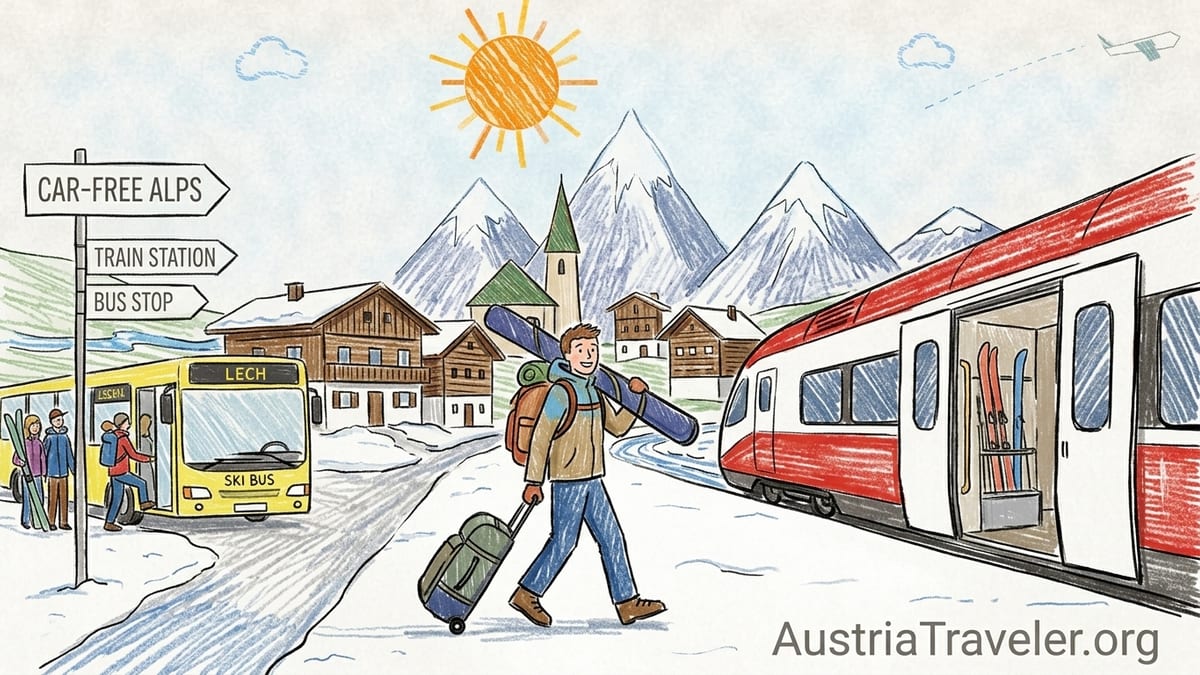
Lech and Zürs on the Arlberg network showed the same pattern with a twist. The official information for Lech Zürs lists Langen am Arlberg and St. Anton am Arlberg as the nearest train stations, with regional bus lines connecting them to the resorts in about twenty to thirty minutes. In practice I arrived by train to St. Anton, walked out to the bus stops in front of the station and boarded the yellow regional bus toward Lech, skis stored upright in the rear rack. Lech is more linear than St. Anton, stretching along the river, but if you book accommodation near the village centre the walk to the main lifts is still modest and often done in ski boots. Where it became trickier was when friends chose chalets at the edges of the village; suddenly, catching the internal village bus or accepting a ten to twenty minute walk in boots on packed snow was mandatory.
In the Stubai valley the issue was distance along the valley. Many guesthouses market themselves as ten minutes from the ski bus stop, which might be accurate for a brisk walk in regular shoes but feels longer in full gear. On days when I stored my skis overnight at the mountain station and walked to the bus in regular shoes, the system worked well: bus to glacier, cable car, skis waiting in a locker next to the boot room. On days when I carried skis down to the village and back, any detour or delay in the bus timetable made itself felt in tired hands and shoulders.
Other Austrian resorts I visited were halfway houses. Zell am See has a station close to the town centre and lifts, but if you stay around Kaprun for the Kitzsteinhorn glacier you will rely on frequent buses running between Zell, Kaprun and the gondola bases. A sustainability page for Kitzsteinhorn stresses that visitors can come car free by train to nearby stations and then use public buses to Kaprun and the glacier, underlining that the region wants fewer cars. In practice that meant that once I set my watch to the bus timetable and accepted that I would not be able to dash back for a forgotten glove, the system felt predictable. Still, compared to walking straight from a station to a lift, these valley systems introduce more moving parts.
What I learned is that “car free friendly” is less about the size or fame of the resort and more about how many separate places you have to connect daily. A compact, well organised village like St. Anton or a base-town plus ski-bus combination with tight schedules can feel smoother without a car than a scattered series of hamlets even if they sit under great mountains. When booking, I now study not just the rail map but also the village plan: Where is the station relative to my hotel, the ski hire, the lifts and the ski bus stops?
Departure Day: Storage, Showers and the Long Ride Home
Returning home without a car introduces its own rituals. In car based trips, I was used to checking out, loading the boot, skiing a few final hours and then changing in a car park before driving to the airport. With trains and buses, I had to think harder about where my luggage and boots would live between check out and departure. Most Austrian hotels and pensions I stayed in provided a luggage room after check out at no cost, alongside the usual heated ski room. On my final day in St. Anton, for example, I left my suitcase in a locked room at the pension, walked five minutes in trainers to the lifts with skis on my shoulder, and after skiing came back to shower in a communal bathroom before collecting everything and walking to the station for the late afternoon train.
In larger resorts, lift companies often offer paid lockers at valley stations, some large enough to swallow both skis and small bags. In the Stubai valley, I used rental lockers at the glacier base station on several days, paying a modest daily fee to leave skis and boots overnight. On the final morning, I checked out of the guesthouse, took all my baggage onto the bus, locked the luggage and boots at the base station, and skied in ordinary shoes and rental boots stored up the mountain. After lunch I changed back, reclaimed my bags and boarded the bus to Innsbruck with dry socks and no awkward parking-lot costume change.
The main stress point on departure days was timing the last lift down with the bus or train schedule. In St. Anton, with frequent late afternoon trains heading east and west along the valley, there was enough redundancy that being delayed by a final run simply meant catching the next service. In the Stubai valley, where the bus from the glacier to Innsbruck follows a more fixed pattern, missing one departure could add an hour to the journey. On one trip, a wind hold higher up the glacier caused a queue for the gondola back down to the bus stop, which in turn made me narrowly miss the bus I had planned. I still made the onward train, but only because I had allowed a generous buffer in Innsbruck. Traveling car free taught me that in the Alps, buffers are as important as ticket reservations.
There was also a psychological adjustment: without a car, you surrender some flexibility but gain the ability to rest properly in transit. After my final ski day looking across to the Valluga above St. Anton, I boarded a late afternoon Railjet toward Munich and watched other skiers do the same. Boots were unbuckled, helmets went into overhead racks, and someone quietly ate a sandwich instead of crawling through a motorway tunnel. My bag sat heavy by my legs, but I did not have to stay alert for ice on the road.
Does Car-Free Travel Really Save Time and Money?
Comparing door to door times between car based and car free trips is tricky, because airport formalities and weather can dominate everything. Still, after a handful of itineraries certain patterns emerged. From Munich Airport to St. Anton by train, following the tourist office timetable, I typically saw total travel times of about four and a half to five hours from aircraft door to hotel reception, including one or two train changes and a short walk in the village. The same route by rental car, according to mapping services, can take around three hours in good conditions, but that ignores the time spent at the rental desk, finding the car, checking for damage, and queuing in traffic near the resort on busy Saturdays. On one peak-season Saturday I left Munich Airport by train as a friend picked up a car; I arrived in my pension only about forty minutes after he arrived at his, even though the theoretical driving time was shorter.
Costs also evened out more than I expected. A Railjet ticket from Munich Airport to St. Anton, booked in advance with saver fares, can be under 60 euros one way in second class, more if bought last minute. A small rental car with winter tyres, picked up at Munich Airport for a week in high season, frequently costs several hundred euros before fuel and tolls. The Austrian motorway vignette, required for using most motorways, adds around 10 euros for the ten day version, and fuel for a return journey plus local driving can easily add another 60 to 80 euros depending on vehicle and prices. Parking in Austrian ski resorts ranges from free in peripheral open lots to 15 or 20 euros per day for covered parking garages close to lifts, and some hotels charge a nightly fee as well. By the time those numbers were tallied, my train plus ski bus combination was competitive, and in some cases clearly cheaper, particularly as a solo traveler.
Where the car still held an advantage was in off-peak arrival times and side trips. Reaching a small side valley late at night by public transport can be awkward or impossible, while a car simply continues up the road. On one trip, I wanted to combine a few days in St. Anton with a spontaneous day in a smaller neighbouring area that required two different buses and a long wait at a junction; with a car, this would have been an easy half-hour drive. Car free, I chose to spend that day exploring a different sector of the main Arlberg area instead. That was not a hardship, but it did limit my improvisation.
The other friction point is crowding. Ski buses leaving resort villages between 8 and 9 in the morning can be standing room only on busy days, particularly on weekends when day trippers from nearby cities arrive. With a car, you can time an early or late start and park at a different base station; with public transport, you simply stand a little closer to your neighbours. Personally I preferred this to inching along an icy road toward a car park, but it is a real consideration for families with young children who may find packed buses stressful.
The Takeaway: Who Should Go Car-Free, and When a Car Still Helps
After several winters spent threading together Austrian ski trips entirely on public transport, I do not view car free skiing as a moral issue so much as a practical choice that suits some scenarios very well and others less so. As a solo traveler carrying only my own gear, the combination of long distance trains, regional buses and well organised ski buses worked better than expected. I could read, sleep or work on trains, walk from stations to centrally located pensions, and use free or low cost ski buses to reach lifts each morning. Renting skis locally instead of dragging my own through stations made these trips materially easier without increasing the overall budget dramatically once I factored in the costs of car rental, fuel, tolls and parking.
For couples and small groups staying in one major resort for a full week, especially places like St. Anton, Lech, Innsbruck plus Stubai or Zell am See, I would actively recommend a car free approach. The infrastructure is geared toward it, with clear signage from stations to bus stops, luggage rooms in almost every hotel, and ski storage options at valley or mountain stations that take the pain out of departure days. Booking accommodation within a ten minute walk of the main lifts or a primary ski bus stop is the single most powerful way to make these trips feel smooth.
Families with young children and lots of gear face a more nuanced picture. If you are prepared to rent skis and perhaps even helmets and boots locally, and to pack each child’s kit in their own small wheeled bag or backpack, then a transfer by train and bus into a compact resort can still be realistic and even fun. Children tend to like trains, and not having a stressed parent driving in snow is a subtle but real safety benefit. Yet if your holiday style involves frequent side trips, afternoon sledging in a neighbouring village, or flexible departure times after nap windows, a car can still earn its keep, particularly in regions where ski buses are less frequent.
For groups of friends who plan to ski multiple different areas in one week, from big-name destinations to small local hills, the equation depends heavily on how tightly those areas are woven into the public network. In western Austria, where lines like the Arlberg railway and numerous regional bus routes connect many valleys, it is very possible to plan a car free “ski safari” as long as you respect timetables and book accommodation near stops. In other regions, where the last kilometres into side valleys rely on limited post buses, a car may still save substantial time.
Ultimately my biggest surprise was psychological. I went into my first car free Austrian ski trip half expecting hassle and compromise. What I discovered was that much of the stress I associated with winter driving vanished, replaced by gentler questions of connection times and packing lists. I still occasionally rent a car when I know I will be staying in scattered hamlets or chasing fresh snow at short notice, but when I picture an ideal, unhurried week carving pistes under blue Tyrolean skies, that image now begins not at a car rental desk, but on a station platform with skis waiting a short walk away.
FAQ
Q1. Is it realistic to reach major Austrian ski resorts using only public transport?
Yes. Resorts such as St. Anton am Arlberg, Lech (via bus from Langen or St. Anton), Kitzbühel, Zell am See and several Stubai valley areas are routinely reached by international visitors using a combination of long distance trains, regional buses and local ski buses, without renting a car at any point.
Q2. Does renting skis locally really make train travel easier?
In my experience, leaving skis at home and renting in resort made a noticeable difference. Without a long ski bag to manoeuvre through stations and on buses, boarding was quicker, hands were free to manage other bags, and walks from station to hotel were less awkward, especially on icy pavements.
Q3. How close are train stations to the lifts in Austrian ski towns?
It varies. In St. Anton the railway station is only a few minutes on foot from the main Galzigbahn and Rendlbahn lifts. In Zell am See the station is close to the town centre and lower lifts. For Lech and Zürs you alight at Langen or St. Anton and continue about twenty to thirty minutes by regional bus to reach the village and lift bases.
Q4. Are ski buses in Austria free for visitors?
Often, but not always. In several regions, ski buses are included when you hold a valid ski pass or local guest card from your accommodation. In others, especially for longer valley routes, there may be a small fare. It is worth checking the latest information from the local tourist office or your host before you travel.
Q5. What about luggage and ski storage on departure day without a car?
Most hotels and guesthouses I used in Austrian resorts offered a secure luggage room after check out, and many had dedicated ski rooms. Some lift stations and glacier bases also provide paid lockers large enough for skis and bags, which are particularly useful if you want to ski on the last day before an evening train or flight.
Q6. How do travel times by train compare with driving from airports?
From airports such as Munich or Vienna, trains to western Austrian resorts typically take a bit longer than driving in light traffic but are competitive once you factor in rental car formalities, road conditions and potential congestion. For example, Munich Airport to St. Anton might be around four and a half to five hours by train versus roughly three hours driving in ideal conditions.
Q7. Is car-free travel suitable for families with young children?
It can be, especially if you rent equipment locally and choose accommodation close to lifts or main ski bus stops. Trains offer space to move around, and families avoid the stress of driving in snow. However, crowded morning ski buses and fixed departure times can be challenging, so careful planning and realistic expectations are important.
Q8. What happens if I miss a bus or connection in a ski valley?
In larger hubs such as St. Anton or Innsbruck, services are frequent and missing one departure usually just adds a short wait. In side valleys or glacier access roads, buses can be less frequent, so missing a service might delay you by an hour or more. Building buffer time into transfers, especially on departure day, is essential.
Q9. Are car-free ski trips cheaper than renting a car?
For solo travelers and some couples, total costs for long distance train tickets plus local buses often compare favourably to car rental, fuel, motorway vignettes and parking, especially in peak season. For larger groups sharing a single vehicle, a car can work out cheaper on a per person basis, although it comes with added driving responsibilities.
Q10. What kind of traveler benefits most from going car-free in Austria?
Patience and flexibility help. Solo skiers, couples and small groups planning to stay in one well connected resort for a week are the best fit. They can take full advantage of Austria’s dense rail and bus network, enjoy relaxed travel days and avoid winter driving, all while having easy access to lifts and village amenities on foot.