


I thought I knew what my Austrian ski week would cost. I had checked the lift pass and a couple of hotel deals and felt quietly smug about my budgeting. Then I added in airport transfers, on-mountain lunches, rental boots, spa afternoons and a few too many schnapps, and the total bill told a very different story. This is a real breakdown of what I actually spent on a recent trip, what surprised me most, and how much you should realistically budget for an Austrian ski holiday in winter 2026/27.
The Trip: When, Where and Who Paid What
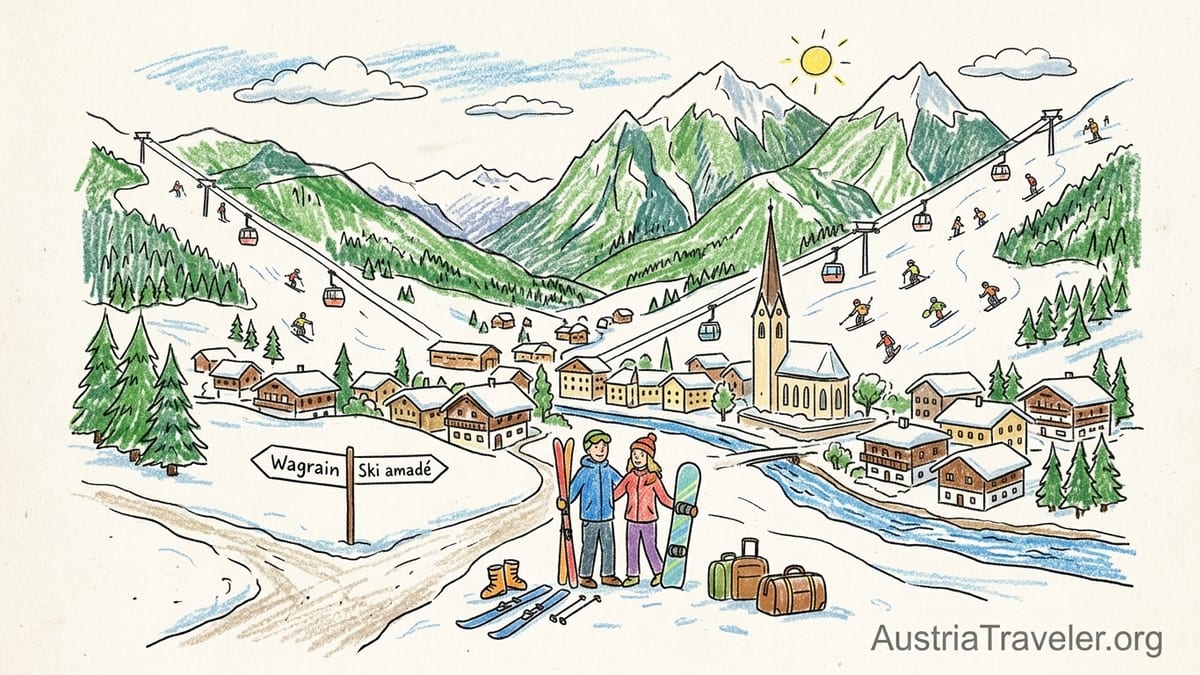
To make this concrete, let us start with the real trip that underpins the numbers in this article. In late January 2026, I spent six days skiing in the Ski amadé region of Salzburg, basing myself in Wagrain, one of the villages linked into Snow Space Salzburg. It was a classic mid-season week: Saturday to Saturday, six days on snow, travelling as a couple from London and sharing a double room.
We chose Wagrain because it sits between Flachau and St. Johann-Alpendorf, giving wide access to the Ski amadé area without the price tag of the most famous Austrian names such as St. Anton or Ischgl. The flip side is that it is not ski-in ski-out, and that choice had knock-on costs that became very obvious once I started totalling everything up.
All prices in this breakdown are what we actually paid for the 2025/26 winter, converted to euros where needed and rounded to the nearest whole euro for clarity. Where I give current examples for 2026/27, they are based on publicly advertised prices available at the time of writing and may change with demand, snow conditions and exchange rates.
Most importantly, this is one real-world example, not a national average. A week in Wagrain is not the same as a week in a tiny local hill in Upper Austria, or a peak-season blowout in Lech. Treat this as a framework and a reality check rather than a fixed template.
Getting There: Flights, Trains, Transfers and Cars
For our January 2026 trip, we flew from London Gatwick to Salzburg on a Saturday morning, returning the following week. Booked in September, return flights cost 190 euros per person including a checked ski bag shared between us. Had we waited until December for the same dates and times, similar flights were already showing closer to 260 to 280 euros per person, so booking early genuinely mattered here.
On arrival in Salzburg, we had three realistic options to reach Wagrain, roughly 70 kilometres away: a shared shuttle, a scheduled bus-and-train combination, or a rental car. We opted for a pre-booked shared transfer minibus that cost 70 euros per person return. It took around an hour and fifteen minutes door to door and dropped us directly at our hotel. For comparison, a week-long compact rental car from Salzburg Airport for the same dates, including winter tyres and basic insurance but without fuel, was quoted around 320 to 360 euros, plus roughly 60 euros in fuel for the week and 20 euros in parking fees at our hotel. That would have worked out slightly cheaper overall for two people but more stressful in heavy snow.
On a different trip earlier in the 2024/25 season to Schladming, I tried the train. From Salzburg Hauptbahnhof to Schladming, a pre-booked Sparschiene advance ticket with a Railjet connection cost about 25 euros per person each way in January 2025, plus a short taxi to the hotel that added another 15 euros. Comfortable, scenic and reliable, but with luggage changes that some families might prefer to avoid. For most visitors who fly into Salzburg or Munich, you should expect to pay between 50 and 100 euros per person return for transfers if you use a shuttle or train, or around 400 to 450 euros per week for a rental car including fuel, motorway vignette and parking.
Accommodation: The Biggest Line on the Bill
Accommodation was easily the biggest single cost of our Austrian ski week. In Wagrain we stayed at a three-star superior guesthouse a short walk from the Grafenberg gondola, in a double room on half-board (breakfast and dinner). Booked directly with the property in August for late January, the rate was 115 euros per person per night. For seven nights this came to 1,610 euros for two people, including a simple wellness area with sauna and steam room.
To sense-check that against other areas, I compared it with a self-catering apartment in Kaprun in April 2024, where a one-bedroom unit for two that I booked late in the season was 140 euros per night without meals. A nearby hotel in the same resort offered half-board supplements around 24 euros per person per night on top of the room rate during spring 2024. In higher-end resorts such as Obertauern or Lech, it is not unusual in the main February weeks to see four-star hotels charging well over 200 euros per person per night on half-board.
What surprised me most was how worthwhile half-board felt in Austria. Our evening meals were generous multi-course menus that made eating out elsewhere largely unnecessary, and the value compared with à la carte restaurant prices on the mountain was clear every time we saw 20 to 25 euros for a single main course. On a previous self-catering stay in Zell am See, I assumed cooking in would save a fortune. In reality, frequent “we are tired, let us just eat out tonight” decisions quietly pushed the total food budget above what half-board would have cost.
If you are trying to keep costs under control, think of accommodation as the lever with the biggest impact. Choosing a three-star in a satellite village rather than a four-star slopeside hotel in a marquee resort can easily halve this part of the budget. For a mid-season week in 2026/27, a realistic band for a comfortable but not luxurious stay in many Austrian resorts runs from about 80 euros per person per night in a basic guesthouse with breakfast up to 170 euros per person per night in a four-star hotel with spa and half-board.
Lift Passes and Dynamic Pricing: Why Timing Matters
Lift passes are the cost most skiers focus on first, and for good reason. For our six ski days in January 2026 in the Ski amadé area, we bought six-day adult passes online in November using the regional early booking system. The dynamic pricing meant that, booked early, our six-day passes came to 372 euros per person, which matched the lower end of the current band for 2026/27. For the coming winter, a six-day adult Ski amadé pass bought online can range roughly from 367.50 euros to 432.50 euros depending on the booking date and demand levels for your chosen week.
In practical terms, this meant that by committing a couple of months ahead, we saved about 50 to 60 euros each compared with walking up to the ticket window in a main-season week. Across two adults, that saving covered most of one person’s ski rental plus a decent mountain lunch. It also meant we locked in our dates with non-refundable passes, which carries some risk if work or weather changes your plans, although Ski amadé now offers an optional cancellation guarantee on online ski pass purchases for a small per-day fee.
Prices in other Austrian regions vary significantly. When I checked winter 2025/26 rates for Ski Arlberg, a six-day adult pass in the main season was around the mid-400 euro mark. Meanwhile, smaller, family-focused ski hills in Salzburg or Styria still advertise six-day passes well under 300 euros per adult outside peak school holiday weeks. The key points are that lift passes are not a single Austrian average and that dynamic pricing is now standard in the big linked areas, so booking early is no longer just a marketing slogan, it directly changes the number on your credit card statement.
Even so, when I totalled the full week, the lift pass came out as around a quarter of the total cost, not half. That was the first major surprise. Accommodation and food together were comfortably more expensive than the pass itself.
Equipment, Lessons and the True Cost of Comfort
On this Wagrain trip I travelled with my own skis but rented boots and a helmet on arrival. Comfortable, well-fitting boots are one area where I now refuse to compromise after too many days cut short by numb toes. In Wagrain, a high-end rental shop near the lift quoted 120 euros for six days of premium ski boots and 30 euros for a helmet. I paid a small extra fee of about 10 euros for a boot fitting service that allowed swapping models after the first day if needed.
Across Austria, current published rental prices for the 2025/26 and 2026/27 seasons show similar patterns. In Sölden, one large rental chain lists adult skis, boots and poles as a package for a week in the region of 200 to 230 euros, with boots alone often priced between about 80 and 110 euros for six to seven days and adult helmets adding 25 to 35 euros for the same period. Smaller family areas may charge somewhat less, but a realistic combined budget for skis, boots and helmet for an adult in Austria is now usually around 170 to 230 euros per week.
Lessons are another cost that first-timers and those returning after a long break should not ignore. During my January week I booked a three-hour private lesson in Wagrain to work on steep terrain techniques. The ski school charged 245 euros for a three-hour private session for one person, which is broadly in line with similar major resorts. Group lessons spread the cost much more: typical adult group courses run around 80 to 100 euros per day, and children’s week-long packages with lunch included are commonly in the 300 to 400 euro bracket in 2024/25 price lists.
In terms of value, the boot rental and the private lesson were two of the best uses of money all week. Being able to ski comfortably from first lift to last without constantly thinking about pressure points transformed the experience. The private lesson, taken on the second day, improved my skiing enough that I skied more confidently and safely for the rest of the trip. In contrast, on a previous budget-driven trip to a small Styrian resort I opted for older, cheaper boots and no formal instruction. Saved maybe 120 euros at the time, lost far more in shorter days, sore feet and limited progression.
If you own modern, well-fitted equipment at home, bringing it on the plane still often works out cheaper than renting in resort, even after paying 40 to 60 euros each way for a ski bag on many European airlines. For occasional skiers or those flying long-haul, renting locally remains excellent value in Austria compared with North America, but it is worth budgeting realistically rather than assuming rental is just a small extra.
Food, Drinks, Spa Time and the Quiet Extras
Mountain food in Austria has a well-deserved reputation for hearty portions and sensible prices compared with some neighbouring countries, but it still adds up quickly over six days. On our Wagrain trip we typically ate one hot meal on the mountain at lunchtime and then took full advantage of our half-board dinners back at the hotel. A standard self-service lunch of a main dish such as schnitzel with fries or a bowl of goulash soup, plus a soft drink or small beer, generally came in around 18 to 22 euros per person in winter 2025/26 across the Ski amadé huts we visited.
Over six ski days we spent around 260 euros on mountain lunches for two, averaging just over 21 euros per person per day. Add to that about 140 euros over the week on coffee stops, shared cakes and occasional late-afternoon glühwein at 4 to 6 euros per drink, and food and daytime drinks on the slopes came to roughly 400 euros for two people. Because dinners were included in our accommodation rate, we only ate out in town twice, each time spending around 35 to 40 euros per person including a drink. Had we been in self-catering accommodation without half-board, it would have been easy for our food bill to climb by another 200 to 300 euros over the week.
Après-ski is the classic budget wildcard. In Wagrain and Flachau, a half-litre beer in a lively bar during peak late-afternoon hours cost between 5.50 and 7 euros in January 2026, while basic mixed drinks were usually 7 to 10 euros. We are moderate après people and still spent close to 160 euros over the week on drinks and tipples. Friends on a concurrent trip to Saalbach, with a heavier après focus and a similar length of stay, later told me they had spent more than 350 euros each purely on evening drinks and club entries.
Hotel spa access can either be a free perk or a discreet extra cost. In Wagrain, use of the sauna and small pool was included in our half-board rate, but in a four-star spa hotel I stayed at in Obertauern in March 2024, there was a 15 euro per person daily “wellness fee” that was easy to overlook in the small print. Over a week, that added more than 200 euros to a couple’s bill. Similarly, many larger resorts now charge for heated ski lockers at the base of the lifts. In Sölden, for example, rental depots typically charge around 8 to 12 euros per locker per day in recent seasons, which covers two sets of gear. In our case, a simple shared locker in Wagrain cost 50 euros for the week and was worth every cent for the comfort of putting on warm, dry boots each morning.
All told, including lunches, drinks, spa extras and lockers, our “small extras” reached about 650 euros for two over the week. That was the line of the spreadsheet that surprised me when I finally sat down to add everything. It is very easy to focus on the pre-booked items you pay for months in advance and forget about the quiet daily taps of the card on the mountain.
Car Costs, Parking, Vignettes and Insurance
For this specific Wagrain trip we chose not to rent a car, but on a separate March 2025 visit to the Zillertal valley I did exactly that. A compact rental car from Munich Airport with winter tyres and basic insurance worked out at 420 euros for eight days. Fuel for the round trip and local driving cost approximately 90 euros. On top of that, driving into Austria required a motorway vignette, which at the time cost just under 10 euros for ten days for private cars bought at service stations on the German-Austrian border.
Parking policies vary widely by resort and accommodation. In the Zillertal, my guesthouse offered one free outdoor parking space per room, while an underground garage space in the same village would have cost 15 euros per night if needed. In some upmarket Austrian ski towns, covered hotel parking routinely runs 15 to 25 euros per day. Over a week, this becomes a significant add-on.
Travel insurance is another easily overlooked but crucial cost. For the January 2026 Ski amadé week, we bought a European annual multi-trip policy with explicit winter sports cover for 148 euros for two adults. When I priced single-trip policies with similar medical and rescue limits for a seven-day Austrian ski holiday, they typically came in somewhere between 40 and 70 euros per person, depending on age and coverage. It is tempting to pare this back, but in a sport where a simple fall can lead to a costly helicopter ride, this is one area I would not skimp on.
Between the rental car, vignette, fuel, parking and insurance on that Zillertal trip, land transport and cover added up to roughly 650 euros for two people for a week. That reinforced my sense that, for smaller groups, resort shuttles and trains can be more economical, while for families of four a car often makes both financial and logistical sense, especially if you value the flexibility to explore multiple ski areas in a single holiday.
What I Actually Spent: The Full Week in Numbers
Bringing all of these pieces together, here is what our late January 2026 Ski amadé week for two adults in Wagrain looked like when the credit card statements were finally reconciled. Accommodation on half-board for seven nights: 1,610 euros. Flights from London to Salzburg with one shared ski bag: 380 euros. Shared shuttle transfer: 140 euros. Early-booked six-day Ski amadé passes: 744 euros for two. Rental boots and helmets: 300 euros. One three-hour private lesson: 245 euros. Mountain lunches, coffees and snacks: 400 euros. Après drinks and evenings out: 160 euros. Ski locker rental: 50 euros. Annual travel insurance, pro-rated for this one trip: around 75 euros of the total annual premium.
That brings the rough total to just under 4,100 euros for two adults for a week, or around 2,050 euros per person. Of that, the lift passes represented about 18 percent of the total spend. Accommodation and food together, including the half-board element, made up just over half. Transport including flights and transfers accounted for roughly a fifth. Equipment and lessons combined came in around 13 percent, with the remaining slice taken by lockers, insurance and other small extras.
Which costs surprised me most? First, how large the food and drink category became even with half-board. Second, how quickly little convenience payments like lockers, spa fees and coffees added up. In contrast, the early-booked lift passes and the comfortable boots felt like excellent value in hindsight. Money I would probably think twice about spending again included one or two high-energy après sessions that blurred into each other, and a couple of extravagant on-mountain desserts that were more about the view than the flavour.
The overarching lesson was clear: if you focus only on comparing lift-pass prices between Austrian resorts, you are missing most of the picture. It is the combination of where you stay, how and when you book, how you move around, and how disciplined you are once there that really determines whether Austria feels like great value or an unexpectedly expensive indulgence.
Current Example Budgets: From Frugal to Splash-Out
To show how widely Austrian ski holiday costs can vary, here are three current-style example budgets for a six-day ski trip in the 2026/27 season, based on publicly available prices and recent real-world spending patterns. These are not quotes from any single provider but composite illustrations grounded in realistic figures.
For a budget-focused week, imagine a couple travelling in mid-January to a smaller Ski amadé village such as Radstadt. They fly into Salzburg on midweek flights booked months ahead for around 160 euros per person, then take a combination of train and bus to the resort for 40 euros per person return. They stay in a simple guesthouse with breakfast for about 70 euros per person per night, totalling around 980 euros for two for the week. They rent standard skis, boots and helmets from a local shop for roughly 160 euros per person. By booking online very early, they secure six-day Ski amadé passes at around 370 euros per person. Eating mainly supermarket food and occasional mountain lunches, keeping après to a couple of quiet beers, their food and drink might total 400 to 500 euros for two. Add basic winter sports travel insurance at about 50 euros per person and incidental costs like lockers at 40 euros, and you are looking at an approximate total of 2,600 to 2,800 euros for two, or about 1,300 to 1,400 euros per person.
A mid-range example could be a family of four heading to Schladming in late February outside the absolute peak carnival week. They fly to Munich on reasonably priced weekend flights, perhaps 220 euros per person return, rent a car for 500 euros for the week including fuel and vignette, and stay in a family-run four-star hotel on half-board at about 140 euros per adult per night and 70 euros per child per night. For six nights that comes to roughly 2,520 euros for accommodation. Ski rental for parents and two children might run around 550 to 650 euros total. With Ski amadé passes dynamically priced somewhere in the mid- to upper-300s per adult and discounted for children, their total for four passes may land roughly between 1,200 and 1,400 euros. Add 700 to 900 euros for extra food, mountain lunches and après across the week, plus 200 to 250 euros for insurance and lessons for the kids, and this family week could reasonably come in around 6,000 to 6,500 euros all-in.
At the premium end, picture two adults choosing a high-altitude, snow-sure resort such as Obertauern or Lech in prime school-holiday season. They book relatively late, so flights from a major European city cost 280 to 350 euros per person, private transfers from Salzburg or Innsbruck add 250 to 300 euros each way, and a four-star superior slopeside hotel with extensive spa facilities on half-board charges in the region of 250 to 300 euros per person per night. For seven nights that alone totals 3,500 to 4,200 euros for two. Add six-day regional lift passes approaching or exceeding 430 euros per person, top-tier ski and boot rental at 250 to 280 euros per person, a couple of private lessons at 250 to 300 euros each, and a liberal approach to champagne-fuelled après and spa treatments. It is easy for this kind of holiday to reach 9,000 to 11,000 euros for two adults.
What these examples underline is that there is no single number that defines the cost of “an Austrian ski holiday”. The same country in the same winter can deliver anything from a carefully curated 1,300-euro-per-person week to a five-figure luxury blowout, with lift passes representing a notably smaller share of the total than newcomers often assume.
The Takeaway
Looking back on my January 2026 week in Wagrain and the other recent trips that fed into this article, a few clear lessons emerge for anyone planning an Austrian ski holiday. First, treat the lift pass as an important cost but not the defining one. In real budgets, accommodation, food, and transport usually loom larger. Dynamic pricing in big areas like Ski amadé means that booking passes early can save meaningful money, but those savings will be overshadowed if you choose a hotel that is beyond your comfort zone or fall into the trap of daily restaurant dinners you had not planned for.
Second, decide what is genuinely worth paying extra for. For me, that includes a well-located hotel close to the lifts, even if it is not strictly ski-in ski-out, a good pair of boots whether rented or owned, and at least one private lesson early in the week. These investments increase both the number of hours you spend happily on snow and the safety of those hours. Half-board, especially in Austria where hotel kitchens take pride in generous dinners, also continues to feel like excellent value compared with ad hoc eating out.
Third, be honest about your habits when budgeting for food, drink and small extras. If you know you love buzzing après scenes, build that into the plan instead of hoping you will skip the bar. If you crave spa days, choose a hotel where access is included rather than paying daily entrance fees. Setting a realistic daily allowance for on-mountain spending and sticking to it can make the final reckoning far less painful.
Finally, remember that Austria still offers some of the best value skiing in Europe if you are flexible on dates and resort choices. Opt for January or March rather than the busiest school holidays, look a little beyond the best-known names to linked but quieter villages, and use dynamic pricing to your advantage, and you can enjoy world-class snow and infrastructure without your budget disappearing in a flurry of unexpected charges.
FAQ
Q1. How much should I budget per person for a week of skiing in Austria in 2026/27?
For a typical one-week trip with six ski days, most adult skiers should plan on spending somewhere between 1,300 and 2,200 euros per person, excluding very high-end luxury options. This assumes flights from within Europe, mid-season dates, shared accommodation, lift pass, rental equipment, insurance and a moderate level of on-mountain food and drink.
Q2. What percentage of my total ski holiday budget will the lift pass usually be?
On my January 2026 Ski amadé trip, the six-day lift pass represented about 18 percent of the total cost. In many realistic scenarios, the lift pass falls between 15 and 25 percent of the overall budget, with accommodation and food normally taking much larger shares.
Q3. Is it really worth booking Austrian lift passes online in advance?
In large linked ski areas with dynamic pricing, such as Ski amadé, booking online early can significantly reduce the price. For winter 2026/27, a six-day adult Ski amadé pass ranges roughly from the high 360s to the low 430s in euros depending on booking timing and demand, so early purchase can save tens of euros per person.
Q4. Are Austrian ski resorts cheaper than France or Switzerland?
Overall, Austria often compares favourably on price, especially for lift passes, accommodation in family-run hotels and on-mountain food. However, within each country there is a huge range. An upmarket Austrian resort in peak season will not feel “cheap” compared with a modest French or Swiss village in low season, so it is important to compare like with like.
Q5. How much does ski and boot rental usually cost in Austria for a week?
For an adult renting in-resort, a realistic current range for six to seven days of skis, boots and helmet in Austrian shops is around 170 to 230 euros, varying with the quality level of the equipment, the resort and any online discounts.
Q6. Is half-board in Austrian hotels good value compared with self-catering?
In many Austrian resorts, half-board still represents strong value, especially if you enjoy hearty evening meals and prefer not to cook after skiing. Once you factor in the price of restaurant dinners and the temptation to eat out when tired, half-board can often work out cheaper and simpler than self-catering, particularly for couples and families.
Q7. How much should I allow for food and drinks on the mountain each day?
As a rough guide based on recent seasons, budgeting around 25 to 35 euros per person per ski day for a hot lunch, a drink or two and occasional snacks is realistic in many Austrian resorts. Very frugal skiers who bring snacks and water can spend less, while those who enjoy long lunches and more drinks will spend more.
Q8. Do I need a car for an Austrian ski holiday?
You do not necessarily need a car. Many major Austrian resorts are well served by shuttle buses and train connections from Salzburg, Innsbruck or Munich. For couples and solo travellers, transfers and public transport are often cheaper and simpler. For families or groups of four or more who want to visit multiple ski areas, a rental car can be cost effective and convenient.
Q9. How important is travel insurance for skiing in Austria?
Travel insurance with explicit winter sports cover is essential. It protects you against the cost of medical treatment, mountain rescue and potential repatriation after a skiing accident. Single-trip policies for a week in Austria are typically a modest share of the total holiday cost but provide crucial financial security.
Q10. When is the best time to visit Austria for better value without terrible snow?
Outside Christmas and school holidays, mid-January and much of March usually offer a good balance of price, snow reliability and quieter slopes. Prices for accommodation and flights are often noticeably lower than in late December and February, while high-altitude and well-managed Austrian resorts typically maintain solid snow cover during these periods.