


After more than a decade of chasing snow in Austria, I have learned that the difference between a good ski trip and a genuinely easy one is rarely the number of stars on the hotel sign. It comes down to small, practical details: where the ski room sits in relation to the slope, whether the boot dryers actually dry overnight, if breakfast starts early enough for first lift, and whether “ski-in/ski-out” means skiing to the door under normal snow conditions or shuffling 200 metres in your socks. The hotels below are organised not by resort but by what they are actually good at on a ski holiday, and I have only placed them in a category where my own stays have genuinely supported that label.
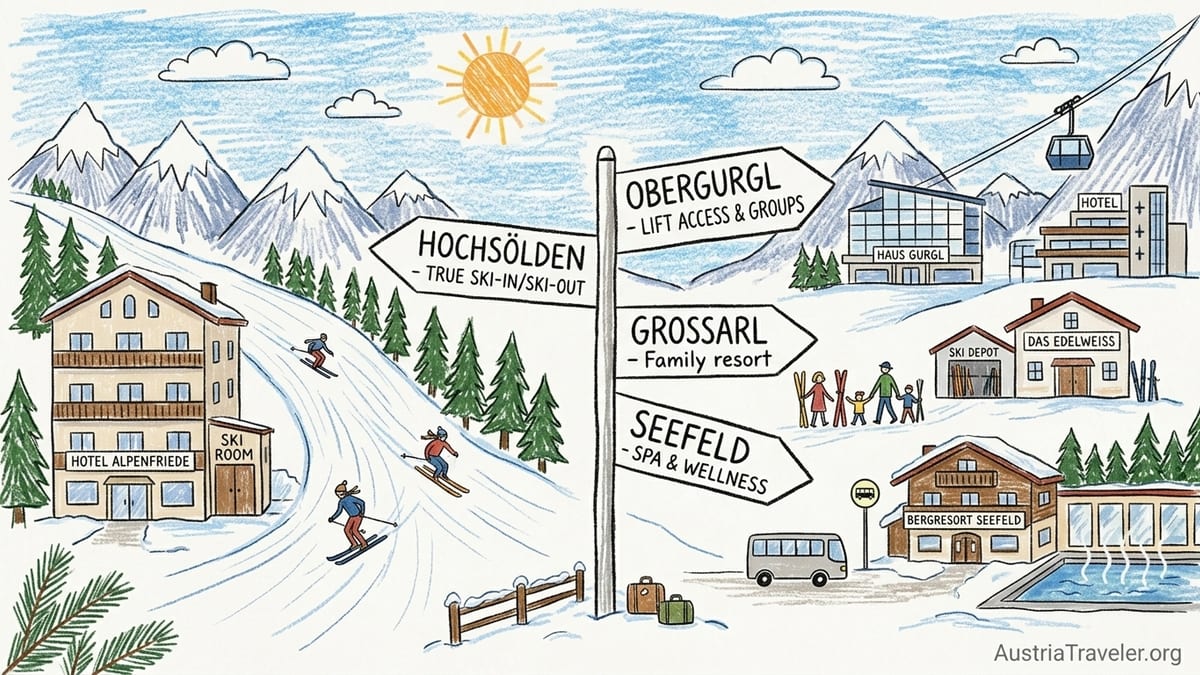
Best True Ski-In/Ski-Out Stay: Hotel Alpenfriede, Hochsölden
Hochsölden is a small hamlet perched above Sölden, and Hotel Alpenfriede is the first place in Austria where “ski-in/ski-out” in the brochure matched what happened with skis on my feet. I clicked in at the ski room door in the morning, slid down a short, gentle incline, and in less than a minute was gliding onto a groomed red piste that feeds directly into the main Sölden lift network. Coming back was equally straightforward. In normal snow conditions, you ski almost to the door; the final few metres require either a small push on poles or a short climb if you misjudge your speed, but you remain on snow rather than walking across car parks or icy driveways.
The ski room sits one floor below reception, directly adjacent to the slope. Access is via a side door, so you never need to drag wet skis through the lobby or up staircases. Each room has its own numbered locker with integrated boot dryers that run properly hot overnight. I could leave boots and gloves damp at five in the afternoon and find them completely dry by eight the next morning. There is enough space for four full sets of skis and boards in a family locker, and the benches are sturdy enough to sit on while clipping buckles, not the flimsy fold-down kind that collapse when two people use them at once.
Breakfast officially starts at 7:30, which is realistic for making the first serious lifts that open from 8:30 in Sölden. For early departures on transfer days, the team laid out a smaller cold buffet from around 6:45 and offered packed breakfasts if you needed to catch a 6 a.m. taxi. Half-board dinners were far above the generic buffet standard: multi-course menus with a salad bar, a proper soup course, and main dishes that leaned heavily into Tyrolean comfort food. The risk with half-board is always feeling trapped into mediocre dinners to “get your money’s worth,” but here I never once felt the need to eat out instead.
Rooms are traditional Tyrolean in style, with lots of wood, firm but comfortable beds, and properly adjustable heating. Storage is generous, with full-length wardrobes that actually take bulky jackets and ski pants plus a separate shelf that worked well for drying midlayers overnight. Bathrooms are simple with good water pressure and consistent hot water, and my room included both a bathtub and a handheld shower, useful for soaking tired legs. Noise insulation is decent for a mountain hotel; the only noticeable sounds came from the bar area closing around 11 p.m., which faded quickly. My south-facing balcony looked straight across the valley to the opposite ridge rather than simply into another building, which matched the photos, though the rooms felt fractionally smaller than some images suggest.
Best Lift-Access Hotel: Haus Gurgl, Obergurgl
For a lift-access focused stay, Haus Gurgl in Obergurgl worked extremely well, especially for mixed-ability groups and learners who want easy access to the ski school. This is not a clip-in-at-the-door hotel in the strictest sense, but in practice it felt almost as convenient. The ski school meeting point sits just across from the hotel, visible from many of the balconies, and the main lift for Obergurgl is only a short walk in ski boots. Crucially, that walk is flat and on cleared pavement rather than an icy downhill shuffle.
The ski room here is one of the best thought out I have used in Austria. It is at ground level, accessed from both inside the hotel and from the street, so you are not clattering up and down steps with equipment. Each room gets a generous locker with built-in boot drying arms capable of handling up to four pairs of boots. In my stay, they were set on a timed cycle that finished shortly before breakfast, so boots warmed without becoming sweaty again. Skis sit in wide, stable racks with enough space between slots that tips and bindings do not clash. Ski hire through a partner shop is effectively door-to-door: during my package trip the rental outlet was directly connected to the hotel, which meant I could walk from the boot room through a corridor into the hire shop in socks and step back to the locker fully kitted without going outside.
Breakfast starts around 7:30 with a substantial buffet: eggs cooked to order, cereals, cured meats, cheeses and fresh bread. For keen skiers, that felt just about right for making lifts without rushing. Dinner as part of the half-board offering was a highlight, with three main options each night (typically meat, fish and vegetarian) and a salad and cheese buffet. Portion sizes were generous without being wasteful, and the wine list leaned towards Austrian and Italian bottles at fair prices. I never felt locked into eating in, but on a short stay I saw no reason to look elsewhere.
Rooms at Haus Gurgl feel brighter and more contemporary than some classic Tyrolean properties, with plenty of pale wood and clean-lined furniture. Beds are on the firmer side but paired with good quality duvets, and the heating is steady and easy to turn down at night, which matters in well-insulated buildings. Storage impressed me: a separate alcove with hanging space for ski gear meant the main room stayed uncluttered and wet clothing did not dominate. Bathrooms are modern, with walk-in showers in many units and heated towel rails that genuinely contribute to drying gear. Street noise is minimal, thanks to Obergurgl’s compact size, and even rooms facing towards the bus stop remained quiet once the last ski buses finished in the early evening.
Best Family Hotel: Das Edelweiss Salzburg Mountain Resort, Grossarl
For families who want a comfortable base where logistics run smoothly, Das Edelweiss Salzburg Mountain Resort in Grossarl combines serious child-friendly facilities with practical ski details. The resort sits right next to a main cable car station, so older children and confident teens can walk to the lift without navigating roads or long staircases. The hotel offers its own ground-floor ski depot, which is effectively an extension of the lift base. Each room has its own heated locker, so there is no need to carve out boot space on balconies or in bathrooms.
From a parent’s perspective, the layout saves both time and arguments. In the morning, we would ride the lift down from room floors to the ski depot, get boots from the family locker, and step outside onto a short path that leads directly to the gondola station. The actual distance in ski boots felt somewhere in the range of a slow two-minute shuffle with kids, including inevitable stops to adjust helmets. Because all equipment lives in the depot, there is no carrying skis through the lobby or up internal stairs, and children can be taught to handle their own gear safely in a controlled space. Boot dryers are integrated into the locker system and worked effectively; wet boots from a slushy afternoon were reliably dry by 8 a.m.
Breakfast here begins early enough for families catching ski school, with full service by 7:30. The buffet layout is family-friendly: cereal islands, hot options and a decent spread of fruit. Staff were quick to arrange early plates for children on transfer days, and packed breakfast bags were offered if you had a very early departure. Half-board works well for families who do not want the hassle of finding tables in town every evening. The dinner offer is more elaborate than a simple set menu, and there is enough variety that older children and picky eaters will find something without needing constant special requests. On the nights we did not feel like a full dinner, the informal areas still allowed for a lighter bite.
Rooms at Das Edelweiss vary, but the family suite I experienced combined a main bedroom with a semi-separated children’s sleeping area. This keeps bedtimes manageable without cutting off adults from the rest of the room. Bed comfort is excellent, and blackout curtains help with early starts. Storage is strong, with large wardrobes, plenty of drawers, and hooks near the entrance where you can hang damp jackets and pants without them dripping over seating areas. Bathrooms are modern, and in family configurations it is worth choosing a layout with both a tub and a separate shower, which speeds up post-ski routines. Soundproofing is better than average for a family resort; some corridor noise is inevitable in school holiday weeks, but closing the inner door between the entry area and beds reduced this noticeably.
Best Spa Hotel: Bergresort Seefeld, Seefeld in Tirol
If you prioritise spa time as much as time on snow, Bergresort Seefeld offers one of the more complete wellness spreads in an Austrian ski setting. It is important to understand, however, that this is not a pure ski-in/ski-out property despite some marketing language that hints in that direction. From the hotel, I used the ski bus to reach the Seefeld slopes. The bus stop is within a short walk of the entrance, and services run frequently in the main season, but you should factor in the extra time in boots compared with staying directly at a lift base.
The ski room sits in the basement with direct access from the car park and from internal corridors. There are heated boot racks but not individual lockable lockers for every room, so you share open racks with other guests. During my stay there was always space, but very security-minded travellers might prefer to keep skis in vehicle racks overnight. The walk from the boot room to the bus stop in ski boots takes around five minutes at a normal pace, mostly on cleared pavement. That is perfectly manageable for adults but can feel long with young children or in heavy snowfall. The trade-off is that you return in the afternoon knowing a full spa is waiting rather than just a small sauna.
The wellness area is the key attraction. Multiple saunas, a steam room, relaxation spaces and a sizable pool make it possible to stay on site after skiing rather than heading into town. After 4 p.m. in peak weeks the spa does become busy; loungers by the pool fill quickly and the hotter saunas see a constant flow of guests. That said, I always managed to find a quieter corner by heading either slightly earlier, straight from the mountain, or slightly later, after 6 p.m. when families migrated back to dinner. Bathrobes and spa towels are provided in rooms, so there is no need to bring your own.
Breakfast starts at 7:30, which suits a bus-based ski schedule if you aim for mid-morning laps rather than first chair. The buffet focuses as much on wellness options as hearty ski fuel, with plenty of fruit, yoghurts and whole grain breads alongside eggs and bacon. Half-board dinners are decent but not spectacular. In my experience the food quality justified eating in most nights for convenience, but the set menus did not quite match the level of the spa. There are simpler restaurants in Seefeld’s centre for those evenings when you want something more low-key or specifically Tyrolean.
Rooms reflect the resort’s dual identity as a spa and mountain hotel. Bedding is comfortable, with feather duvets and pillows, and there are usually seating areas where you can lounge in a robe between spa visits. Heating is easily regulated, which helps when drying damp base layers on hangers or rails overnight. Bathrooms vary between more traditional tub-and-shower combinations and updated walk-in showers; if you prefer the latter, it is worth specifying when you book. Views range from garden-facing to mountain-facing; the latter catch more afternoon sun, which also helps dry clothing on balconies, though you should avoid hanging heavy wet ski gear directly on visible railings. Some marketing photos make the standard rooms look a touch more spacious and newly renovated than they are in reality, but they remain comfortable for a classic week-long ski and spa break.
Best Value Hotel: Hotel Austria, Niederau (Wildschönau)
For travellers who want solid ski convenience without premium resort prices, Hotel Austria in Niederau struck one of the best value balances I have found in Austria. Officially rated three stars, it delivers the essentials skiers actually care about while keeping room rates notably lower than in headline destinations such as St Anton or Lech. The hotel sits just across the road from the local ski facilities, and a ski and boot hire shop in the same building connects internally to the hotel’s basement level.
The ski room here is more functional than luxurious, but it works very well. Guests receive swipe cards granting access to a dedicated basement ski storage area with lockers for each party. Lockers come with integrated boot drying racks that warmed reliably overnight. I was able to leave boots that had been through slushy afternoon snow and find them reasonably dry the next morning without resorting to placing them on radiators. The fact that you can walk from your room down to the ski hire shop in indoor shoes, sort equipment, then exit via a side door to reach the nursery slopes and main drag elevator saves a lot of faffing in bad weather.
Breakfast is straightforward but more than adequate: fresh bread, cold cuts, cheese, hot eggs, and cereals. It tends to begin around 7:30, which leaves a comfortable margin for walking over to lessons or local lifts in time. There is usually the option of an early continental-style plate on departure days if you notify staff in advance, which is helpful for package transfers. Evening meals on half-board are honest, hearty Austrian fare rather than gourmet dining. The value equation made sense: eating in most nights significantly reduced the daily spend compared with seeking out separate restaurants, and while a couple of dishes felt plain, it never tipped into feeling trapped by a dining room you were not enjoying.
Rooms at Hotel Austria are basic but clean, with firm beds, older-style patterned carpets and enough storage for a week’s worth of gear. Cupboards are deep enough for ski clothing, although you will often end up hanging some items on the backs of chairs to fully dry. Bathrooms, many with shower-only setups, are compact but functional, with reliable hot water and wall-mounted hairdryers. Some street noise carries into the front-facing rooms at pub closing time, but it quietens quickly, and double-glazing helps. Photos largely reflect reality, though angles in promotional material sometimes make bathrooms appear larger than they are. Given the price point, the overall package in terms of location, boot room, and inclusive meals feels like strong value.
Best for Car-Free Travel: Sporthotel Ellmau in Tirol, Ellmau
Not every skier arrives in Austria with a hire car. For those who prefer to travel by train and bus, Sporthotel Ellmau in Tirol offers a practical compromise between on-snow access and village facilities. The hotel sits close to beginner-friendly slopes and benefits from ski buses that stop at both the front and back of the property, running to the main gondola and further into the SkiWelt area. That combination meant I could step out in ski boots, hop on a bus within a few minutes, and be at a major lift without dealing with parking or long roadside walks.
The ski room at Sporthotel Ellmau is equipped with heated boot hangers and ski stands, though there are no individual lockable lockers. In the week I stayed, that was not an issue; the hotel attracts a mix of Austrian and German families, and there was an informal trust that everyone respected each other’s gear. If you are particularly cautious, you might store skis in a room overnight and only use the ski room for boots. The walk from the boot room to the nearest bus stop in ski boots is very short, noticeably under two minutes at a normal pace. The beginner runs are reachable on foot without a bus, which is helpful if you are splitting days between teaching a newcomer and heading further up the mountain yourself.
Breakfast starts around 7:30, with plenty of seating, so there is no need to queue even when tour groups are present. On days when I wanted to make an early bus, staff were helpful in bringing coffee quickly and pointing me towards the sections of the buffet that were already replenished. There are free shuttles during certain parts of the day between the hotel and gondola, which reduces reliance on public buses at peak times. In my experience, these ran reliably within the published windows, although I still allowed a 10 to 15 minute buffer for busy weekends. Returning in the afternoon, I often simply skied down to the lower slopes and walked back in boots rather than waiting.
Rooms are classic alpine with a slight leaning towards the traditional, including carved wooden headboards and floral fabrics. Beds are comfortable with firm mattresses and decent pillows. Heating is effective, maybe even too much so, so it is worth turning down radiators before heading to dinner if you plan to hang damp layers around the room. Storage is acceptable, with wardrobes and a few shelves, although families with a lot of gear will need to use every available hanger and chair. Bathrooms vary but generally include a good-sized basin area and either a walk-in or over-tub shower. Noise levels are reasonable; rooms facing away from the main road are notably quieter, so it is worth requesting this if you are a light sleeper. The photos on booking sites are broadly accurate in style and space, and the mountain backdrop visible from many balconies remains a genuine highlight.
Best for Groups and Best Splurge: Hotel Edelweiss & Gurgl, Obergurgl
For groups looking to combine convenience with a touch of luxury, Hotel Edelweiss & Gurgl in Obergurgl stands out. The hotel occupies a prime position at the bottom of the slopes, which makes coordinating different ability levels and start times far easier than in many scattered resorts. Lifts rise almost from the doorstep, and many rooms face directly onto the piste, so you can watch friends skiing back while you finish a coffee on the balcony.
The practical heart for skiers is the basement level, where the hotel’s own ski hire outlet shares space with a well-designed boot room. Every room is allocated a numbered, lockable ski locker corresponding to the room number, accessible with the room key. Inside, there is space for multiple sets of skis and boards, and the built-in boot dryers are properly powerful. After a day of heavy snow and slush, our group’s boots went in noticeably wet and emerged bone dry the next morning. Crucially, you move from this boot room straight out to the slopes without crossing public roads or trekking through the lobby with dripping gear.
Breakfast caters well to both keen skiers and slower starters in a group, running a broad window with a full buffet. There is always something substantial available from around 7:30, which let the most enthusiastic in our party catch early lifts while others drifted down later. Half-board dinners are a step up from average ski hotel fare, with multi-course menus, salad and cheese buffets, and an above-average selection of wines. For a group, the half-board option simplified planning. We did not feel “trapped” because the standard was high enough that no one argued to eat elsewhere, and splitting bottles of wine across the table helped moderate the cost compared with dining out every night in resort restaurants.
Rooms at Edelweiss & Gurgl run from comfortable standards to more expansive suites that suit groups or families willing to splurge. Beds are high quality, with supportive mattresses and thick duvets, and storage is generous, including full wardrobes and additional drawers. Many rooms have balconies directly overlooking the slopes, which gives both atmosphere and a practical place to air-dry outer layers in the afternoon. Bathrooms are modern and well lit, often with walk-in showers and double basins in upgraded categories. Soundproofing is better than average, especially important when you have multiple friends in adjacent rooms and a bar that stays lively in the evenings. Promotional photos do a fair job of representing the more premium rooms; standard categories may feel slightly less glamorous than the imagery implies but remain perfectly comfortable for a week’s stay.
The wellness area is not on the same scale as a dedicated spa resort but includes an appealing pool and sauna facilities, which gave our group somewhere to decompress after skiing without leaving the building. After 4 p.m. it does become busy, particularly on bad-weather days when more guests opt for spa time over skiing. If quiet is important to you, aim to visit either immediately on returning from the slopes or later in the evening after dinner.
The Takeaway
Austria offers a dizzying number of ski hotels, and it can be tempting to choose purely on headline features such as star ratings, stylish photography or the vague promise of “ski-in/ski-out.” My own stays across the country have reinforced that what truly matters is the alignment between a hotel’s strengths and the way you like to ski. If you care about squeezing every possible lap from a lift pass, a place like Hotel Alpenfriede in Hochsölden, where you genuinely clip into your skis at the door, may be worth more than the fanciest spa. Families might value the effortless logistics and on-site ski depots at Das Edelweiss over a more remote but quieter chalet.
Looking beyond marketing phrases to specifics such as ski room location, boot dryer performance, breakfast timing, and the real-world walk to the lift in ski boots will help you choose a property that makes the entire rhythm of your ski day easier. That might mean accepting a short boot walk in exchange for a serious spa, as at Bergresort Seefeld, or trading a glamorous postcode for strong value and solid basics at Hotel Austria in Niederau. Whichever route you take, asking the right practical questions before you book will go a long way towards turning a simple ski trip into an unhurried, genuinely enjoyable holiday on snow.
FAQ
Q1. What should I look for in an Austrian ski hotel if I want genuine ski-in/ski-out access?
Prioritise hotels where the ski room door opens directly onto a groomed piste under normal snow conditions, with no need to cross roads or carry skis more than a few steps.
Q2. How early do Austrian ski hotels usually serve breakfast for skiers?
Most dedicated ski hotels begin full breakfast service around 7:30 a.m., which is generally early enough to reach lifts opening from 8:30 a.m., though very early transfers may rely on a reduced buffet.
Q3. Are boot dryers standard in Austrian ski hotels?
In many mid-range and higher Austrian ski hotels, heated boot racks or lockers are now standard, but it is worth checking whether dryers run long enough overnight to fully dry boots after slushy days.
Q4. Does half-board usually save money in Austrian ski resorts?
Half-board can reduce overall costs compared with eating out every night, especially in well-known resorts, but you should read recent reviews to ensure dinner quality is high enough that you will not feel stuck with mediocre meals.
Q5. How crowded do hotel spas in Austrian ski resorts get after 4 p.m.?
In properties with popular wellness areas, saunas and pools often become busy from about 4 p.m. to early evening, particularly on bad-weather days, so visiting either just before or after this window can feel more relaxed.
Q6. Is it realistic to ski without a car in Austrian resorts?
Yes, many Austrian resorts are designed around ski buses and village lifts, and hotels like those in Ellmau or Seefeld work well without a car as long as you choose accommodation near bus stops or lift bases.
Q7. How important is room storage for a ski trip?
Ample storage, including wardrobes, shelves and hooks near the entrance, makes it far easier to dry and organise bulky jackets, pants and midlayers, which directly improves day-to-day comfort on a ski holiday.
Q8. Should I worry about carrying skis through hotel lobbies?
Hotels with ski rooms that open onto exterior doors or slopes are far more convenient, as they keep snow, water and sharp edges out of carpeted lobbies and save you from navigating stairs in clumsy equipment.
Q9. Are value-oriented Austrian ski hotels still suitable for serious skiers?
Yes, some lower-priced hotels offer excellent proximity to lifts, reliable ski rooms and solid meals; the trade-off is usually simpler decor and fewer wellness facilities rather than compromised ski convenience.
Q10. How can I tell if hotel photos accurately represent rooms in Austrian ski resorts?
Comparing professional images with a wide range of recent guest photos and reviews will give a more realistic sense of room size, views and wear, and help you spot where marketing angles make spaces seem larger than they are.