


After half a dozen trips to the Austrian Alps in different seasons, I stopped asking “What is the best month to go?” and started asking a better question: “What exactly do I want to do on this trip?” Hiking at 2,000 meters, swimming in glacier-fed lakes, chasing autumn colors and booking a Christmas ski week all peak at different times. On top of that, many lifts, huts and even whole villages switch off between summer and winter. What follows is based on my own warm‑season and autumn experiences in places like Zell am See, the Zillertal and Salzkammergut, combined with carefully researched winter guidance where I have not personally skied.
Why There Is No Single “Best Month” in the Austrian Alps
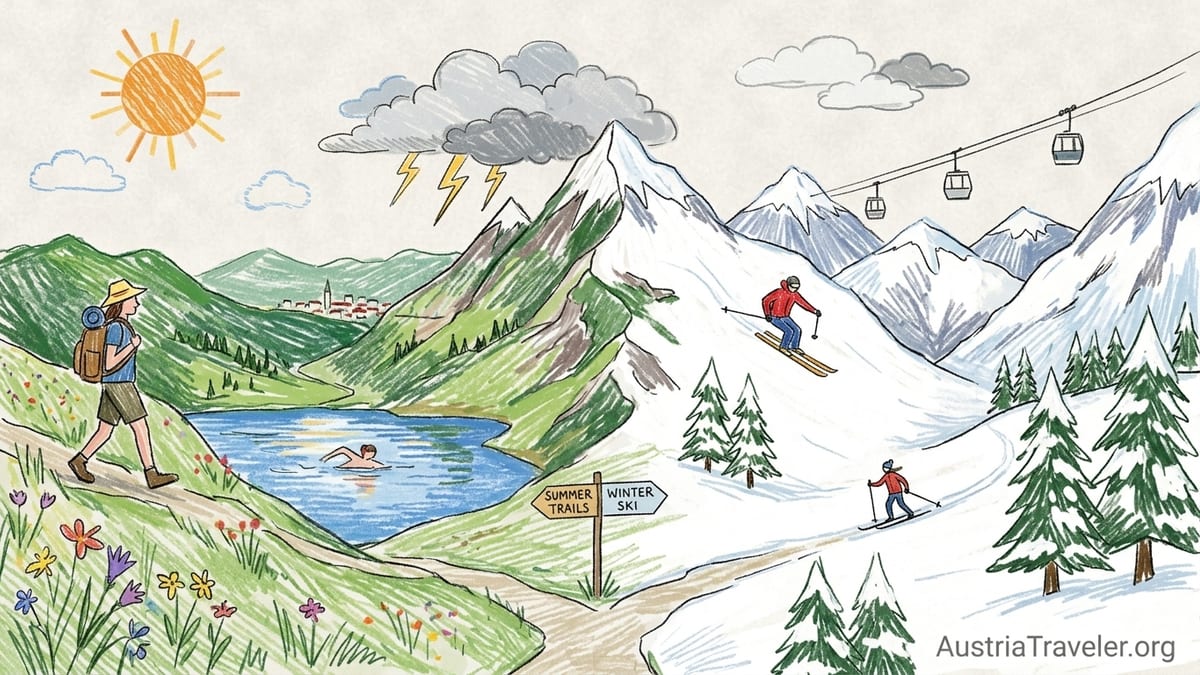
Standing on a July ridge above Zell am See with thunderheads building over the Hohe Tauern, it was obvious that the “best month” depends entirely on what you hope to do. The valley below was baking in nearly 30°C sunshine, while up at 2,000 meters I was zipping my jacket against a chilly wind. Two days later, the lake was calm and warm enough for an evening swim, but the high trail I had planned was still patchy with old snow. That mix of heat, chill, snow patches and storms is typical of the Alps in summer, and it makes a one‑size‑fits‑all answer impossible.
For hiking and hut trips, my most rewarding weeks have been in late June and late August, when most snow has melted from marked trails but daytime temperatures in the mid‑teens at altitude still make steep climbs bearable. For warm lake days with nearly sure swimming weather, peak season is usually mid‑July to mid‑August, when water temperatures on popular lakes such as Achensee in Tyrol often reach around 20 to 22°C, noticeably less bracing than in early summer. For pure skiing, by contrast, the sweet spot often runs from late January through early March in the big resorts, with reliable snow cover and full lift operations.
On top of these activity windows come the two quiet shoulder periods that have shaped several of my trips: late October into November, and late April into May. In these weeks many cable cars stop, mountain restaurants lock their doors and hotel prices fall sharply, while weather flips between golden sun and sleet in a matter of hours. Those lulls can be atmospheric if you know what to expect, but they are a shock if you arrive imagining postcard villages in full swing.
So instead of asking when to go “to the Alps,” it is far more useful to match your dates to a specific purpose: hiking, lakes, scenic drives, skiing, Christmas markets, or simply empty trails and low prices. Once you narrow that down, seasonality suddenly makes sense and you can work with it instead of fighting it.
My Summer Experiences: Heat in the Valleys, Fast‑Changing Weather at Altitude
Most of my time in the Austrian Alps has been in summer, when the contrast between valley and mountain is most dramatic. In the Zillertal, for instance, I have woken up in Mayrhofen to 28°C in the afternoon forecast, only to shiver in 10°C wind on a ridge the same day. A rule of thumb that fits my experience is that you lose roughly 6 to 7 degrees Celsius for every 1,000 meters you climb. That means a hot 30°C day in the village can translate to a very fresh 16 to 18°C at 2,000 meters, colder again in shade or wind.
On a June hike above Bad Hofgastein, gentler lower trails were already dry and dusty, but north‑facing slopes still held old snowfields around 2,200 meters. The tunnel‑like forest section of the trail was muddy, with meltwater turning the track into a series of slick steps and short streams. Higher up, snow depth off the trail reached mid‑calf in places, which was enough to soak my trail‑runners and convince me that waterproof boots would have been a better choice that week.
The lift system influences how easily you can reach this higher terrain. In Zell am See, the Schmittenhöhe cable cars typically begin their summer season around mid‑May and run into late October. Nearby, the Gerlitzen Alpe above Carinthia concentrates its main summer operation in July and August, and states that outside high season the cable car may not operate at all in bad weather. I have turned up to “open” lifts in June only to find a weather‑related closure sign, and the inverse in late September, when a good forecast prompted an extra weekend of operation. The practical lesson is simple: in summer, always check the specific lift’s daily status and not just the printed season dates.
The other summer signature is the rhythm of afternoon thunderstorms. On several July trips I saw a similar pattern: calm, blue mornings, then clouds building into towering formations from early afternoon and the first rumbles between about 2 and 4 pm. On a ridge walk above Kaprun one July, dark clouds mushroomed behind the Kitzsteinhorn glacier far faster than forecast, turning what had been a generous two‑hour margin into a nervous forty‑minute race for the mid‑station. The rain that followed turned dusty tracks into slippery mud within minutes and sent small rivulets of water down steep sections. Planning early starts, building in turnaround times and never assuming a blue morning guarantees a blue afternoon has become non‑negotiable for me in the Alps.
Hiking Season: From Snow Patches in June to Stable Trails in September
For hikers, the most important question is not the valley temperature but when snow retreats from popular paths. In my experience, and broadly in line with local hiking advice, lower and mid‑altitude paths around 1,500 meters are usually snow‑free by early June in a typical year, while classic panoramic routes around 2,000 to 2,400 meters can still hold shaded snowfields into late June. On a trip near the Dachstein massif one mid‑June, a well‑known balcony trail was passable but still crossed half a dozen snow tongues. Each crossing was short, but the compacted snow was icy in the morning and turned to heavy slush by midday, making poles invaluable.
By July, most marked summer hiking trails I have used in regions like the Salzkammergut and Pinzgau have been fully open, with only a few residual snow patches tucked under cliffs or on north‑facing aspects. Trail surfaces also change with the calendar. In June, I frequently encounter wet roots, boggy meadows and rock slabs that weep water from melt, especially after cool nights. By August, the same paths have often dried into firm dirt or gravel, though heavy rain can still rapidly turn steep sections into loose, slippery channels.
August has given me the most stable conditions overall. At moderate elevations between 1,800 and 2,200 meters I have typically seen daytime highs around the mid‑teens to low twenties Celsius, cool mornings near 8 to 10°C, and long strings of days when the only real issue was sun exposure. That stability is one reason August is crowded on the most famous routes. In the Hohe Tauern, for example, main access paths to huts can feel busy by late morning, and you will notice queues for popular viewpoints near cable car stations.
By contrast, early October hiking has felt like a privilege reserved for those willing to accept more uncertainty. I remember climbing above Zell am See in the first week of October in bright, clear air with larch trees just starting to turn gold. Trails that felt packed in August were almost empty, yet the same week brought a sudden cold snap that dusted ridges above 2,000 meters with a fresh 5 to 10 centimeters of snow overnight. Lower trails remained walkable, but higher, rockier paths were icy until late morning and required more care. That trip taught me that “summer hiking” in the Alps fades gradually, not on a specific date.
Lakes, Valley Heat and Swimming Conditions
One of the pleasures of summer in the Austrian Alps is ending a hot hike with a lake swim. The catch is that many of these lakes are relatively high and deep, which keeps their water cool compared with Mediterranean beaches. Achensee in Tyrol, for instance, sits at around 930 meters between the Karwendel and Rofan ranges and is known for clear, drinking‑quality water. In recent summers the surface temperature there has often reached around 20 to 22°C in July and August, which I found refreshing rather than warm. In late June, by contrast, both Achensee and lakes in the Salzkammergut such as Wolfgangsee still felt brisk, better suited to quick dips than long, lazy swims.
Another factor I have learned to consider is the timing of valley heat. During a July stay near Zell am See, afternoon air temperatures in town repeatedly climbed to 28 to 30°C, while the lake itself still hovered in the high teens. By evening, the warm air over the comparatively cool lake produced frequent low fog and mist, which made for atmospheric sunsets but also meant that temperatures dropped faster than I expected after sundown. Packing an extra layer for lake evenings turned out to be wise even in high summer.
Wind and cloud cover on a given day matter as much as seasonal averages. On a seemingly ideal August afternoon at Wolfgangsee, a stiff breeze and passing clouds made the 22°C water feel far cooler than the number suggested, and most swimmers clustered in more sheltered coves. On a still, sunny day with the same measured temperature, it felt much more comfortable. I now treat published water temperatures as a starting point, not a guarantee of comfort, and combine them with the day’s wind and sun forecast.
Lake areas also illustrate how quickly the atmosphere in resorts changes as the season turns. Around late August, families begin leaving and by mid‑September even scenic lakeside villages can feel noticeably calmer. Boat timetables often reduce in late September, and some lidos and rental outfits close entirely by early October, even if the weather remains pleasant. On one early October visit to a Salzkammergut lake, the wooden bathing platforms were already being dismantled for winter despite several days of 22°C sunshine, a tangible reminder that operators plan for long winters, not last warm spells.
Shoulder Seasons: Quiet Trails, Closed Lifts and Cheaper Rooms
The biggest shifts I have experienced in the Austrian Alps have come not between summer and winter proper, but in the shoulder weeks that separate them. Late October into November and late April into May are when I have most strongly felt the sensation of villages “powering down” or “waking up.” These transitions bring real advantages, such as lower prices and empty paths, but they also bring logistical headaches that are easy to underestimate.
One October, I arrived in a small Tyrolean village for what I imagined would be a last‑of‑the‑season hiking week. Online photos showed busy terraces and long summer opening hours. In reality, the main cable car had shut down a week earlier, most mountain inns were already closed and the only fully operational restaurant in town was a pizzeria. Hotel rates were around a third lower than in August, and my room had a balcony with an uninterrupted valley view, but I had to plan walks entirely from valley trailheads, adding several hundred meters of extra ascent to every route.
A similar pattern appears in spring. While some glacier resorts in Tyrol offer skiing from around October through May, the majority of non‑glacier ski areas close by early April. When I have visited low and mid‑altitude villages in late April, snow has still lingered on north‑facing slopes, grassy meadows in the valley were only beginning to green up, and many lifts were shut while staff switched the infrastructure from winter to summer mode. Paths at 1,200 to 1,500 meters were walkable but muddy and rutted from a season of ski traffic and thaw.
On the positive side, shoulder seasons have given me some of my quietest Alpine days. In early November above a lake in Carinthia, I walked for hours under a pale sun, crunching over frozen leaves with only the sound of distant cowbells. The trade‑off was a very narrow weather window. Daytime highs barely reached 8 to 10°C in the shade, nights dropped close to freezing, and by late afternoon cold air pooled in the valley, bringing fog and making the post‑sunset temperature swing feel dramatic.
Daily services also scale back. Bus frequencies drop outside the core tourist months, and some seasonal routes stop running altogether. In one October week in the Pinzgau region, I noticed that a summer hiking bus that links trailheads had already stopped for the year, which meant relying on less frequent regional buses or using a car. Parking, on the other hand, was significantly easier, with large lots that were snarled and full in August standing almost empty in October, and some municipal parking that was free again after peak‑season charges ended.
Research‑Based Winter Picture: Skiing, Snow Depth and Christmas Atmosphere
I have not yet spent a full skiing week in the Austrian Alps in winter, so what follows is drawn from resort data and regional tourism information rather than my own first‑person skiing. That said, the patterns fit what I have seen on brief winter visits and from following local reports while planning trips.
In typical years, dedicated glacier areas like Hintertux, Stubai, Sölden, Pitztal and Kitzsteinhorn aim to offer skiing from around October through at least April, sometimes longer at the very highest lifts, depending on snow and temperatures. A regional pass in Tyrol has in recent seasons offered ten days of glacier skiing between early October and mid‑May, underlining how long those high‑altitude seasons can be. At more conventional, non‑glacier ski areas, opening dates cluster in late November and early December, but early weeks can mean partial operations if natural snow is limited.
Resorts with high base elevations, such as Obertauern, which sits above 1,600 meters, have a reputation for good early and late‑season coverage and often target late November events to launch the season. By contrast, lower‑lying family areas that start closer to 800 or 900 meters in elevation may not have all runs open in early December, especially long valley descents. From what I have observed and read, the core winter period for reliable piste skiing in Austria tends to be from early January to early March, when snow depth on marked runs at 2,000 meters is often measured in well over a meter, groomed daily and backstopped by snowmaking.
Christmas and New Year add a layer of atmosphere that many travelers seek even if conditions are still building. Advent markets in Alpine villages, decorative lights and special seasonal events give December trips a very different feel from March ski weeks. Costs, however, follow the mood. Package prices that might be relatively moderate in mid‑January can increase sharply over Christmas week, and occupancy is high, so booking months ahead is normal rather than cautious. The same applies to February school‑holiday periods in German‑speaking countries, when lift queues and crowding on pistes are at their peak.
Winter weather in the Austrian Alps can change even more violently than summer. A blocking high can bring a week of sun and crisp temperatures well below freezing at night, while a warm Foehn wind episode can rapidly strip south‑facing slopes and push freezing levels up toward 2,000 meters or higher for several days. That volatility is why many experienced skiers treat any very early or very late season dates as a calculated gamble, favoring higher, north‑facing resorts or glacier areas if they want to maximize the odds of good cover.
Even if I have not personally clipped into skis yet in Austria, I have walked winter valley paths enough to feel the impact of short daylight. Around the December solstice, usable daylight in mountain valleys can feel compressed into six hours once you allow for late sunrise behind ridges and very early shade in the afternoon. Planning becomes more about choosing a single main activity per day rather than trying to stack several, and simple tasks such as walking back from dinner can mean icy pavements and deep cold.
How Season Affects Prices, Crowds and Village Atmosphere
The same village in the Austrian Alps can feel like two different destinations depending on the month. In peak summer and deep winter I have found resort towns busy, bright and fully staffed. Outdoor terraces buzz with conversation, ski schools or hiking guides assemble clients each morning, and shops open long hours. In late October, April or even early June, the same streets can be so quiet that the only sound at night is the river.
In my own bookings, July and August have consistently been the most expensive months for lakeside and hiking bases, particularly in renowned areas like the Salzkammergut. Hotels on or very near the water often run close to full capacity, and nightly rates reflect that demand. By shifting stays to the last week of June or the first half of September, I have seen prices for the same style of mid‑range accommodation fall by roughly a quarter, with noticeably more choice of room categories.
Winter pricing follows a more pronounced pattern. Although I have so far visited only briefly in the cold season, monitoring ski‑package offers has shown that Christmas to New Year and the main February holiday weeks command the highest rates for both accommodation and lift passes. A week in late January often sits in a middle zone: more reasonable prices, generally excellent snow on piste, but still a lively atmosphere in resorts large enough to fill with international visitors. Smaller family hills, on the other hand, can feel almost private on mid‑January weekdays, with empty car parks and wide‑open slopes.
Restaurant openings track these waves closely. In peak weeks, even a medium‑sized lakeside town can require dinner reservations, and traditional Austrian kitchens can run two full sittings per evening. In shoulder weeks, quite a few establishments close completely for company holidays, leaving a skeleton selection of pizzerias and hotel dining rooms. I learned this the hard way one November Tuesday in a Tyrolean village, when the only open option within walking distance was a small bar that mainly served toasties. It was charming in its way, but not the Alpine cuisine I had promised my travel companion.
Parking and road feel change with the calendar too. High‑season August Saturdays can bring slow‑moving traffic on access roads and full car parks around popular lakes. In contrast, on an overcast October Thursday I once parked directly at a lakeside lot that had been impossible to use in summer due to day‑trippers. Municipalities also adjust fees seasonally, reintroducing or dropping day‑parking charges outside main tourism windows, which can make car‑based itineraries cheaper in shoulder months.
What I Would Personally Book Differently Next Time
After several trips spread across early summer, high summer and autumn, plus a lot of winter research, I would now plan my Austrian Alps calendar far more deliberately. For a hiking‑focused trip, I would target either late June or early September rather than the heart of July or August. Late June tends to offer lush, green meadows, full waterfalls and relatively moderate temperatures, accepting the trade‑off of occasional snow patches at altitude. Early September, on the other hand, usually brings very stable trails, fewer thunderstorms and thinner crowds, while most lifts and huts are still operating.
For a combined lakes and hiking holiday, I would lean toward the last week of August into early September in regions like Zell am See or the Salzkammergut. By then, lake temperatures are about as warm as they are going to get for the year, yet many families have started to leave, and prices begin to soften. I would avoid peak August holiday weeks unless bound by school schedules, simply because crowded jetties, busy boat services and booked‑out lakefront hotels make it harder to enjoy the setting.
If I were finally planning a first dedicated ski week in Austria, I would aim for the last third of January or the first week of March in a major, high‑altitude resort. Those windows usually combine strong snow cover with longer daylight than December and quieter slopes than February. I would budget higher prices than in November or April but lower than over Christmas and school holidays, and I would favor accommodations within easy walking distance of lifts to reduce reliance on buses in the cold.
On the shoulder‑season front, I would be more intentional. I still value October trips for their light and quiet, but I would only book them in towns with clear, year‑round infrastructure: at least one supermarket, a cluster of restaurants that advertise continuous opening, and access to at least one cable car still running into October. Similarly, I would think twice before committing to a small, single‑lift village in late April, when operations may pause entirely between winter and summer. In practical terms, that means checking not just hotel availability but also lift timetables, advertised maintenance closures and even local bus schedules before paying deposits.
The Takeaway
The Austrian Alps reward travelers who think in terms of seasons, not a single perfect month. My own trips have shown me hot valleys and chilly ridges on the same July afternoon, October days that felt like a secret second summer, and quiet villages caught between winter and summer identities. None of those experiences were “wrong.” They simply suited different purposes.
If you dream of long, sunny hikes with open huts and active lifts, late June to mid‑September is your canvas, with early and late edges offering more peace in exchange for less predictability. If your priority is carving groomed pistes and sipping Glühwein in a fully lit‑up village, winter comes into focus from early January to early March, framed by more atmospheric but riskier Christmas and late‑season weeks. Lakes, autumn color, lower prices and the strange beauty of shoulder seasons each have their own narrower windows.
Rather than chasing someone else’s idea of the “best time,” decide first what you want your trip to feel like on the ground. Picture whether you are more excited by cool morning ascents to high viewpoints, by steam rising from a cold lake at sunset, by Christmas lights on snow, or by empty paths under a low autumn sun. Then choose the month that matches that vision, accept its trade‑offs, and pack accordingly. In the Austrian Alps, that alignment between season and purpose is what turns a good trip into a memorable one.
FAQ
Q1. When is the best time to visit the Austrian Alps for hiking?
For most hikers, late June to late September offers the best balance of snow‑free trails, operating lifts and long daylight. Early in that window you may still cross old snow at higher elevations, while September usually brings very stable paths and fewer crowds.
Q2. Are July and August too hot for hiking in the Austrian Alps?
Valleys can be hot in July and August, often near or above 28°C on sunny days, but temperatures at 2,000 meters are usually much cooler. If you start early, choose routes with shade and carry enough water, high summer can still be an excellent time to hike, though it is also the busiest.
Q3. When are Austrian lakes warmest for swimming?
Mountain lakes such as Achensee and Wolfgangsee are usually warmest from mid‑July to late August, when surface temperatures often reach around 20 to 22°C. Even then they feel refreshing rather than bath‑warm, especially on windy or cloudy days.
Q4. What is the most reliable period for skiing in the Austrian Alps?
Based on resort operations and snow patterns, the core ski season with the most reliable piste conditions runs from early January to early March. Glacier areas may open as early as October and run into May, but early and late weeks always involve more uncertainty.
Q5. Is it worth visiting the Austrian Alps in October or November?
It can be, if you value quiet trails, autumn color and lower prices, and accept that many cable cars, huts and hotels will be closed. Expect short daylight hours, cool temperatures and very limited dining options in smaller villages during these shoulder weeks.
Q6. How quickly can weather change at altitude in the Austrian Alps?
Weather can change within an hour at higher elevations. In summer, morning blue skies can give way to afternoon thunderstorms, while in spring and autumn a sunny day can turn to sleet or snowfall above 2,000 meters. Always check the latest forecast, carry layers and build conservative turnaround times into hikes.
Q7. Are hotel prices much lower outside peak seasons?
Yes. In my experience, moving a stay from peak July or August into June or September can reduce room rates by roughly a quarter in popular regions. Late October, November, April and early May often bring even steeper discounts, though with significant reductions in services and atmosphere.
Q8. Will I find many restaurants open in shoulder season?
In small resort villages, many restaurants close completely in late autumn and spring, leaving only a handful of options. Larger towns and year‑round communities fare better, but it is still wise to check opening days and perhaps book accommodation with half board if traveling in very quiet weeks.
Q9. Do mountain lifts run all year in the Austrian Alps?
Only a few glacier and landmark lifts operate almost year‑round. Most cable cars and chairlifts have distinct summer and winter seasons and close for several weeks in between for maintenance and to switch equipment. Always check specific lift timetables for your travel dates rather than assuming continuous operation.
Q10. If I want both hiking and skiing, when should I plan my trip?
It is difficult to combine good hiking and reliable skiing in a single short trip, because their prime seasons only overlap on high glaciers. One option is a late September visit focused on hiking, followed by a separate ski trip between January and March, treating them as two complementary Alpine experiences rather than trying to do everything at once.