


The first time I pointed a car into the Austrian Alps, I thought I was prepared. I had maps saved offline, a list of dream passes, and hotel bookings that looked sensible on paper. What I did not have was a real feel for gradients that pin you to the seat, tunnels that seem to go on forever, village streets just wider than the wing mirrors, or how tired you feel after eight hours of tight hairpins and surprise roadworks. This is what I actually learned driving real Alpine roads in Austria, from the car I chose to the mistakes that cost me time, money and energy.
Starting Point: The Car, Season and Insurance Reality
My Alpine driving started in Salzburg, where I picked up a midsize rental car with front-wheel drive and an automatic transmission. It was a common compact class model with roughly a 1.5 to 1.8 liter petrol engine and about 130 horsepower, the kind of car many travelers will be handed at the airport counter. On motorways and wide valleys the engine felt perfectly adequate, but on steeper high roads, especially with two people and luggage, I had to plan overtakes carefully and accept that I would often sit behind trucks or motorhomes instead of blasting past them.
The trip straddled late May and early June, by which time most major passes were already open, though some very high secondary roads still had snowbanks at the sides and the occasional meltwater crossing the asphalt. The rental came on summer tyres, which was fine for dry conditions and mild temperatures, but it made me acutely aware that an early spring or late autumn trip would feel very different. On a previous winter visit with my own car, I had driven the A10 Tauern motorway and valley roads on proper winter tyres with the required M+S and snowflake markings, and the extra grip on slushy mornings was noticeable.
Insurance and the motorway vignette were the first administrative realities. The rental company included basic third party liability and a standard collision damage waiver with a relatively high excess, which I chose to lower slightly. What mattered most in the mountains was not theoretical paperwork but the knowledge that any damage from a misjudged rock wall in a tight village street or a parking scrape on a crowded pass would not be financially catastrophic. Before leaving Salzburg, I checked the windshield and bumper carefully and took photos. With narrow Alpine parking and loose gravel at some viewpoints, this felt less paranoid and more like common sense.
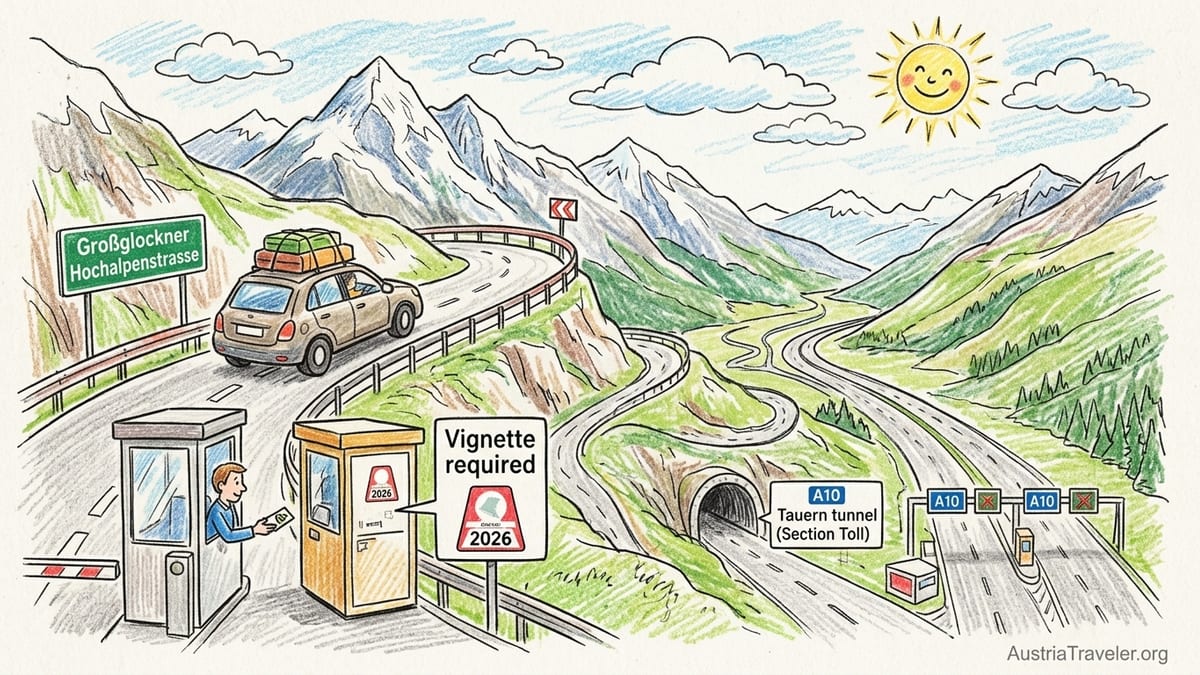
Austria requires a vignette for using most motorways. In 2026, a passenger car vignette costs 9.60 euros for one day, 12.80 euros for ten days, 32 euros for two months and 106.80 euros annually. Some rental cars come with a vignette already on the windshield, but mine did not, so I opted for a ten-day digital vignette purchased at a fuel station before joining the A1 westbound. That seemed the best balance of flexibility and cost for a week focused mainly on the Alps, with a bit of cushion for detours.
First Taste of Altitude: Salzburg to Zell am See via A10 and B311
The Alpine portion of the trip truly began when I joined the A10 Tauern motorway heading south from Salzburg. At first, it felt like any central European motorway, with two or three lanes in each direction and moderate gradients. As the mountains closed in, the road began to climb more noticeably and long tunnels appeared, including the Tauern and Katschberg tunnels on this general corridor, which work on a section toll in addition to the vignette. At the time of driving, the combined toll for a car on this route was roughly the cost of a restaurant meal for one, enough to feel but not ruinous. Paying it cut out a lot of slow valley traffic and the risk of winding detours.
Leaving the A10 for the B311 towards Zell am See provided the first contrast between fast valley corridors and slower scenic roads. The B311 follows the Salzach River and alternates between wide, flowing sections and more constrained parts where rock walls, rail lines and the river press closely against the asphalt. Gradients are moderate, usually under 8 percent, but there are multi-kilometer stretches where the car sits in a lower gear and engine braking becomes your friend on descents. Traffic can become dense on summer afternoons when lake-bound tourists mix with local trucks, and overtaking opportunities are limited by curves and oncoming traffic.
My first real mistake came on this section. I had left Salzburg later than planned, after lingering over lunch and underestimating how quickly afternoon congestion builds. By the time I reached the narrower part of the valley, a drizzle had started, casting a shiny film on the road. I found myself in a slow-moving line of cars behind a campervan at about 60 kilometers per hour, with very few safe chances to pass. What looked like a quick two-hour hop on the map stretched to nearly three and a half, and I arrived in Zell am See too late to comfortably explore the lakeside promenade or scout the next day’s departure point.
Parking in Zell am See provided an early lesson in Alpine town logistics. Central garages near the lakefront can fill by afternoon in high season, pushing late arrivals to peripheral lots that are either pricier or require a longer walk with luggage. I circled twice before settling for a covered garage a few blocks from my guesthouse. In hindsight, reserving a property with on-site parking or arriving earlier in the day would have reduced end-of-day stress significantly.
Climbing High: Großglockner Hochalpenstrasse in Real Life
The Großglockner Hochalpenstrasse is perhaps Austria’s most iconic high Alpine road, and my drive up from the Zell am See side is where I learned to respect gradients. The toll booth sits at Ferleiten, at around 1,145 meters above sea level. From there the road climbs in a series of hairpins and long ramps that at points approach or exceed 10 percent gradient. In a mid-powered automatic, that meant the transmission spent much of the time in lower gears, and on steeper inner hairpins I could feel the car dig in and labor slightly if I was not generous enough with the throttle.
I reached the toll plaza later than ideal, almost 11 a.m., thinking a mid-morning start would miss the early rush. Instead, I met a steady stream of day trippers. The weather was cooperative, with broken clouds and good visibility, but by the time I approached popular viewpoints like the Edelweissspitze turnoff, many of the small parking terraces were either full or required tight maneuvering among motorbikes and classic cars. Twice I passed promising stops simply because squeezing into a remaining gap would have risked a door ding or required multiple awkward shunts on an incline.
The combination of altitude, constant concentration and a car that felt near the limit of comfortable power made this one of the most tiring days of the entire trip. Technically, the road surface is excellent and the lanes are reasonably wide, but there is very little mental downtime. You are either climbing through a series of hairpins with a rock wall on one side and a drop or barrier on the other, passing cyclists who rightfully claim their share of the road, or negotiating tight parking at overlooks. There is no cruise control, no relaxed drifting of the mind. After four or five hours that level of focus becomes physically draining.
The biggest practical lesson came not from the ascent but from my planning of accommodation. I had chosen to stay in Zell am See for two nights, meaning I would drive the Großglockner as an out-and-back day trip. On the map, this looked ideal. In reality, it meant finishing the high road, descending to the Carinthian side, then climbing back over and descending again to Zell am See the same day. By the time I rolled back into town early evening, my right leg felt heavy from constant throttle and brake modulation, and my shoulders were stiff. Next time, I would overnight on the south side in a village such as Heiligenblut or further into Carinthia, cutting the daily driving hours and allowing the high road to be savored more slowly.
Tunnels, Section Tolls and the Fast-Track Corridors
After crossing to the Carinthian side, my route eventually connected with the main north-south A10 corridor again and, later in the trip, with other major Alpine crossings. This is where Austria’s mix of vignette system and additional section tolls becomes very tangible. Beyond the general vignette requirement, certain key Alpine routes have their own toll charges, including the Brenner route between Austria and Italy, the Tauern and Katschberg tunnels on the A10, the Arlberg road tunnel connecting Tyrol and Vorarlberg, the Bosruck and Gleinalm tunnels on the A9 between Upper Styria and the Linz area, and the Karawanken tunnel toward Slovenia.
In practice, these major corridors feel like the backbone of Alpine travel, designed to move long-distance traffic as efficiently as the terrain allows. The tunnels often run for several kilometers, maintaining relatively gentle gradients inside. The approach roads on both sides are engineered with careful banking and wide lanes, and speed limits are generally higher than on secondary mountain roads, though still lower than on flatland motorways. On long days when a weather front brings low clouds and rain to the high passes, choosing the tunnel routes instead of scenic alternatives can mean the difference between a safe, predictable four-hour drive and a stressed six-hour slog with limited visibility.
Yet these routes can surprise the unprepared traveler. One afternoon, heading north in deteriorating weather, I decided to avoid a longer scenic detour and instead stay on the A10 through one of the tolled tunnel sections. I assumed my digital vignette covered everything, as smaller tunnels earlier on the trip had not required extra payment. The section toll plaza appeared suddenly, and while the charge for a car was reasonable in absolute terms, the unexpected cost felt like a small penalty for my lack of homework. It was a reminder that every “shortcut” in the Alps may carry an unseen price tag, whether in euros, fuel or lost scenery.
Tunnels themselves bring a different sort of fatigue. The visual monotony, constant artificial lighting and the sensation of moving through a confined tube for minutes at a time can be oddly draining, especially toward the end of a long day. I found that alternating between tunnel-based routes and open passes over the course of a week kept the experience balanced. Too many tunnels in a row made me miss the sky, but too many exposed passes in unstable weather felt imprudent.
Village Streets, Tight Parking and Everyday Roadworks
Not all of the stress in an Alpine road trip comes from sweeping passes and dramatic tunnels. A surprising share of tension accumulates in ordinary villages and small towns where medieval street grids meet modern traffic. In parts of Tyrol and Salzburg provinces, I found myself threading the rental car through streets with buildings so close that I instinctively pulled in the mirrors. Passing a delivery van on such a lane involved inching past at walking speed while watching both the wing mirrors and the hubs.
Parking was a daily tactical exercise. At popular valleys like the Stubai or near lake resorts, central car parks can fill by mid-morning in summer. On one day trip into a side valley off the Inn Valley, I arrived at the main trailhead lot around 10:30 a.m., only to find a roadside digital sign announcing “Besetzt,” indicating it was full. The overflow car park several kilometers back had spaces, but returning there meant losing time and adding an uphill walk at the end of the day. I took a calculated risk and followed a convoy of cars as they waited for departing hikers to vacate spots, looping slowly through the lot for nearly twenty minutes. It worked, but it underlined how arriving just one hour earlier could have smoothed the day considerably.
Roadworks are part of Alpine reality, especially in short construction seasons when crews rush to repair winter damage. On one valley road near the Dachstein region, a temporary traffic light controlled a one-lane section where crews were stabilizing a rock face. What would normally be a straightforward 30-minute drive stretched to almost an hour with two long waits. There was no simple detour that did not add even more time, and by the time I reached my guesthouse, my schedule for a planned evening walk was gone. Before this, I had underestimated how often small worksites, seasonal maintenance or rockfall protection projects can disrupt even short hops.
These smaller delays accumulate and compound fatigue. A day that looks like “only” four or five hours at the wheel on a map can turn into a sequence of concentration-heavy stints punctuated by boredom in queues. In one village, I misjudged the closing time of a central car park barrier and had to navigate unfamiliar residential streets at dusk to find overnight parking, adding another half-hour of low-level stress after what had already been a long driving day.
Fast Valleys vs Scenic High Roads: Two Different Trips
Driving in the Austrian Alps is really two experiences in one. The valley floors and major motorways are about covering distance: steady speeds, consistent surfaces and relatively predictable travel times. The scenic high roads and minor passes are about immersion in the landscape, but they demand more energy and flexibility.
On a fast valley day, the car usually sits in higher gears, and cruise control can handle long stretches of the A12 Inn Valley motorway or the lower B-roads linking larger towns. Gradients, while present, are gentle enough that the engine rarely struggles, and overtaking is more frequent thanks to passing lanes and clearer sightlines. After four hours of this kind of driving with proper breaks, I would step out of the car feeling like I had worked but still had energy for a town stroll or an evening meal without rushing.
A scenic high road day feels entirely different. Consider a loop involving the Großglockner, a side pass such as the Felbertauern road, or a climb toward a well-known ski resort in the off-season. Even if the raw distance on the map is only 200 to 250 kilometers, you may spend seven or eight hours behind the wheel. Average speeds drop sharply, down to 40 or 50 kilometers per hour on some segments. Hairpin turns require constant steering input and precise throttle control, and you are often sharing the road with cyclists, motorbikes, buses and slower tourist cars whose drivers are also distracted by the views.
After a full scenic day like this, the fatigue is not just physical. Your attention has been locked on lane position, brake temperatures, gear selection and ever-changing light conditions on the mountain slopes. Late in the afternoon, as shadows lengthen and patches of forest become darker, reaction times naturally slow. On one such day, pushing for a final scenic detour into a side valley turned out to be unwise. The road narrowed, the surface deteriorated and the promised viewpoint turned out to be a small gravel lot with limited vistas. The extra two hours I had added to the route delivered little reward but left me drained and irritable rolling into town after sunset.
Mistakes That Changed the Trip
Several missteps during this journey taught me more than any guidebook could. One of the most basic was starting key mountain roads too late in the day. On the Großglockner, a mid-morning start meant competing with the peak flow of day visitors from both sides of the pass. On another day, I attempted to drive a well-known panoramic side road above an Inn Valley town after lunch, only to find that low cloud had rolled in. Visibility shrank so much that the drive became an exercise in staring at wet asphalt between white posts instead of admiring peaks. Beginning that climb early morning, before convection brought in clouds, would likely have offered clearer views and less stress.
Another mistake was underestimating how overnight base choices lock in daily backtracking. I anchored myself for several nights in valley towns that looked central on the map, such as staying in the broad Inn Valley rather than higher up a side valley closer to the scenic roads I wanted to drive. This meant each day began and ended with the same 30 to 40 minute climb or descent on busy local arteries. In one case near a glacier-fed valley, the additional daily up and down added nearly three hours of repetitive driving over the course of the stay, time that could have been spent on shorter walks or simply resting.
Unexpected tolls also reshaped the budget and route. Keeping the vignette requirement in mind was easy, but I had not adequately accounted for each major tolled crossing. When faced with the choice between a tolled tunnel and a free but much longer detour over a slower pass, I would sometimes try to save money and end up spending it on extra fuel and an additional unplanned meal stop. In hindsight, it would have been worth listing the main tolled segments on my planned route and accepting that using a few of them strategically would streamline the trip more than chasing savings through convoluted detours.
Finally, parking decisions occasionally cost prime moments. Arriving at lakes such as those near Zell am See or in the Salzkammergut region after the main influx of visitors meant running into full lakeside car parks and having to leave the car further out. On one memorable evening, I arrived at a small lakeshore village just as golden light painted the peaks, only to spend nearly half an hour circling and walking from a distant spot. By the time I reached the water’s edge, the best light was gone. It was a harsh reminder that in popular Alpine landscapes, parking is not just logistics; it is part of how you access the actual experience.
How I Would Structure the Road Trip Next Time
Looking back, the biggest change I would make is to treat the Austrian Alps not as a continuous loop to be “conquered,” but as a series of focused clusters, each with its own base and rhythm. Rather than a single long arc from Salzburg through Tyrol and back, I would divide the trip into zones: perhaps a Zell am See and Großglockner segment, a Carinthian or East Tyrolean high road segment, and a western Tyrol and Arlberg region segment. Each base would be chosen with two criteria in mind: secure, easy parking and minimal daily backtracking to reach the scenic roads I most want to drive.
In practical terms, that means staying at least one night on each side of a major pass rather than trying to treat it as a there-and-back outing. For the Großglockner, I would stay a night on the Zell am See side and another south of the pass, so I could cross without the pressure of having to return the same day. For a section involving the Arlberg tunnel or pass, I would anchor myself once in the Inn Valley and once in the Vorarlberg side, creating natural travel days with clear objectives instead of long, looping circuits.
I would also schedule dedicated “valley connection days” and “scenic high road days” instead of mixing both heavily in one. A connection day would accept that its purpose is mileage: predominantly motorway or main valley roads, timed for midweek where possible to avoid weekend leisure traffic. A scenic day would cover a shorter distance but include more time set aside for walking short trails, lingering at viewpoints and dealing calmly with inevitable delays from roadworks or queues. This separation helps manage fatigue and expectations, and makes it less likely that you will be tempted into a last-minute detour when you are already tired.
Finally, I would lock in a few non-negotiables ahead of time. That includes choosing accommodation with on-site or reserved parking in busier towns, budgeting realistically for section tolls on key corridors like the Brenner or Tauern, and setting a hard cut-off hour in the afternoon after which I do not start a new major climb. If it is past 3 p.m. and a high pass remains un-driven, I would rather tackle it fresh in the morning than creep up in failing light just to keep the itinerary on paper intact.
The Takeaway
Driving the Austrian Alps is as rewarding as any mountain journey in Europe, but it is not the endless, carefree panoramic reel that promotional images suggest. Real life on these roads includes queues at toll booths, tight squeezes in medieval streets, rain-smudged windshields on afternoons that were supposed to be clear, and the dull ache in your legs and shoulders after hours of hairpins. Yet precisely because of that, the moments when the clouds part over a glacier, or when you pull into a quiet pass-top car park at 8 a.m. with only cowbells for company, feel even more special.
The biggest lesson from my own journey is to respect the mountains not just as scenery but as a force that shapes time, distance and energy. Gradients that look trivial on a contour map can test a lightly powered car, and a day that appears modest in kilometers can leave you more tired than a much longer flatland drive. Factoring in real-world constraints like parking capacity, construction seasons, and the cost of section tolls changes an idealized route into a workable plan.
If you accept those realities and structure the road trip accordingly, the Austrian Alps become less of a test and more of a companion. Start early on the big passes, give yourself permission to use the fast corridors when weather turns or fatigue sets in, and choose bases that minimize repetitive climbs. Above all, remember that you are not obliged to drive every possible road. Leaving a few passes unexplored is not a failure; it is a reason to return.
FAQ
Q1. Do I need a vignette to drive in the Austrian Alps?
Yes, you need a motorway vignette for most Austrian motorways, including those leading into Alpine regions. In 2026 a passenger car vignette costs 9.60 euros for one day, 12.80 euros for ten days, 32 euros for two months and 106.80 euros annually. Some scenic routes can be reached on non-motorway roads, but using the main corridors without a vignette risks fines.
Q2. What is the difference between a vignette and section tolls?
The vignette is a general access fee for using Austria’s motorway network. Section tolls are additional charges applied to specific major routes, often involving long tunnels or high-maintenance Alpine crossings, such as the Brenner, Tauern and Katschberg, Arlberg, Bosruck and Gleinalm, and Karawanken routes. You may need to pay both if you use these particular sections.
Q3. Is an automatic transmission suitable for Austrian mountain roads?
An automatic transmission works well for most drivers in the Austrian Alps, especially modern gearboxes with manual override modes. For steep descents, it is important to use lower gears to assist braking. The main limitation with an automatic is when paired with a low-powered engine and full load, where the car may feel strained on the steepest climbs.
Q4. When is the best season to drive high Alpine roads in Austria?
Late spring to early autumn is generally the safest period to drive high roads, as most major passes open by late May or June and close again sometime in autumn, depending on snowfall. Weather can still change quickly at altitude, so it is wise to check local conditions shortly before driving, especially early and late in the season.
Q5. How tiring are long days on Alpine passes compared to normal motorway driving?
Long days on Alpine passes are significantly more tiring than equivalent hours on flat motorways. Continuous hairpins, gradients, changing visibility and shared use with cyclists and motorbikes require constant attention. After seven or eight hours on high roads many drivers feel both physically and mentally drained, more so than after longer but easier motorway runs.
Q6. Do I need special tyres to drive in the Austrian Alps?
In summer conditions standard summer tyres in good condition are usually sufficient. In winter and designated periods, Austria requires appropriate winter tyres for many routes, and snow chains may be necessary in some areas when indicated. Rental cars in winter are typically equipped accordingly, but drivers should confirm tyre type and legal requirements before setting off.
Q7. How should I plan fuel stops in the mountains?
Fuel stations are common in major valleys and along motorways, but they can be sparse on high scenic roads. It is sensible to start major passes with at least half a tank, refuel when passing larger towns and not rely on finding fuel at very high elevations. Prices can be slightly higher in remote areas, so planning ahead supports both safety and budget.
Q8. Is parking difficult in popular Alpine towns and trailheads?
Parking can be challenging at peak times, especially near lakes, well-known viewpoints and popular trailheads. Central car parks often fill by late morning in high season. Arriving early, choosing accommodation with on-site parking and being prepared to use peripheral lots or walk further can reduce stress. In some villages barriers or time limits apply, so signs should be checked carefully.
Q9. Are scenic detours worth the extra driving time?
Scenic detours can be very rewarding but they also add significant time and fatigue. A short-looking side road may add several hours once gradients, lower speeds and traffic are taken into account. Weigh the expected views and experiences against your energy level, the weather and arrival time at your next base before committing to extra climbs late in the day.
Q10. How many driving hours per day are reasonable in the Austrian Alps?
For a balanced trip many travelers find that four to six hours of mixed driving per day is a comfortable upper limit, especially on days involving high passes. On more intense scenic days, planning shorter total distances and building in regular breaks helps manage fatigue. Reserving some lighter “valley connection” days also keeps the overall journey enjoyable rather than exhausting.