


On my first proper Austrian Alps trip, I arrived with a Vienna-sized budget and left wondering how lift tickets and hotel parking had quietly eaten through my savings. Over two recent journeys, one winter ski week in March 2024 and a summer hiking road trip in August 2023, I tracked every euro from motorway tolls to spa days. The result was a clear lesson: an Alpine holiday in Austria is priced by altitude and infrastructure rather than by city logic. Here is what I actually spent, why the mountains feel expensive in ways that surprise first-timers, and what that means for planning an Austrian Alps trip in 2026.
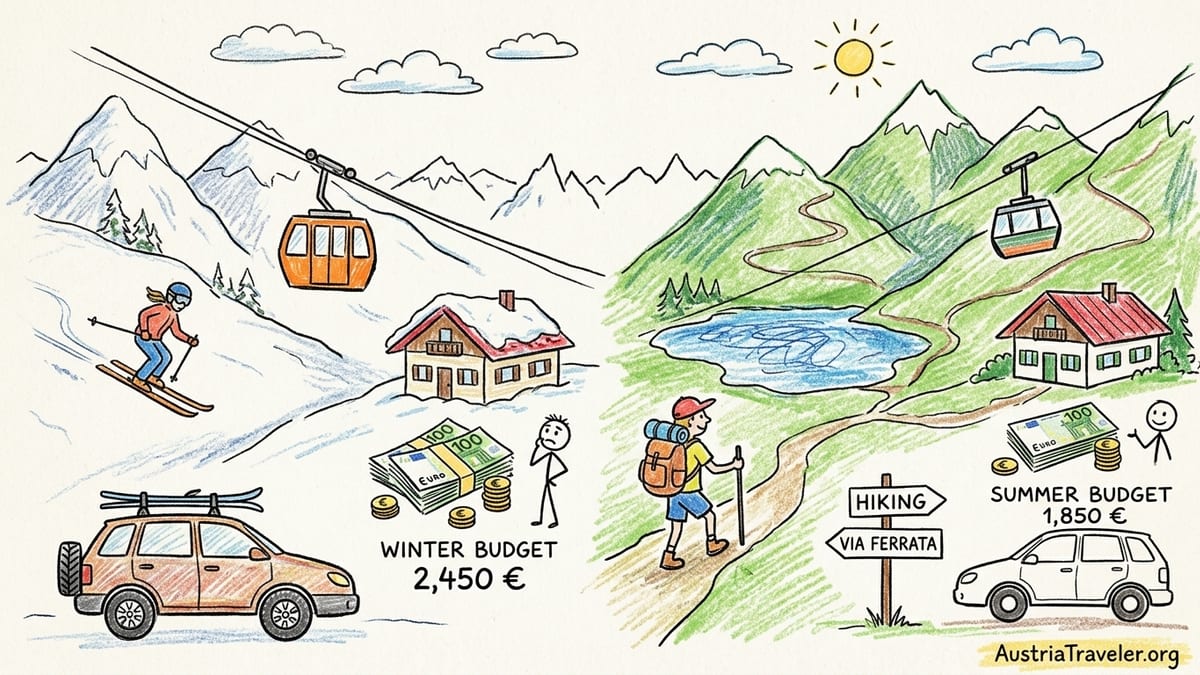
My Real Austrian Alps Budgets: Winter vs Summer
To understand what an Austrian Alps trip really costs, it helps to start with two concrete itineraries. The first was a one-week ski trip to St. Anton am Arlberg in March 2024, traveling as a couple. We stayed six nights in a midrange hotel ten minutes’ walk from the Galzigbahn, drove in from Germany, and skied four full days. The second trip was a nine-night summer road loop in August 2023 through Vorarlberg and Tyrol, including Brandnertal, the Bregenzerwald and the Zillertal region, focused on hiking, easy via ferrata routes and lake days. Both trips started and ended in Munich with a rental car.
On the March 2024 ski week, we spent roughly 2,450 euros for two people, excluding gear we already owned. The biggest single item was ski passes, followed by accommodation and restaurant meals on the mountain. Petrol, Austrian motorway tolls and village parking felt small at the booking stage but added up by the time we crossed back into Germany. By contrast, the August 2023 hiking loop cost around 1,850 euros for nine nights, again for two people. We hiked most days, used summer lift passes where it made sense, and swapped big ski passes for a mix of local guest-card benefits and occasional paid lifts. Accommodation was slightly cheaper than in winter, but restaurant prices in major resorts were broadly similar.
These are not shoestring trips. We chose private rooms with breakfast in family-run hotels or guesthouses rather than hostel dorms, and we were willing to pay for good coffee and hot lunches above the tree line. The point is not that everyone will spend exactly these amounts. It is that the pattern of spending in the Alps looks very different from a city break in Vienna or Salzburg, even when the headline room rate seems similar.
On a city trip, the main costs are transport to the city, accommodation, food and a handful of museum and concert tickets. In the Alps, the mountain itself is the attraction, and access to that mountain is monetised through lift systems, ski passes, summer cards and toll roads. The result is that what you pay is determined less by how many days you stay and more by how many vertical metres you want to gain with mechanical help.
Accommodation, Parking and the Shock of Peak-Season Rates
The most visible cost difference between Alpine and city travel appears when you search for rooms in late February or early August. In March 2024 in St. Anton, a standard double room with breakfast in a three-star hotel ten minutes from the lifts cost us just under 210 euros per night, booked in November. That rate looked comparable to a good city hotel in Vienna in high season, so it did not feel extreme at first. What surprised me was how little flexibility there was closer to the ski area. Staying slopeside or in four-star spa hotels often pushed rates up toward 300 to 400 euros per night in the same period, even before half board.
Summer in 2023 felt gentler but still driven by school holidays. In Brandnertal in early August, a double room with breakfast in a three-star guesthouse cost around 140 euros per night. In a Bregenzerwald village with fewer major lifts, we dropped to about 120 euros for a similar standard. Compared with Vienna, where I have found comfortable central doubles around 130 to 150 euros outside of festival weeks, these prices are not dramatically higher. The difference is that many Alpine stays effectively bundle in access costs through guest cards or half board, which changes the value calculation in a way you do not see in cities.
Parking was where my urban instincts failed me. In Vienna or Graz it is common to keep a hotel car in a public garage for a modest daily rate and rely on public transport during the stay. In St. Anton in March 2024 our hotel charged 12 euros per day for open-air parking. Several central four-star properties were quoting 20 euros or more per night for a spot, even outside garages. That felt steep because a car is almost obligatory for many multi-resort or self-catering itineraries, yet the parking line is easy to miss in the booking summary. If you are driving and comparing prices between properties, checking the nightly parking fee and any separate charge for an electric-vehicle charger is essential.
One subtle advantage in the mountains appeared in the form of half-board deals. In our Brandnertal stop in 2023, upgrading from bed and breakfast to half board cost 22 euros per person per night. For that we received a substantial multi-course dinner that would have cost at least 30 euros in most village restaurants. In a city, where you are spoiled for food choice, half board often feels limiting. In smaller Alpine resorts, it can anchor your budget and reduce the temptation of daily mountain-restaurant splurges.
Rail, Rental Cars, Vignettes and Tunnels: The Invisible Transport Bill
From a cost perspective, one of the biggest differences between an Austrian city trip and an Alpine journey is how transport spending is spread across many smaller line items. Traveling by rail to a city like Vienna or Innsbruck is straightforward: you buy an intercity ticket and perhaps a local transit pass, and that is largely it. Getting to and around the Alps often means stacking a rental car, a motorway vignette, potential section tolls and village bus fares or parking.
On both of my trips, I opted for a rental car out of Munich. In March 2024 for the St. Anton ski week, a compact manual car with winter tyres cost about 55 euros per day including basic insurance when booked a few months ahead. Petrol for the 600-kilometre round trip, plus local driving, came to roughly 95 euros at early-2024 prices. On the August 2023 loop the rental rate dropped slightly to around 45 euros per day for nine days, and fuel came in near 110 euros for a longer route that included Vorarlberg and Tyrol.
For motorway driving in Austria, cars up to 3.5 tonnes need a vignette, a time-based toll sticker or its digital equivalent. As of late 2024, the Austrian authorities list the 10-day vignette for passenger cars at just under 5 euros, with month and year options priced correspondingly higher. The new one-day vignette introduced from 2024 provides a cheaper option if you are simply transiting to Italy. These prices are low enough that the vignette itself did not trouble our budget, but the details matter. The vignette does not cover certain high-cost sections such as the Brenner Motorway or the Arlberg tunnel, which have separate section tolls that can reach around 12 to 14 euros per direction for cars by 2026.
In practice, the tunnel and section tolls were the transport costs that surprised me more than the vignette. On the March 2024 run toward Vorarlberg, the Arlberg Road Tunnel was still under long-term renovation and largely closed, so we drove over the Arlberg Pass instead and avoided a separate tunnel toll. That saved money but added time and required winter driving confidence. Looking ahead to 2026, with the tunnel reopened and section toll tariffs updated, a return trip through the Arlberg tunnel or over the Brenner can easily add 25 to 30 euros to a week’s transport bill on top of the vignette.
If you avoid renting a car and rely on rail, your cost structure looks different. For example, an advance-purchase ticket from Vienna to Innsbruck or Bregenz on the main Westbahn or Railjet corridors can sometimes be found around 30 to 60 euros per person each way in 2024, depending on timing and class. From there, regional buses and trains reach many mountain valleys for just a few euros more, and several guest-card schemes include free use of local public transport. However, once you add luggage, ski bags and the need to move between valleys, the flexibility of a car often wins out despite its extra toll and parking charges.
Lifts, Ski Passes and Summer Cards: Where the Real Money Goes
For most visitors, the biggest single category that distinguishes Alpine costs from city travel is access to the mountain through lift systems. During our March 2024 ski week in St. Anton, the four-day Ski Arlberg pass for adults cost just under 300 euros per person when bought at the regular dynamic rate. That meant a ski pass bill of close to 600 euros for two people for four days on the slopes, significantly more than we had spent on intercity rail on previous city-focused Austria trips. Day passes at large destinations in Tyrol and Vorarlberg have continued to rise, with some peak-season adult day tickets approaching or crossing the mid-80-euro mark by the 2025 to 2026 seasons according to publicly discussed price tables.
The price shock is even more noticeable for travelers used to city sightseeing cards. In Vienna, for instance, a 24-hour public transport ticket and a handful of museum entries rarely approach the cost of an Alpine lift day. In the mountains, a single return ride to a panoramic viewpoint can cost 25 to 40 euros per adult, even in summer, while an all-day hiking pass at a major cable-car network can quickly exceed 50 euros if bought à la carte.
On our August 2023 hiking loop, we experimented with regional summer cards that bundle lift access and public transport. In the Kitzbüheler Alpen area, for example, the 2024 published price list shows a two-day Kitzbüheler Alpen Summer Card for adults around the low 70-euro range, with discounts for holders of local guest cards and children paying about half of the adult rate. Multi-day versions up to 14 days reach into the 170-euro range but include broad use of participating lifts and, on most options, local buses on defined routes. These cards transformed how we used lifts: instead of agonising over each individual cable-car fare, we planned two full lift-intensive days, rode multiple gondolas, and felt we extracted serious value from the card.
Guest cards issued by accommodation providers also made a material difference. In several Vorarlberg valleys in 2023, our overnight stay automatically included a regional card that gave free access to local buses and, on set dates, free or heavily discounted use of summer lifts. In Brandnertal, for example, the local tourism board promotes that overnight guests with the regional card can use the main cable cars on certain days without paying individual fares, and receive reductions on others. At first glance, the room rate in these villages seemed similar to that of a comparable guesthouse without such benefits. Once we counted the value of two return lift rides and multiple bus journeys, the effective daily cost dropped by 30 to 50 euros for the two of us.
In winter, the parallel is the season pass. Though we did not purchase one, the Snow Card Tirol, which gives access to many ski areas across Tyrol, is priced around 1,000 euros for an adult for the 2023 to 2024 season according to published tariffs. That sounds high until you divide it by 20 or more ski days, at which point the per-day cost undercuts buying day passes at large resorts. For a week-long visitor, however, there is little incentive to go beyond the regular multi-day pass, and the ski ticket line remains the anchor of the budget.
Gear, Lessons, Huts and On-Mountain Food
Another area where mountain trips pull ahead of city budgets is equipment and on-mountain services. On the March 2024 ski trip we brought our own skis and boots, but one friend who joined for two days rented intermediate skis, boots and poles from a shop near the St. Anton lifts. For a two-day rental, including insurance against damage, the bill came in around 90 euros. A full week’s rental package for adults in major resorts can easily reach 150 to 200 euros, especially for higher-performance gear or premium storage options at valley stations.
Ski and snowboard lessons add a further layer. Group adult lessons in leading Tyrolean resorts in 2023 and 2024 typically cost in the range of 90 to 120 euros per day, with reductions for multi-day bookings. Private lessons climb substantially higher, often quoted at 250 euros or more for a half day for up to two people. For beginners or those returning to the sport after a break, this can be the single largest packaged cost outside lift tickets and accommodation, and it is one many city travelers do not anticipate when they equate a ski week with a normal holiday plus some equipment hire.
In summer 2023, our gear costs were lower but still noticeable. Renting a via ferrata kit in Vorarlberg, including harness, lanyard and helmet, was typically around 20 to 25 euros per day per person from local sports shops. Mountain-bike rentals in regions such as the Zillertal or Kitzbüheler Alpen were commonly listed around 50 to 70 euros per day for a hardtail or basic full-suspension bike, with e-bikes often a little higher. These are optional add-ons, but if you want to explore bike trails or try a via ferrata, the cost accumulates fast compared with a city day that might involve a simple museum entry.
Alpine huts and on-mountain restaurants were the category that surprised me most emotionally. In March 2024 in St. Anton, a self-service mountain restaurant charged around 16 to 18 euros for a plate of Tiroler Gröstl or schnitzel with fries, about 6 to 7 euros for a half-litre of beer and 4 to 5 euros for a soft drink. For two hungry skiers, a simple lunch with no dessert routinely landed between 40 and 50 euros. In summer in Vorarlberg, hut meals were slightly cheaper but still felt premium: a bowl of goulash soup around 9 euros, Kaiserschmarrn in the low teens, and drinks priced much like winter.
What made those prices more palatable was context. These huts maintain staff, supply routes and waste disposal at high altitude. On wet, cold days when a hut provided shelter, hot food and a chance to dry gloves, we never resented the bill and would willingly pay it again. The costs I would rethink were the casual coffees and beers taken on every single lift ride simply because the terrace looked inviting. On a week-long ski trip, trimming one or two daily on-mountain drink stops can easily save 20 to 30 euros a day for a couple without harming the experience.
Wellness, Lakes and Other Paid Experiences
Many modern Alpine trips include spa and wellness time, especially in regions where hotels revolve around thermal pools and saunas. In March 2024, several four-star spa hotels in and around St. Anton were quoting night rates above 300 euros for double rooms that included large wellness areas. Because we stayed in a simpler property without a spa, we instead spent one late afternoon at a public wellness centre in a nearby valley, paying around 30 euros per person for a three-hour sauna and pool ticket. Similar pricing appears in major Tyrolean resorts, where day tickets to elaborate spa complexes can range between 25 and 45 euros depending on duration and facilities.
In summer 2023, lake activities offered better value relative to city attractions. Public bathing areas at many Alpine lakes, including some in the Salzkammergut and Tyrol, charged only a few euros for admission, often under 10 euros per adult for a full day’s access to lawns, changing rooms and basic facilities. Pedal-boat or stand-up paddleboard rentals, however, could quickly approach city-level leisure prices, with half-hour hires frequently around 10 to 15 euros and hour-long sessions near 20 euros.
Other paid experiences that cropped up in our budgets included guided hikes, canyoning tours and high-rope parks. In Vorarlberg in 2023, half-day canyoning trips were commonly advertised in the 60 to 90-euro range per adult, including gear. High-rope forest parks with zip lines often cost 25 to 35 euros for several hours. Compared with a museum ticket in Vienna that might cost 15 to 20 euros, these activities are more expensive per hour but also provide a very different physical memory.
If there was a category that I underestimated in advance, it was the small-town entertainment spending in poor weather. On a rainy August day in the Bregenzerwald, we ducked into a local museum, a café and finally a small spa, turning what could have been a low-cost hiking day into one of the more expensive days of the trip. While I did not regret the spending, it highlighted how, in the Alps, bad weather tends to push travellers indoors into higher-priced activities, whereas in cities, you can always default to free churches or simply walking different neighbourhoods under an umbrella.
How 2026 Prices Are Shaping Up
Looking toward 2026, it is clear that costs in the Austrian Alps are not standing still. Motorway pricing has been adjusted, with official information indicating higher section tolls for key Alpine routes such as the Brenner and Arlberg corridors from 2025 and 2026. For example, public sources note that the Arlberg Road Tunnel one-way car toll reaches the low to mid-teens of euros per trip by January 2026, meaning a simple return through the tunnel is a noticeable budget line rather than a minor footnote. At the same time, the national vignette system has expanded with a one-day vignette, which slightly softens the blow for road trippers passing through briefly.
Lift ticket prices also continue to rise. Regional reporting and published ski-pass tables show that day passes at premier Austrian resorts have climbed steadily since the late 2010s, with adult peak-season day tickets at some major areas moving into the mid-80-euro range by the 2025 to 2026 seasons. Multi-day passes and season cards remain better value on a per-day basis, but the absolute sums are meaningful. A six-day adult pass at a flagship resort can today rival the cost of a week’s accommodation in a smaller city-based guesthouse elsewhere in Austria.
On the positive side, summer card schemes and guest benefits have become more structured rather than less. In the Kitzbüheler Alpen, the 2024 summer card tariffs continue to show clear price differentials for guests who hold a local guest card, trimming a few euros per day off lift-inclusive passes. Arlberg’s summer offerings include comprehensive hiking cards that bundle multiple lifts, and hotels in Lech or Zürs often arrange the local Lech Card for guests at a favourable rate or as part of packages. In Vorarlberg, the spread of inclusive regional cards means that in 2026 it remains very plausible to pay a similar nightly room rate to 2019 while effectively receiving far more lift and bus access in return.
For food, spa and basic services, early 2026 menus and price lists suggest incremental rather than dramatic rises compared with 2023 and 2024. A hearty main course at a midmountain restaurant often still sits in the mid-teens of euros, a coffee in the high single digits and a draught beer around 5 to 7 euros, depending on resort prominence. The real inflation story plays out more clearly in the bundled products that define an Alpine trip: ski passes, spa hotels that package multiple services, comprehensive summer cards and multi-tunnel driving routes.
The takeaway for a traveler planning 2026 is that the structure of costs remains the same as on my 2023 and 2024 trips. The numbers will be somewhat higher, especially on ski passes and toll roads, but the levers to control your budget are familiar. Choose regions where guest cards include generous lift and transport benefits, decide consciously how many lift days you truly need, and weigh whether you gain enough flexibility from a rental car to justify the cumulative costs of vignettes, tunnels and parking.
The Takeaway
After two substantial trips into the Austrian Alps, my main conclusion is that mountain travel is not inherently more expensive than an Austrian city break, but its costs are concentrated in places that catch first-time visitors off guard. Accommodation headline rates can look comparable to cities, but deeper in the booking details lie parking fees, spa surcharges and the implicit value of guest cards. Once you step into the mountains themselves, lift tickets, ski passes and summer cards become the quiet gravitational centre of the budget.
The expenses I would willingly pay again are the ones that clearly convert money into time or experience. A comprehensive lift pass on a bluebird week that lets you chase snow across interconnected valleys feels worth its weight. A well-run spa that restores battered legs after long hikes, or an alpine hut that serves hot stew in a sudden storm, are the sort of costs that still make me smile when I look back at my notes. Likewise, guest cards that unlock free buses and lifts all week have repeatedly turned what looked like an average room rate into a genuine bargain.
The costs I would watch more carefully on another trip are the invisible and incremental ones. Hotel parking that quietly adds 20 euros per night, tunnel tolls that stack up on a multi-valley drive, and the habit of defaulting to expensive terrace coffees at every cable-car station can collectively rival the price of a lift day. None of these are obligatory for enjoying the Alps, but they are easy to underestimate if you budget using city heuristics.
If you are planning an Austrian Alps trip for 2026, build your budget from the mountain outward. Decide first how many days you want mechanical help to gain altitude, then add accommodation, transport and food around that core. Look closely at what local guest cards include, especially in Vorarlberg and Tyrol, where free buses and lifts can reshape your spending. And when you inevitably choose a few indulgences, make them the kinds of expenses that will still feel vivid when the snow has melted and the last spa steam has cleared.
FAQ
Q1. Is an Austrian Alps ski trip always more expensive than a city break?
Not necessarily. Nightly room rates can be similar, but in the Alps you add major costs for ski passes, lifts and sometimes toll roads, so the overall bill often ends up higher unless you ski fewer days or use guest cards strategically.
Q2. How much should I budget per day for lifts and ski passes in 2026?
At large Austrian resorts, adult peak-season day passes in 2026 can sit in the mid-80-euro range, while multi-day passes slightly lower the per-day cost. For planning, many skiers now allow roughly 70 to 90 euros per person, per ski day, depending on resort and timing.
Q3. Are summer hiking trips in the Austrian Alps significantly cheaper than winter ski weeks?
They can be. Summer room rates are often lower and you avoid ski pass costs, but lift rides, summer cards and paid activities like biking or via ferrata still add up. On my trips, a hiking-focused August loop cost noticeably less than a March ski week but not by half.
Q4. Do I really need a rental car for an Austrian Alps holiday?
You can reach many valleys by train and bus, especially in Tyrol and Vorarlberg, and guest cards sometimes include local transport. A car adds freedom for side trips but also costs for rental, fuel, vignettes, section tolls and parking. If you plan to stay mostly in one resort, rail plus buses can be cheaper and simpler.
Q5. How do Austrian guest cards help reduce costs?
Guest cards issued by hotels or tourist offices can include free regional buses, discounts or free days on summer lifts, reduced entry to pools and museums and occasionally guided activities. In some Vorarlberg and Tyrolean areas, the value of these inclusions can reach tens of euros per day for a couple, effectively lowering your real accommodation cost.
Q6. What surprised you most about food and drink prices in the Alps?
Mountain restaurants are more expensive than valley spots, with main courses often in the mid-teens of euros and drinks a little above city café prices. What surprised me was how quickly casual coffees, beers and lunches at altitude added 40 to 60 euros per day for two people, even when we avoided elaborate meals.
Q7. Are spa and wellness facilities worth the premium in Alpine hotels?
If you enjoy saunas and pools after active days, they can be excellent value. Spa hotels carry higher room rates, but a single afternoon ticket to a public wellness centre can cost 30 euros or more. When used regularly, an in-house spa often feels like a good trade-off, especially on winter or rainy days.
Q8. How do Austrian tolls and vignettes affect a road-trip budget?
The standard motorway vignette for cars is relatively cheap, but it does not cover special toll sections like the Brenner Motorway or Arlberg tunnel, where one-way tolls can reach into the low to mid-teens of euros. On a multi-valley circuit, these charges, plus hotel parking, can add 100 euros or more to your total without feeling dramatic day to day.
Q9. Can I rely on summer lift and activity cards to replace individual tickets?
Often yes, if you plan to use lifts and public transport intensively over a few days. Products like regional summer cards include multiple lifts and bus routes at a fixed price, which becomes cheaper than individual tickets once you ride two or three cable cars daily. They are less useful if you only plan one or two lift rides during a week.
Q10. What is the single best way to control Austrian Alps trip costs?
The most powerful lever is how many paid lift days you schedule. Reducing from six ski or heavy lift days to four, or concentrating hiking lifts into a two- or three-day summer card window, tends to have a bigger impact than shaving a few euros off meals or drinks, while still leaving plenty of time in the mountains.